
You are currently browsing the tag archive for the ‘Equality Before the Law’ tag.
Equality before the law is one of the basic principles of a free society.
It means that every citizen enters the legal system with the same basic standing. The law does not treat a person as more guilty, more innocent, more believable, more suspicious, more deserving, or less deserving because of race, sex, religion, class, ancestry, political tribe, or social status.
The law deals with persons, not castes.
This does not mean every case is identical. Facts differ. Circumstances differ. Harm differs. Intent differs. Evidence differs. A fair legal system can recognize relevant differences between cases.
Equality before the law means those differences must be legally relevant. Identity by itself does not create superior or inferior legal standing.
1. The law recognizes citizens, not groups
A society governed by equality before the law treats people first as citizens.
A person is not merely a representative of a race, sex, religion, class, political movement, or historical category. A person is an individual with rights, duties, agency, and responsibility.
That matters because group-based judgment changes the nature of law. Once people are treated primarily as members of categories, legal judgment drifts toward inherited guilt, inherited innocence, inherited victimhood, or inherited suspicion.
Equality before the law keeps the legal focus on the person, the act, the evidence, and the standard being applied.
2. Protection and accountability both apply equally
Equality before the law has two sides.
The first is protection. Every person is protected by the same basic rights, whether popular or unpopular, powerful or weak, respectable or disliked.
The second is accountability. Every person is answerable to the same law when accused of wrongdoing.
A society loses equality before the law when some people become too important to punish, too sympathetic to scrutinize, too useful to question, or too unpopular to defend.
Equal law means protection is not a favour and accountability is not selective.
3. Guilt and innocence belong to individuals
In a classically liberal legal order, guilt is individual.
A person is not guilty because of race, sex, religion, ancestry, class, nationality, or political association. Nor is a person innocent because of those things.
The law asks what this person did, what evidence exists, what intent can be shown, what harm occurred, what rights apply, and what process is required.
Collective guilt and collective innocence both undermine equality before the law because both replace individual judgment with group judgment.
The law may consider context, but it cannot turn identity into verdict.
4. Process must be consistent
Equality before the law applies to process as well as outcomes.
Who gets investigated, charged, believed, doubted, excused, or punished? If similar cases are handled differently because of politics, status, public pressure, institutional embarrassment, or group identity, trust in the legal system erodes.
Consistent process does not mean mechanical sameness. It means similar standards of evidence, procedure, and accountability apply across cases.
Without consistent process, equality before the law becomes a slogan rather than a reality.
5. Context can matter without becoming legal rank
A fair legal system can recognize context.
Age, intent, coercion, mental capacity, prior conduct, vulnerability, harm, motive, and circumstance may all matter in different legal settings. Law is not blind to reality.
But context is different from rank.
Context helps the law understand the case. Rank changes the standing of the person before the law.
Equality before the law allows relevant facts to matter. It does not allow identity, status, or political usefulness to create superior or inferior legal standing.
6. The opposite is caste law
The opposite of equality before the law is not merely unfairness.
It is caste law.
Caste law means different rules, presumptions, protections, punishments, or privileges depending on who someone is. One group receives leniency. Another receives suspicion. One group is protected from criticism. Another is denied ordinary sympathy. One group is treated as morally authoritative. Another is treated as morally suspect.
A society does not need formal castes to drift in this direction. It only needs institutions that apply different standards to different people for reasons the public can see but officials refuse to admit.
That is why equality before the law matters to public trust.
Citizens can endure imperfect laws more easily than they can endure selective law.
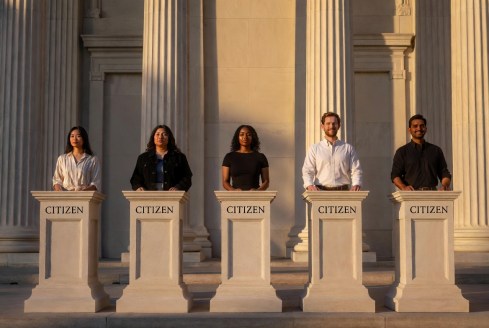
Equality before the law means the law sees citizens, not castes.
In summary
Equality before the law means every person has the same basic legal standing.
It means citizens are protected by the same rights, answerable to the same laws, and judged by the same standards of evidence and process.
It does not mean every case is identical. It does not mean context never matters. It does not mean equal outcomes are guaranteed.
It means identity is not legal rank.
It means guilt and innocence belong to individuals, not groups.
It means the law sees citizens, not castes.
People often say they support “the rule of law,” but the phrase can become so familiar that we stop asking what it means.
The rule of law does not simply mean that a society has laws. Every society has laws. Dictatorships have laws. Theocracies have laws. Police states have laws. A government can pass thousands of statutes and still be unjust if those laws mainly serve power rather than restrain it.
In the classical liberal sense, the rule of law means that public power is exercised only according to public, known rules that also bind those who wield power.
That is the central idea: the rule of law is not only about controlling citizens. It is about controlling power.
1. The law applies to everyone
A rule-of-law society begins from the principle that no person or institution stands above the law.
This includes politicians, police, judges, bureaucrats, regulators, public agencies, private citizens, corporations, activists, and ordinary voters. The law recognizes different roles and responsibilities, but it does not create a class of people exempt from ordinary legal limits.
The same principle runs in the other direction. No one falls beneath the protection of the law. An unpopular person is still protected. A disliked minority is still protected. A political opponent is still protected. A person accused of wrongdoing remains protected by process until guilt is established.
Equality before the law does not mean everyone has the same wealth, status, history, talents, or circumstances. It means the law recognizes citizens as citizens, rather than sorting them into favoured and unfavoured classes.
2. The state acts under legal authority
The state has powers ordinary citizens do not have. It can tax, arrest, regulate, prosecute, fine, imprison, seize property, restrict movement, and use force. Some of those powers are necessary. A society without courts, policing, public order, or contract enforcement will not remain free for long.
But necessary power is still power.
The rule of law requires government to justify its actions by law. A public official cannot rely merely on usefulness, popularity, safety, urgency, or good intentions. The relevant question is: what legal authority permits this action, and what limits govern that authority?
Without that requirement, law becomes something government applies to others while remaining above meaningful restraint itself.
3. Laws are public and knowable
People cannot obey laws they cannot know.
For law to guide citizens, it has to be public, accessible, and clear enough that ordinary people can understand what is expected of them. Modern legal systems are complicated, and not every rule can be simple. Even so, citizens are not governed well by hidden standards, secret procedures, vague commands, or rules that only become clear after punishment begins.
Vague law expands official discretion. It allows officials to decide later who counts as guilty, which makes citizens dependent not on law itself, but on the judgment, mood, ideology, or priorities of those enforcing it.
A rule-of-law society makes legal duties knowable before citizens are punished for violating them.
4. Laws are general, not targeted
Law is built around principles rather than enemies.
A general law applies across cases. It does not exist merely to punish a disliked person, silence a faction, reward an ally, or create special treatment for a favoured group. When law becomes too targeted, it stops functioning as law and starts functioning as political power in legal form.
This does not mean law never distinguishes between situations. Criminal law treats theft differently from murder. Tax law treats income differently from gifts. Public safety law treats dangerous conduct differently from ordinary conduct.
The problem is not distinction. The problem is arbitrary distinction.
A rule-of-law society distinguishes between laws grounded in general principles and laws used to protect friends or punish enemies.
5. Due process matters
Due process means that the state cannot simply accuse, condemn, and punish. There has to be fair procedure.
At minimum, a person knows the accusation, has a chance to respond, faces evidence rather than rumour, and is judged by an impartial process. The more serious the possible punishment, the more important these protections become.
Due process is sometimes treated as a loophole or a technicality, especially when the accused person is unpopular. But due process is most important when it is least popular.
Under the rule of law, punishment follows lawful process rather than public anger, political convenience, bureaucratic shortcut, or moral panic.
6. Courts and remedies exist
Rights are weak if citizens have no way to enforce them.
A rule-of-law society has independent courts and meaningful remedies when government exceeds its authority. Citizens have some lawful path to challenge unlawful action, whether through courts, appeals, judicial review, legislative oversight, public inquiries, ombudsmen, or other accountability mechanisms.
No institution is perfect. Courts can be slow, expensive, inconsistent, or wrong. But without some independent body able to say to government, “You have gone too far,” legal rights become largely decorative.
The rule of law depends not only on written promises, but on mechanisms that allow citizens to test whether those promises have been kept.
7. Emergency powers remain limited
Emergencies are real. Wars, disasters, riots, pandemics, and public-order crises can require government to act quickly. A rule-of-law society does not pretend that ordinary conditions always apply.
But emergency power arrives with urgency attached. The public is told there is no time for normal limits, ordinary procedures, or careful objections. Temporary extraordinary powers may sometimes be justified, but under the rule of law they remain lawful, limited, proportionate, reviewable, and temporary.
A crisis does not erase legal restraint. Crisis is precisely when legal restraint becomes most necessary, because fear makes people more willing to grant power without limits.
Rule of law versus rule by law
The distinction between rule of law and rule by law is useful.
Rule of law means law restrains power.
Rule by law means power uses law as a tool.
An authoritarian government may have courts, police, regulations, official procedures, and legal language. It may pass laws constantly. But if those laws mainly protect the regime, punish enemies, control speech, excuse officials, or make citizens dependent on arbitrary discretion, then the society is not governed by the rule of law in the liberal sense.
The question is not simply whether laws exist. The question is whether law stands above power, or whether power bends law to its own purposes.

Law is not merely what power writes down. Rule of law means power itself is bound.
In summary
The rule of law means that society is governed by public, general, knowable, and fairly applied laws rather than arbitrary power.
It means the law binds the state as well as the citizen. It requires legal limits on government, equality before the law, due process, independent review, and meaningful remedies when power is abused.
It does not mean every law is wise. It does not mean every court is right. It does not mean government can never act. It means that even necessary government action must remain under law.
Rule of law is not merely having laws.
Every tyranny has laws.
Rule of law means law restrains power.
Across Canada, we are witnessing a subtle yet sweeping shift: ideology increasingly outweighs empirical judgment, and institutions once grounded in caution are now pressing ahead with conviction. When belief eclipses observation, society risks felling its own future. This essay explores how the parable of A Short History of Progress becomes a cautionary mirror for our age, when economic vitality, civic trust, and long-term health hang, in effect, on that final swing of the axe.

“The Last Tree” draws a sharp line from the collapse of Easter Island’s ecosystem to three modern Canadian crises—net-zero policy, selective law-enforcement in protest, and rapid-onset gender-affirming care—to ask: when ideology becomes our arbiter rather than evidence, what are we willing to sacrifice?
The Last Tree: When Ideology Fells the Future
In Ronald Wright’s A Short History of Progress, the tale of Easter Island stands as a stark parable of human folly. Isolated in the vast Pacific, the Rapa Nui people arrived around 800 AD and transformed a forested paradise into a monument to their ingenuity and hubris. Over centuries, they felled the island’s palm groves to haul colossal moai statues across the terrain, using timber for sledges, ropes from bark, and fuel for fires. What began as a display of ancestral piety and clan prestige spiraled into ecological catastrophe. Soil eroded, fertility plummeted, bird populations vanished, and the once-vibrant ecosystem crumbled. By the 17th century, the population had crashed from perhaps 15,000 to a few thousand, amid famine, warfare, and cannibalism. Wright captures the inexorable logic: progress, unchecked, devours its own foundations.
Yet it is the final act that lingers—a moment of crystalline horror. The people who felled the last tree could see it was the last, could know with complete certainty that there would never be another. Imagine that islander, axe in hand, gazing at the solitary palm swaying against the horizon. The wind carries the salt of an empty sea, the ground beneath him scarred and barren. What raced through his mind? Not ignorance, for the warnings were etched in the dust: topsoil washing into the ocean, rats devouring every seed, canoes rotting on barren shores. No, it was something fiercer—a conviction forged in ritual and rivalry.
This tree, he might have reasoned, honours the ancestors; to spare it is to dishonour them, to invite the gods’ wrath. The rival clan cannot be allowed supremacy in statue-toppling; one more moai secures our lineage’s glory. Tradition demands it, the priests decree it, and in the face of clan elders’ unyielding stares, doubt withers like the fronds around him. Survival? A coward’s calculus, subordinate to the sacred narrative of progress through monument. With a swing, ideology claims its victory over reality, sealing the island’s doom.
This scene, Wright implies, is not ancient history but a mirror to our own susceptibilities. Ideological blindness is not partisan—it afflicts any society where belief eclipses observation. We stand at analogous thresholds today, where cherished convictions compel us to strike the final blow.
Consider our pursuit of net-zero emissions, pursued with a fervour that borders on the messianic. The federal government’s 2030 targets, however well-intentioned, risk undermining the very prosperity they claim to safeguard. The rhetoric of existential apocalypse—tipping points invoked like divine judgments—drowns out the data: Canada’s emissions constitute roughly 1.5 percent of the global total, and even full compliance would yield negligible climatic impact while rivals like China and India accelerate coal-fired expansion. Policymakers, axe raised, justify the cut: it honours the intergenerational covenant, shames the sceptic as a heretic. Yet the last “tree” here is economic vitality itself, felled in service to a narrative that confuses virtue with viability.
No less alarming is the selective blindness in enforcing the rule of law, particularly amid the surge of “Free Palestine” protests since October 7, 2023. These demonstrations, while not all hateful, have coincided with a documented explosion of antisemitism: synagogues vandalised, Jewish students harassed, and public chants equating Zionism with Nazism increasingly tolerated under the banner of free expression. Authorities often cite the need to avoid escalation or protect equity rights—but to apply the law unevenly corrodes the Charter’s promise of equal protection. The justification echoes the islander’s: equity demands deference to the aggrieved, lest we be branded oppressors. Thus, the final tree of civic trust is hacked away under the banner of performative solidarity.
Perhaps most viscerally, our medical institutions’ embrace of gender-affirming care reveals ideology’s grip on empirical mercy. Provincial guidelines expedite hormones and surgeries for minors, often with scant longitudinal scrutiny, despite emerging evidence of regret and harm. Critics—including those echoing the UK’s Cass Review—argue that compassion has been recast as affirmation, turning clinics into ideological fortresses where dissent is pathologised. This is not to deny the reality of gender dysphoria or the dignity of trans adults seeking relief; it is to insist that true compassion must rest on evidence, not dogma. The clinician, scalpel poised, rationalises: empathy compels affirmation; to probe deeper risks transphobia’s charge. Reality—the patient’s lifelong body, the data’s gaps—yields to the doctrine, mutilating futures in the name of inclusion.
These Canadian vignettes, like Easter Island’s denouement, expose ideology’s seductive tyranny: a narrative so totalising it renders the evident obsolete. Friedrich Nietzsche foresaw this abyss in his dissection of nihilism, that devaluation where “the highest values are losing their value.” Like Wright’s islanders, we mistake self-destruction for virtue—a form of nihilism Nietzsche saw as civilisation’s end-game. Cloaked in Marxist activist garb—equity as the new god, progress as its prophet—these policies dissolve society’s sinews not through malice but through a will to power masquerading as justice. Nietzsche warned that such illusions prolong torment, for “hope in reality is the worst of all evils because it prolongs the torments of man.”
To reclaim our ground, we must confront the axe in our hand: interrogate the story, honour the verifiable, and plant anew before the last tree falls. The islanders could not. We still can.
References
- Wright, Ronald. A Short History of Progress. Anansi, 2004.
- Fraser Institute, “Measuring the Cost of Canada’s Net-Zero Climate Policy,” 2024.
- B’nai Brith Canada, Annual Audit of Antisemitic Incidents, 2024.
- Government of Canada, 2030 Emissions Reduction Plan, 2022.
- Cass, Hilary. Independent Review of Gender Identity Services for Children and Young People (The Cass Review). UK NHS, 2024.
- For Canada-specific studies on gender-affirming care outcomes:
- Jackman, Liam et al., “Patient-reported outcomes, provider-reported outcomes, and physiologic parameters after gender-affirming hormone treatment in Canada: a systematic review” (2025). (SpringerLink)
- Lawson, M.L. et al., “A Cross-Sectional Analysis from the Trans Youth CAN! Study” (2024). (Jah Online)
- “At-a-glance – Gender identity and sexual attraction among Canadian youth: findings from the 2019 Canadian Health Survey on Children and Youth” (2023). (canada.ca)
 The protests at McGill University in April 2025 and the Trucker Convoy of 2022, while distinct in their scale, context, and authority, offer a compelling lens through which to examine accountability and lawbreaking in Canada. The McGill protests, driven by anti-Israel activists, involved physically blocking lecture halls and disrupting classes, as reported by B’nai Brith Canada, thereby denying students their right to education. In contrast, the Trucker Convoy, a nationwide movement against COVID-19 mandates, paralyzed critical infrastructure like the Ambassador Bridge, causing billions in economic losses and prompting the federal government to invoke the Emergencies Act. The scale of the Trucker Convoy’s impact was far greater, affecting national and international trade, while McGill’s disruptions were localized to a university campus. Additionally, the authority responding differed—McGill’s administration, a private institution, managed the campus protests, whereas the federal government, with its broader legal powers, tackled the Trucker Convoy. These differences in scope and jurisdiction naturally shaped the responses, but they also highlight a shared challenge: ensuring accountability when laws or rules are broken.
Acknowledging the protesters’ perspectives strengthens the case for consistent accountability. At McGill, the activists likely saw their actions as a moral imperative, aiming to pressure the university into divesting from companies linked to Israel’s actions in Gaza, which they framed as complicity in genocide. Similarly, the Trucker Convoy participants believed they were defending personal freedoms against government overreach, with some public support reflecting sympathy for their cause, as noted in historical polling data. Both groups may argue that their lawbreaking was justified by higher ethical goals—whether social justice or individual rights. However, this justification does not negate the harm caused: McGill students were intimidated and denied education, while the Trucker Convoy’s blockades disrupted livelihoods and public safety, with reports of harassment like defecating on lawns, as documented in news coverage from the time. The principle of free expression, a cornerstone of Canadian democracy, does not extend to actions that violate others’ rights or break laws, whether on a university campus or a national border. Recognizing the protesters’ motivations does not absolve them of responsibility; rather, it underscores the need for equitable enforcement to maintain social order and trust in institutions.
 The disparity in official responses to these events reveals a troubling inconsistency in addressing lawbreaking in Canada, fueling perceptions of a two-tier justice system. The Trucker Convoy faced severe consequences—hundreds of arrests, vehicle seizures, and frozen bank accounts under the Emergencies Act, as reported by Globalnews.ca—reflecting the government’s prioritization of economic and public safety. In contrast, McGill’s response was tepid, with the university implementing ID-based access controls only after days of disruption, and no immediate legal consequences like arrests or suspensions for the protesters, despite calls from advocacy groups for decisive action. While the federal government’s authority and the national stakes justified a stronger response to the Trucker Convoy, McGill’s leniency raises questions about institutional accountability on Canadian campuses. This inconsistency—where one group faces significant repercussions while another does not—erodes public confidence in the rule of law, suggesting that the consequences of lawbreaking may depend on the cause, context, or authority involved. Canada must strive for a balanced approach, ensuring that all acts of lawbreaking, regardless of scale or motivation, are met with fair and proportionate accountability to uphold the principles of justice and equality that define the nation.











 bleatmop
 Mystro
 The Arbourist


 Dead Wild Roses
Your opinions…