
You are currently browsing the tag archive for the ‘Media Complicity’ tag.
The first duty of public journalism after a massacre is simple: name the dead, establish the sequence, and tell the truth about what is known and what is not. That is media hygiene. That is how a public learns. That is how systems get fixed.
Instead, we got a firewall.
In the immediate wake of the Tumbler Ridge killings—home first, then school; five students dead, an education assistant dead; the perpetrator dead by suicide—the national conversation was quickly steered away from forensic clarity and toward reputational triage. In at least one major network segment, the frame was explicit: the story was “anti-trans disinformation” after the shooting. Not the chain of events. Not the failure points. Not the institutional blind spots. The message was prophylactic: watch what you say; the real danger is how people might talk about it.
This is not merely tone-deaf. It’s a form of complicity.
Not complicity in the act, obviously—complicity in what follows: the slow, predictable replacement of accountability with moral theatre. When a newsroom’s first instinct is to manage narrative risk, it begins to treat facts as flammable materials—things to handle with gloves, filter through approved experts, and keep away from ordinary citizens who might draw the “wrong” conclusions.
That is how gatekeepers lose legitimacy. And it is how tragedies become recurring.
The mechanism: switch the object of fear
Watch the pivot closely and it’s always the same move.
- A real event happens in the world—blood, bodies, families blown open.
- The newsroom identifies a second-order risk: public anger, political fallout, reputational damage to a protected consensus.
- The coverage shifts from “What happened?” to “What must we prevent?”
- Prevention is defined as protecting a narrative, not repairing a system.
The object of fear changes. Instead of fearing the next killing, the institutions fear the next argument.
So they tell you the problem is “misinformation.” They tell you the danger is “conflation.” They tell you this is a moment for “community support” and “protecting vulnerable people.” And those may all be decent impulses—in their proper place, at their proper time. But as a lead story? As the framing lens? As the moral of the segment?
That’s not reporting. That’s crisis communications.
“Don’t conflate” becomes a solvent
One line in particular functions like a solvent in the modern media ecosystem:
Don’t conflate an identity with violence.
Fine. True in the general case. But after a massacre, deployed as the first moral reflex, it does more than discourage scapegoating. It quietly discourages inquiry.
Because inquiry is not a vibe. Inquiry is a chain:
- What was the timeline?
- What were the warning signs?
- Who saw what?
- What interventions were tried?
- Where did they fail?
- What policies shaped those failures?
- What is going to change next week because children are dead?
A solvent doesn’t “refute” those questions. It dissolves the social permission to ask them. It turns scrutiny into contamination.
That is why it feels so out of touch to grieving parents: it is journalism behaving as if the central public hazard is discussion rather than risk.
Media complicity looks like this
Complicity, in this context, is not about malice. It’s about habit.
It’s the habitual choice to protect institutions from accountability by rerouting attention:
- From the scene to the discourse.
- From the victims to the community statement.
- From the timeline to the think-piece.
- From “what failed?” to “what mustn’t be said?”
A professional newsroom used to be allergic to this. The old standards—imperfect, often biased, frequently arrogant—still had a core ethic: facts first, advocacy last. If advocacy entered the frame, it was labeled as such. If uncertainty existed, it was named. If a claim couldn’t be verified, it didn’t get aired as settled truth.
Today, too often, we get advocacy laundering: press-release moralizing presented as news, with the added twist that dissent is treated as a moral defect rather than a factual dispute.
That is not neutrality. That is narrative commitment wearing a blazer.
What “media hygiene” used to mean (and must mean again)
A return to old standards isn’t nostalgia. It’s practical survival. Here’s what media hygiene looks like when it’s done properly—especially after mass violence:
1) Victims first.
Name the dead. Describe the community. Make the loss real before you make it useful.
2) Sequence before interpretation.
Timeline, confirmed facts, and clearly separated unknowns. No moral “lesson” until the basic chain is established.
3) Mechanisms over slogans.
If firearms were involved, the mechanism is access and storage—specific failures, not national clichés. If mental health is part of the background, the mechanism is escalation thresholds and follow-up—specific gaps, not hashtags.
4) No prophylactic framing.
Do not lead with “misinformation,” “backlash,” or “what this might fuel.” Those are downstream effects. They are not the event.
5) Don’t pre-label inquiry as bigotry.
Scapegoating is wrong. So is shutting down investigation by treating questions as dangerous.
6) Separation of church and newsroom.
Advocacy voices may be relevant. They must not become the controlling lens. Journalists should interrogate them the way they interrogate police, politicians, and corporations.
7) Corrections that cost you pride.
If you get something wrong, correct it prominently, not performatively. Trust is built when gatekeepers admit error without theatrics.
None of this requires “hating” anyone. It requires doing the job.
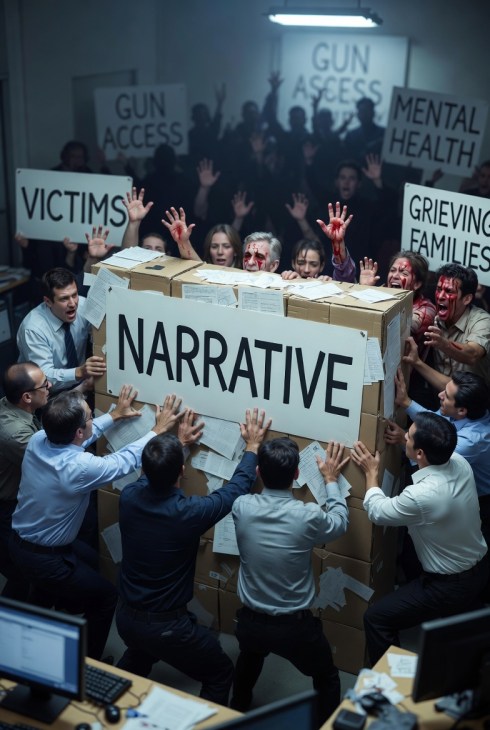
The consequence of failing the job
When media behaves like a narrative defense force, the public does not become more compassionate. It becomes more suspicious. It begins to assume that every tragedy will be translated into a pre-approved moral. It begins to look elsewhere for facts—often to sources far less responsible, far more conspiratorial, and far more cynical.
That is the boomerang effect of the firewall: the attempt to prevent “bad interpretations” produces a credibility vacuum, and the vacuum fills with poison.
If journalists want to stop that cycle, they can’t do it by lecturing the public into compliance. They can only do it by earning trust the old way: through sequence, clarity, restraint, and the disciplined refusal to turn atrocity into messaging.
Because if the first move after a massacre is to protect a narrative, the system will not learn.
And if the system does not learn, it will repeat. 🕯️
In the remote British Columbia town of Tumbler Ridge, a horrific school shooting unfolded on February 10, 2026, claiming eight lives, including five children aged 12 to 13 and a female educator, while injuring more than two dozen others. One 12-year-old girl remains in critical condition with severe brain trauma from a gunshot wound to the head. The perpetrator, 18-year-old Jesse Van Rootselaar, a biological male who had been transitioning and identifying as female since approximately age 12, first killed their 39-year-old mother and 11-year-old stepbrother at home before opening fire at Tumbler Ridge Secondary School. Van Rootselaar then died by suicide. Authorities noted a history of mental health crises, multiple police interventions at the family home, school dropout several years prior, and access to household firearms despite an expired license.
Canadian legacy media outlets, including CTV, quickly pivoted to familiar territory: gun control. Coverage highlighted past mass shootings as drivers for stricter firearm laws, the suspect’s lapsed license, and questions about why previously seized household weapons were returned. This framing reduced the tragedy to a debate over firearms access rather than examining the full context of the shooter’s background and actions. By prioritizing this narrative, major outlets failed to provide the public with a complete picture, focusing on policy talking points instead of the human and societal elements at play.
The cultural and personal factors warrant far greater scrutiny. Van Rootselaar’s transition began in early adolescence, a developmental stage coinciding with documented mental health challenges and police contacts. Broader societal patterns include rising youth mental health crises potentially linked to identity-based ideologies, social influences on gender dysphoria, family disruptions, and widespread use of psychiatric medications. When media outlets gloss over or sideline these dimensions in favor of gun-centric stories, they shield uncomfortable truths about how modern cultural pressures such as rapid affirmation of gender confusion in minors may contribute to instability in vulnerable young people.
This selective reporting directly endangers the public. By obsessing over gun restrictions while minimizing mental health epidemics, the effects of early gender transitions amid distress, and the role of identity politics, media and policymakers divert attention from actionable prevention. Communities, families, and educators lack candid discussion of warning signs or reforms needed to address root causes. The outcome is repeated tragedies, as resources target symptoms among law-abiding citizens rather than the underlying cultural and psychological drivers producing alienated or radicalized youth.It is time to demand truthful journalism that confronts reality head-on. The Tumbler Ridge victims deserve more than politicized narratives that dishonor their memory by avoiding difficult conversations about mental illness, unchecked gender ideology, and societal conditions fostering despair. Facing these issues honestly through better mental health support, cautious approaches to youth transitions, and cultural course correction offers the best hope of preventing future horrors.
Legacy media’s reluctance to engage fully undermines public safety and erodes trust when clarity is most needed.

References
- CNN: Canada mass shooting at a school and home (February 11-12, 2026) – https://www.cnn.com/world/live-news/tumbler-ridge-canada-shooting-02-11-26
- USA Today: Who is Jesse Van Rootselaar, teen who killed 8 in Canada – https://www.usatoday.com/story/news/nation/2026/02/11/jesse-van-rootselaar-tumbler-ridge-canada-shooter/88631889007/
- CTV News: Mass shootings in Canada have helped prompt changes to firearm laws – https://www.ctvnews.ca/politics/article/mass-shootings-in-canada-have-helped-prompt-changes-to-firearm-laws-over-the-decades/
- BBC News: Police name suspect in Canada school shooting as 18-year-old Jesse Van Rootselaar – https://www.bbc.com/news/live/cr5lnzqdr5pt
- Al Jazeera: Canada police identify shooting suspect as 18-year-old Jesse Van Rootselaar – https://www.aljazeera.com/news/2026/2/12/canada-police-identify-shooting-suspect-as-18-year-old-jesse-van-rootselaar
- Additional reporting from The New York Times, CBC News, and official RCMP statements via multiple outlets.
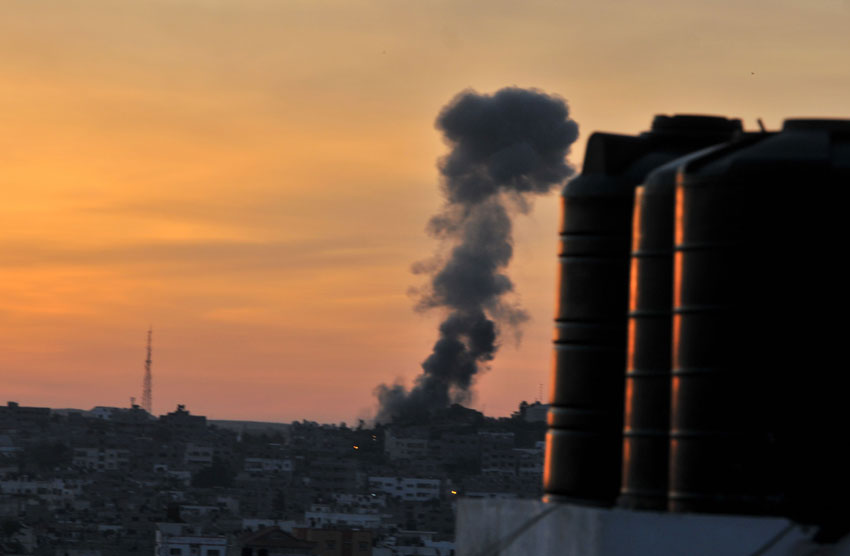 “Since Israel’s brutal 21-day assault on Gaza in the winter of ’08-’09 (dubbed by Israeli politicians as Operation Cast Lead) that led to over 1,400 Palestinian deaths – of which 930 were civilians including many women and children – followed by its deadly raid on a civilian Turkish ship headed to Gaza in June 2010 that resulted in nine casualties and dozens injured, many Palestinians as well as their advocates in the West have spoken of a significant “sea change” in the western media’s once hegemonic support for Israel. However, since this latest military operation began – already claiming more than 30 lives and injuring hundreds – evidence of any changing tide has been scant.”
Well we need to have *some* happy news from the occupied territories no? It can’t always be more innocents dead and heavy handed state oppression can it?
“Some mainstream liberal media outlets have discussed the imbalance between the rocket launches from Gaza resistance groups and the attacks executed by one of the mightiest armies in the world. While some may take this as a sign of newfound “support” or “empathy” for Palestinians, this is precarious logic. If Hamas’ rockets were to become more powerful, as they are proving to be, will these outlets retract their critique of Israel’s actions? Or is support for Palestinians contingent on them remaining “victims” and will vanish at any sign of their resistance becoming more powerful or effective?”
Perspective is always so important. The farcical Fox News is readily distinguishable as propaganda, but are we ready to see the propaganda function of other media organizations, the BBC for instance.
“A focus on “who started it?” consumes the mainstream media’s discussion on the latest violence, leading commentators to discuss timelines as though they were opinions rather than verifiable facts to consider and, to a one, even getting that wrong, with media outlets from NPR to the NYT declaring that Israel’s – rather than Hamas’ – strikes were retaliatory.
Meanwhile pundits feverishly try to tease out a political motive to explain Israel’s latest massive assault on Gaza. So far, the realpolitick most commonly alluded to is the impending Israeli election, scheduled for January 22, giving Prime Minister Netanyahu and Defence Minister Ehud Barak strategic reasons for timing an assault on Gaza now.”
Defending the nation is always a great political platform to run on, even when you are the aggressor.
“When it comes to looking behind the scenes of Israeli military assaults on Gaza (or Lebanon), there is always a general hoping for a promotion, a politician looking for votes, and an arms dealer making profits, but the rationale that enables that triumvirate to enact the lethal policies we are seeing play out in Gaza right now is the same one that allows the Israeli government to calculate how many calories each Palestinian in the Gaza Strip needs to survive, and to then intentionally allow fewer trucks and supplies in to meet that need. And it’s the same rationale that motivates the Israeli occupation authorities to prevent construction in Area C of the West Bank and East Jerusalem, to encourage widespread drug addiction in Area B, and to make near-daily incursions into Area A to arrest political leaders, activists and journalists.
It’s the rationale of a coloniser, who wants land but not the people on it.
The other pervasive rationale has been that Israel is “testing” the Muslim Brotherhood government in Egypt as well as, to a degree, President Obama in his second and last term in office.”











 bleatmop
 Mystro
 The Arbourist


 Dead Wild Roses
Your opinions…