
You are currently browsing the tag archive for the ‘Philosophy’ tag.
I knew there was a reason to give Philosophy another go. :)
 I’ve always enjoyed(?) studying philosophy. The courses I’ve taken have always been intellectually challenging and have provided some small insight into explaining how we think about ‘stuff and things’. Fast forward to the present – the experience of Philosophy has changed. It is an inward cringe because what philosophy means on the interwebs is usually a dense obscurantist pile of word-guano ostensibly put forward as a “defence” of some vile maxim or another (see all of christian apologetics). Wading through the glitzy word patina to uncover, and then prove, that the author(s) is(are) self-justifying the jebus shaped hole in his heart just isn’t a satisfying intellectual experience.
So I’m with Mary on what she says about philosophers.
“What is wrong is a particular style of philosophising that results from encouraging a lot of clever young men to compete in winning arguments. These people then quickly build up a set of games out of simple oppositions and elaborate them until, in the end, nobody else can see what they are talking about. All this can go on until somebody from outside the circle finally explodes it by moving the conversation on to a quite different topic, after which the games are forgotten. Hobbes did this in the 1640s. Moore and Russell did it in the 1890s. And actually I think the time is about ripe for somebody to do it today.”
A little less word salad and a little more clarity would be a good move for Philosophy. :)
Philosophy is/has been described as the root of all bullshite, and it is a fact that BS can baffle brains. The religiously orientated, faced with an ever increasing secular reality, can and will grasp at all straws in order to make their ooga-booga based reality seem reasonable and not a reason to be laughed at.
Variants of the Ontological argument fly thick and fast, just waiting to trip up the unprepared. Fear the the BS no longer as this tidy chunk of youtube education will inoculate you and provide the means to show your opponent that, once again, they are wrong.
Discussing the refutation of Alvin Plantinga’s ‘Evolutionary Argument Against Naturalism’ based on truth as a conventional semantic property. A bit of mouthful, but very interesting stuff for your brain to chew on.
The lack of reflection in North American society reflects in our policies and economic choices. Countries that have experienced the ripsaw of neo-liberal capitalism (essentially the unbalanced “free-market” reforms that we impose on other countries to savage their people and exploit their resources) are contemplating life after the free marketers have been kicked out and those countries must once again reform a nation from the hollow shell left by ‘free-market’ plundering. In this piece from Al-Jazeera we gain an inside look at what happened at the forum and some of the topics discussed.
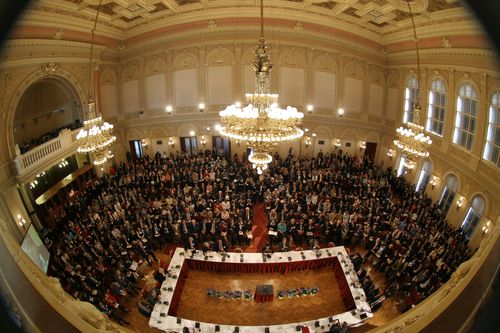 “I just returned from the sixth International Forum of Philosophy in Maracaibo, Venezuela, where philosophers from four continents were invited to discuss “State, Revolution and the Construction of Hegemony”.The event was inaugurated by the vice-presidents of Venezuela and Bolivia, televised by several channels, and on the last day, a prize of $150,000 was awarded to the best book presented within the Libertador Award for Critical Thinking of 2011.”
It is nice to see that somewhere in the world people can speak of the world as it is as opposed to the geo-political bias imposed by living in North America.
“Similar to the World Social Forum of Brazil, both the prize and forum aim to reflect not only upon the social progress that characterises these nations, but also the progress taking place in rest of the world; this is why only thinkers whose position is essentially leftist are invited, that is, those in the service of the weak, marginalised, and oppressed sectors of society.”
Before we jump on the ‘fair and balanced’ objection, let me remind you fair readers that the opposing point of view can be found by simply accessing any major newspaper of record, or any corporate media source.
“Regardless of how effective the conference’s statement is on the governors that read it, what is interesting for us – European academics – is the institutional significance that is given to philosophy in the region. Is there a philosophy conference or forum in the United States or EU where vice-presidents take time to inaugurate a similar event?
Before exploring this relation [between governance and philosophy], it is necessary to remember that most Latin American countries today are governed by socialist governments whose main objective is to elevate from poverty those citizens that were discarded by the neoliberal (and in some cases dictatorial) states that ruled the region in the past. This is why for more than a decade now, such renowned progressive intellectuals as Noam Chomsky, Naomi Klein, and many others have been endorsing Chavez, Morales, and other democratically elected presidents for their social programmes and economic independence from the IMF.
It might be nice to learn some of the lessons from these failed neoliberal experiments as the doctrines are still playing in Canada, US and Europe.
“But despite the social progress (since 2003, extreme poverty has been reduced by 72 per cent in Venezuela), ecological initiatives (Morales has been declared the “World Hero of Mother Earth” by the president of the United Nations General Assembly), and economic efficiency (unlike the EU, Latin American economies will grow by 4.7 per cent in 2012) of these governments, a campaign of hatred and disinformation has been taking place throughout our Western media in order to discredit these achievements.
Perhaps, as Oliver Stone pointed out in his brilliant documentary South of the Border, this campaign is a symptom of fear that citizens in the West might also begin to demand similar policies. After all, while in Europe we are cutting social services following the European Central Bank demands, Latin American states are increasing them, just as so many western protesters (“indignados”, Occupy Wall Street, and other courageous movements) demand.”
Ah, the threat of a good example. To the embattled North American Economies a threat worse than Iran, Iraq and the Taliban all rolled into one. The idea that a model focused on people rather than profit can and is working in the world. Fortunately for these Southern Cone countries they are now too big and well organized to be brought down, as Nicaragua was in the 90’s by the US.
“These Latin American countries are not calling philosophers to obtain from them rational justifications or hoping that some of us write propaganda articles for their policies. Rather, they are showing their awareness that history has not ended. I’m referring here to Francis Fukuyama’s famous theory of “the end of history” (“liberal democracy is the only legitimate form of government broadly accepted”), which has now been assimilated, if not completely incorporated, by our capitalist culture.
But history in Latin America has neither ended nor started anew. It’s simply proceeding as an alternate to our capitalist logic of economic enrichment, technological  progress and cultural superiority. The Latin American countries do not aim to dominate others, but simply to evoke those whom Walter Benjamin called the “losers of history”, that is, the ones who have not succeeded within our neoliberal democratic system. These unsuccessful “shareholders” are represented not only by underprivileged citizens, but also by underdeveloped nations and continents. In this condition, philosophy is called upon to think historically – that is, to maintain living history. But how?”
How refreshing to see another point of view being expressed and some of the tenets of neoliberalism thoughtfully challenged. And how do we see our “free press” respond to such a conference? Observe. The silence is deafening. Such an unscrupulous avoidance news is a regular feature of our corporate news media, that exists mostly to feed and reinforce the system that it profits from, and most certainly not to educate its populace.
Let’s hope that people can find out more about alternative points of view and learn about competing narratives so they can more effectively judge the systems that they currently inhabit. The OWS movement is a step in the right direction but need to ground themselves in the historical struggle for citizens rights and power within the state capitalist system. Looking toward Latin America and what people have and are achieving there would be a good start.
The books we read define who we are. The books we choose inform our world view and how we look at the events in the world. The dissident viewpoint is not particularly fun or easy to hold as every point must be scrupulously backed up with ample evidence to be even considered in conversations and debate. This list, as the title says, is not complete nor will it probably ever be as education and learning never stops during a lifetime.
This post serves also to provide insight into the how and why I talk about issues and the positions I take while debating.
The first, and probably most important work to my education as a rational human being would have to be the grand tomb by Edward S. Herman and Noam Chomsky – Manufacturing Consent. It is an acutely precise documented look at the American Media. Manufacturing Consent also offers a propaganda model to assist in analyzing and understanding how the media works, the reason for the prevalent rightward bias, and why that bias exists.
MC really started my adult education, as it caused me to become skeptical of what I had been taught in school and question the assumptions and point of view of how most my classes where taught.
I should mention Hegemony or Survival and The Fateful Triangle and Year 501: The Conquest Continues as well. They all brought clarity to the questions about how the world works and more importantly the structures in place that work against justice, egalitarianism and freedom.
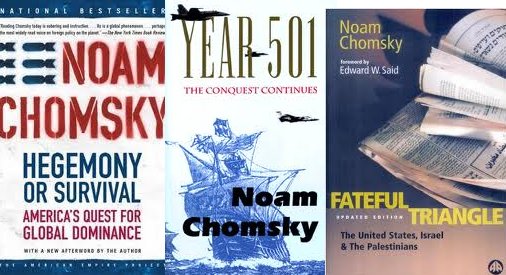
I have read more Chomsky, particularly to understand the Vietnam War but I would single out these four works as being particularly important.
 Howard Zinn is another major figure in my interpretation of history. It was his A People’s History of the United States that really reinforced the idea of history being written by the victor and how important alternate narratives are in understanding history. Out of the rest of his works, I have read War and Terrorism, which I also recommend as it is also very informative and illuminating.
In a similar vein, Major General Smedley Butler‘s work War is a Racket also ranks prominently in my readings of Western History because he simply tells it like it was for him, as a member of the United States Armed forces. His prescient observations are ever more true today.
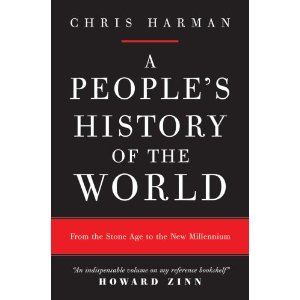 I came upon Chris Harman’s book A People’s History of the World, like Zinn’s work it is a depressingly good read. I have only read it once, but it is coming back into rotation as is a valuable reference and starting point for further historical analysis.
It sits beside my copy of Zinn’s work as part of the spine of my history collection.
A fiery excerpt from one of his speeches.
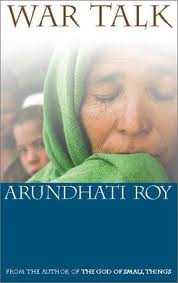 War Talk, An Ordinary Person’s Guide to Empire by Arundhati Roy, and Taraq Ali’s Pirates Of The
 Caribbean: Axis Of Hope (2006), Bush in Babylon (2003), and Clash of Fundamentalisms: Crusades, Jihads and Modernity (2002). Both Roy and Ali provide external analysis of our situation in the West and how we are viewed by the rest of the world. Ali is a powerful speaker and I had the opportunity to listen to him when he came to the University in 2008. His eloquence and arguments made for an evening to remember. External points of view are necessary, but sometimes a homegrown view is necessary to provide more perspective on the important issues of our time.
The Canadian Naomi Klein and her works fits nicely into the puzzle giving a Canadian view of the world as it. I did not enjoy NoLogo very much but found The Shock Doctrine to be a necessary and informative read about how the elites do what they must to rule the world. The Shock Doctrine explains how countries are jolted into submission before neoliberal reforms are forced on them. Again, file under good but depressing reading.
I almost forgot one of the most important works of history that I have read. It is called The Great War for Civilization by Robert Fisk. It is a huge work spanning most of Fisk’s journalistic career. It is history close up, a punch in the nose of a wake up call as for what trouble with Middle East and ‘civilizing influence’ there.
This list is a longer than I first expected, as even after 500 words I have covered only a couple of areas of the literature that informs my view and opinion on the world (in retrospect, probably a good thing). I will cover other areas of my interests in future posts.
 One of the many tenets of Christianity that I strongly object to is the notion of Original Sin. Adam and Eve transgressed against the wishes of God, thus we (their descendants) are in need of saving, hence our reliance on Jesus and his crucifixion. It depends on the premise that responsibility and blame for evil acts are passed down from parent to child. For this post I will not focus on why such an idea is psychologically harmful (especially to children), although that would be a valid avenue of criticism. Instead, I think it would be more effective to just show why it is wrong.
Imagine that a man rapes and impregnates a woman. The rapist then escapes the authorities while the woman is left with child. Over the nine month gestation, the police hunt the rapist to no avail. As the mother gives birth to a son, the police get a lead on the infant’s biological father. Three weeks later the police raid the rapist’s hideout only to find that he had committed suicide via drug overdose mere hours before they arrived. At the scene they find a note where the rapist describes his life of murder, crime, and hedonism. Further, he wrote that after having committed all these atrocities, there were no more thrills left for him. And so he decided he best end his life pleasantly, lest someone else do it for him in a much less favorable manner.
What we have here is someone who has done many evil things, done nothing to make up for his misdeeds, and has escaped all punishment. He leaves behind two victims who are denied all forms of restitution, justice, and closure. This is, of course, one of the worst kinds of situations and I don’t pretend to know a good way to deal with it. But one way I know to be wrong would be to apply the principle of original sin.
If responsibility and blame are indeed passed from parent to child, then we need only go to the infant son to extract justice. If the sins of the father are the sins of the son, then the three week old baby is accountable for his mother’s rape. If original sin held true, the righteous thing to do would be to punish the newborn just as we would punish the rapist had he been caught.
If you agree with me that the previous paragraph’s conclusions are not only absurd, but monstrously unjust and immoral, then the same must be said of the Christian notion of original sin. No fair and just adjudicator would ever hold someone responsible for something that they did not do, let alone for something that happened before they came into existence. But that is what Christianity says that their god does. (a great reason to start indoctrinating your children early – ed. )
Here is another quick thought experiment. Think of the worst thing you have ever done in your life. Then categorize that misdeed with a word or short phrase like ‘neglect’ or ‘assault’, or ‘theft’, or ‘betrayal’. Now, would a just punishment for your category of transgression involve crucifixion? Do you think it would require someone to have their hands and feet nailed to planks of wood and then slowly, agonizingly asphyxiate to make up for any of the offences I just mentioned? Absolutely not. The fact is that no one human has ever done anything that deserved anything close to that kind of torture. Even if you believe that the absolute worst of history’s monsters deserve brutal punishment, those rare instances compose a negligible percentage of the population. The point being that humans, as a whole, are not evil beings and we certainly don’t deserve crucifixion or any other torturous punishment by default. But Christianity says that we are and that we do.
Of course, it has to. If we were not responsible for evil deeds done before our existence and we did not deserve a cruel fate, then we would have no need of a savior, no need for a messiah, and no need of Jesus or Christianity. If we are on the whole morally higher than rapists and child molestors (empirical evidence says we are), and if we are answerable only to our own deeds (reason and justice say we are) then the idea of original sin is aboration of truth, a mockery of rationality, and an assault on morality.











 bleatmop
 Mystro


 Dead Wild Roses
Your opinions…