
You are currently browsing the tag archive for the ‘Plutocracy’ tag.
Well we can’t be posting sunshine everyday here at DWR. A small reminder of what the people of our nations are up against. From the essay titled Revolution and American Empire by Rob Urie.
“Liberal economists have ‘fought the good fight’ for nominally populist economic programs for the last decade with little but growing frustration to show for it. In sequence, Bill Clinton, George W. Bush and Barack Obama enacted economic policies— deregulation of banks, tax cuts for the very wealthy, the largest bank bailouts in human history and ‘trade’ deals that formalize corporate control over civil governance. There exist economic theories to support each and every one of these policies. Many prominent economists base which economic policies they support or oppose on which political Party is in office at the time they are proposed. The policies enacted are retroactively deemed ‘politically feasible’ in tacit admission that economic outcomes are politically determined. ‘Markets’ are used to explain these outcomes with the politics removed.
From the time of the American Revolution to today, with a brief compromise between 1948 and about 1973, the U.S. has been run by and for a self-serving plutocracy. Slavery and genocide weren’t ‘accidents’ nor were they the product of primitive thinking. U.S. wars in Central America, Southeast Asia and Iraq were / are as primitive, in the sense of being for-profit and brutal, as any in human history. And it is hardly an accident that elite impunity and immunity from prosecution for crimes, including War Crimes, is matched by brutal repression of the economic underclasses. Banks and corporations are the social forms of economic imperialism, necessary to the imperial project that places the rest of us as imperial subjects. Back to the start: the American Revolution was fought for the freedom to repress while the revolutions of liberation it has opposed were / are by-and-large fought against it.
The obligatory liberal chides against Russian and Cuban totalitarianism, in their contemporary incarnations against ‘strongman’ Vladimir Putin and the aging Fidel Castro, never admit to two centuries of American crimes or to never ending U.S. attempts to undermine democratic revolutions around the globe. This isn’t to gloss over crimes— the U.S. is the only nation in history to drop atom bombs on largely civilian populations, U.S. General Curtis LeMay joked that had the U.S. lost WWII he would have hung for the bombing of Tokyo, three million killed in the Korean War, three million killed in Vietnam, one million killed in Iraq and substantial portions of Central America turned into right-wing gangster states. Cuba is poor today because the U.S. has enforced an economic blockade of it for half a century. And the only guarantee from ‘liberalized’ relations between the U.S. and Cuba is that Cuba will get the worst of it.”

[Source:Counterpunch]
 Finding a way out of the the seemingly permanent global economic crisis is going to require looking at the factors that got us there. Noam Chomsky opines that the downfall really started in the 1970’s and has been on an ever increasing spiral of ruin ever since. One of the interesting parts of his article has to do with the division of the people into the Plutocrats and the Precariat.
“Plutonomy refers to the rich, those who buy luxury goods and so on, and that’s where the action is. They claimed that their plutonomy index was way outperforming the stock market. As for the rest, we set them adrift. We don’t really care about them. We don’t really need them. They have to be around to provide a powerful state, which will protect us and bail us out when we get into trouble, but other than that they essentially have no function. These days they’re sometimes called the “precariat” – people who live a precarious existence at the periphery of society. Only it’s not the periphery anymore. It’s becoming a very substantial part of society in the United States and indeed elsewhere. And this is considered a good thing.
So, for example, Fed Chairman Alan Greenspan, at the time when he was still “Saint Alan” – hailed by the economics profession as one of the greatest economists of all time (this was before the crash for which he was substantially responsible) – was testifying to Congress in the Clinton years, and he explained the wonders of the great economy that he was supervising. He said a lot of its success was based substantially on what he called “growing worker insecurity”. If working people are insecure, if they’re part of the precariat, living precarious existences, they’re not going to make demands, they’re not going to try to get better wages, they won’t get improved benefits. We can kick ’em out, if we don’t need ’em. And that’s what’s called a “healthy” economy, technically speaking. And he was highly praised for this, greatly admired.
So the world is now indeed splitting into a plutonomy and a precariat – in the imagery of the Occupy movement, the 1 per cent and the 99 per cent. Not literal numbers, but the right picture. Now, the plutonomy is where the action is and it could continue like this.
If it does, the historic reversal that began in the 1970s could become irreversible. That’s where we’re heading. And the Occupy movement is the first real, major, popular reaction that could avert this. But it’s going to be necessary to face the fact that it’s a long, hard struggle. You don’t win victories tomorrow. You have to form the structures that will be sustained, that will go on through hard times and can win major victories. And there are a lot of things that can be done.”
Can we stem the tide? We must, otherwise our struggle will become the struggle of our children.
Rick Salutin should not have been dismissed as an op-ed writer at the Canada’s ‘national’ newspaper the Globe and Mail. His spot taken by religious apologist Irshad Manji has left a gaping hole in coverage of news and events from the perspective of the working class. However, one and awhile they allow Jim Standford to add a bit of reality to the generally rightward op-eds that are par for the course in the Globe and Mail.
Jim lays the smack down in an article that tells about how our society is being (has been) structured to benefit the wealthy and their interests and how new movements such as the Tea Party seemed to have missed the target when it comes to where they lay their righteous anger. This post will be quote heavy as I intend to reference it as a basis for economic discussions in the future, so please bear with the meticulous quoting as to what Mr. Standford had to say.
 “American economist Emmanuel Saez has painstakingly assembled a century-long statistical series on U.S. income distribution. On two occasions, the share of income captured by the richest 1 per cent reached about a quarter of the national total. The first time was in 1928, the second in 2007. As we all know, both peaks in wealth concentration were followed by financial catastrophe and depression. Indeed, maldistribution clearly contributed to both meltdowns.”
Not to harp on a point but progressive taxation addresses this problem well and at one point in time was actually in the tax code of the US.
“But there’s a startling difference in the political reverberations that followed the two conflagrations. In the 1930s, outrage at the pre-Depression extravagance of the rich, contrasting with the dislocation experienced by masses of Americans, sparked a decade of left-leaning foment. Government expanded income security, directly hired millions of unemployed, and actively supported a new generation of unions to fight for the common folk. Meantime, it reined in business excess through tough financial rules, anti-trust policies, and high taxes on the rich.”
So what is different this time around? Why are we not getting the limitations put back on the business class?
“This time around, there’s been plenty of populist anger – but (so far) it’s been steered in exactly the opposite direction. Social supports and public employment are being cut dramatically (especially by U.S. state and local governments). Barack Obama’s election promise to modernize labour laws and rebuild unions was dead – even before he lost Congress. And several state governments are now preparing a full assault on union rights: Recent proposals in Ohio and Wisconsin would virtually outlaw collective bargaining across broad swaths of the public sector.”
It seems like this is the road that has brought us to ruin, let’s go faster! The important questions to keep in mind is economic disaster and ruin for whom and which segments of society are not being as dramatically effected.
“The richest 1 per cent almost tripled their share of U.S. national income since 1978, gobbling two-thirds of the income gains generated in the whole economy over the past decade. With numbers like these, highlighting the incomes of the ultra-rich is no longer an idle, envious pastime. The concentration of wealth at the top has become macroeconomically significant.”
Two thirds of all the income gains, to the top 1%. This is not equitable, rational or even reasonable. Why does emergent political policy look the way it does? Political influence of this nascent oligarchy is the answer.
‘Recession or no recession, the gravy train at the top hasn’t paused for breath: Executive bonuses keep rising, and the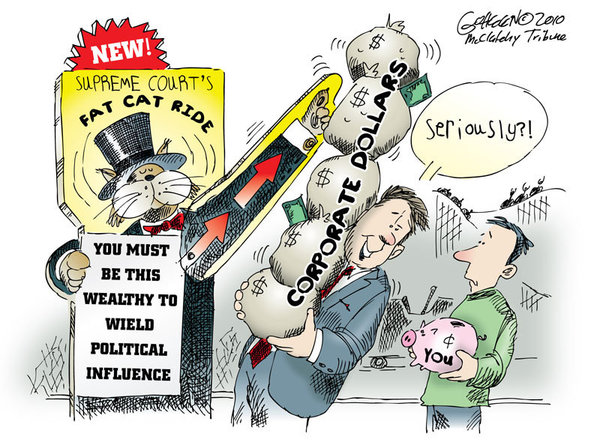 top 25 hedge-fund managers made a staggering $1-billion each in 2009. Nevertheless, the trend in U.S. politics is not to challenge the contrast between the top and the bottom, but to reinforce it. The Tea Party portrays government itself as the problem. And rather than empowering average workers to improve their lot (like the Wagner Act did in 1935), America’s rightward lurch in labour relations will reinforce the stagnation at the bottom.”
I would speculate that measures that increase social and economic equality such as Universal Healthcare were derailed precisely because of this misplaced furor of the Tea party and other people, who wrongly blame the government rather than elites for their current economic situation. It certainly was not the government that took 2/3 of all the economic income gains from 1978. Indeed it is pretty bad in the US, but does Canada fare any better?
“Canada is a kinder, gentler, fairer place. So the numbers aren’t as extreme. Or are they? Here, the richest 1 per cent (less than 250,000 tax filers) capture 17 per cent of total income, and that share has merely doubled (not trebled) since the egalitarian 1970s. A full third of all income gains across Canada since 1987 have gone to that lucky group. For the ultra-ultra-rich (the top 0.1 per cent of families, 25,000 in total, with average income of $1.5-million), their share of national income has trebled to 6.5 per cent.”
Erm. Well… Yeah, we are a little better of as the egalitarian principles in Canada are eroding at a slower rate than those of the US.
“Despite this largesse, in Canada, too, the political bandwagon lurches to the right. There’s been infinitely more hot air expended since the financial meltdown over the salaries of unionized garbage collectors than those of high-flying financiers. Our home-grown plutocracy, meanwhile, keeps raking it in. Bonuses at the Big Six banks alone reached $8.9-billion in 2010, the highest ever. The Canadian Centre for Policy Alternatives recently documented that the typical Canadian CEO made as much by 2:30 p.m. on Jan. 3 as the average worker makes all year long.“
It is not rational for this sort of imbalance to exist in an economy. This is not the market determining a fair price for work done, this is naked avarice strutting though Canadian society as if nothing was wrong.
“Imagine a city the size of Saskatoon hogging a third of all the new income generated by the entire country. Imagine folks who earn as much in a few hours as the rest of us do in a year – yet still lecture us on the need to tighten our belts. Imagine 25,000 families earning as much as the bottom seven million tax filers put together. How long will these excesses fly under the public’s radar, while we bicker over wage gaps between unionized garbage collectors and non-union fast-food workers? Not long, I hope.”
The belt tightening needs to start at the top, competent leaders, lead by example and from the front. Did we see during this latest recession the business classes calling for more social programs and higher taxes on their cohort? Not even a faint whisper. Why? Because when rapacious avarice is the name of the game, sharing the pain and helping others is not even in the playbook.
Feathering the nests and nest eggs on the backs of the rest of society is par for the course of North American elites. Witness the wage stagnation that is still with us since the 1970’s. And who (are we told to) do we blame for this? The penuriousness of the burgeoning plutocracy? Of course not. The blame goes to the Government and the Unions, two public institutions that have mandates to actually protect, rather than exploit, people. A tip of the hat for the propaganda program that has set the people against themselves rather than those who are actually running the show.











 bleatmop
 Mystro


 Dead Wild Roses
Your opinions…