
You are currently browsing the tag archive for the ‘Prorogue’ tag.
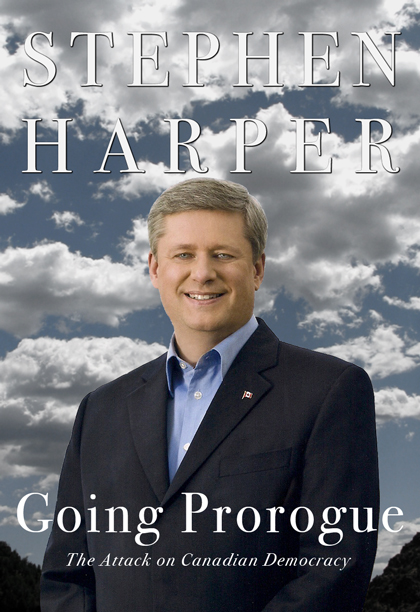 Well, now that the Senate has been stacked in the Conservatives favour, I’m sure Harper and his minions can get on with the the business of running our country. Unfortunately, the House of Commons is still closed for business till the Olympics are done.
I wonder how much the Conservatives are betting that we will forget about the Afghan Detainee Torture Scandal? I hope, for once our spineless opposition will not let the government squirm away from the issue. Our culpability in Afghanistan needs to be fully explored. Proroguing parliament may halt the formal aspects of our democratic process but it will not end our responsibility to those we have transgressed against.
 Proroguing Master Steven Harper is concerned about the economy.
“Canadians want the government to stay the course on the road to economic recovery but to start planning for deficit reduction, Prime Minister Stephen Harper said Friday.”
Thank you for stating the blindingly obvious. Although, would it not be better to have a forum to work on the upcoming budget…oh say a little thing called parliament?
“The economic action plan has been working, and we must see it through,” Harper said. “Second, we have been told, start planning now for deficit reduction when the recession ends.”
So we need to shore up our pork barrels and get to work on cutting social services. Thanks for the update Steve. It is working well for you in the polls.
I am not a big fan of Stephen Harper and his merry band of reactionary pundits which he calls a government. His

Kittens: Great for Breakfast.
proroguing of parliament is another bitch-slapping of democracy and the Canadian People.
We need a voting system that better represents the people of Canada. I am proud to be part of the riding that went to the NDP in the last federal election. It was a close battle with the incumbent conservative (tough on crime, currently facing drug charges) was beaten by Linda Duncan. We are the tiny crack in what has been fortress tory Alberta for much too long. Go to Fair Vote Canada and sign up and let us turf this antiquated and thoroughly anti-democratic First Past the Post system of representation.
Fair Vote Canada has a great FAQ. I snipped the first two topics off their page. Read the rest here.
Myths About Fair Voting and Proportional Representation
Rather than defend the glaring problems with Canada’s winner-take-all voting system, critics usually spend more time trying to frighten people about change. Let’s look at some of common myths they promote, compared to the facts.
Myth 1: There are trade-offs between good democracy and good government.
The Facts: In his landmark study, Patterns of Democracy: Government Forms and Performance in Thirty-Six Democracies (1999), internationally-renowned political scientist Arend Lijphart assessed and compared the performance of majoritarian democracies (associated with winner-take-all voting systems) and consensus democracies (associated with proportional representation systems).
He concluded: “the overall performance record of the consensus democracies is clearly superior to that of the majoritarian democracies” and “the good news is that, contrary to the conventional wisdom, there is no trade-off at all between governing effectiveness and high-quality democracy – and hence no difficult decisions to be made on giving priority to one or the other objective.”
Fair Vote Canada has prepared an 8-page summary of Dr. Lijphart’s key findings.
Myth 2: Proportional representation means coalition governments and that’s bad because it requires deal-making.
The Facts: Governments formed under any voting system are coalitions of different groups who negotiate and make deals. That’s the way democracy works.
In Canada, the two largest “big tent” parties are coalitions of factions which are generally hidden from public view except during leadership races. These internal factions compete with one another and then negotiate and compromise on the party platform and policies.
The primary difference between this and the formation of multi-party coalition governments under fair voting systems are: 1) transparency – coalition negotiations among parties are generally more visible to the public and the compromises are publicly known; and 2) majority rule – under fair voting systems, the resulting coalition or governing group represents a true majority of voters.











 bleatmop
 Mystro


 Dead Wild Roses
Your opinions…