
You are currently browsing the tag archive for the ‘Quebec’ tag.
 I’m always impressed with La Belle Province and her ability to serve up controversy. Recently a judge in Quebec decided that a hijab was considered not to be suitable attire for her courtroom and dismissed a case when the litigant refused to comply with her request. The judge’s words courtesy of the CBC:
“Hats and sunglasses for example, are not allowed. And I don’t see why scarves on the head would be either,” Marengo says in the recording.
“The same rules need to be applied to everyone. I will therefore not hear you if you are wearing a scarf on your head, just as I would not allow a person to appear before me wearing a hat or sunglasses on his or her head, or any other garment not suitable for a court proceeding.”
The stage is set and the result:
“When El-Alloul first appeared before Marengo, the judge asked her why she had a scarf on her head. El-Alloul replied that it was because she is a Muslim. The judge then said she would take a 30-minute recess.
When Marengo returned, she told El-Alloul she had a choice: remove her headscarf immediately or apply for a postponement in order to consult a lawyer. El-Alloul replied that she couldn’t afford a lawyer and that she didn’t want to postpone the case. Marengo then adjourned the case indefinitely.”
Boom. Tinder meet match. Religious freedom versus the institutional values of a secular court.
There are a multitude of ways to look at what transpired in the courtroom but here are two that I think represent both sides of the argument.
A. In a secular court of law, the secular values and rules of a society must be followed. If a judge rules that what you’re wearing to be inappropriate for the proceedings it behooves you to follow the same standards that everyone else must follow.
B. Canada is a multicultural society and we respect and treasure the cultural practices that every Canadian brings to the table and, if secular protocol can be reinterpreted to allow for the diversity of cultural expression within secular institutions we should do so.
Before we go into further discussion we should note the reaction from El-Alloul, it was one of shock and dismay:
“[…] But what happened in court made me feel afraid. I felt that I’m not Canadian anymore.”
“El-Alloul said she’s speaking out because she doesn’t want what happened to her to happen to any other Muslim woman. When she insisted I should remove my hijab, really I felt like she was talking with me as … not a human being. I don’t want this thing to happen to any other lady. This is not the work of a judge. She doesn’t deserve to be a judge.”
El-Alloul is rightly quite upset at the outcome of her hearing (or lack thereof). There should be a more amenable solution available to the parties involved – a transfer to a different judge that has a more liberal interpretation of ‘suitably dressed’ might have saved a lot of ink and electrons as this story blossomed across Canadian news networks.
This seemingly simple case of what “suitably dressed” means and how it is enforced speaks to how intersectional an issue multiculturalism is. Institutional power in Canada remains largely white and male and thus reflects the normative values of what is considered ‘normal’ culture here in Canada. From this orthodoxy we get the notions such as:
1. Why should our Canadian institutions cater to every whim of the minorities?
2. If it is good enough for everyone else, what is the problem here?
3. Why aren’t secular Canadian values being learned by new Canadians?
Under the assumption that we are a multicultural society, clearly, point 1 is out to lunch. The very point of having a tolerant open society is that we appreciate and try to accommodate the everyone and their preferences within the state structure of Canada.
Point 2 is problematic because the words “everyone else” usually uses the dominant culture as a touchstone thus, by play of words, avoids the obvious racism associated with similar statements.
Point 3 has the most merit as new Canadians do adopt Canadian values and standards, but the process of acculturation takes a great deal of time, often generations before the values of the dominant culture are ingrained. It is unrealistic however to expect that somehow Canadians of all types have a switch that can be flipped instantaneously that would guarantee cultural assimilation.
The Hijab should be allowed in Canadian courtrooms as it does not interfere with workings of the court or the dispensing of justice.
However, as an open and tolerant secular society we should also have the ability to rightly name and not adopt cultural practices that would be corrosive to our society. For instance, honour killings and female genital mutilation, have no place in Canadian or any other civilized society and I can assert this claim with a good deal of confidence because we need only to discuss the negative impacts these practices have on those societies who still practice these modalities (cultural relativism be damned).
Maybe we should update our preferred torture methods, hanging perhaps?
Our society is progressing ever so slowly (and will continue to do so if we don’t let the corporations win, restore the 25% tax rate please). I often look to the politics and citizenry of Quebec for cues on progressive society and the model we should be working toward. Progress does come in fits and starts, but the latest PQ notion of a Secular Charter is a retrograde notion at its very best.
The Parti Québécois wants to introduce a secular charter and ban all civil servants from wearing or exposing overt religious symbols.
This isn’t the first time the Parti Québécois has mentioned the introduction of a secular charter aimed at making sure public and parapublic institutions are free of religious bias and symbols.
This part is good. Government needs to be free of the stench of religion and all of the sectarian nonsense that comes with it. The wider the wall between church and state, the better off society will be. Spot the problem with this next bit from Pauline Marois:
“We will fight for what we need because we think this is essential for the public’s well-being by taking its values and writing them in a charter,” Marois said.Under such a charter, civil servants would not be allowed to wear conspicuous religious symbols.
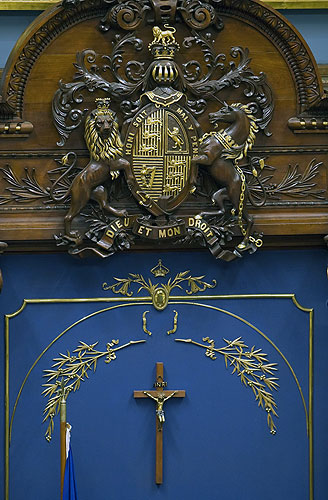
The crucifix at Quebec’s national assembly, however, would remain untouched.
Marois also talked about the fact that many of Quebec’s institutions used to be based on religion.It’s part of our heritage, but taking a step to ensure the state’s secularity is not to deny what we are, but that we are at a new moment in our lives and believe the state’s neutrality and the fundamental values, equality between men and women must guide us toward a life together in Quebec,” Marois said.
*broken record sound* What phoque is going on with that?
We’ll keep our christian torture symbol prominently displayed in the national assembly, but the rest the religious stuff, you know you immigrants and your pagan practices…that shite has to go!
If you are going to adopt a secular charter then all of the religious bullshite has to go, you can’t keep the ones that you like and then say no to others citing “the secular nature of society” that is just discrimination of the racist sort and therefore has no place in progressive secular society.
Fits and starts I tell thee. Come on Quebec, get it right and turf all the religious ooga-booga, it will do Quebec and Canada proud.











 bleatmop
 Mystro


 Dead Wild Roses
Your opinions…