
You are currently browsing the tag archive for the ‘Rape’ tag.
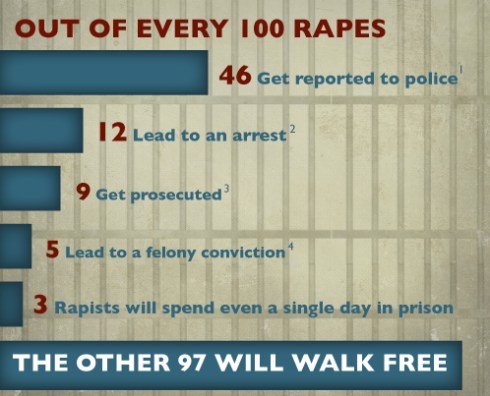
The wheels of justice are moving slow on this one, as is often the case with rape. It is ‘funny’ that our society won’t take the time to look at the reality of the situation when it comes to rape and the legal system.
One could say that, tacitly, rape is condoned in our society. Not a particularly happy conclusion, but there it is.
Add i believe you, it’s not your fault to your bookmarks, your blog, your whatever. It is too important not to.
The Best Revenge is Living a Good Life. (TW Rape, Child Abuse)
I am the only female child in my family of four children and I am the youngest. When people hear that, they often think of me as the spoiled little princess child. Nothing could be further from the truth.
I was sexually abused by two of my brothers and, eventually, my father as well. My abused started when I was young. Five or six, I can’t remember exactly. It started with molestation and without my saying no because I was little and I believed my brothers would never hurt me. But they did. Repeatedly. Night after night. Day after day. Things progressed to become more violent when I started saying no. Until one day, after I got home from school when I was 13, my brother raped me. Not the violent act most picture in their minds when they hear the word rape. By this time, I had become numb and would typically “zone out” when the abuse was happening.
My life changed that day. I became pregnant from the one incidence of rape. I am that statistic. I was young and didn’t have regular periods so I didn’t realize I was pregnant until my mother saw stretchmarks on my breasts.
You may wonder, “Where was your mother when all this was happening? Why didn’t you tell your mother?” I suppose deep down, I knew my mother would never “save” me. Her response to the fact that I was pregnant, by my brother, from rape, was to go into another room and cry hysterically while screaming, “My baby!” over and over again though never once coming to “her baby” to console me.
My father arranged for an abortion. I was in my second trimester at this point and had to go to a hospital for the procedure. When my parents “discovered” what my brothers had been doing, they kicked them out of our house. And then my father started waking me up for school in the mornings. He began molesting me.
I contacted Child Protective Services on my own behalf. I was placed in the first of two foster homes. My mother came to see me and, weeping, asked me, “How could you do this to our family?” Eventually, “we” went to trial and…eventually my father admitted his guilt. My brothers were never charged. “We” were sentenced to family counseling and I was told I would be placed in juvenile hall if I did not participate. Fourteen months later, the counselor proclaimed us “healed” and I was placed back into my parents custody. Yes, my father began molesting me again.
But the good news is, I grew older. I eventually moved away from their home. I got married. Got pregnant…
My life changed again. I became the mother to a little tiny princess. Four years later I was blessed with another tiny princess. Both beautiful and strong and everything my heart ever needed to heal. I was still in contact with my family at this point. Then the mother tiger in me was awakened. I had a birthday party for my oldest. I left the party for a few brief moments to get something I had forgotten. When I came back home, the birthday girl was nowhere to be seen. I asked my husband where she was and he said, “She’s in the backyard with your dad.” (Yes, my husband knew about what had happened to me.) I can’t even describe the utter horror, the panic, the fear that coursed through my veins. I found her in the backyard. She was fine. Nothing had happened but the guilt of exposing her to what I knew in my soul was a potential high risk changed me. I cut all ties with my family.
I tried for a while to keep in contact with my mother. Until the day my mother said to me on the phone, “When are you going to get over it?” This conversation took place 15 years ago and I can still hear the words as if they are still floating in the air. My response that day and still is… “How about never?”
This tragic tale may make you feel sorry for me or make it appear that my life has been horrible. I’m here today to share the tragedy but to also share the wonderful life I am living. Never forget, “THE BEST REVENGE IS LIVING A GOOD LIFE.” I am the mother of two gorgeous human beings who humble me and make me proud everyday. I have a fabulous job. I own my own home. I have three dogs who love me unconditionally. I am attending school while working. I go to concerts all the time. I go to the beach. I have a life that many of my friends envy and I know why they do! My happiness overruns constantly. I have a great life.
You will too. Live a good life. Smile. Laugh. Engage in the positive that is out there. Never ever ever feel that the sickness that hurt you defines who you are. You are a blessed child of this Universe and you were made for love. You were made for happiness. Seek it as often as you seek nourishment for your body. Don’t forget to nourish your soul.
I believe you.
It’s not your fault.
It was never your fault.
Love,
Leen
 Christianity and its various sects harm women.
In the early 1960’s, in response to the call of many millions of Catholic women, especially in the US, who wanted to limit the size of their families through the use of contraception, a papal commission was set up to look at Catholic teaching on birth control in light of the current scientific knowledge. If found that there was no scriptural, theological, philosophical reason, or basis in natural law for the Church’s prohibition on birth control.
[…]
However, in 1968, Pope Paul VI responded instead with an encyclical Humanae Vitae. The encyclical reaffirmed the Church’s rejectionist stance: Contraceptives were evil and against God’s law. Ten years later, Pope John Paul declared that Humanae Vitae was ‘a matter of fundamental Catholic belief’.
In the West, many if not most Catholics ignored the ban. For them, however painful, the decision of whether to conceive or not was rarely a life-or-death issue. Unfortunately for women in the poorest parts of the world, it often is. There, the right to choose weather or not to conceive was vitally linked to a woman’s prospectsfor freeing herself and her family from poverty. It is in this context that the inherent and deeply rooted misogyny of the Church has taken its greatest toll on the lives of women. Pope John Paul II spent a considerable port of his pontificate propagandizing on behalf of a doctrine that tells poor and illiterate women that to use a condom is the moral equivalent of murder and that each time they use contraceptives they render Christ’s sacrifice on the cross ‘in vain’. He said:’No personal or social circumstances have ever been able, or will be able, to rectify the moral wrong of the contraceptive act.
Underlying this attitude is the assumption that when it comes to having a baby, a woman’s consent is not necessary and that once made pregnant, accidentally or not, her own will is rendered irrelevant. The moral implications of this are interesting when compared with those governing our attitudes to rape. All civilized societies accept that a woman’s consent is necessary in order to have intercourse with her. Not to seek that consent and to coerce her into intercourse is to commit rape, which is a serious crime. But yet according to the Church, in the vital matter of pregnancy, a woman’s consent is beside the point.
She can be made pregnant against her wishes, and without her consent. The inexorable law of God overrides her will and the fact that she is pregnant determines her fate. Her personal autonomy is denied to her.
To deny the need for her consent in this the most important aspect of a woman’s life is surely the moral equivalent of justifying rape. It reminds us once more of the profound contempt that has underpinned Catholic attitudes towards women and that has been responsible for so much suffering down through the centuries.
– Jack Holland. A Brief History of Misogyny: The World’s Oldest Prejudice. p. 241 – 243
Religion, centuries of practice keeping women in their place…
 The really bestest-awesomest part of discussing rape culture with dudes (and select handmaidens of the patriarchy) is their abject denial of rape culture. Yet, objectively, the culture we live in is a rape culture and this study adds even more support to what many feminists have been saying for so many years.
“(April 2014) – New evidence from the journal Gender & Society helps explain what women’s advocates have argued for years – that women report abuse at much lower rates than it actually occurs. According to the Rape, Abuse & Incest National Network (RAINN), 44% of victims are under the age of 18, and 60% of sexual assaults are not reported to police.
The study, “Normalizing Sexual Violence: Young Women Account for Harassment and Abuse,” will appear in the June 2014 issue of Gender & Society, a top-ranked journal in Gender Studies and Sociology. The findings reveal that girls and young women rarely reported incidents of abuse because they regarded sexual violence against them as normal.
Sociologist Heather Hlavka at Marquette University analyzed forensic interviews conducted by Children’s Advocacy Center (CAC) with 100 youths between the ages of three and 17 who may have been sexually assaulted. Hlavka found that the young women experienced forms of sexual violence in their everyday lives including: objectification, sexual harassment, and abuse. Often times they rationalized these incidents as normal.
During one interview, referring to boys at school, a 13 year-old girl states:
“They grab you, touch your butt and try to, like, touch you in the front, and run away, but it’s okay, I mean… I never think it’s a big thing because they do it to everyone.”
The researcher’s analysis led her to identify several reasons why young women do not report sexual violence.
- Girls believe the myth that men can’t help it. The girls interviewed described men as unable to control their sexual desires, often framing men as the sexual aggressors and women as the gatekeepers of sexual activity. They perceived everyday harassment and abuse as normal male behavior, and as something to endure, ignore, or maneuver around.
- Many of the girls said that they didn’t report the incident because they didn’t want to make a “big deal” of their experiences. They doubted if anything outside of forcible heterosexual intercourse counted as an offense or rape.
- Lack of reporting may be linked to trust in authority figures. According to Hlavka, the girls seem to have internalized their position in a male-dominated, sexual context and likely assumed authority figures would also view them as “bad girls” who prompted the assault.
- Hlavka found that girls don’t support other girls when they report sexual violence. The young women expressed fear that they would be labeled as a “whore” or “slut,” or accused of exaggeration or lying by both authority figures and their peers, decreasing their likelihood of reporting sexual abuse.
The young women in the study provided insight into how some youth perceived their experiences of sexual violence and harassment during sexual encounters with men. In particular, the study pointed to how the law and popular media may lead to girls’ interpreting their abuse as normal. According to the author, policymakers, educators, and lawmakers need to address how sexual violence is actually experienced by youth beginning at very young ages in order to increase reporting practices, and to protect children from the everyday violence and harassment all too common in their lives.”
Sometimes you just can’t pass up an opportunity to signal boost an important message. Trigger warnings for Rape, Sexual Abuse, Rape Culture
Original Essay: The Not Rape Epidemic
*Trigger Warning*
Latoya’s Note: So, as promised, here’s the original version of the essay that appears in Yes Means Yes. If you see this popping up in your reader, I do not recommend you read it at work.
Rape is only four letters, one small syllable, and yet it is one of the hardest words to coax from your lips when you need it most.
Entering our teenage years in the sex saturated ’90s, my friends and I knew tons about rape. We knew to always be aware while walking, to hold your keys out as a possible weapon against an attack. We knew that we shouldn’t walk alone at night, and if we absolutely had to, we were to avoid shortcuts, dark paths, or alleyways. We even learned ways to combat date rape, even though none of us were old enough to have friends that drove, or to be invited to parties with alcohol. We memorized the mantras, chanting them like a yogic sutra, crafting our words into a protective charm with which to ward off potential rapists: do not walk alone at night. Put a napkin over your drink at parties. Don’t get into cars with strange men. If someone tries to abduct you, scream loudly and try to attack them because a rapist tries to pick women who are easy targets.
Yes, we learned a lot about rape.
What we were not prepared for was everything else. Rape was something we could identify, an act with a strict definition and two distinct scenarios. Not rape was something else entirely.
Not rape was all those other little things that we experienced everyday and struggled to learn how to deal with those situations. In those days, my ears were filled with secrets that were not my own, the confessions of not rapes experienced by the girls I knew then and the women I know now.
When I was twelve, my best friend at the time had met a guy and lied to him about her age. She told him she was sixteen and she did have the body to back it up. Some “poor hapless” guy sleeping with her accidentally would make complete sense – except for the fact that guy was twenty-five. He eventually slept with her, taking her virginity, even after he figured out how old we were. After all, it’s kind of a dead giveaway if you’re picking your girlfriend up at a middle school.
Another friend of mine friend shocked me one day after a guy (man really) walked past us and she broke down into a sobbing heap where we stood. She confided in me that when she was eleven she had a child, but her mother had forced her to put the child up for adoption. The baby’s father was the guy who had nonchalantly passed her by on the street. We were thirteen at the time, a few weeks shy of entering high school.
Later, I found out that she was at school when she met her future abuser/baby daddy. He was aware she was about eleven – what other age group is enrolled in Middle School? At the time, this guy was about nineteen. He strung her along in this grand relationship fantasy, helping her to cut school as they drove around and had sex in the back of his car. When she got pregnant with his child, he dropped her. However, living in the same area means she would run into him about once a month, normally leading to an outburst of tears or screaming fits on her end and cool indifference (with the occasional “you were just a slut anyway”) from him.
In high school, I had two Asian friends I was fairly close with. We would often end up hanging out after school at the mall with all the other teenagers our age. Occasionally, we would take the bus to the really nice mall in the upper class neighborhood, so we could be broke in style. It was there – in the affluent neighborhood – that my Asian friends dealt with the worst of their harassment. I can remember that each friend, on different occasions, was approached by older white men in their thirties and forties and quizzed about their ethnic backgrounds, ages, and dating status. These men always seemed to slip cards into their hands, asking them to call them later. My friends smiled demurely, always waiting until the man had gone before throwing their number away.
The years kept passing and the stories kept coming.
My ex-boyfriend had a friend who had been dating the same girl for about seven years. I found out the girl was eighteen at the time of their breakup. Eighteen minus seven equals what? The girl was eleven when they began dating while the man involved was nineteen. When the relationship ended, he was twenty-seven. I expressed disgust, and my ex had told me that while everyone else in their friend circle had felt the same way, the girl’s parents were fine with it, even allowing the guy to spend the night at their home. “Besides,” my ex offered nonchalantly, “she had the body of a grown woman at age eleven.”
Not rape came in other many other forms as well. No one escaped – all my friends had some kind of experience with it during their teen years.
Not rape was being pressured into losing your virginity in a swimming pool pump room to keep your older boyfriend happy.
Not rape was waking up in the middle of the night to find a trusted family friend in bed with you – and having nightmares about something that you can’t remember during the daylight hours.
Not rape was having your mother’s boyfriends ask you for sexual favors.
Not rape was feeling the same group of boys grope you between classes, day after day after day.
Not rape was being twelve years old, having a “boyfriend” who was twenty-four and trading sex for free rides, pocket money, Reeboks, and a place to stay when your mother was tripping.
My friends and I confided in each other, swapping stories, sharing out pain, while keeping it all hidden from the adults in our lives. After all, who could we tell? This wasn’t rape – it didn’t fit the definitions. This was Not rape. We should have known better. We were the ones who would take the blame. We would be punished, and no one wanted that. So, these actions went on, aided by a cloak of silence.
For me, Not rape came in the form of a guy from around the neighborhood. I remember that they called him Puffy because he looked like the rapper Sean “Puffy” Combs. He was friends with a guy I was friends with, T. I was home alone on hot summer day when I heard a knock on the patio door. I peeked through the blinds and recognized Puffy, so I opened the door a few inches. He asked if I had seen T around, and I told him no. The conversation continued, the contents so trivial that they are lost to memory.
So, I have no idea why he chose to pause and look me full in the face before saying:
“I can do whatever I want to you.”
My youthful braggadocio got the best of me, so I spat out, “Oh, what the fuck ever,” moving to pull the door closed.
Quick as a cobra, his hand darted past the screen, catching my wrist as I reached for the latch. A bit of tugging quickly turned sinister as I realized he wasn’t playing around.
He pinned me in the doorway, forcing me down to the floor barely inside my apartment. Holding my arm behind my back with one hand as I struggled against him, he calmly, deliberately allowed his free hand to explore my body. He squeezed my still budding breasts, then slipped his hands down my pants, taking his time while feeling up my behind. When he was finished, he let me up, saying again, “I can do whatever I want.” After he finished his cold display of power, he walked away.
After he left, I closed the balcony door, locked it, and put the security bar in the window, even though it was broad daylight.
I felt disgusting and dirty and used. I remember wanting to take a shower, but instead taking a seat on the couch trying to process what had happened and what I could do next.
Fighting him was out, as he had already proved he was stronger than I was. I considered telling some of my guy friends, but I quickly realized I had nothing to tell them. After all, I wasn’t raped, and it would really come to my word against his. As I was the neighborhood newcomer, I was at a disadvantage on that front. Telling my mom was out as well – I’d only get into trouble for opening the door for boys while she was at work.
I gritted my teeth in frustration. There was nothing I could do to him that wouldn’t come back on me worse. So I got up, took my shower, and stayed silent.
A few weeks later, I ran into T and some other guys from the neighborhood while I was walking to the store with one of my friends. T informed us that they were going to hang out in one of the empty apartments in the neighborhood. This was a popular activity in my old neighborhood – some guys would normally find a way to gain entry into one of the vacant apartments or townhouses and then use the place as a clubhouse for a few days.
My friend was game, but I felt myself hesitate. The memory of my Not rape was still fresh in my mind and T was still friends with Puffy. There was also the possibility that Puffy would be there in the apartment, and that was a confrontation I did not want. I refused, and my friend was angry at me for passing up the chance to hang out with the cutest boys in the neighborhood. Since I had never told this particular friend what happened, I shrugged off her anger and made an excuse to head home.
A few days after that meeting, I was on the school bus headed to morning classes. The local news report was on and the announcement that came across the airwaves stunned the normally rowdy bus into silence. The voice on the radio informed us of a brutal rape that occurred in our neighborhood. Due to the savage nature of the crime, all six of the teenage defendants would be tried as adults. The names were read and a collective gasp rose from the bus – T’s name was on that list! Jay, a guy who knew about the friendly flirtation I had going with T, leaned over and joked “Uh-huh – T’s gonna get you!”
I remained silent as my mind was racing. The strongest, most persistent thought rose to the top of my mind – oh my God, that could have been me.
At the time, I didn’t know how right I was.
A few years later, I was a high school junior on top of the world. For the most part, memories of my Not rape had been buried in the back of my mind somewhere. My third year in high school was consumed by two major responsibilities: student government and mock trial.
When I was sixteen, I knew I was destined to be a lawyer and I took advantage of every opportunity that would push me toward that goal. I signed up for mock trial and as part of our responsibilities our trial team was supposed to watch a criminal proceeding in action.
On the day we arrived at the local courthouse, there were three trials on the docket: a traffic case, a murder case, and a rape case. Nixing the traffic case, we trouped into the first courtroom which held the murder trial, only to find that the trial was on hold, pending pre-trial motions. We turned back and went into the courtroom where the rape trial was being held.
Never did it cross my mind that I would walk through the doors to see to picture of my Not rapist, captured in a Polaroid and displayed on a whiteboard with the other five rapists being tried. The prosecution was speaking, so we were quickly caught up on the specifics of the case.
While the rape had occurred in 1997 and most of the defendants – including T – had been convicted in 1998, this was the trial to determine the fate of the last of the six, a man who claimed he had left the scene before any crime had occurred.
Through word of mouth, I had learned that T had been sentenced and he would not be eligible for parole until he was forty-six years old. (I have since learned that T should be released by the end of this year. His victim should be about 21 years of age.) I had also learned that the crime was a gang rape, but knew no other details.
The prosecutor pulled out a picture of the girl the six boys had brutalized. In the first photo she was bright-eyed and neat looking, her dark hair pulled into a high ponytail which complimented her fair skin. She was dressed in athletic casual wear, as if she was on her way to a track meet.
The prosecutor then pulled out a second picture, taken post assault. Her face was a mass of purple and red bruises. One of her eyes was blood red – the attorney informed us that she had received extensive damage to the blood vessels in her eyes. The other eye was swollen shut. Her lips were also bloodied and bruised. He placed the two photographs side by side. From photo to photo, the girl had been rendered unrecognizable.
Quietly laying out the facts, the prosecutor deftly painted a tale of horror. The girl had met T and another boy (my Not rapist? I still didn’t know his government name) on a bus. The boys had convinced her to come with them and they led her to a vacant apartment. Unknown to the girl, there were four other men also hanging out that day. She was forced to give oral sex to some of the men, and then she was beaten, raped, and sodomized. She was found in the apartment unconscious, surrounded by used condoms, semen, and fecal matter.
My blood ran cold as I tried to process what I was hearing.
T was capable of this? The prosecutor was still speaking, and he made mention that there appeared to be one main ringleader with the other five guys going along for the ride. My teammates sat in rapt attention while I tried to figure out how soon we could leave. On one hand, I realized that my Not rapist and T were behind bars already, instead of roaming the streets to do this to someone else.
And yet, a part of me wondered if I should have spoken up. If I had told someone, anyone, could I have prevented this from happening? I regarded the girl’s picture once again. It is pretty rare to see the expression “beaten to a bloody pulp” illustrated in real life. I should have said something, I thought to myself, I should have tried.
My internal monologue was interrupted by the defense attorney taking the floor. He pointed out his client from the photos lining the wall, and calmly explained how his client was present in the apartment, but left before the attack began. He built his case, explaining that his client was generally a good kid, but outnumbered, and that his client opted to leave the area instead of participate in any wrongdoing. He then turned to the jury and said:
- You will also hear that —– wasn’t such a good girl after all. You will hear that she skipped school. You will hear that she smoked marijuana. You will hear that she willingly skipped school to go smoke marijuana with two boys she had just met.
My mouth fell open out of shock. There wasn’t even a question of consent in this case – the damage to the girl’s face attested to that. And yet, here was this defense attorney trying to assassinate the victim’s character. For what? Why was what she was doing that day even relevant in the context of what she experienced?
The defense attorney finished his opening statement and the judge started dispensing instructions to the jury. I forced myself to swallow the bile in my throat. As the judge dismissed the court for a break, I scooted out of the room and took a deep breath of air. My team went for lunch, and I persuaded them not to go back to watch the next part of the trial.
That day in court was the day I fully understood the concept of being raped twice – first during the act and then later during the court proceedings. That was also the day I realized that telling someone about my Not rape would have netted a similar, if not more dismissive response. I had no evidence of the act, no used condom wrapper, no rape kit, no forced penetration.
If the defense attorney was attempting to sow the seeds of doubt in the face of indisputable evidence, what would have happened if I had chosen to speak up?
This is how the Not Rape epidemic spreads – through fear and silence, which become complicit in perpetuating the behaviors described here. Women of all backgrounds are affected by these kinds of acts, regardless of race, ethnicity, or social class. So many of us carry the scars of the past with us into our daily lives. Most of us have pushed these stories to the back of our minds, trying to have some semblance of a normal life that includes romantic and sexual relationships. However, waiting just behind the tongue is story after story of the horrors other women experience and hide deep within the self behind a protective wall of silence.
As I continue to discuss these issues, I continue to be surprised when revealing my story reveals an outpouring of emotion or confession from other women. When I first began discussing my Not Rape and all of the baggage that comes with it, I expected to be blamed or not to be believed.
I never expected that each woman I told would respond with her own story in kind.
I am twenty-four years old now, ten years removed from my Not rape. I still think of the girl who was assaulted and hope that she was still able to have something of a normal life. As I matured, I came to understand more about the situation. As the years passed, my shame turned to anger, and I began learning the tools I could have used to fight back.
At age fourteen, I lacked the words to speak my experience into reality. Without those words, I was rendered silent and impotent, burdened with the knowledge of what did not happen, but unable to free myself by talking about what did happen.
I cannot change the experiences of the past.
But, I can teach these words, so that they may one day be used by a young girl to save herself.
Not rape comes in many forms – it is often known by other names. What happened to me is called a sexual assault. It is not the same as rape, but it is damaging and painful. My friends experienced statutory rape, molest, and coercion.
What happened in the courtroom is a byproduct of rape culture – when what happens to women in marginalized, when beyond a shadow of a doubt still isn’t enough, when your past, manner of dress, grade point average or intoxication level are used to excuse the despicable acts of sexual violence inflicted upon you by another.
Internalized shame is what I experienced, that heavy feeling that it was my fault for allowing the sexual assault to happen. There was a fear that if I spoke up, people would look at me differently, or worse, wouldn’t believe me at all.
Without these words, those experiences feed off each other, perpetuating a culture of silence and allowing these attacks to continue.
With the proper tools, we equip our girls to speak of their truth and to end the silence that is complicit in rape culture.
Teenaged girls need to know that dating an older man will not make them cooler, and that older man cannot rescue them from their parents. Teenaged boys should be able to help as well, trying to keep their friends away from predators. (My male friends did this for me a few times if they were around, coming to my aid of some guy started acting up. For some reason, the simple presence of another man is enough to make these kind of men leave.) Adult men should be cautioned about the effects of the actions and how most of these girls are not of the age of consent. And parents should be made aware that their children are being targeted by predatory men and that they should stay vigilant.
Adults, particularly older women, should take an active interest in the young girls they know.
My boyfriend has two younger sisters. One of them recently entered her teenage years. Her body started to develop and she has attracted more male attention. I notice small changes in her – how she looks at the floor a lot more than she used to, or how she seems uncomfortable going anywhere without a group of girlfriends. She still looks like an average teenager but she is often hesitant and uncomfortable, unless she is around her peers. However, I knew her before she developed so quickly. And I notice the change that a year (as well as taking the metro to and from school) starts. I’m fairly certain she’s trying to navigate the minefield of male attention she receives.
After all, I’ve walked that same field as well.
Finally, we need to cast a critical eye on how rape culture is perpetuated on an institutional level. From how hospitals distribute rape kits to keeping tags on questionable verdicts, we must take the lead in telling the criminal justice system that rape apologists and enablers will not be tolerated.
But above all, we must give girls the tools they need to defend themselves against sexual predators.
The small things we can do – paying attention, giving the words they need, instilling the confidence in which to handle these situations and providing a non judgmental ear when a student or teen approaches us with a problem – may be the best, an perhaps only, weapons they have to continue the fight against this epidemic.
This post from The Bewilderness explains the low prevalence of false rape accusations.
“Anon asked: Tonight I was speaking with a female coworker about rape culture and how terrifying it is to live with fear of knowing that if I was raped, it’s a high possibility that no one would believe me or take me seriously. She then said that she doesn’t have a problem with that because “most girls lie about being raped”. What would you say in response to that? I’ve heard many people say that but I have no idea how to respond.”
And the response – (TW Rape)
Your female co-worker doesn’t know anything. I hate that she said that.
There is zero benefit to “crying rape”. There was a study out last year, I believe, that cited of all rape accusations, .5% of them were false accusations.
The reason? Because once again, there is zero benefit in doing so. When you claim someone has raped you, what that means is you are about to get dragged through the mud. Every decision you’ve ever made, “relevant” or otherwise will be questioned. You will be called horrific names, so on and so forth.
And that’s why so many women and girls who are raped choose not to come forward. In doing so, they are re-traumatized, and they will likely have nothing to show for it; meaning, no one will believe them, and their loved ones will often turn on them.
Rape is a kind of horror, but the aftermath of it within a rape culture, is another beast all together. xx
That is the way the myth is created.
If you report a rape they don’t believe you because denial is the first response to bad news.
Then they bargain. Maybe it wasn’t really rape because you weren’t beaten half to death by a stranger. Maybe it was just a misunderstanding.
Misdirected anger comes next for you saying such a terrible thing about such a “nice guy” or famous guy or friendly guy. And what were you wearing, you probably were asking for it.
By now the rape victim has usually been silenced. They sure as hell won’t be talking to you about it ever again.
So it must have been a lie they told for sympathy, or meanness, or attention, or any one of the many reasons for lying that we ascribe to victims of abuse for having the unmitigated gall to speak of the abuse they suffer.
So they repeat the myth that most girls lie and that perpetuates the myth that most girls lie.
It never seems to occur to them that most boys lie, most men lie, most rapists lie.
Men can be better than this. Change your thoughts, change the culture around *you*; take your spoons, speak up, and when you see the rape enabling BS, make a difference.











 bleatmop
 Mystro
 The Arbourist


 Dead Wild Roses
Your opinions…