
You are currently browsing the tag archive for the ‘Repressive Tolerance’ tag.
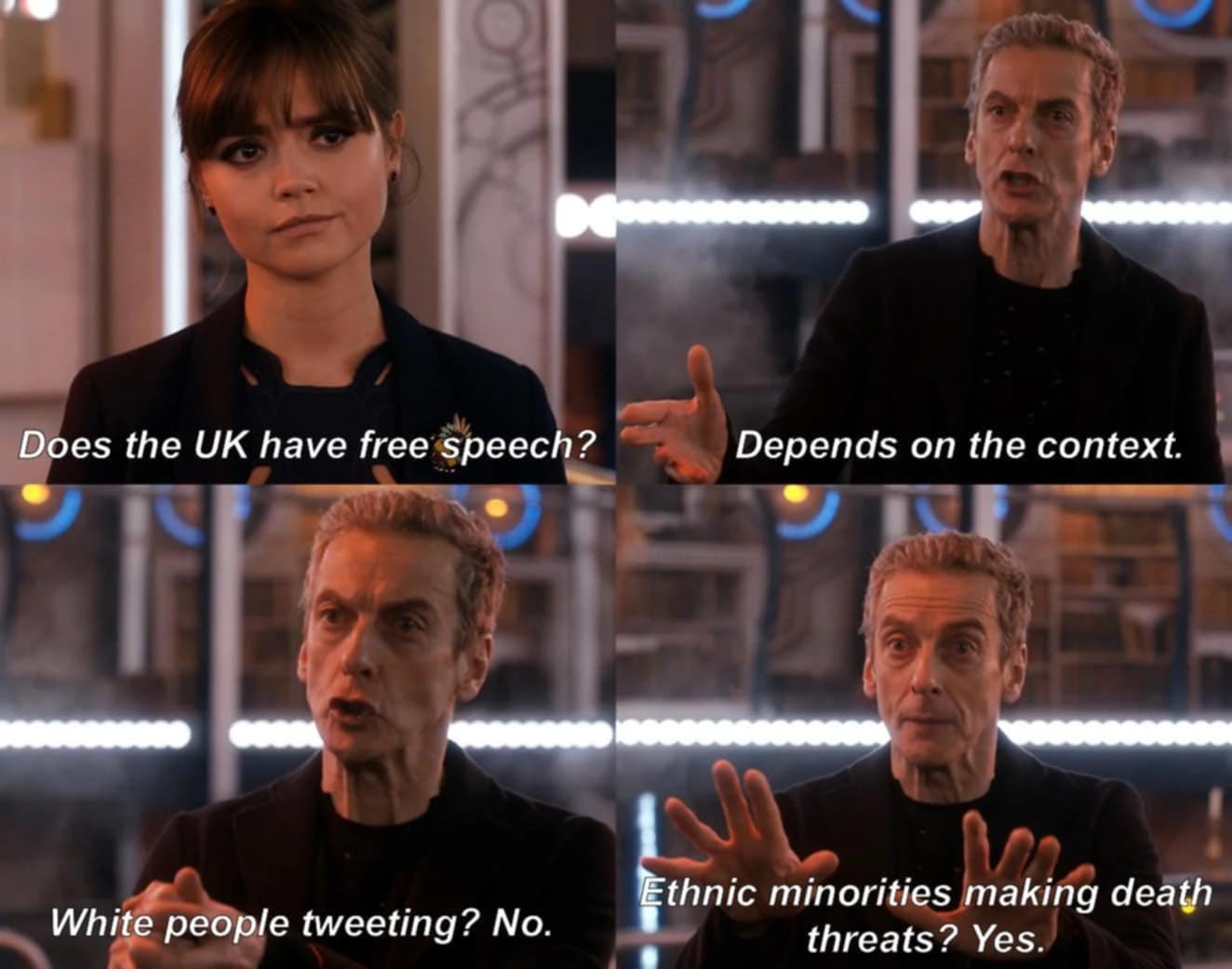
The background.
- https://www.bbc.com/news/articles/c62ln7mzd5ro – This BBC analysis explores the escalating debate on UK free speech limits, highlighting comparisons to authoritarian regimes like North Korea and the heated rhetoric around Starmer’s policies.
bbc.com
- https://www.wsj.com/opinion/free-expression/watch-what-you-say-or-two-tier-keir-might-put-you-away-73e99511 – A Wall Street Journal opinion piece critiques selective punishment of speech dissenting from progressive views in Starmer’s Britain, directly referencing the “Two Tier Keir” nickname.
wsj.com
- https://www.city-journal.org/article/britain-keir-starmer-free-speech-crime – This City Journal article discusses Britain’s shift toward authoritarianism, focusing on Starmer’s role in prosecuting speech crimes and curtailing individual freedoms.
city-journal.org
- https://www.foxnews.com/world/uk-government-accused-cracking-down-free-speech-think-before-you-post – Fox News reports on accusations of Starmer’s government rolling back free speech protections, including the “Two-tier Keir” label amid claims of selective law enforcement.
foxnews.com
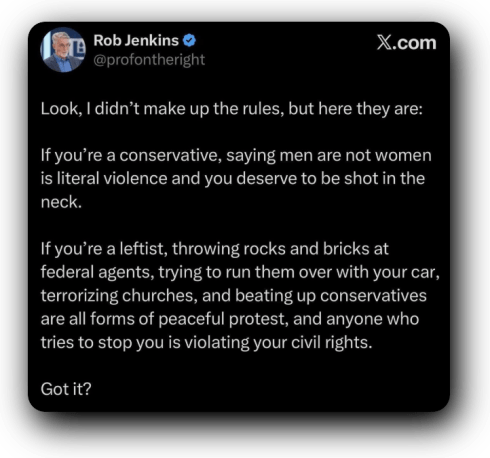
The X post is doing something familiar: it takes two ugly sentences, assigns one to “conservatives” and one to “leftists,” and then says, See? The rules are different. It’s a compressed morality play about “two-tier” reality—speech treated as violence on one side, actual violence laundered as “peaceful protest” on the other. The point isn’t subtle. The point is that subtlety is for suckers.
And yes: there is a real intellectual touchstone for the logic the meme is gesturing at—Herbert Marcuse and his essay Repressive Tolerance. Marcuse’s argument, in brief, is not “be nice to everyone equally.” It’s that “tolerance” inside an unjust system can function as a stabilizer for the powerful. If the social order is already rigged, then neutral tolerance becomes complicity. So “tolerance” may need to become selective: intolerance toward movements judged oppressive; preferential latitude toward movements judged emancipatory.
That is a mechanism you can recognize in our current atmosphere even if you reject Marcuse’s conclusions. Once you accept that framework—“neutral rules are a mask for power”—you quickly get to the idea that the formal categories we inherited (free speech, due process, viewpoint neutrality, equal enforcement) are not the point. The point is the moral direction of history. If you think the stakes are existential, then anything that slows “liberation” looks like violence, and anything that advances it starts to look excusable.
That’s the lure. It feels like moral seriousness.
It also tends to produce the exact thing the meme is ridiculing: asymmetric permission structures. On paper: “We oppose violence.” In practice: “We oppose violence when it serves the other tribe.” On paper: “Words have consequences.” In practice: “Words are violence when spoken by the wrong person, and merely ‘context’ when spoken by the right one.” If you want to defend selective enforcement as justice, Marcuse gives you a vocabulary. If you want to mock selective enforcement as hypocrisy, this meme gives you an image.
But the meme cheats in two ways.
First, it packages maximal caricatures as if they are the daily policy of real institutions: “people deserve to be shot,” “running over agents is peaceful,” “terrorizing churches is civil rights.” Those aren’t arguments; they’re adrenaline. They’re useful precisely because they let the reader skip the hard work: which specific cases, which authorities, which jurisdictions, which outcomes, which standards? A meme that can’t name a case doesn’t want to inform you. It wants to recruit you.
Second, it collapses three distinct questions into one hot blob:
- What is the law?
- How is it being enforced?
- Should the law be changed?
You can have a serious conversation about two-tier policing and still be allergic to meme logic. Two-tier policing isn’t a vibe; it’s an empirical claim: similar conduct, different outcomes, explained by ideology rather than facts. That’s testable, at least in principle. Pick comparable cases. Compare charging decisions, bail, sentencing, media framing, institutional statements, internal policies, and (crucially) what evidence was available at the time. If the pattern holds, you’ve found something corrosive.
Neutrality is never clean. Discretion and bias are baked into enforcement. That’s why consistency and transparency aren’t niceties; they’re the only way discretion doesn’t become patronage.
And if the pattern doesn’t hold? Then the meme is just a mood board for resentment.
Here’s the deeper issue: equal application of the law is not a decorative liberal slogan. It’s the only thing that keeps politics from becoming a permanent emergency. The moment your faction decides that formal neutrality is merely “repressive tolerance,” you have granted yourself a standing exemption. The moment the other faction learns that lesson, you get escalation, then retaliation, then institutional rot. The system stops being a referee and becomes a weapon. Everyone notices. Nobody trusts verdicts. Everything becomes a street fight conducted through courts, bureaucracies, and HR policies.
Which is, ironically, a recipe for more repression—just not evenly distributed. 🙂
If you want to critique selective enforcement without becoming a partisan mirror image, try this simple discipline:
- Name the standard (what rule should apply?).
- Name the comparator (what similar case was treated differently?).
- Name the decision point (who chose not to enforce, or enforced aggressively?).
- Say what you’d accept if the tribes were swapped.
Sometimes the double standard is real. The remedy is not revenge; it’s comparison—same conduct, same rule, same consequence, even when it’s your side.
That last one is the lie detector. Most people fail it quickly. That’s not because they’re stupid; it’s because the incentive structure is poisonous. If you’re convinced the other side is not merely wrong but illegitimate, “neutral rules” start to feel like self-harm.
Marcuse understood that temptation and tried to turn it into theory. The meme understands the temptation and turns it into a dunk.
My view is more boring and therefore more useful: a society can survive deep disagreement; it cannot survive the public belief that enforcement is a tribal privilege. If you think we have two-tier policing or two-tier moral accounting, don’t answer with a meme that trains your readers to crave revenge. Answer with receipts, standards, comparators, and the willingness to be constrained by the rule you want applied to your enemies.
Otherwise, you’re not defending fairness. You’re just changing who gets to do the repressing.
 Herbert Marcuse’s 1965 essay *Repressive Tolerance* argues that tolerance in liberal societies isn’t neutral—it props up power while smothering real dissent. He saw it as a rigged game: the system tolerates ideas that fit its frame and represses those that don’t. Marcuse’s fix? “Liberating tolerance”—coddling radical change, even lawbreaking, if it’s “progressive,” while crushing “regressive” resistance. Fast-forward to today: police and courts often give left-leaning lawbreakers a pass when their cause aligns with elite vibes, but hammer right-leaning groups like Canada’s Trucker Convoy. Let’s break this down with real cases through Marcuse’s eyes.
Marcuse’s Core Idea
Marcuse claimed tolerance in capitalist democracies—like free speech or legal fairness—shields the status quo. It’s not about justice; it’s about control. He pushed for intolerance toward oppressive ideas (think war or exploitation) and leniency for acts challenging them, even if illegal. The hitch: who picks the winners? Today’s justice system seems to—favoring leftist breaches while pummeling right-wing ones. Two real examples show it plain.
The Left’s Light Touch
Look at the 2020 Portland protests after George Floyd’s death. Night after night, activists clashed with police, torched a federal courthouse, and smashed storefronts. Over 1,000 arrests happened across months, per Portland Police data, but Multnomah County DA Mike Schmidt dropped charges for most non-violent cases—hundreds walked free. Rioting and property damage? Illegal, sure. But Schmidt called it “proportional” to focus on “serious” crimes, nodding to the protests’ racial justice aim.
Marcuse might nod too. He’d see this as “liberating”—lawbreaking to dismantle systemic racism, a cause he’d back. The state’s leniency fits his playbook: tolerate disruption if it’s “just.” But context matters. Media framed it as moral outrage, and cultural elites cheered. Tolerance here wasn’t blind—it leaned on a narrative Portland’s leaders could stomach.
The Trucker Convoy: Heavy Hand
Now flip to Canada’s 2022 Trucker Convoy. Truckers rolled into Ottawa, protesting vaccine mandates. They parked rigs, honked horns, and gridlocked downtown—illegal blockades, no question. No firebombs, though; it was loud, not violent. Ottawa’s response? A state of emergency. Police arrested 191 people, per the Ottawa Police Service, and the feds invoked the Emergencies Act—first time since 1988. Bank accounts got frozen, crowdfunding cash was seized, and leaders like Tamara Lich faced charges carrying up to 10 years. Courts still grind on some as of 2025.
Marcuse might call this “regressive”—truckers resisting public health for personal freedom, not his revolutionary vibe. His theory would greenlight repression here. But step back: these were blue-collar workers, not suits, pushing against centralized control. The state didn’t just enforce law—it flexed hard, with banks and media tagging them “extremists.” Tolerance? Out the window when the script flipped.
Side by Side
Portland versus Ottawa lays it bare. In Portland, sustained lawbreaking—arson, vandalism—drew arrests, but prosecutors waved off most penalties. The cause? Racial justice, a darling of progressive elites. The truckers broke laws too—blockades, noise—but got hit with emergency powers, asset freezes, and jail time. Their cause? Individual liberty, a sore spot for the same elites. Both disrupted public order. One got a shrug; the other got shackles.
Marcuse’s lens tracks this. He’d argue Portland’s activists deserved slack—their fight aligned with his anti-oppression stance. The truckers? Too “backward” to tolerate. Yet the truckers’ working-class roots and anti-mandate gripes echo his underdog ideal more than Portland’s curated chaos. The difference? Cultural clout. Left-leaning causes get a halo; right-leaning ones get a boot.
Steel-Manning the Divide
To be fair, the state’s not a monolith. Portland’s leniency could reflect local politics—progressive DAs like Schmidt prioritize “equity” over punishment. Ottawa’s crackdown? Public safety after weeks of gridlock, not just ideology. Law’s messy, not a conspiracy. Still, the gap’s real. A 2021 DOJ report showed 93% of Portland riot cases got dismissed or deferred; contrast that with the Convoy’s 70+ convictions by 2023, per Canadian court records. Police logged 1,000+ hours on Portland protests with kid gloves; Ottawa saw 2,000+ officers deployed in days, batons out. Numbers don’t lie—tolerance tilts.
Marcuse didn’t see this coming. He figured the repressed were leftists battling a right-wing Goliath. Now? Power’s cultural, not just economic, and it leans left—media, tech, academia. The truckers, not the rioters, look more like his outcasts. Yet “repressive tolerance” still flows his way—toward causes that sound noble, not ones that clash with the zeitgeist.
The Takeaway
Marcuse’s *Repressive Tolerance* nails today’s double standard. Portland’s rioters broke laws and walked; Ottawa’s truckers did the same and sank. It’s not random—tolerance tracks power’s favorites. Marcuse wanted it for revolution, but it’s become a perk for the loudest voices. Scroll X, pick a protest, and test it: who gets the pass? The answer’s in the outcomes, not the excuses.”
Credit to Grok AI, for the legwork with regards to statistics and editing for clarity.
Chanel Pfahl, a high school teacher in Ontario, Canada, has become a focal point in the ongoing cultural battle over education, activism, and free expression. On March 8, 2025, Pfahl announced via X that she is facing her fourth investigation by the Ontario College of Teachers for her social media posts and podcast comments criticizing activist policies, such as those promoting critical race theory and gender ideology in schools. This repeated targeting exemplifies the tactics of “woke cancel culture,” where individuals who challenge progressive orthodoxies are subjected to professional scrutiny, public shaming, and potential career destruction. Pfahl’s case highlights a broader trend in Canadian education, where dissent against ideological conformity is met with punitive measures, undermining open dialogue.
The investigations into Pfahl’s tweets and podcast remarks reveal a pattern of selective enforcement and ideological policing. Her posts, which include sharing images of school pride decorations, questioning gender-affirming care policies, and critiquing the imposition of group identities in education, are being scrutinized as “problematic” by the Ontario College of Teachers. Yet, as Pfahl notes, the same schools and educators who originally shared these materials on social media face no consequences. This double standard suggests a deliberate attempt to silence her voice, a hallmark of cancel culture, where individuals are held to inconsistent standards based on their alignment with prevailing ideological norms. The Democracy Fund, representing Pfahl in a related 2022 investigation, has argued that her comments are neither racist nor offensive, yet the investigations persist, illustrating the weaponization of regulatory power.
Pfahl’s situation also demonstrates the use of “repressive tolerance,” a tactic described by critics of critical social justice movements, as noted on the website Stop Woke Activism. While proponents of these ideologies claim to champion inclusion and diversity, their actions often exclude and punish those with opposing views, such as Pfahl. By compiling “pages and pages” of her tweets and podcast quotes, the Ontario College of Teachers is engaging in a form of public shaming, aiming to deter other educators from questioning activist policies in schools. This approach mirrors the “cancelling” tactics outlined in web resources, where dissenters are smeared, investigated, and pressured to conform, undermining fundamental democratic principles like freedom of expression and equality before the law.
The impact of these tactics extends beyond Pfahl, threatening the broader educational landscape in Canada. As highlighted in the National Post’s 2022 article on critical race theory’s influence in Canadian education, large school boards and institutions have adopted these ideologies, often without room for debate. Pfahl’s case underscores the risks for teachers who challenge this orthodoxy, potentially chilling free speech in classrooms and stifling diverse perspectives. Parents, as the primary educators of their children, also have a stake in this issue, as Pfahl’s advocacy aligns with concerns about ideological indoctrination in schools, a point emphasized by critics of critical social justice movements. Her investigations signal a broader cultural shift where dissent is pathologized rather than debated.
Ultimately, Chanel Pfahl’s repeated investigations by the Ontario College of Teachers serve as a stark warning about the dangers of woke cancel culture in Canadian education. By targeting her for expressing views that question activist policies, the regulatory body is enforcing a narrow ideological conformity that suppresses open discourse and individual rights. This case, rooted in Pfahl’s commitment to fostering an inclusive education free from imposed ideologies, reveals the need for a balanced approach that respects diverse opinions while upholding professional standards. Without such balance, the principles of liberal democracy—freedom of expression, equality, and parental rights—risk being eroded in the very institutions tasked with nurturing critical thinking and open-mindedness.

The framework of the world we live in has been set.
https://www.marcuse.org/herbert/publications/1960s/1965-repressive-tolerance-fulltext.html











 bleatmop
 Mystro
 The Arbourist


 Dead Wild Roses
Your opinions…