
You are currently browsing the tag archive for the ‘Review’ tag.
This game has a long title, it is called Warhammer:Endtimes – Vermintide. Vermintide is a four player cooperative survival game, set in the Warhammer fantasy universe. People familiar with Valve’s Left4Dead series will be familiar with the play-style and challenges to be encountered in Vermintide.
The plot of the game resolves around the actions of the five playable heroes as they travel around the besieged city of Ubersreik. As this is a first person melee combat game all missions will revolve around you introducing the sharp end of your sword into the assorted Skaven rat beasts that serve as the enemies in Vermintide. Certainly, there is variation in theme, as there a missions where supplies are gathered or objectives are required to be destroyed, but make no mistake of where the focus lies in this game.

The focus of Vermintide is melee and the developer, FatShark, has done an excellent job of making rat smashing an exciting and challenging experience. Each character has a range of melee weapons that require different strategies adding a fair bit of depth to the game – for instance, choosing a two handed hammer versus a sword and shield combination will effect how the the player interacts with the levels.
The interaction with enemies is modelled very much on the Valve’s Left4Dead series with the Skaven hordes standing in for the zombie hordes that swarm the players. Being swarmed in game encourages the players to stick together and use the environment to their advantage to minimize the damage hordes can do. Facing down hordes would become stale quite quickly though, fortunately special classes of Skaven exist to only to wreck havoc and break apart tight knit groups of player characters.
- Skaven Gutter-Runners are agile, teleporting assassins that leap onto a player from medium distance. Assassins knock down their targets and require another player remove them.
- Skaven Globadiers or Gas-Rats throw area of effect poison clouds that break up the group.
- Skaven Ratling Gunners bring a mini-gun to the party and focus fire one of the members of the party.
- Skaven Packmasters bring are armed with a medieval man-catcher and will drag their victim away from the party.
- Skaven Rat Ogres – Huge, Durable, Uber-Rats that will punch or pound the players into submission.
The special Skaven force players to make quick tactical decisions as these specials are all high priority targets and always seem to show up with the party knee deep in regular Skaven.
 Knee deep in regular Skaven and constant besieged by specials – this formula keeps the pressure high through most maps. The difficulty level in Vermintide is quite challenging. This is one of those games where skipping the ‘easy’ and ‘normal’ levels is not a good idea. Without a firm grasp of Vermintide’s blocking and dodging mechanics novice players quickly succumb to the ravages of the Skaven horde.
Vermintide can be a grind, as better weapons are awarded only at the end of a completed map. Wiping halfway through a map grants only a small pittance of raw materials, and this barrier to progression can be frustrating at times.
Optimization issues still plague Vermintide as this game will put a heavy load on your CPU and GPU. Scaling down the graphics helps, but much work still remains for Fatshark when it comes to streamlining their code.
I’ve had a great deal of fun with Vermintide and if you have a beefy CPU and some friends who like cooperative action I would heartily recommend this game.
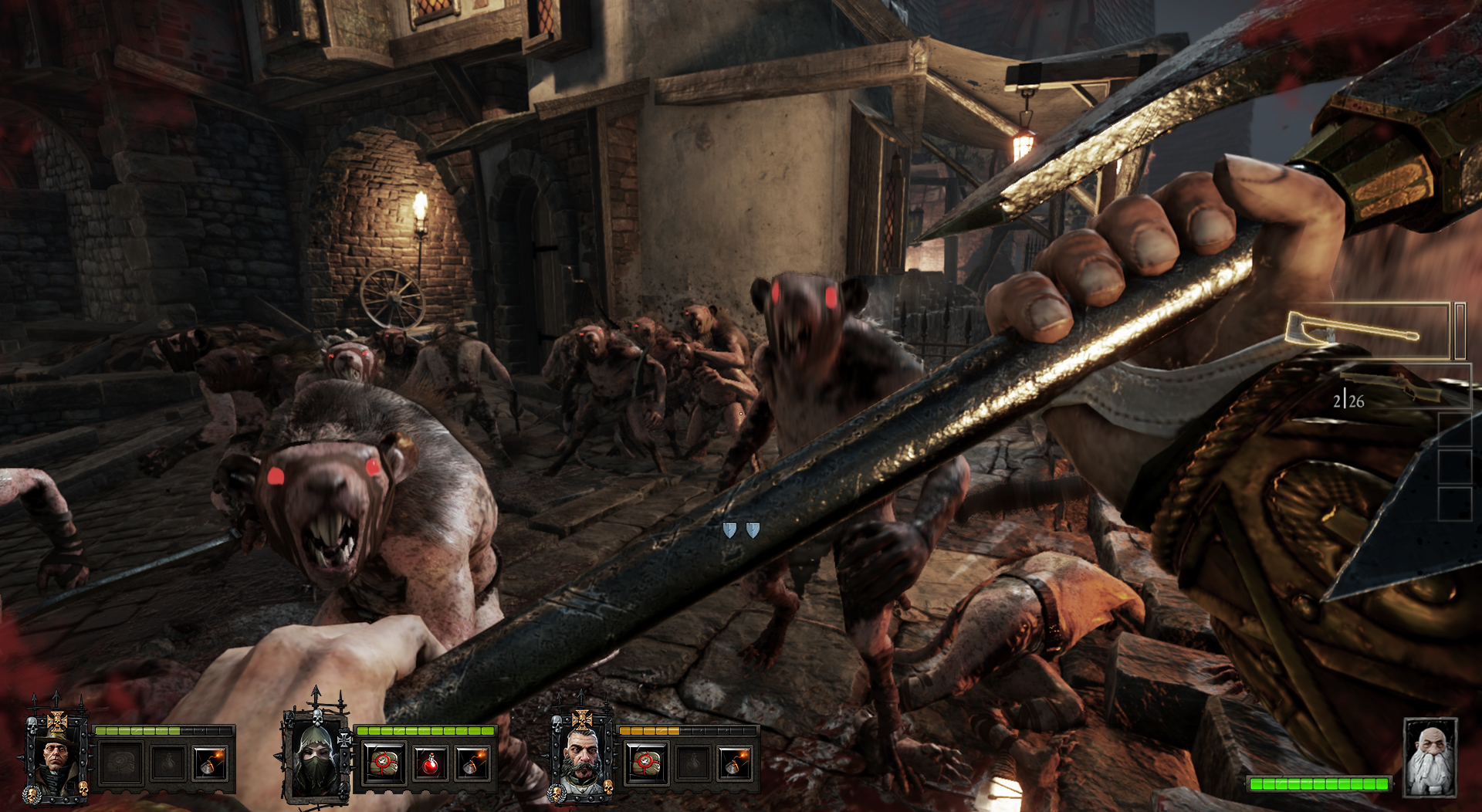
So many rats…
I rarely watch good movies. I spend my screen time on the blog, and with my current Diablo 3 addiction. Last night however, I did get the the opportunity to watch “Her”, a movie about a dude whose marriage is all but dissolved finding a new companion. The twist is that his new companion is an operating system that is sentient and programmed to learn.
It was a emotive, touching film that I would highly recommend everyone go see.

 Diablo 3 is an action RPG, in other words, it is one happy dungeon romp after another, always in search of the biggest and brightest loot to make the character of your choice that much more powerful. D3 does a wonderful job at using a variable reinforcement schedule when it comes to getting your items as all treasure dropped by monsters is random, so you never know when your lucky spin is going to come up. Someone did their psychology homework, full marks Blizzard. D3 falls down in a few areas for me that I would like to touch on, specifically the character advancement system and how, despite a plethora of neat character skills, almost every skill does exactly the same thing. I have a couple of quibbles with the character advancement schema as well that I will touch on before getting to what I see as a major problem with Diablo 3.
Character advancement, as opposed to Diablo 2, is rigid as character statistic advancement points are doled out in what is deemed to be the correct ratio for your particular character class. So, for instance, as a Witch Doctor, when you level up your intelligence always receives the majority of your advancement points. Contrast the beefy barbarian that advances her strength at a increased rate. Now, these predetermined choices make sense for how each character is designed, but by making the point allocation automatic, players miss out on customizing their characters to their wishes as opposed to what what Blizzard thinks is best. Why bother with attributes at all when they are not player controlled? This leads, in a minor way, to a certain baseline similarity between characters in terms of how they are built. You won’t find a burly mage, or a barbarian that is intellectually gifted. Not really a big problem, but it plays into my main concern with how D3 feels distinctly modular when it comes to the core mechanic of the game. 
Diablo 3’s core mechanic is to defeat monsters and gain experience and gear that make your character more powerful and set up for the next challenge. Not a complex task, but a viscerally satisfying one as you, through various means, send the earthbound minions of hell back to hell, preferably in bloody, non-tessellated bite sized pieces. I’m good with that and the graphics for the various characters their associated skills are really quite amazing. When I see a Wizard call down a meteor swarm my screen shakes and huge fiery globes of burning death rain down on the enemies – Awesome! Or when the Witch Doctor summons an inhospitable pool of acid for the baddies to bathe in, or when the Barbarian begins adding extra ventilation on the nearest demon, it is all good. But here is the thing, despite all the cool graphical monster annihilating madness being served up what is actually being inflicted upon our most gracious enemies is a number (and the exact same number in each of these cases) and its called DPS, or damage per second.
 The DPS generated by your character is dependent on your (predetermined) statistics and of course the gear you happen to have on. This is where I find the modularity of D3 detracts from the game. The epic minion crisping meteor swarm cast by the wizard does damage based on her DPS rating, that same wizard could cast Blizzard, a different area of effect spell, and do roughly the same amount of damage. Different graphical effects, same end results. There is certain amount of variation as you can modify the abilities you use with different runes that are unlocked as you gain experience, this provides some variation but does not adequately address the problem of modularity. It is like playing with Mr.Potato Head, whether you slap the goofy glasses on that lovable spud or configure him to wear his nose as a hat, in the end he is still just Mr.Potato head. Similarly in D3, using the the wizard example, you can pummel and deep-fry your foes with meteors and do X damage, or you can freeze them with blizzard and do, you guessed it, that same X damage.
So all you need to worry about is your DPS (damage), the choice of what shiny way you want to deliver said damage is mostly inconsequential, because if you remember the game mechanic that D3 is based on is slay da monster, get da loot, rinse and repeat. As the game increases in difficulty instead of becoming more complex the choices really boil down to two factors:
1. How much DPS am I doing?
2. How much life do I have?
Not enough of 1 but lots of 2 means that you’re trying to defeat enemies with harsh words while your demonic foes are peeling your face like a banana and using your skin to make doilies.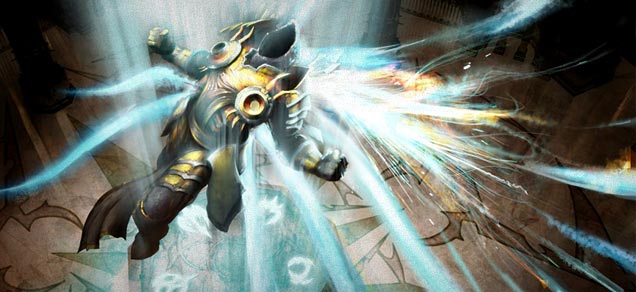
Not enough of 2, but lots of 1 means your are one means you’re viciously kicking ass, chewing bubble gum and taking names until you cut yourself on the gum-wrapper,bleeding out as you keel over dead.
So really, the meta-game of D3 is finding the balance between killing your foes and not becoming fish food yourself. Determining this requires playing with two factors, your DPS and your Vitality (life), everything else is secondary to this axiomatic notion in D3. And that is where the problem for me lies.











 bleatmop
 Mystro


 Dead Wild Roses
Your opinions…