
You are currently browsing the tag archive for the ‘Rule Enforcement’ tag.
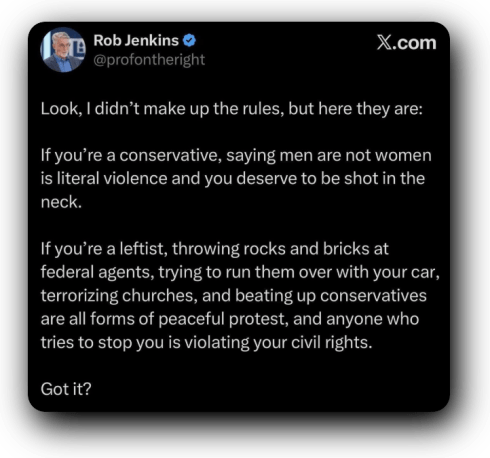
The X post is doing something familiar: it takes two ugly sentences, assigns one to “conservatives” and one to “leftists,” and then says, See? The rules are different. It’s a compressed morality play about “two-tier” reality—speech treated as violence on one side, actual violence laundered as “peaceful protest” on the other. The point isn’t subtle. The point is that subtlety is for suckers.
And yes: there is a real intellectual touchstone for the logic the meme is gesturing at—Herbert Marcuse and his essay Repressive Tolerance. Marcuse’s argument, in brief, is not “be nice to everyone equally.” It’s that “tolerance” inside an unjust system can function as a stabilizer for the powerful. If the social order is already rigged, then neutral tolerance becomes complicity. So “tolerance” may need to become selective: intolerance toward movements judged oppressive; preferential latitude toward movements judged emancipatory.
That is a mechanism you can recognize in our current atmosphere even if you reject Marcuse’s conclusions. Once you accept that framework—“neutral rules are a mask for power”—you quickly get to the idea that the formal categories we inherited (free speech, due process, viewpoint neutrality, equal enforcement) are not the point. The point is the moral direction of history. If you think the stakes are existential, then anything that slows “liberation” looks like violence, and anything that advances it starts to look excusable.
That’s the lure. It feels like moral seriousness.
It also tends to produce the exact thing the meme is ridiculing: asymmetric permission structures. On paper: “We oppose violence.” In practice: “We oppose violence when it serves the other tribe.” On paper: “Words have consequences.” In practice: “Words are violence when spoken by the wrong person, and merely ‘context’ when spoken by the right one.” If you want to defend selective enforcement as justice, Marcuse gives you a vocabulary. If you want to mock selective enforcement as hypocrisy, this meme gives you an image.
But the meme cheats in two ways.
First, it packages maximal caricatures as if they are the daily policy of real institutions: “people deserve to be shot,” “running over agents is peaceful,” “terrorizing churches is civil rights.” Those aren’t arguments; they’re adrenaline. They’re useful precisely because they let the reader skip the hard work: which specific cases, which authorities, which jurisdictions, which outcomes, which standards? A meme that can’t name a case doesn’t want to inform you. It wants to recruit you.
Second, it collapses three distinct questions into one hot blob:
- What is the law?
- How is it being enforced?
- Should the law be changed?
You can have a serious conversation about two-tier policing and still be allergic to meme logic. Two-tier policing isn’t a vibe; it’s an empirical claim: similar conduct, different outcomes, explained by ideology rather than facts. That’s testable, at least in principle. Pick comparable cases. Compare charging decisions, bail, sentencing, media framing, institutional statements, internal policies, and (crucially) what evidence was available at the time. If the pattern holds, you’ve found something corrosive.
Neutrality is never clean. Discretion and bias are baked into enforcement. That’s why consistency and transparency aren’t niceties; they’re the only way discretion doesn’t become patronage.
And if the pattern doesn’t hold? Then the meme is just a mood board for resentment.
Here’s the deeper issue: equal application of the law is not a decorative liberal slogan. It’s the only thing that keeps politics from becoming a permanent emergency. The moment your faction decides that formal neutrality is merely “repressive tolerance,” you have granted yourself a standing exemption. The moment the other faction learns that lesson, you get escalation, then retaliation, then institutional rot. The system stops being a referee and becomes a weapon. Everyone notices. Nobody trusts verdicts. Everything becomes a street fight conducted through courts, bureaucracies, and HR policies.
Which is, ironically, a recipe for more repression—just not evenly distributed. 🙂
If you want to critique selective enforcement without becoming a partisan mirror image, try this simple discipline:
- Name the standard (what rule should apply?).
- Name the comparator (what similar case was treated differently?).
- Name the decision point (who chose not to enforce, or enforced aggressively?).
- Say what you’d accept if the tribes were swapped.
Sometimes the double standard is real. The remedy is not revenge; it’s comparison—same conduct, same rule, same consequence, even when it’s your side.
That last one is the lie detector. Most people fail it quickly. That’s not because they’re stupid; it’s because the incentive structure is poisonous. If you’re convinced the other side is not merely wrong but illegitimate, “neutral rules” start to feel like self-harm.
Marcuse understood that temptation and tried to turn it into theory. The meme understands the temptation and turns it into a dunk.
My view is more boring and therefore more useful: a society can survive deep disagreement; it cannot survive the public belief that enforcement is a tribal privilege. If you think we have two-tier policing or two-tier moral accounting, don’t answer with a meme that trains your readers to crave revenge. Answer with receipts, standards, comparators, and the willingness to be constrained by the rule you want applied to your enemies.
Otherwise, you’re not defending fairness. You’re just changing who gets to do the repressing.











 bleatmop
 Mystro
 The Arbourist


 Dead Wild Roses
Your opinions…