
You are currently browsing the tag archive for the ‘School Violence’ tag.
Canadian media know how to do pattern recognition when they want to.
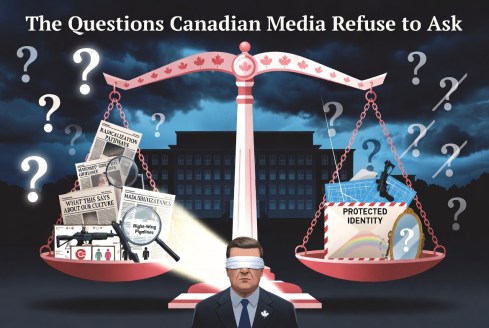
Give them the right suspect, the right ideology, or the right grievance story, and they will produce instant analysis about pathways, warning signs, radicalization, social meaning, and what the event “says” about the culture. But let violence intersect with a politically protected identity category, and the appetite for explanation suddenly disappears.
That is the real story here.
A youth in Nova Scotia is accused in a foiled school attack plot involving online coordination, handwritten plans, imitation weapons, hate symbols, and threats. Weeks earlier, Canada saw the Tumbler Ridge massacre, one of the country’s rare school-linked mass shootings, carried out by a trans-identified male with prior mental-health-related police contacts. Two cases do not prove some grand law. They do, however, justify a question. When identity disturbance, grievance, alienation, and violence begin to cluster, are we allowed to notice, or does the conversation get shut down the moment the demographic becomes inconvenient?
That question is treated as indecent when it should be treated as basic public seriousness.
The point is not that trans identification causes violence. That would be a stupid claim, and an unserious one. The point is that severe identity instability, grievance, social isolation, and moral insulation from scrutiny can form a combustible mix, and our institutions become evasive when gender ideology is somewhere in the picture. They know how to be curious. They simply become selective about when curiosity is allowed.
That selectivity matters because schools are not seminar rooms. They are places where adults are supposed to notice risk before bodies hit the floor.
Instead, the public gets the usual flattening language. Troubled youth. Mental health struggle. Isolated incident. Complex circumstances. All of that may be true as far as it goes. What is missing is any willingness to ask whether a culture that treats identity claims as sacred, untouchable, and morally beyond scrutiny might also be making honest risk assessment harder than it should be. If a young person’s entire psychic life is being organized around grievance, estrangement, fantasy, and a demand that reality ratify the self at all costs, that is not automatically a violence pathway. But it is certainly not nothing.
And yet the moment this territory appears, Canadian media go soft in the head.
“When violence intersects with a protected identity category, Canadian media suddenly lose their appetite for explanation.”
They will interrogate masculinity, whiteness, right-wing pipelines, online extremism, misogyny, colonial resentment, and institutional failure when those frames are available. But when gender ideology may be part of the unstable mix, the analysis collapses into vagueness. Suddenly nobody wants to generalize. Nobody wants to connect dots. Nobody wants to risk saying the wrong thing. The protected category gets narrative shelter that other categories do not receive.
That is not neutrality. It is selective curiosity.
None of this means most gender-distressed youth are violent. Of course they are not. But public safety is not served by pretending that every cluster of instability must be discussed in the most generic terms possible just because one part of the profile has become politically delicate. Schools, parents, and the public deserve better than ritual euphemism after every near miss or body count.
The issue is not a proven demographic pattern. The issue is that when violence and identity pathology appear together inside a protected narrative, Canadian media suddenly lose their nerve. They stop asking explanatory questions not because the questions are irrational, but because the answers might offend the wrong people.
And that is how taboo makes serious societies stupider than they can afford to be.











 bleatmop
 Mystro


 Dead Wild Roses
Your opinions…