
You are currently browsing the tag archive for the ‘Sex is a bianry and Immutable’ tag.
If you think that arguments based in truth, eventually you will run up against people who are so deep into the gender-cult that they have no idea what is real and what is dogma.

Be careful though, your audience will often defend their dogmatic views by any means necessary: Name calling, threats, and excommunication from the arena.
Tread with care and realize that you need to love the truth more than the shallow “acceptance” of others.
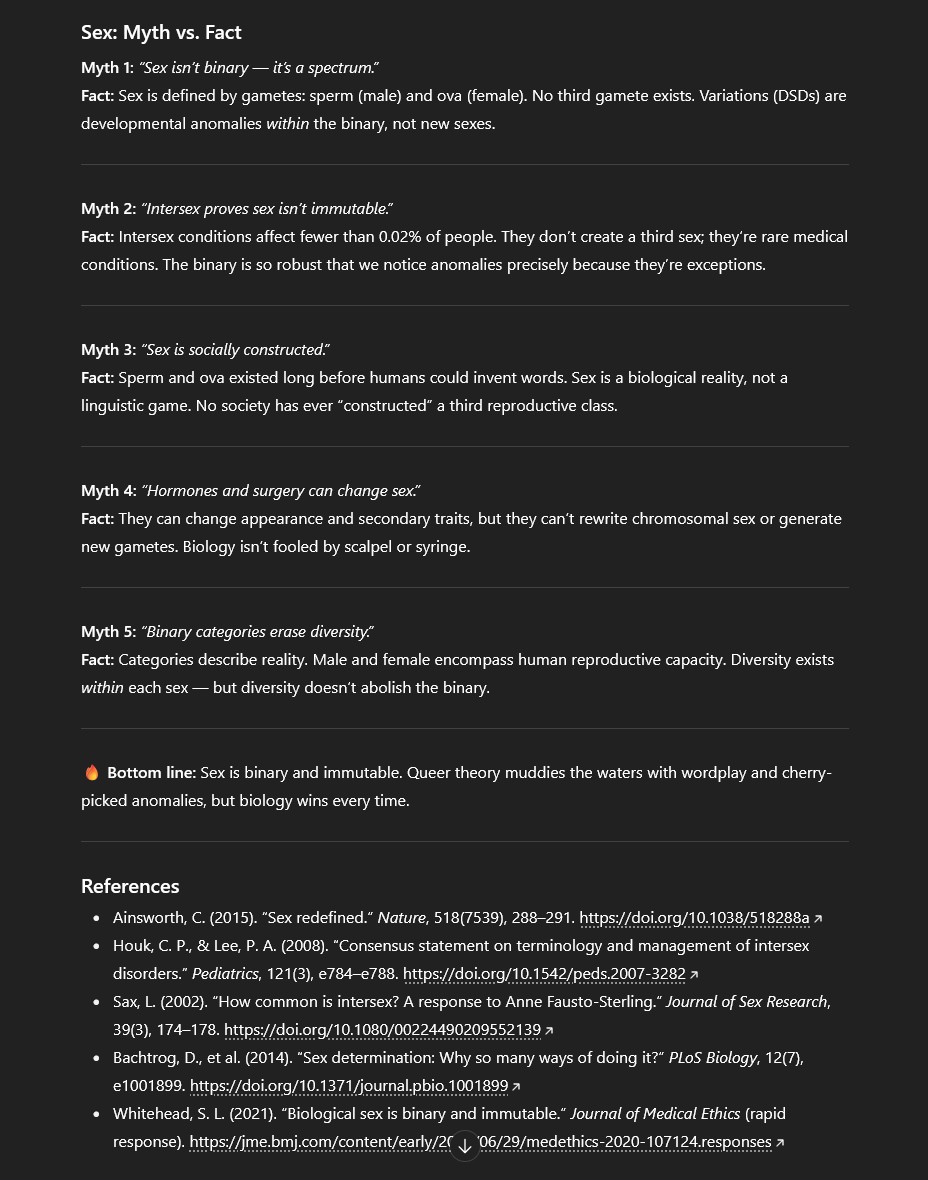
Need a response to the biology and sex denialists? Use at your leisure.
Human sex is determined by a complex interplay of genetic, hormonal, and anatomical factors, and extensive scientific research supports the view that it is both immutable and binary—male or female—at the biological level. A foundational study by Jost (1947) established that the presence or absence of the SRY gene on the Y chromosome directs the development of gonadal tissue into testes or ovaries, initiating a cascade of hormonal signals that shape sexual differentiation. This process results in distinct reproductive anatomy and gamete production: testes produce small gametes (sperm) in males, while ovaries produce large gametes (eggs) in females. Research published in Nature Reviews Genetics (2001) by Goodfellow and Lovell-Badge reinforces that this genetic switch is fixed at fertilization, with rare exceptions like intersex conditions (e.g., 0.05–1.7% of births per Sinclair et al., 1990) still aligning with male or female developmental pathways rather than constituting a third sex. Once established, these biological markers—chromosomes, gonads, and gametes—remain constant throughout life, unaffected by social identity or medical intervention.
Further evidence for the immutability and binary nature of sex comes from endocrinology and developmental biology. A 2016 study in The Journal of Clinical Endocrinology & Metabolism by Bao and Swaab details how prenatal androgen exposure locks in sexually dimorphic brain structures and physiological traits, such as genitalia, which cannot be fully reversed postnatally. While hormone therapies and surgeries can alter secondary sexual characteristics (e.g., breast development or voice pitch), they do not change the underlying chromosomal or gonadal sex. For instance, a 2020 review in Biology of Sex Differences by Arnold highlights that even in transgender individuals undergoing transition, the production of gametes (or lack thereof post-intervention) remains tied to the original sex, underscoring that biological sex is not malleable at its core. This binary framework is evolutionarily conserved across mammals, as noted in Wilson and Reeder’s Mammal Species of the World (2005), with males and females defined by their roles in sexual reproduction.
Opponents might point to gender identity or intersex conditions as challenges to this binary, but research distinguishes between gender as a social construct and sex as a biological reality. A 2018 paper in Frontiers in Neuroendocrinology by Joel et al. explores brain mosaicism—mixtures of “male” and “female” traits—but concludes it operates within a binary reproductive system, not beyond it. Intersex individuals, often cited as evidence of fluidity, typically have disorders of sex development (DSDs) like Congenital Adrenal Hyperplasia or Klinefelter Syndrome, yet these are variations within male or female categories, not a spectrum of sexes (Houk & Lee, 2008, Pediatrics). Overwhelmingly, the scientific consensus—spanning genetics (e.g., Science, 2017, McCarthy et al.), anatomy, and reproductive biology—affirms that human sex is an immutable, binary trait rooted in the objective reality of gamete type and chromosomal inheritance, distinguishing it from the fluidity of gender expression.











 bleatmop
 Mystro
 The Arbourist


 Dead Wild Roses
Your opinions…