
You are currently browsing the tag archive for the ‘Skywell’ tag.
Thanks to the BBC for their essay on Skywells.
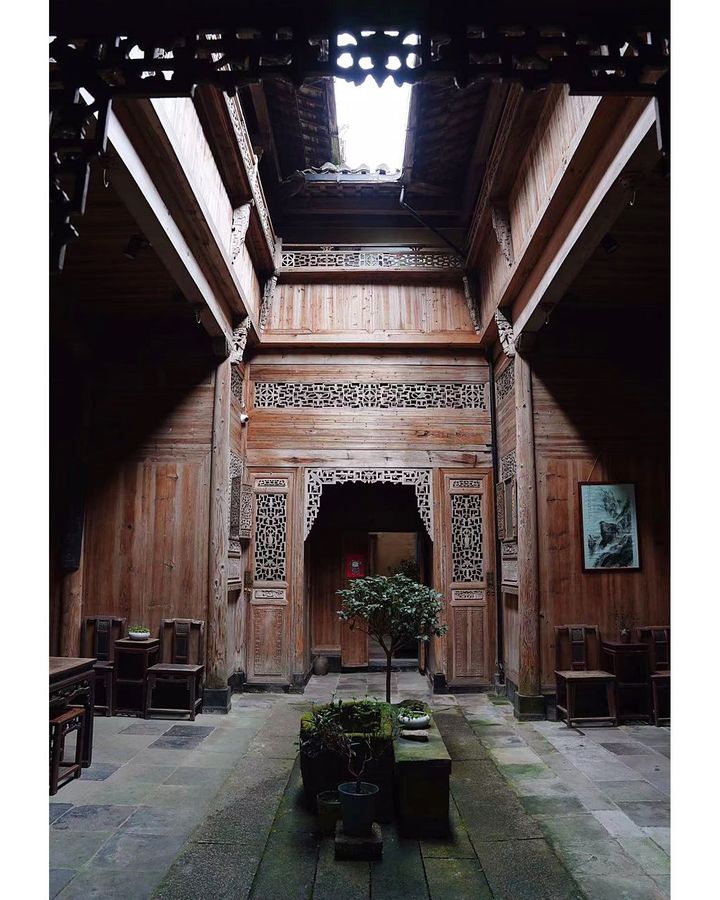
A skywell, or “tian jing” (天井) in Mandarin, is a typical feature of a traditional home in southern and eastern China. Different from a northern Chinese courtyard, or “yuan zi” (院子), a skywell is smaller and less exposed to the outdoor environment.
They are commonly seen in homes dating to Ming (1368-1644) and Qing (1644-1911) dynasties, which were designed to house different generations of relatives, according to a 2010 paper published by the Journal of Nanchang University in China.
Although a skywell’s size and design vary from region to region, it is almost always rectangular and located in the core of a house. It is either enclosed by rooms on four sides or three sides plus a wall. Some large houses have more than one skywell.
They are relatively common in historic residences in large swathes of southern and eastern China, such as Sichuan, Jiangsu, Anhui and Jiangxi. Some of the best-preserved can be found in Huizhou (徽州), a historical region that spreads between modern-day Anhui and Jiangxi.
Skywells were designed to cool buildings in an era well before air-conditioning existed. When wind blows above a skywell house, it can enter the indoor space through the opening. Because outdoor air is often cooler than indoor air, the incoming breeze travels down the walls to the lower stories and create airflows by replacing warmer indoor air, which rises and leaves through the opening.
Yu Youhong, 55, has spent more than 30 years restoring skywell homes in Wuyuan county of Jiangxi province, a part of the old Huizhou. As an inheritor of intangible cultural heritage recognised by China’s Ministry of Culture and Tourism, he has obtained a wealth of knowledge about skywells.
The main purposes of a skywell, he says, is to allow in light, improve ventilation and harvest rainwater. In Huizhou, a skywell is small but tall, and the rooms around it can block out sunlight on hot days, enabling the bottom of the skywell to stay cool, he adds.
Meanwhile, hot air inside the house can rise and escape through the opening above the skywell, which “works just like a chimney”.
“The ground floor of old Huizhou houses normally have very high ceilings and face towards the skywell directly, which is good for ventilation,” Yu says. “Some wealthy families had two or even three skywells, enabling them to have even better ventilation.”
My question is well, you seem to have a hole in your roof and that means not only all the rain, but all the bugs can get into your house. Neither of those are good for comfortable living.











 bleatmop
 Mystro


 Dead Wild Roses
Your opinions…