
You are currently browsing the tag archive for the ‘Solar Panels’ tag.
The future cost of utilities was one of the reasons why I installed solar panels on my roof. I wanted to take action to protect myself from the volatility of the energy market and maybe take a small step in the green direction

Thankfully at the time of installation, there were rebates from the Provincial government in place that took about a third of the cost of the install of the top, which was very nice.
After a very rocky installation – (never ever choose Polaron as your solar installer) – we’ve been up and running for about 2 years now. Production has been pretty good, although during the winter a ladder and snow roof rake are required to keep the panels clear. During the non constantly snowing months my household uses zero power from the grid when the sun is out. Any excess generation is sold back to the utility.
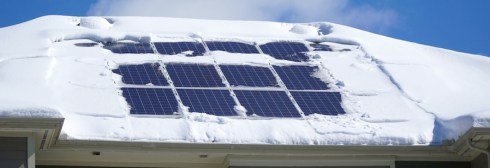
Sounds good right? But here is the thing – the utilities are not raising power rates per say – but rather everything else on the bill. So we get franchise fees, local area fees, delivery fees, fee fees et cetera. All those costs are significantly ramping up, enough so that there is little benefit at the moment for being a local energy co-generator.
Would I recommend getting solar panels installed? Without a government rebate – definitely not. With rebates maybe, but until we re -regulate the power utilities and their ‘fixed fee structure’ do not expect anything more than marginal cost saving benefits.
 It is encouraging to see capitalism used to actually do something, as opposed to swish money around a hollow economy and proclaim “Profit!” at the end as what has been the North American trend since the 1980’s.
“Researchers in China, the world’s leading provider of wind turbines and solar panels, are working toward making renewable energy cheaper, more efficient and a bigger part of the country’s power grid. But despite China’s rapid leap to being a global leader in the renewable energy field, more government investment is needed for research and development if China is to truly blaze a path toward a clean energy future, researchers say.
Zhao Xingzhong, professor at Wuhan University’s School of Physics and Technology, is researching dye-sensitised solar cells, a low-cost, high-efficiency alternative to more prevalent solid-state semiconductor solar cell technology.”
Go go China. The dependence on fossil fuels will be with us for awhile, but it nice to see some nations actually take the future seriously and begin to plan for it.
“Although Zhao’s team’s research is unique at home and abroad, he says support from the Chinese government is far from enough. He notes that Japan and South Korea have jointly invested about 1.6 billion U.S. dollars on research on third-generation solar technology since 2000. In China, however, Zhao says there have been just five native projects in the solar field in the last decade, with spending of around 4.5 million dollars per project.
“It is difficult to break through the technological bottleneck because of the inadequacy of (financial) input,” Zhao says”
Like most breakthrough products and technologies, renewable power innovation has come through the spending of the state who pays for the R&D of projects and then farms them out to the private sector where they can be made readily available to the public. (Although boo on China for what seems to be, at least in Zhao’s case underfunding his work.) It is one of the great myths of capitalism that private business is the dynamo that runs the economy, it is significant but far from the primary driver. It is the State, through Universities and publicly funded R&D institutes that contribute a great deal to the ‘innovation’ of our economies and societies.
“In recent years, China has become the global leader in renewable energy technology manufacturing, surpassing the United States in terms of both the number of wind turbines and solar panels it makes. The accounting firm Ernst & Young in September named China the best place to invest in renewable energy.
Chinese companies, led by the Jiangsu-based Suntech, have one-quarter of the world’s solar panel production capacity and are rapidly gaining market share by driving down prices using low-cost, large-scale factories. China’s 2009 stimulus package included subsidies for large solar installation projects.
In terms of wind power, home-grown companies have rapidly gained market share in recent years after the government raised local partnership requirements for foreign companies to 70 percent from 40 percent (the government has since removed local partnership requirements) and introduced major new subsidies and other incentives for Chinese wind power companies.”
The day is approaching when solar panels will not be out of range of most people. That will be a good day.
“Critics say China’s interest in renewable energy is essentially a business opportunity – most of what it produces is sold abroad – and that it is less interested in applying the more expensive technology at home. China has not yet caught up to the United States in terms of renewable energy production. The country is the biggest consumer of coal in the world and is expected to burn 4.5 billion tonnes of standard coal by 2020, according to figures from the National Energy Administration.
While coal will still make up two-thirds of China’s energy capacity in 2020, the government has promised to invest billions of dollars into the development of wind, solar and nuclear power. The country’s top legislature, the National People’s Congress, now requires power grid companies buy 100 percent of the electricity produced from renewable energy generators.”
For all the strides China has made in renewable energy, the magnitude of their economy and power needs dictates they well need to rely on coal well into the foreseeable future, as we do in North America. Hopefully, with another major power taking the lead in the development and manufacture of solar panels a renewable energy race might start and really kick things off here in North America where we have both the know how and the consumer base to make renewable energy feasible.
I’m going to watch this film, I think you should too.
A better path? I am not sure, but one that deserves serious examination.











 bleatmop
 Mystro
 The Arbourist


 Dead Wild Roses
Your opinions…