
You are currently browsing the tag archive for the ‘Space’ tag.
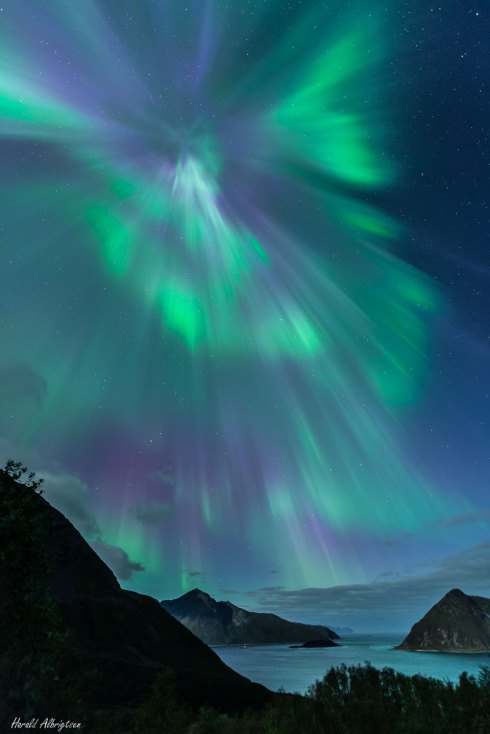
Auroral Corona over Norway : Higher than the highest mountain lies the realm of the aurora. Auroras rarely reach below 60 kilometers, and can range up to 1000 kilometers. Aurora light results from energetic electrons and protons striking atoms and molecules in the Earths atmosphere. Somewhat uncommon, an auroral corona appears as a center point for a surrounding display and may occur when an aurora develops directly overhead, or when auroral rays are pointed nearly toward the observer. This picturesque but brief green and purple aurora exhibition occurred last month high above Kvalya, Troms, Norway. The Sessyfjorden fjord runs through the foreground, while numerous stars are visible far in the distance. via NASA
[Source:just-space]
Scientists are predicting the Perseid Meteor Shower will be extra-spectacular this year, with up to double the usual number of meteors – up to 200 per hour!
Arb and I are probably not going to get to see them: the forecast is for clouds and rain a good portion of the night. If any of our dear readers manage to take in the sight, I’d love to live vicariously through your reports!
 I hate the word ‘utilize’.
There is an art form to selecting words. One mustn’t be drab, nor overly verbose. Large words should be used for clarity and precision in terms of expressing one’s intent. They should NOT be used to merely for the sake of making the speaker sound smarter or more official. As my wonderful philosophy professor once lectured, this makes your writing [or speaking] ‘fluffy’. It takes up lots of space, but has little substance. Further, if one is hellbent on using an impressive sounding word, make damn sure it means what you think it means. When people violate these two rules, I think back to that professor and how I ought to correct the culprits in his honour. Guillermo, this post is for you.
The first example of the misuse of words comes straight from the lecture that ultimately inspired this post. ‘Utilize’. This word is the epitome of ‘fluffy’ language. There is not one instance where the word ‘utilize’ adds any meaning that could not be derived from the word ‘use’.
Indeed, the only time ‘utilize’ is used is when the speaker/writer wants to sound smart and gain extra credibility without earning it. Try it out. The next time you hear someone say ‘utilize’, check the context. They are most likely trying to convince their audience of a) their position, b) their intelligence, or c) their import. Further, if you take their sentence and put in ‘use’ instead of ‘utilize’, you will find that not one iota of meaning has been lost.
Let us compare this to another pair of words: ‘end’ and ‘terminate’. Like the set in our example, they are synonyms. However, there is an important difference. Compare the following:
“My job was terminated today.”
“My work day terminated at 4:30 today.”
The word ‘terminate’ has a sense of finality to it that is not present in ‘end’. In our first sentence, ‘terminate’ conveys that the speaker was fired, that their job is no more. It is a valid use of a large word.
The second sentence doesn’t sound right, though, as the speaker is merely speaking of what time they finished their job that day. This conflicts with the extra meaning associated with ‘terminate’. As the message doesn’t contain the extra meaning, it is an incorrect application of the larger word. Read the rest of this entry »
Early primate hunters nearly initiated their own extinction by using the advanced technology of the time to stress their environment and hunt at unsustainable levels. At one time, our future rested on less than 20,000 individuals world wide. Luckily we did not die off completely and came to flourish and expand across the globe.
Despite the lessons of the past we continue to prioritize short term thinking over long term planning. Time after time our populations smash up against the carrying capacities of the environment. The wreckage of past societies lay quietly in the shallows of time as grim reminders of the poor choices societies have made and sadly, continue to make.
Our short shortsightedness continues to threaten our hopes for the future, as we clog the space around the earth with debris from our space programs.

Enhanced image of the "junk" that is orbiting the Earth
“There are 22,000 objects in orbit that are big enough for officials on the ground to track and countless more smaller ones that could do damage to human-carrying spaceships and valuable satellites. The International Space Station has to move out of the way of debris from time to time.”
Watching the space shuttle or the International space station glide through space looks serene. A gossamer constellation hung in space. Yet in reality the ISS is travelling at roughly 27724 km per hour around the globe. Imagine the impact and damage when something strikes the station going over 20,000 km/h. Yet, we are putting more garbage into orbit through our actions.
“We’ve lost control of the environment,” said retired NASA senior scientist Donald Kessler, who headed the National Academy of Sciences report.
Since the space age began 54 years ago, civilization has littered the area just above Earth’s atmosphere with leftover boosters and other parts that come off during launches, as well as old satellites. When scientists noticed that this could be a problem, they came up with agreements to limit new space junk and those plans had been working.”
The warnings have already been issued. As usual, we are not listening.
Those agreements are intended to make sure what is sent into orbit eventually falls back to Earth and burns up.
“But two events in the past four years — a 2007 Chinese anti-satellite weapon test and a 2009 crash-in-orbit of two satellites — put so much new junk in space that everything changed, the report said. The widely criticized Chinese test used a missile to smash an aging weather satellite into 150,000 pieces of debris larger than one-centimetre and 3,118 pieces can be tracked by radar on the ground, the report said.
“Those two single events doubled the amount of fragments in Earth orbit and completely wiped out what we had done in the last 25 years,” Kessler said.
All that junk that means something has to be done, “which means you have to look at cleaning space,” said Kessler.”
Yes, so rather than attempting to minimize the hazards of space travel we are upping the ante with more projectiles circling the earth waiting to shred whatever happens to be in their path. Of course we look to technology to save us once again –
“The study only briefly mentions the cleanup possibility, raising technical, legal and diplomatic hurdles. But it refers to a report earlier this year by a Defence Department science think-tank that outlines all sorts of unusual techniques. The report by the Defence Advanced Research Projects Agency is called “Catcher’s Mitt” and it mentions harpoons, nets, tethers, magnets and even a giant dish or umbrella-shaped device that would sweep up tiny pieces of debris.
While the new report does not recommend using the technology, Kessler said it is needed. He likes one company’s idea of a satellite that is armed with nets that could be sprung on wayward junk. Attached to the net is an electromagnetic tether that could either pull the junk down to a point where it would burn up harmlessly or boost it to safer orbit.”
If that doesn’t work, we may deny ourselves the possibility of ever leaving our planet. Of course, that is just pessimistic long term thinking…











 bleatmop
 Mystro
 The Arbourist


 Dead Wild Roses
Your opinions…