
You are currently browsing the tag archive for the ‘The CBC Signature Series’ tag.
We’ve reached the summit folks. C major is the final key in the CBC Signatures Series. Thank you to all who have come along for the ride enjoying the music, writing down pieces that caught your ear and generally have a great time listening to wonderful music.
The C major scale (often just C or key of C) consists of the pitches C, D, E, F, G, A, and B. Its key signature has no flats/sharps.
Its relative minor is A minor, and its parallel minor is C minor.
C major is one of the most common key signatures used in music. Most transposing instruments playing in their home key are notated in C major; for example, a clarinet in B-flat sounding a B-flat major scale is notated as playing a C major scale. The white keys of the piano correspond to the C major scale. Among brass instruments, the more common trumpet is the trumpet in C, and the contra-bass tuba is in C. A pedal harp tuned to C major has all of its pedals in the middle position.
C major is often thought of as the simplest key, due to its lack of sharps or flats, and beginning piano students’ first pieces are usually simple ones in this key; the first scales and arpeggios that students learn are also usually C major. However, going against this common practice, the Polish composer Frédéric Chopin regarded this scale as the most difficult to play with complete evenness, and he tended to give it last to his students. He regarded B major as the easiest scale to play on the piano, because the position of the black and white notes best fit the natural positions of the fingers, and so he often had students start with this scale. A C major scale lacks black keys and thus does not fit the natural positions of the fingers well.


A one-octave C major scale.
Twenty of Joseph Haydn’s 104 symphonies are in C major, making it his second most often used key, second only to D major. Of the 134 symphonies mistakenly attributed to Haydn that H. C. Robbins Landon lists in his catalog, 33 are in C major, more than any other key. Before the invention of the valve trumpet, Haydn did not write trumpet and timpani parts in his symphonies, except those in C major. H. C. Robbins Landon writes that it wasn’t “until 1774 that Haydn uses trumpets and timpani in a key other than C major … and then only sparingly.” Most of Haydn’s symphonies in C major are labelled “festive” and are of a primarily celebratory mood.[1] (See also List of symphonies in C major).
Many Masses and settings of Te Deum in the Classical era were in C major. Mozart wrote most of his Masses in C major and so did Haydn.[2]
Of Franz Schubert’s two symphonies in the key, the first is nicknamed the “Little C major” and the second the “Great C major.”
Many musicians have pointed out that every musical key conjures up specific feelings. This idea is further explored in a radio station called The Signature Series. American popular song writer Bob Dylan claimed the key of C major to “be the key of strength, but also the key of regret.” “French composers such as Marc-Antoine Charpentier and Rameau generally thought of C major as a key for happy music, but Hector Berlioz in 1856 described it as “serious but deaf and dull.” Ralph Vaughan Williams was impressed by Sibelius’s Symphony No. 7 in C major and remarked that only Sibelius could make the key sound fresh. However, C major was a key of great importance in Sibelius’s previous symphonies.[3] Claude Debussy, noted for composing music that avoided a particular key center, once said, “I do not believe in the supremacy of the C major scale.”
A big thank you to the Canadian Broadcasting Corporation and the creator of the series Paolo Pietropaolo. for all of his hard work.
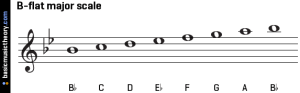 The B♭ (B-flat) major scale consists of the pitches B♭, C, D, E♭, F, G, and A. Its key signature has two flats, B/E (see below: Scales and keys).
Its relative minor is G minor, and its parallel minor is B♭ minor.
Many transposing instruments are pitched in B-flat major, including the clarinet, trumpet, tenor saxophone, and soprano saxophone.
A few famous works in B flat major:
- Brandenburg Concerto No. 6 (Bach)
- Piano Concerto No. 15 (Mozart)
- Piano Concerto No. 27 (Mozart)
- Piano Sonata No. 11 (Beethoven)
- Piano Concerto No. 2 (Beethoven)
- Symphony No. 4 (Beethoven)
- String Quartet No. 6 (Beethoven)
- String Quartet No. 13 (Beethoven)
- Große Fuge (Beethoven)
- Piano Sonata No. 29 (Beethoven)
- Piano Sonata No. 21 (Schubert)
- Symphony No. 2 (Mendelssohn)
- Piano Concerto No. 2 (Brahms)
- Symphony No. 5 (Bruckner)
- Symphony No. 5 (Prokofiev)
- Piano Concerto No. 4 (Prokofiev)
- String Sextet No. 1 (Brahms)
- Prelude in B-flat major (Rachmaninoff)
- String Quartet No. 5 (Shostakovich)
- Mass No. 3 (Schubert)
A big thanks to the CBC and Paolo Pietropaolo for hosting the Signature Series.
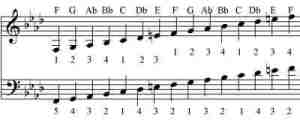 F minor is a minor scale based on F, consisting of the pitches F, G, A♭, B♭, C, D♭, and E♭. The harmonic minor raises the E♭ to E♮. Its key signature has four flats (see below: Scales and keys).
Its relative major is A-flat major, and its parallel major is F major.
F minor is a key often associated with passion. Two famous pieces in the key of F minor are Beethoven’s Appassionata Sonata, and Haydn’s Symphony No. 49 in F minor, La Passione.
Glenn Gould once said if he could be any key, he would be F minor, because “it’s rather dour, halfway between complex and stable, between upright and lascivious, between gray and highly tinted…There is a certain obliqueness.”[1]
In the Baroque period, music in F minor was usually written with a three-flat key signature and some modern editions of that repertoire retain that convention.
Again, many thanks to the CBC and Paolo Pietropaolo for bringing us the Signature Series.
I love the Beethoven interspersed with Vivaldi. : )
 Many thanks to Paolo Pietropaolo and the CBC for bringing us the Signature Series.
G minor is a minor scale based on G, consisting of the pitches G, A, B♭, C, D, E♭, and F. For the harmonic minor scale, the F is raised to F♯. Its relative major is B-flat major, and its parallel major is G major.
Changes needed for the melodic and harmonic versions of the scale are written in with accidentals as necessary. G minor is one of two flat key signatures that require a sharp for the leading-tone (the other is D minor).
Mozart’s use of G minor
Main article: Mozart and G minor
G minor has been considered the key through which Wolfgang Amadeus Mozart best expressed sadness and tragedy,[1] and many of his minor key works are in G minor, such as the Piano Quartet No. 1 and the String Quintet in G minor. Though Mozart touched on various minor keys in his symphonies, G minor is the only minor key he used as a main key for his numbered symphonies (No. 25, and the famous No. 40). In the Classical period, symphonies in G minor almost always used four horns, two in G and two in B-flat alto.[2] Another convention of G minor symphonies observed in Mozart’s No. 25 was the choice of E-flat major for the slow movement, with other examples including Haydn’s No. 39 and Johann Baptist Wanhal‘s G minor symphony from before 1771 (Bryan Gm1).[3]
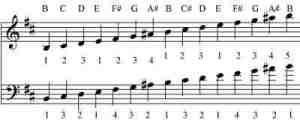 B minor is a minor scale based on B, consisting of the pitches B, C♯, D, E, F♯, G, and A. The harmonic minor raises the A to A♯. Its key signature has two sharps
Its relative major is D major, and its parallel major is B major.
Changes needed for the melodic and harmonic versions of the scale are written in with accidentals as necessary.
In Baroque times, B minor was regarded as the key of utter despair.[citation needed] The theorist Christian Friedrich Daniel Schubart (1739–1791) regarded B minor as a key expressing a quiet acceptance of fate and very gentle complaint, something commentators find to be in line with Bach’s use of the key in the St John Passion.[1] By Beethoven’s time, however, the perception of B minor had changed considerably: Francesco Galeazzi wrote that B minor was not suitable for music in good taste, and Beethoven labelled a B minor melodic idea in one of his sketchbooks as a “black key”.[2]
Thanks to CBC radio 2 and the Signature series for bringing you the lovely key of B minor.
 The CBC Signature Series hosted by Paolo Pietropaolo forges on with A-flat major.
A little bit more on A-flat major from Wikipedia:
The A-flat major scale consists of the pitches A♭, B♭, C, D♭, E♭, F, and G. Its key signature has four flats (see below: Scales and keys).
Its relative minor is F minor, and its parallel minor is A-flat minor.
It was used quite often by Franz Schubert; twenty-four of Frédéric Chopin‘s piano pieces[quantify] are in A-flat major, more than any other key.
Beethoven chose A-flat major as the key of the slow movement for most of his C minor works, a practice which Anton Bruckner imitated in his first two C minor symphonies and also Antonín Dvořák in his only C minor symphony.
Since A-flat major was not often chosen as the main key for orchestral works of the 18th Century, passages or movements in the key often retained the timpani settings of the preceding movement. For example, Beethoven’s Symphony No. 5 in C minor has the timpani set to C and G for the first movement. With hand tuned timpani, there is no time to retune the timpani to A-flat and E-flat for the slow second movement in A-flat; accordingly, the timpani in this movement are reserved for the passages in C major. In Bruckner’s Symphony No. 1 in C minor, however, the timpani are retuned between the first movement in C minor and the following in A-flat major.
Charles-Marie Widor considered A-flat major to be the second best key for flute music.[1]
Sir Edward Elgar‘s Symphony No. 1 in A-flat major is probably the best-known symphony in that key in the standard orchestral repertoire.[citation needed] However, Arnold Bax‘s 7th Symphony is also in the same key.
A-flat major was the flattest major key to be used in the keyboard and piano sonatas of Domenico Scarlatti, Joseph Haydn and Ludwig van Beethoven, with each of them using the key for two sonatas: Scarlatti’s K. 127 and K. 130, Haydn’s Hob XVI 43 and 46, and Beethoven’s Op. 26 and Op. 110, while Franz Schubert used it for one piano sonata. It was also the flattest major key to be used for the preludes and fugues in Johann Sebastian Bach‘s Well-Tempered Klavier, as flatter major keys were notated as their enharmonic equivalents.
Felix Mendelssohn, Johann Nepomuk Hummel, John Field, and Friedrich Kalkbrenner each wrote one piano concerto in A-flat (Mendelssohn’s being for two pianos); they had the horns and trumpet tuned to E-flat. Max Bruch‘s Concerto for Two Pianos in A-flat minor has its last movement in A-flat major, which is the parallel major; this concerto plays with the contrast between the two keys.
Works for stringed instruments in this key include Antonin Dvorak‘s String Quartet No. 14 and Benjamin Godard‘s Violin Sonata No. 4.











 bleatmop
 Mystro
 The Arbourist


 Dead Wild Roses
Your opinions…