
You are currently browsing the tag archive for the ‘The Intersex Ploy’ tag.
Introduction
Despite activist claims that human sex exists on a continuum, biological science tells a different story. Sex in humans is binary, rooted in the immutable organization of the body to produce one of two gamete types: sperm or ova. Disorders of sex development (DSDs) do not blur this binary—they confirm it by illustrating how rare developmental anomalies still adhere to the underlying male or female blueprint. Understanding this distinction is crucial for preserving scientific integrity and fostering honest dialogue about the difference between sex and gender.
1. Sex Is Binary and Immutable
When confronting individuals who assert that human sex constitutes a spectrum due to the existence of disorders of sex development (DSDs), one must begin by clarifying foundational biological truths. Sex in humans is binary and immutable, determined by the organization of reproductive anatomy to produce either small gametes (sperm) or large gametes (ova). This distinction remains fixed from conception and unaltered by developmental anomalies.
This binary framework arises from anisogamy—the biological system in which two and only two gamete types exist. Evolutionary pressures favored this division because it optimizes reproductive success; the fusion of small and large gametes is the only mechanism by which human life continues. Any notion of a “sex continuum” is therefore biologically untenable.
Crucially, sex must not be conflated with gender. Sex is an observable, material reality rooted in chromosomes, hormones, and anatomy. Gender, by contrast, encompasses socially constructed roles, behaviors, and stereotypes arbitrarily imposed on the sexes—norms that often perpetuate hierarchies or restrict personal freedom. Conflating these categories distorts both science and social ethics.
2. What DSDs Actually Are
Disorders of sex development, often mischaracterized as evidence for a sex spectrum, are in fact sex-specific developmental conditions that affirm the binary nature of sex. These rare congenital variations—affecting roughly 0.018 percent of births—involve ambiguities in genital, gonadal, or chromosomal development but align with either male or female pathways, not a third category.
For instance, congenital adrenal hyperplasia (CAH) and androgen insensitivity syndrome (AIS) both occur in individuals whose biology is oriented toward one sex, with deviations resulting from genetic mutations or hormonal disruptions. These do not create functional intermediates or new reproductive categories.
Such specificity underscores the binary: DSDs are developmental errors within male or female pathways, not the emergence of a new sex. Individuals with DSDs typically produce—or are organized to produce—only one type of gamete if fertile at all. The biological reality of sex, therefore, remains intact and immutable.
3. Why Exceptions Prove the Rule
The argument that DSDs invalidate the binary misconstrues both scientific reasoning and logic. In truth, these exceptions prove the rule by demonstrating the natural order they deviate from. Biological rules are typological but real: their edges may blur, but the underlying structure remains dichotomous.
True hermaphroditism—where an individual possesses both ovarian and testicular tissue—is vanishingly rare and almost always results in sterility or nonfunctional gonadal tissue. Far from undermining the binary, such anomalies illustrate its boundaries and reinforce its robustness.
DSDs represent developmental anomalies with low reproductive fitness, actively selected against by evolution. Their existence shows that the sex binary is the viable and stable norm for human reproduction. Without such exceptions, the binary framework could not be empirically tested or confirmed; their rarity and deleterious effects affirm its validity.
4. The Gamete Criterion: Biology’s Final Word
A decisive refutation of the “sex spectrum” claim lies in the absence of a third gamete type in humans. Human reproduction depends exclusively on the fusion of sperm and ova. No intermediate or alternative gamete exists, confining sex to two categories:
- Male — organized to produce small gametes (sperm)
- Female — organized to produce large gametes (ova)
Even in rare ovotesticular conditions, any functional gametes—if produced—belong to one type, not a hybrid or new category. Evolutionarily, the emergence of a third gamete type would represent an entirely new reproductive strategy, a macroevolutionary shift not observed in any vertebrate species.
This gamete binary, enforced by genetic mechanisms such as imprinting and gonadal inhibition, precludes hermaphroditism and parthenogenesis in humans and other mammals. As such, sex is not a spectrum but a digital dichotomy essential for genetic propagation.
5. Engaging with Honesty and Precision
When engaging those who conflate DSDs with a sex spectrum, redirect the discussion to verifiable evidence rather than ideology. Clarify the distinction between sex’s biological immutability and gender’s social construction. Acknowledge the human dignity of individuals with DSDs while affirming that their existence does not alter the fundamental binary of human sex.
Binary does not mean uniformity. Just as handedness is binary yet exhibits variation, sex is binary but allows for rare deviations that do not create new categories. By citing the gamete criterion and the sex-specific nature of DSDs, one can show that exceptions test and affirm the rule—they do not abolish it.
This approach promotes truthful, constructive dialogue and safeguards scientific discourse from the encroachment of ideological distortion.
References
- Arboleda, V. A., et al. (2014). Disorders of sex development: Revisiting the spectrum. Endocrine Reviews, 35(6), 945–967. https://pmc.ncbi.nlm.nih.gov/articles/PMC10265381/
- Bachtrog, D., et al. (2014). Sex determination: Why so many ways of doing it? Nature Reviews Genetics, 15(11), 783–797.
- Lee, P. A., et al. (2006). Consensus statement on management of intersex disorders. Pediatrics, 118(2), e488–e500.
- Parker, G. A., Baker, R. R., & Smith, V. G. F. (1972/2011). The evolution of anisogamy: A fundamental change in reproductive biology. Philosophical Transactions of the Royal Society B, 366(1566), 257–270.
- Sax, L. (2002). How common is intersex? Journal of Sex Research, 39(3), 174–178. https://pubmed.ncbi.nlm.nih.gov/12476264/
- National Association of Scholars. (2020). In Humans, Sex Is Binary and Immutable. https://www.nas.org/academic-questions/33/2/in-humans-sex-is-binary-and-immutable
- City Journal. (2022). Understanding the Sex Binary. https://www.city-journal.org/article/understanding-the-sex-binary
- World Health Organization. (n.d.). Gender and Health. https://www.who.int/health-topics/gender
Transgender ideology is being debated and discussed in legislatures. If you value material reality you need to get involved and show up and participate otherwise this bullshit will get even more of a foothold in public institutions.
So brutal. Let’s erase females from society in the name of ‘trans inclusivity’. Absolutely not. We will use terms that accurately describe the reality we all share.
Arguing with gender ideologues can be a very disparaging and fruitless task. Many of the argumentative styles they adopt are purely reflexive and will be based in goading or shaming the person they disagree with into silence or compliance. The ‘social pressure’ dodge will be part three of this series. However, the topic today is the ill considered use of the term “intersex” and intersexed people in general when used as rhetorical ammunition in a gender identity debate.
The Intersex ploy goes something like this:
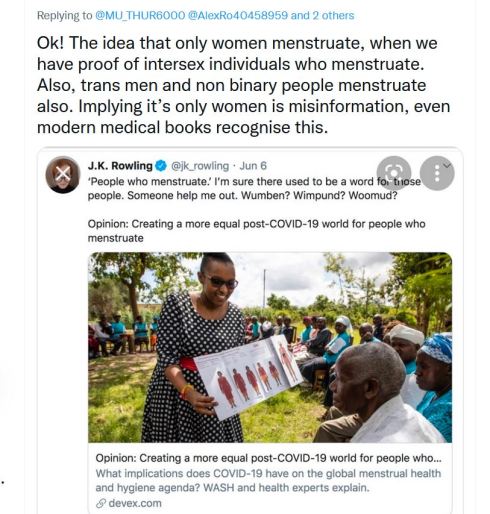
There are several deformed ideas going on in this fine slice of twitter, so let’s parse them out.
1. The notion that intersex individuals are somehow outside of the sex binary.
2. That self identification somehow trumps the biological reality of sex (i.e non binary and trans men).
3. The notion that this third sex or sex spectrum is somehow supported by credible scientific sources.
Firstly, people with intersex conditions are genetically unambiguously male or female.
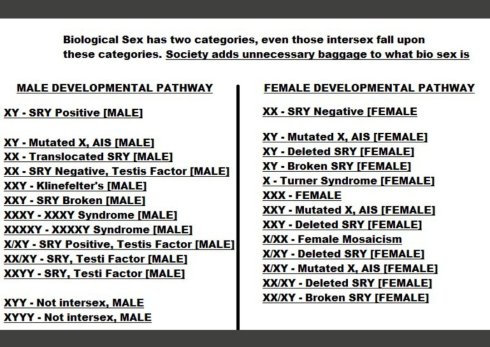
No third sex to be seen here. Also, from the Endocrine Society this definitive assertion:
“Sex is an important biological variable that must be considered in the design and analysis of human and animal research. The terms sex and gender should not be used interchangeably. Sex is dichotomous, with sex determination in the fertilized zygote stemming from unequal expression of sex chromosomal genes. By contrast, gender includes perception of the individual as male, female, or other, both by the individual and by society; both humans and animals have sex, but only humans have gender.”
Secondly, gender beliefs mirror religious beliefs. They have no root in the material reality we all share. Illustrated here.

A big hat tip to Logic vs Pseudoscience for accurately framing the belief in ‘gender identity’. We should not be expected to play a pivotal role in someone else’s self perception. Not ignoring the data our senses accurately report is not a crime, nor is it violence against a person with gender identity claims.
Just like we don’t have to accept the religious claim that is our jesus saviour, we can also show the same skepticism for a male that claims to be woman because he self-identifies or feels like it. Not going along with risibly outlandish claims about reality is a reasonable stance to take.
Thirdly, the bullshit that is mentioned most often in the intersex ploy is a piece by by Anne Fausto – Sterling. Claiming there are 5 sexes and the percentage of intersex people in the population is 1.7%. Fausto-Stirling’s claims have been debunked.
AFS ‘walks-back’ her claims –
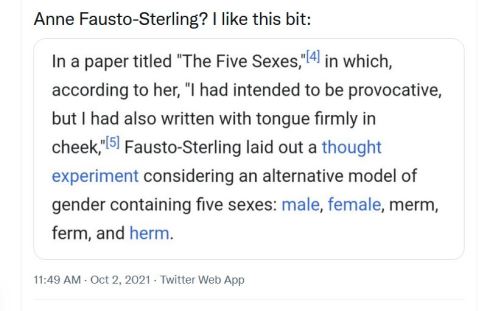
Yeah, so I’m thinking ‘tongue-in-cheek’ assertions are not quite the rigorous science based arguments gender ideologists would like us to think they are. As for the second mistake, her figures are based on a category error and corrected in this paper here.
“Anne Fausto-Sterling s suggestion that the prevalence of intersex might be as high as 1.7% has attracted wide attention in both the scholarly press and the popular media. Many reviewers are not aware that this figure includes conditions which most clinicians do not recognize as intersex, such as Klinefelter syndrome, Turner syndrome, and late-onset adrenal hyperplasia. If the term intersex is to retain any meaning, the term should be restricted to those conditions in which chromosomal sex is inconsistent with phenotypic sex, or in which the phenotype is not classifiable as either male or female. Applying this more precise definition, the true prevalence of intersex is seen to be about 0.018%, almost 100 times lower than Fausto-Sterling s estimate of 1.7%.”
Oops… So be wary of individuals quoting Fausto-Sterling’s ‘facts’ when it comes to the intersex ploy in particular and gender identity arguments in general.
So much ink has been spilled in the quixotic attempt to placate gender confused males. It would be sadly funny, but because trans ideology centres itself on the destruction of female boundaries and rights leaving little room for jocularity .
The very definition of women is under attack. Women = adult human female is now a controversial stance to uphold because it may injure the self perception of males who think they are women. It is a travesty that we would allow male gender feelings to take precedence over the very material realty of being actually female in today’s society.











 bleatmop
 Mystro
 The Arbourist


 Dead Wild Roses
Your opinions…