
You are currently browsing the tag archive for the ‘The West’ tag.
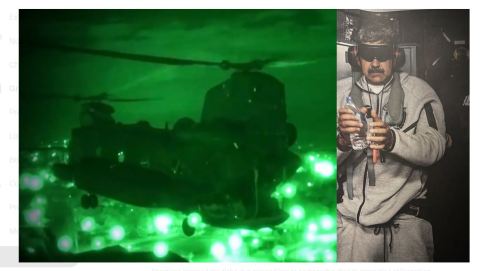
On January 3, 2026, the United States carried out a large-scale operation in Venezuela that resulted in the capture of Nicolás Maduro and his wife, Cilia Flores, and their transfer into U.S. custody. [1] Within hours, the story stopped being only about Maduro. It became a stress test of the West’s default assumptions about how global order actually works.
The reaction split fast and predictably: condemnation framed in the language of sovereignty and the UN Charter; applause framed in the language of liberation and justice; and, underneath both, a quieter argument about whether “international law” is a meaningful constraint—or primarily a vocabulary used to legitimize outcomes power already permits.
Two languages for one event
When a great power uses force to remove a sitting head of state and relocate him for prosecution, states and commentators typically reach for one of two languages.
The first is legal-institutional: Was this lawful? Was it authorized? What does the UN Charter permit? What precedent does it set?
The second is strategic-realist: What will it cost? Who can impose consequences? What does it deter? What does it invite?
These languages often coexist, but Venezuela forced a choice because it exposed the tension between *the claim* of a rules-governed international order and *the mechanism* by which order actually persists.
The enforceability problem
The measured point is not that international law is “fake” in every domain. A great deal of international life runs on rules that are real in practice: treaties, trade arrangements, financial compliance, aviation coordination, maritime norms, and sanctions enforcement. In those domains, rules can be highly consequential because they are tied to access, markets, and institutional membership.
But in the domain that states care about most—hard security and regime survival—international law runs into a structural limitation: there is no global sovereign with a monopoly on force. The question is not whether rules exist, but whether they bind the actors most able to ignore them.
That isn’t a rhetorical flourish. It’s the structural fact everything else sits on.
The UN can convene, condemn, and deliberate. But it cannot consistently coerce major powers into compliance. In the wake of the Maduro operation, the UN Security Council moved to meet and the UN Secretary-General warned the action set a “dangerous precedent.” [2] That may shape legitimacy and alliances. It may raise political costs. But it does not function like law inside a state, because law inside a state ultimately rests on enforceable authority.
This is why the phrase “international law” so often behaves less like binding law and more like legitimacy currency—something states spend, something rivals contest, and something that matters most when it is backed by power.
The reaction spectrum makes more sense as philosophy, not partisanship
The political reactions were not merely partisan reflexes; they were expressions of competing world-models.
Institutionalists treated the precedent as the core danger: once unilateral force becomes normalized, the world becomes easier for worse actors to imitate.
Sovereignty-first critics (especially in regions with long memories of intervention) treated it as a return to imperial patterns—regardless of Maduro’s character.
Results-first supporters treated it as overdue action against an entrenched authoritarian regime and criminal networks.
Realists treated it as a reminder that rules do not restrain actors who cannot be credibly punished.
It is possible to disagree with the operation and still accept the realist diagnosis. “This was reckless” and “this reveals how order works” are not contradictions—they’re often the same conclusion stated in different registers.
A small but telling detail: systems moved, not just speeches
One detail worth noting is that the event had immediate operational spillover beyond diplomacy: temporary Caribbean airspace restrictions and widespread flight cancellations followed, with U.S. authorities later lifting curbs. [3] That’s not a moral argument either way. It’s simply a reminder that great-power action produces real-world system effects instantly—while multilateral processes operate on a different clock.
Meanwhile, Venezuela’s internal institutions scrambled to project continuity. On January 4, 2026, reporting described Venezuela’s Supreme Court ordering Vice President Delcy Rodríguez to assume the interim presidency following Maduro’s detention. [4] Again, one can read this in legal terms or strategic terms. But it underscores the same point: the decisive moves were being made through power, institutional control, and logistics—not through international adjudication.
What Venezuela is really teaching
The strongest measured conclusion is this:
1. International law can matter as coordination and legitimacy.
2. But in hard-security conflicts, it does not function like ordinary law because enforcement is selective, especially against great powers.
3. Therefore, when Western leaders speak as though “international law” itself will constrain outcomes, they are often describing the world they want—or the world they remember—more than the world that exists.
This is the wake-up Venezuela delivers: not that rules are worthless, but that rules don’t become rules until they are paired with credible consequences. If the West wants a world that is safer for liberal societies, it must stop mistaking procedural vocabulary for strategic capacity.
What Western leaders should do differently
If “international law” is often a language of legitimacy rather than a source of enforcement, then the task for Western leaders is not to abandon norms—but to rebuild the conditions under which norms can actually hold. That requires a change in posture that is both external and internal.
First: speak honestly about interests and tradeoffs.
A rules vocabulary can be morally sincere and still strategically evasive. Western publics deserve leaders who can say, without euphemism, what outcomes matter, why they matter, and what costs we are willing to pay to secure them.
Second: re-embody Western values in our institutions, not merely our slogans.
The West is not “a place that sometimes gets things right.” It is the most successful civilizational experiment yet produced: freedom under law, pluralism, scientific dynamism, broad prosperity, and the moral insight that the individual matters. If leaders treat this as an embarrassment rather than an inheritance, they will govern as caretakers of decline.
Third: restore civic confidence by repairing the narrative infrastructure.
A civilization that teaches its own children that it is uniquely evil will not defend itself—or even understand why it should. The “mono-focused West-is-bad” story has become a kind of institutional reflex across parts of education, culture, and bureaucracy. You can reject naïve triumphalism while still insisting on civilizational honesty: that the West has flaws, committed crimes, and still produced the best lived human outcomes at scale to date.
Fourth: build capacity again—material, strategic, and moral.
Norms without capacity do not preserve peace; they invite tests. This means defense industrial readiness, energy resilience, border and migration competence, counterintelligence seriousness, and the willingness to impose costs where deterrence requires it.
Finally: treat multilateralism as a tool, not a substitute for power.
Institutions can amplify strength; they cannot conjure it. A West that wants a stable order must stop acting as though process is the engine. Process is the dashboard.
Afterword: the more polemical take
Western elites keep reaching for “international law” the way a sleepwalker reaches for the bedside table—by habit, not by sight. They speak as if naming the norm substitutes for enforcing it. But there is no authority behind it for the actors that matter most.
So the scandal isn’t disagreement about Venezuela. The scandal is that so many of our leadership classes still talk like we live in a world where legitimacy language can replace power, unity, and competence. That was a comfortable posture in a more unipolar era. It is a dangerous posture now.
In a multipolar environment, moral declarations without strength don’t preserve order. They advertise weakness. And weakness is not neutral: it invites tests.
Footnotes
[1] Reuters (Jan 3–4, 2026): reporting on the U.S. operation capturing Nicolás Maduro and Cilia Flores and transferring them to U.S. custody.
[2] Reuters (Jan 3, 2026): UN Security Council to meet over U.S. action; UN Secretary-General calls it a “dangerous precedent”; meeting requested with backing from Russia/China.
[3] Reuters (Jan 3, 2026): Caribbean airspace restrictions and flight cancellations following the operation; later lifted.
[4] Reuters (Jan 4, 2026): Venezuela’s Supreme Court orders Delcy Rodríguez to assume interim presidency after Maduro’s detention.
Direct Reference Links
[1] Reuters — “Mock house, CIA source and Special Forces: The US operation to capture Maduro”
https://www.reuters.com/business/aerospace-defense/mock-house-cia-source-special-forces-us-operation-capture-maduro-2026-01-03/
[2] Reuters — “UN Security Council to meet Monday over US action in Venezuela”
https://www.reuters.com/world/americas/un-chief-venezuela-us-action-sets-dangerous-precedent-2026-01-03/
[3] Reuters — “US lifts Caribbean airspace curbs after attack on Venezuela”
https://www.reuters.com/world/americas/us-airlines-cancel-flights-after-caribbean-airspace-closure-2026-01-03/
[4] Reuters — “Venezuela’s Supreme Court orders Delcy Rodriguez become interim president”
https://www.reuters.com/world/americas/venezuelas-supreme-court-orders-delcy-rodriguez-become-interim-president-2026-01-04/
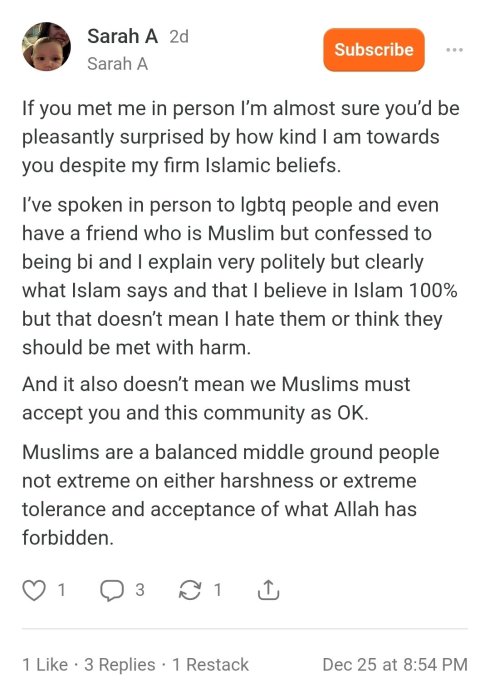
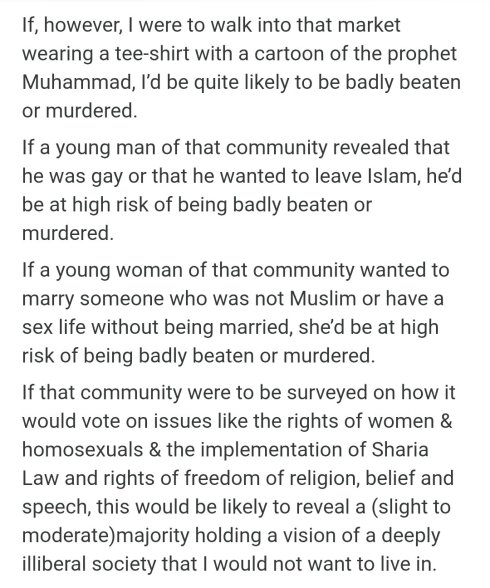
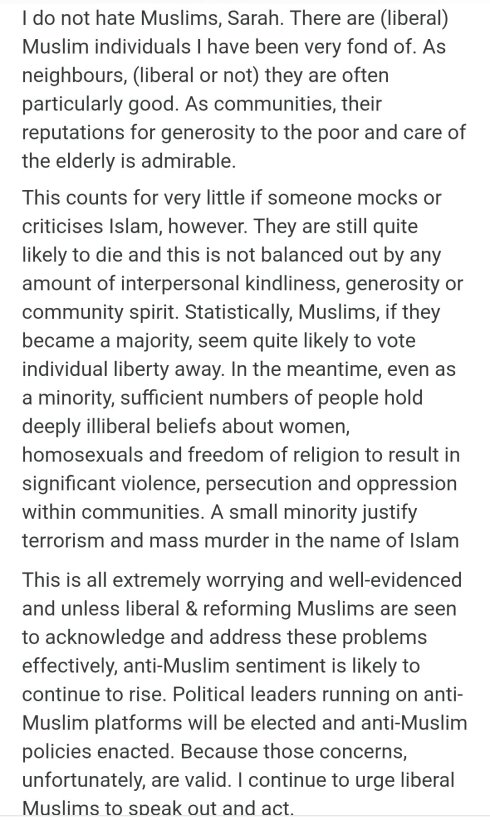
In a thoughtful exchange highlighted by James Lindsay, liberal writer Helen Pluckrose responds to a Muslim commenter who shares personal experiences of generosity within Muslim communities. While warmly acknowledging the kindness and charity she’s witnessed among individual Muslims, Pluckrose firmly points out the broader issue: widespread support in some Muslim populations for Sharia-based views that endorse severe punishments—including violence or death—for apostasy, homosexuality, adultery, and blasphemy. She argues that ignoring these illiberal attitudes, backed by polling data, risks fueling unnecessary backlash against Muslims while failing to address genuine incompatibilities with Western liberal values.

I am an atheist. I do not believe in God, miracles, or an afterlife. Yet I am convinced that without Christianity, the West as we know it would be in deep trouble. This is not a plea for conversion; it is a historical and institutional argument about causation, moral capital, and societal resilience. Christianity supplied the ethical vocabulary, the metaphysical glue, and the organizational scaffolding that transformed a patchwork of tribes into a civilization capable of self-correction and sustained progress. Remove it, and the structure does not stand neutral—it tends toward fragmentation and moral erosion.
Conceding the Objections
The historical record contains horrors: the Inquisition, the Crusades, witch-burnings, and biblical endorsements of slavery and stoning. The Spanish Inquisition executed 3,000–5,000 people over three and a half centuries (Henry Kamen, The Spanish Inquisition, 1997). The Crusades may have claimed 1–3 million lives across two centuries (Thomas Madden, The New Concise History of the Crusades, 2005). Leviticus prescribes death for adultery and homosexuality. These human costs cannot be denied.
Yet scale and context matter. The secular French Reign of Terror executed over 16,000 in a single year (1793–94). Twentieth-century atheist regimes accounted for roughly 100 million deaths in six decades (The Black Book of Communism, 1997). The same biblical canon that justified cruelty also contained the seeds of reform. Jesus’ “let him without sin cast the first stone” (John 8:7) and Paul’s “the letter kills, but the spirit gives life” (2 Corinthians 3:6) inspired Christian abolitionists to resist literalist cruelty. Christianity, unlike pagan or purely rational codes, possesses an internal dialectic capable of moral self-correction.
The Pre-Christian Baseline
The world Christianity inherited was ethically limited. Rome was an administrative marvel but morally parochial: one in four newborns was exposed on hillsides (W. V. Harris, 1982), gladiatorial combat entertained hundreds of thousands, and slavery was normalized by Aristotle and unchallenged by Cicero. Pagan philanthropy existed—evergetism—but it was episodic, tied to civic prestige, not universal duty.
Christianity introduced a transformative idea: every human being, slave or emperor, bore the image of God (imago Dei). Gregory of Nyssa condemned slavery as theft from the Creator in 379 CE. Constantine’s successors banned infanticide by 361 CE (Codex Theodosianus 3.3.1). These were not Enlightenment innovations; they were theological imperatives that eventually rewrote law and custom.
Institutions That Outlived Their Creed
The West’s institutional DNA is stamped with Christian influence:
- Literacy and knowledge: Monastic scriptoria preserved Virgil alongside the Vulgate. Cathedral schools evolved into Bologna (1088) and Paris (1150)—the first universities, chartered to pursue truth as a reflection of divine order.
- Care systems: Basil of Caesarea built the basilias in the fourth century, a network of hospitals, orphanages, and poor relief. No pre-Christian society systematized charity on this scale.
- Rule of law: The Decalogue’s absolute prohibitions and the Sermon on the Mount’s inward ethic created trust horizons essential for complex societies. English common law, the Magna Carta (1215), and the U.S. Declaration’s “endowed by their Creator” trace their lineage to Christian natural-law theory.
Secular analogues arrived centuries later and proved fragile without transcendent accountability. The Soviet Union inherited Orthodox hospitals but could not sustain them after purging “idealism.”
The Borrowing Fallacy
Many modern atheists condemn Leviticus yet insist on universal dignity. That norm is not self-evident; it is a Christian export. Nietzsche saw this clearly: the “death of God” would undo slave morality and return society to master morality (Genealogy of Morals, 1887). When we demand compassion from power, we are smuggling Christian principles into a secular argument. Strip away the premise, and human relations default to “the strong do what they can and the weak suffer what they must” (Thucydides).
Contemporary Evidence
Secularization correlates with institutional and social atrophy. Europe’s fertility rate hovers at 1.5, and marriage and volunteerism track church attendance downward. The World Values Survey shows that religious societies retain higher interpersonal trust. The West exports human rights grounded in Christian-derived universality; competitors offer efficiency without reciprocity.
Some argue secular humanism could replace Christianity. Yet historical experience shows moral innovation without transcendent accountability is fragile: Enlightenment ethics, while intellectually powerful, required centuries of reinforcement from religiously-informed social norms to take root widely.
A Charitable Conclusion
Christians must acknowledge their tradition’s abuses alongside its capacity for self-correction. Atheists should recognize that our moral vocabulary—equality, compassion, rights—was not discovered by reason alone but forged in a crucible we no longer actively tend. The West lives off borrowed moral capital. When the account empties, we will not revert to a benign pagan golden age; we will confront efficient barbarism dressed in bureaucratic language.
Christianity is not true, in my view. But it was necessary. And it may still be.

References
- Harris, W. V. (1982). Ancient Literacy. Harvard University Press.
- Kamen, Henry. (1997). The Spanish Inquisition: A Historical Revision. Yale University Press.
- Madden, Thomas F. (2005). The New Concise History of the Crusades. Rowman & Littlefield.
- Popper, Karl. (1972). The Open Society and Its Enemies. Princeton University Press.
- The Black Book of Communism: Crimes, Terror, Repression (1997). Stéphane Courtois et al. Harvard University Press.
- Nietzsche, Friedrich. (1887). On the Genealogy of Morals.
- Thucydides. History of the Peloponnesian War. Trans. Rex Warner. Penguin Classics, 1972.
- Codex Theodosianus. (438 CE). Codex of the Theodosian Code, Book 3, Title 3, Law 1.
- World Values Survey. (2017). “Wave 7 (2017–2020) Survey Data.” Retrieved from https://www.worldvaluessurvey.org.
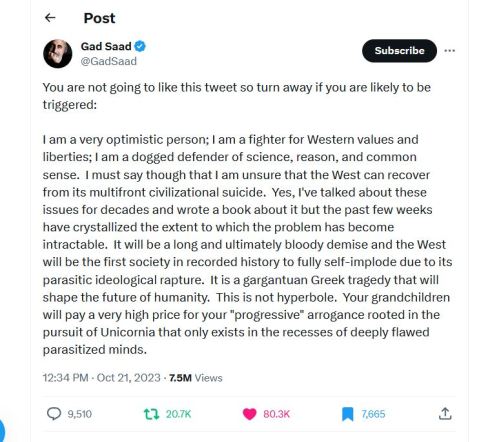
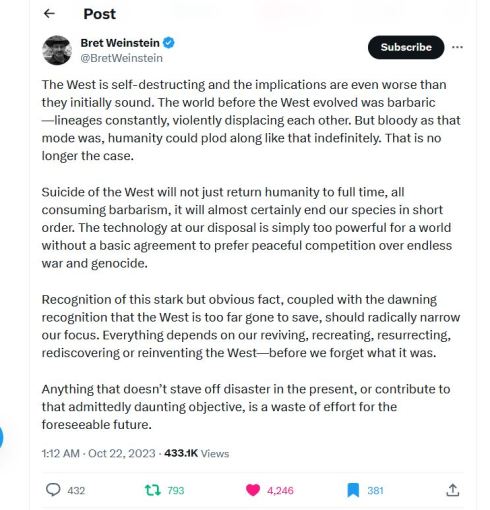
Two views on the current state of the West. Both share a fairly grim tone. We need to as nations of the West turn things around. The classical liberal* principles that our societies were founded on need to be restored and refreshed in their primacy of how we exist as people in society.
There are competing narratives of how we are supposed to advance society, I think if we stray from the path we’re on we going to be in trouble.
*Classical liberalism is a political tradition and a branch of liberalism which advocates free market and laissez-faire economics; and civil liberties under the rule of law, with special emphasis on individual autonomy, limited government, economic freedom, political freedom and freedom of speech
The Western world needs to give its collective head a shake and *not* celebrate terrorism. The conclusion from Benjamin’s essay published on The Free Press.
“How wrong I was. This past week, as over 1,300 Jews were slaughtered, the most murderous attack on Jews since the Holocaust, I saw the true face of Palestinians and their allies. All around the world, they celebrate. They gloat. They mock our tears. They do not protest against Hamas. They embrace pure evil.
And so, to the terrorists I now say:
When you killed my family, I forgave you. When you killed my people, I forgave you. But when you killed my idealism, I had no forgiveness left.
To non-Jewish friends who have reached out, thank you. It is simply the human thing to do. To friends who dare justify what has happened, you are not friends. You are nothing but Nazi supporters dressed up in leftist intellectual language. To the Palestinians: you have lost all moral authority to claim victimhood. I will never advocate for you again. To my family, friends in Israel, and Jews around the world hurting right now, I love you. Stay safe.
In Berlin, where I live today with my German-Ukrainian Jewish wife, Germans love to say “Never Again.” Right now, Never Again is happening again in real time, livestreamed for the whole world to see. I find myself looking up my military number in case the IDF reserves call for me. Unlike our enemy, I feel no joy at the prospect of going to war. But if our people’s existence is at stake, I will do what I must. I will be the world’s favorite villain: the Jew who has the audacity to defend his people.”











 bleatmop
 Mystro
 The Arbourist


 Dead Wild Roses
Your opinions…