
You are currently browsing the tag archive for the ‘Tumbler Ridge’ tag.
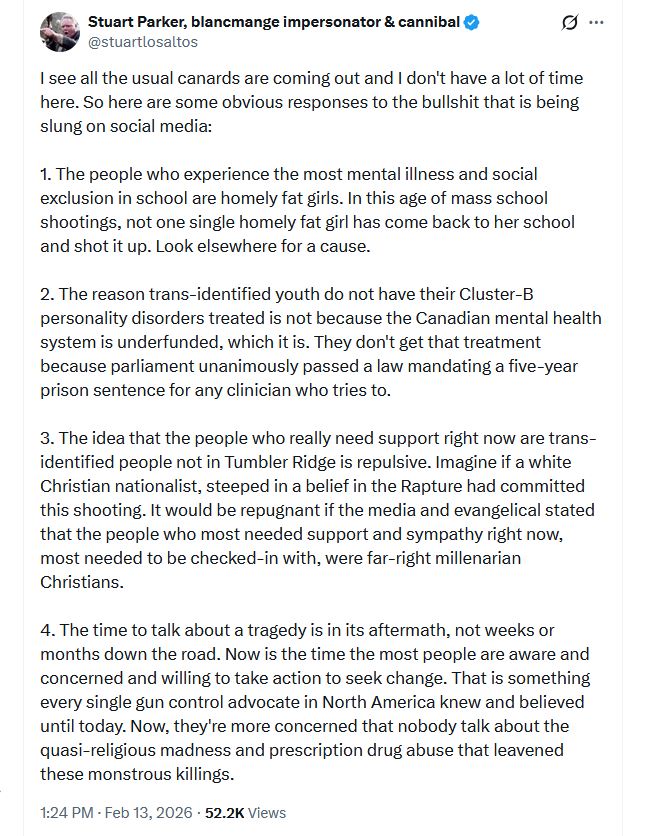
The first duty of public journalism after a massacre is simple: name the dead, establish the sequence, and tell the truth about what is known and what is not. That is media hygiene. That is how a public learns. That is how systems get fixed.
Instead, we got a firewall.
In the immediate wake of the Tumbler Ridge killings—home first, then school; five students dead, an education assistant dead; the perpetrator dead by suicide—the national conversation was quickly steered away from forensic clarity and toward reputational triage. In at least one major network segment, the frame was explicit: the story was “anti-trans disinformation” after the shooting. Not the chain of events. Not the failure points. Not the institutional blind spots. The message was prophylactic: watch what you say; the real danger is how people might talk about it.
This is not merely tone-deaf. It’s a form of complicity.
Not complicity in the act, obviously—complicity in what follows: the slow, predictable replacement of accountability with moral theatre. When a newsroom’s first instinct is to manage narrative risk, it begins to treat facts as flammable materials—things to handle with gloves, filter through approved experts, and keep away from ordinary citizens who might draw the “wrong” conclusions.
That is how gatekeepers lose legitimacy. And it is how tragedies become recurring.
The mechanism: switch the object of fear
Watch the pivot closely and it’s always the same move.
- A real event happens in the world—blood, bodies, families blown open.
- The newsroom identifies a second-order risk: public anger, political fallout, reputational damage to a protected consensus.
- The coverage shifts from “What happened?” to “What must we prevent?”
- Prevention is defined as protecting a narrative, not repairing a system.
The object of fear changes. Instead of fearing the next killing, the institutions fear the next argument.
So they tell you the problem is “misinformation.” They tell you the danger is “conflation.” They tell you this is a moment for “community support” and “protecting vulnerable people.” And those may all be decent impulses—in their proper place, at their proper time. But as a lead story? As the framing lens? As the moral of the segment?
That’s not reporting. That’s crisis communications.
“Don’t conflate” becomes a solvent
One line in particular functions like a solvent in the modern media ecosystem:
Don’t conflate an identity with violence.
Fine. True in the general case. But after a massacre, deployed as the first moral reflex, it does more than discourage scapegoating. It quietly discourages inquiry.
Because inquiry is not a vibe. Inquiry is a chain:
- What was the timeline?
- What were the warning signs?
- Who saw what?
- What interventions were tried?
- Where did they fail?
- What policies shaped those failures?
- What is going to change next week because children are dead?
A solvent doesn’t “refute” those questions. It dissolves the social permission to ask them. It turns scrutiny into contamination.
That is why it feels so out of touch to grieving parents: it is journalism behaving as if the central public hazard is discussion rather than risk.
Media complicity looks like this
Complicity, in this context, is not about malice. It’s about habit.
It’s the habitual choice to protect institutions from accountability by rerouting attention:
- From the scene to the discourse.
- From the victims to the community statement.
- From the timeline to the think-piece.
- From “what failed?” to “what mustn’t be said?”
A professional newsroom used to be allergic to this. The old standards—imperfect, often biased, frequently arrogant—still had a core ethic: facts first, advocacy last. If advocacy entered the frame, it was labeled as such. If uncertainty existed, it was named. If a claim couldn’t be verified, it didn’t get aired as settled truth.
Today, too often, we get advocacy laundering: press-release moralizing presented as news, with the added twist that dissent is treated as a moral defect rather than a factual dispute.
That is not neutrality. That is narrative commitment wearing a blazer.
What “media hygiene” used to mean (and must mean again)
A return to old standards isn’t nostalgia. It’s practical survival. Here’s what media hygiene looks like when it’s done properly—especially after mass violence:
1) Victims first.
Name the dead. Describe the community. Make the loss real before you make it useful.
2) Sequence before interpretation.
Timeline, confirmed facts, and clearly separated unknowns. No moral “lesson” until the basic chain is established.
3) Mechanisms over slogans.
If firearms were involved, the mechanism is access and storage—specific failures, not national clichés. If mental health is part of the background, the mechanism is escalation thresholds and follow-up—specific gaps, not hashtags.
4) No prophylactic framing.
Do not lead with “misinformation,” “backlash,” or “what this might fuel.” Those are downstream effects. They are not the event.
5) Don’t pre-label inquiry as bigotry.
Scapegoating is wrong. So is shutting down investigation by treating questions as dangerous.
6) Separation of church and newsroom.
Advocacy voices may be relevant. They must not become the controlling lens. Journalists should interrogate them the way they interrogate police, politicians, and corporations.
7) Corrections that cost you pride.
If you get something wrong, correct it prominently, not performatively. Trust is built when gatekeepers admit error without theatrics.
None of this requires “hating” anyone. It requires doing the job.

The consequence of failing the job
When media behaves like a narrative defense force, the public does not become more compassionate. It becomes more suspicious. It begins to assume that every tragedy will be translated into a pre-approved moral. It begins to look elsewhere for facts—often to sources far less responsible, far more conspiratorial, and far more cynical.
That is the boomerang effect of the firewall: the attempt to prevent “bad interpretations” produces a credibility vacuum, and the vacuum fills with poison.
If journalists want to stop that cycle, they can’t do it by lecturing the public into compliance. They can only do it by earning trust the old way: through sequence, clarity, restraint, and the disciplined refusal to turn atrocity into messaging.
Because if the first move after a massacre is to protect a narrative, the system will not learn.
And if the system does not learn, it will repeat. 🕯️
Global National ran an “overnight” segment after the Tumbler Ridge massacre under a framing that is, in its own way, a confession: “Anti-trans disinformation circulates after mass shooting.” (Global News)
Not Who died? Not How did this happen? Not What failed? Not What do we change Monday morning?
The story, as packaged, is not forensic. It’s prophylactic. The first institutional instinct is not to look hard at systems and sequences, but to manage reputational spillover: prevent a narrative from becoming “dangerous,” protect a constituency from backlash, and pre-label certain lines of inquiry as moral contamination.
That choice matters, because a town is burying children.
And because when journalism reaches for a firewall before it reaches for an autopsy, it stops being a public service and becomes a public-relations function.
What Actually Happened: Sequence Before Sermon
On February 10, 2026, an 18-year-old, Jesse Van Rootselaar, killed people at home and then attacked Tumbler Ridge Secondary School before dying by suicide. Multiple accounts report that the attack began with the killing of the shooter’s mother and 11-year-old half-brother, followed by the school shooting. (The Wall Street Journal)
The victims include five students (ages 12–13) and a 39-year-old education assistant, with the mother and half-brother killed beforehand. Names and details have been published widely and confirmed in Canadian Press reporting and related coverage. (People.com) The BC RCMP also issued a public confirmation of deceased victims. (RCMP)
That’s the baseline: a chain of events with a clear order—home, then school—ending in a pile of dead kids and a town whose grief will not be solved by better discourse hygiene.
Sequence matters because it points to systems:
- What warnings existed and where?
- What interventions were attempted and by whom?
- How were firearms stored and accessed?
- What did the school know, and when?
- What did police know, and what tools were used (or not used)?
- What gaps exist between “we did a wellness check” and “we prevented a catastrophe”?
Reporting indicates a history of mental-health-related police interactions and investigators reviewing digital footprint and online activity. (The Wall Street Journal)
These are the questions you chase when you treat murder as a real event in the world—not as a pretext for messaging.
What Global Chose to Do Instead
Global’s piece does not begin at the crime scene. It begins in the information ecosystem.
In the related Global coverage and clip description, the emphasis is on how the suspected shooter’s trans identity is “being used to fuel misinformation online,” and the segment elevates advocacy voices concerned about anti-trans sentiment. (Global News)
To be blunt: they treat the massacre as a vector for disinformation, rather than as a symptom of institutional failure.
This isn’t a claim that concerns about backlash are always illegitimate. It’s a claim about priority and timing.
You can caution against scapegoating without making that caution the lead, the thesis, and the moral center—while the basic forensic questions remain unasked in the same breath.
Worse, the frame is fortified by official moral language. BC’s Human Rights Commissioner issued a statement warning against conflating trans identity with violence and calling such conflation “incorrect, irresponsible and frankly dangerous.” (bchumanrights.ca)
Again: that statement may be true as a general principle—identity is not destiny—but it is also rhetorically useful as a solvent. It dissolves scrutiny by implying that scrutiny is the harm.
And in the current media climate, once a question is placed inside the “dangerous” bucket, it stops being investigated and starts being policed.
That is what narrative-commitment looks like: not lying, necessarily—just selecting a reality tunnel and treating alternate tunnels as morally suspicious.
Why This Reads as Out of Touch
Because the public is not asking for a sermon. The public is asking for accountability you can measure.
When parents hear “anti-trans disinformation” as the headline after a school attack, the implied hierarchy is:
- protect the narrative
- protect the vulnerable (as defined by the segment)
- later, perhaps, protect the public
That hierarchy does real damage.
It tells the bereaved: “We have already decided what the real emergency is.”
It tells the skeptical: “Your questions are morally tainted.”
It tells institutions: “If your policies intersect with a protected narrative, you will be insulated from the normal post-disaster autopsy.”
And it tells everyone else to stop trusting the gatekeepers.
Journalism doesn’t lose trust because it has values. It loses trust because it has values that pre-empt facts.
What a Forensic Post-Tumbler Ridge Agenda Looks Like
If you want a serious follow-up—one that serves victims, not narratives—here are the obvious “system” targets. None of this requires scapegoating an identity. It requires the courage to audit failures like adults.
1) A full public timeline, cross-agency
A public accounting that stitches together: school records, police contacts, mental-health interventions, family context, and warning signs—chronologically, with decision points. This is how you find the failure nodes.
2) Firearms access: storage, compliance, and enforcement gaps
Reporting indicates multiple firearms were used and investigators are examining how they were obtained. (The Wall Street Journal)
The question is not “gun control” as a slogan. The question is: What specific mechanisms failed—safe storage, licensing, supervision, enforcement, reporting? Fix the mechanism, not the talking point.
3) Threat assessment and school safety protocols that actually bite
Most institutions are good at paperwork and bad at escalation. Schools need a protocol that converts “concerning behavior” into structured threat assessment, and threat assessment into action—without letting “this might stigmatize” become the veto.
4) Mental-health intervention that doesn’t stop at “wellness checks”
If repeated mental-health-related police visits are part of the story—as reporting suggests—then the system question is: what happens after the tenth check? (NBC 5 Dallas-Fort Worth)
Communities need a bridge between crisis contact and sustained containment: follow-up, risk management, family support, and clear thresholds for escalation.
5) Media standards: separate “backlash management” from “causal inquiry”
A newsroom can do both—but not in a way that treats one as taboo. Post-massacre coverage should have a simple rule:
- Name the victims.
- Lay out the timeline.
- Identify plausible failure points.
- Present what is known, what is not, and what must be investigated.
- Only then: address secondary narratives (backlash, misinformation, online dynamics).
Right now, too many outlets reverse that order.
The Real Test: Can We Ask the Questions Without Being Moralized Into Silence?
There is a difference between scapegoating and scrutiny.
Scrutiny is what you owe dead children.
If the media class cannot bring itself to treat Tumbler Ridge as a forensic event first—if it must immediately translate it into a morality play about discourse—then it is not merely “out of touch.” It is structurally incapable of learning.
And systems that cannot learn repeat.
Not because people are evil, but because the firewall held—until it didn’t.
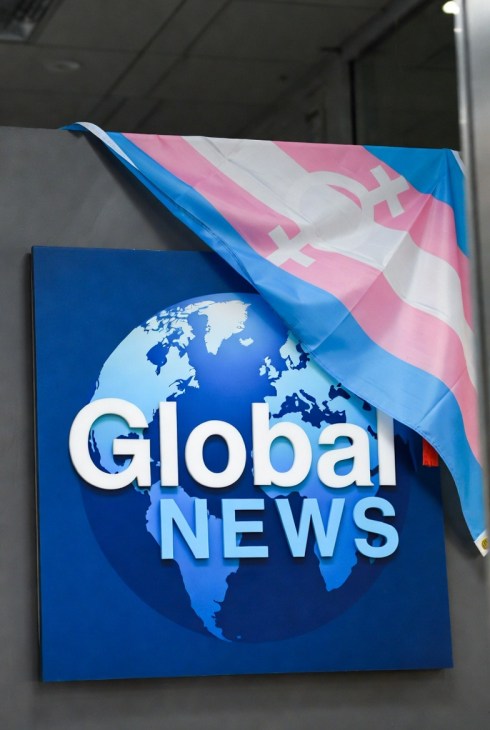
In the remote British Columbia town of Tumbler Ridge, a horrific school shooting unfolded on February 10, 2026, claiming eight lives, including five children aged 12 to 13 and a female educator, while injuring more than two dozen others. One 12-year-old girl remains in critical condition with severe brain trauma from a gunshot wound to the head. The perpetrator, 18-year-old Jesse Van Rootselaar, a biological male who had been transitioning and identifying as female since approximately age 12, first killed their 39-year-old mother and 11-year-old stepbrother at home before opening fire at Tumbler Ridge Secondary School. Van Rootselaar then died by suicide. Authorities noted a history of mental health crises, multiple police interventions at the family home, school dropout several years prior, and access to household firearms despite an expired license.
Canadian legacy media outlets, including CTV, quickly pivoted to familiar territory: gun control. Coverage highlighted past mass shootings as drivers for stricter firearm laws, the suspect’s lapsed license, and questions about why previously seized household weapons were returned. This framing reduced the tragedy to a debate over firearms access rather than examining the full context of the shooter’s background and actions. By prioritizing this narrative, major outlets failed to provide the public with a complete picture, focusing on policy talking points instead of the human and societal elements at play.
The cultural and personal factors warrant far greater scrutiny. Van Rootselaar’s transition began in early adolescence, a developmental stage coinciding with documented mental health challenges and police contacts. Broader societal patterns include rising youth mental health crises potentially linked to identity-based ideologies, social influences on gender dysphoria, family disruptions, and widespread use of psychiatric medications. When media outlets gloss over or sideline these dimensions in favor of gun-centric stories, they shield uncomfortable truths about how modern cultural pressures such as rapid affirmation of gender confusion in minors may contribute to instability in vulnerable young people.
This selective reporting directly endangers the public. By obsessing over gun restrictions while minimizing mental health epidemics, the effects of early gender transitions amid distress, and the role of identity politics, media and policymakers divert attention from actionable prevention. Communities, families, and educators lack candid discussion of warning signs or reforms needed to address root causes. The outcome is repeated tragedies, as resources target symptoms among law-abiding citizens rather than the underlying cultural and psychological drivers producing alienated or radicalized youth.It is time to demand truthful journalism that confronts reality head-on. The Tumbler Ridge victims deserve more than politicized narratives that dishonor their memory by avoiding difficult conversations about mental illness, unchecked gender ideology, and societal conditions fostering despair. Facing these issues honestly through better mental health support, cautious approaches to youth transitions, and cultural course correction offers the best hope of preventing future horrors.
Legacy media’s reluctance to engage fully undermines public safety and erodes trust when clarity is most needed.

References
- CNN: Canada mass shooting at a school and home (February 11-12, 2026) – https://www.cnn.com/world/live-news/tumbler-ridge-canada-shooting-02-11-26
- USA Today: Who is Jesse Van Rootselaar, teen who killed 8 in Canada – https://www.usatoday.com/story/news/nation/2026/02/11/jesse-van-rootselaar-tumbler-ridge-canada-shooter/88631889007/
- CTV News: Mass shootings in Canada have helped prompt changes to firearm laws – https://www.ctvnews.ca/politics/article/mass-shootings-in-canada-have-helped-prompt-changes-to-firearm-laws-over-the-decades/
- BBC News: Police name suspect in Canada school shooting as 18-year-old Jesse Van Rootselaar – https://www.bbc.com/news/live/cr5lnzqdr5pt
- Al Jazeera: Canada police identify shooting suspect as 18-year-old Jesse Van Rootselaar – https://www.aljazeera.com/news/2026/2/12/canada-police-identify-shooting-suspect-as-18-year-old-jesse-van-rootselaar
- Additional reporting from The New York Times, CBC News, and official RCMP statements via multiple outlets.
At the core of much of the tension surrounding transgender issues lies a profound and inescapable cognitive dissonance.
P
Biological reality is clear and immutable.
P
Human sex is binary—male or female—and determined at conception. No medical intervention, no amount of social affirmation, and no subjective feeling can change this fundamental fact. You will always and forever remain the sex you were born.
P
Transgender ideology asserts the opposite. It claims that whatever sex you feel you are, you become in reality. Your internal sense of self overrides chromosomes, reproductive anatomy, and every observable marker of biological sex. This ideology is inherently anti-reality.
P
Those who fully internalize it place themselves in a state of permanent conflict—not just with their own bodies, but with the entire external world. Reality itself becomes the enemy, repeatedly negating their subjective self-perception.
P
Queer Theory provides the escape hatch. Rather than confronting the mismatch between feelings and facts, adherents are guided to externalize the source of their distress. Through an oppressor/oppressed lens, the cause of their pain is never their own faulty perception of self—absolutely not. Instead, it is “normative” society that is actively oppressing them, enforcing rigid gender norms and inflicting all their suffering. This framework transforms personal dissonance into righteous grievance. The distress is no longer internal; it is the fault of everyone else.
P
Medical interventions amplify the problem. So-called “gender-affirming care”—puberty blockers followed by cross-sex hormones—adds fuel to the fire. These treatments carry serious, well-documented deleterious effects on both mental and physical health. Far from resolving underlying issues, they often deepen psychological instability while creating permanent physical changes.
P
The result is a perfect storm: individuals who were already vulnerable, now further destabilized, carrying a massive chip on their shoulders. They view the rest of society—the “normative” majority—as the active source of their pain. To defend their constructed identity and quiet the cognitive dissonance, they feel compelled to strike back against this perceived evil force: you and me.In this worldview, disagreement equals enmity.
P
If you refuse to affirm their ideology, you are not offering a different opinion—you are the oppressor who must be confronted, silenced, or defeated.
P
Dissent is violence.
P
Reality itself is violence.
P
This dynamic helps explain patterns of hostility, aggression, and, in extreme cases, violence that emerge from certain segments of transgender activism. It does not stem primarily from societal rejection, but from a foundational rejection of biological reality and the refusal to address internal distress with honesty.
True compassion does not mean enabling delusion.
P
It means grounding support in reality—the only place where genuine mental health and social peace can be found.











 bleatmop
 Mystro
 The Arbourist


 Dead Wild Roses
Your opinions…