
You are currently browsing the tag archive for the ‘Two Tier Policing’ tag.
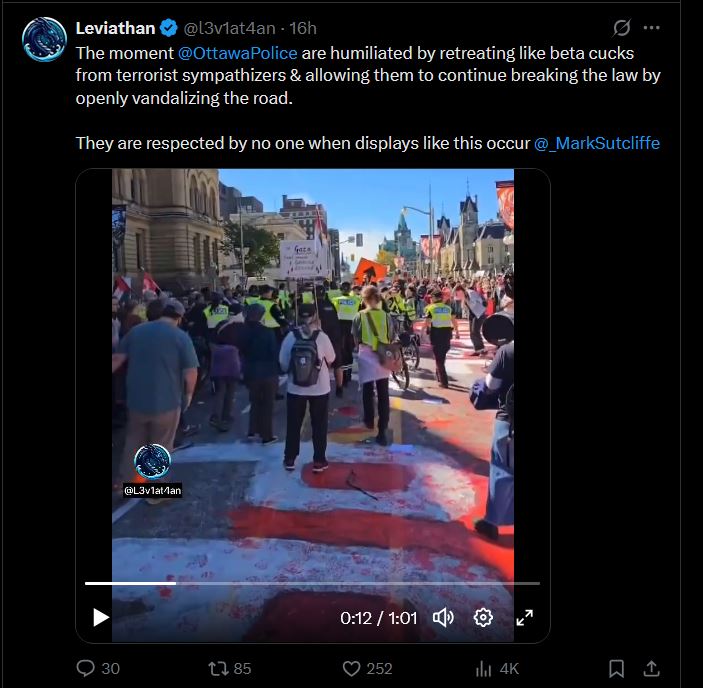
On September 20, 2025, activists from the “Draw the Line” movement staged a highly visible protest directly in front of Parliament Hill, painting a large red-and-white mural on Wellington Street. Ottawa Police closed the street for hours to facilitate the action, citing the use of washable paint, though critics noted that under Canada’s Criminal Code and municipal bylaws, the activity qualifies as vandalism. Two arrests occurred during clashes as protesters attempted to expand the mural near the Prime Minister’s Office. Hundreds participated, and cleanup concluded later the same day, with no reported injuries but lingering questions about liability for slippery surfaces (Ottawa Citizen, CTV News Ottawa, Ottawa CityNews, CBC News). Video evidence posted on X by @l3v1at4an shows police standing by as activists painted, sparking over 450 replies highlighting perceived enforcement disparities (X Thread).
Contrast this with the 2022 Freedom Convoy protests: organizers faced weeks of sustained police enforcement, arrests, and eventually prosecutions including mischief and counselling to disobey court orders. High-profile participants like Tamara Lich and Chris Barber were convicted and sentenced, while the federal government invoked the Emergencies Act — a level of response not seen for the mural or similar protests. The discrepancy demonstrates a clear selective approach in how law enforcement applies the law depending on the protesters’ affiliation, cause, or perceived political stance (AP News, CBC).
The mural incident, combined with historical patterns, fuels concerns over two-tier policing: some groups are allowed to vandalize public property with minimal immediate consequence, while others are met with swift arrest, prosecution, or extraordinary federal enforcement. Canadians deserve equal application of the law — whether it’s a climate mural, a roadblock, or any form of civil demonstration. When enforcement varies by cause, political affiliation, or identity, trust in public institutions erodes, and the perception of injustice becomes reality.
References
- Ottawa Citizen — “Two arrests amid Wellington Street mural painting” (Sept 20, 2025) — https://ottawacitizen.com
- CTV News Ottawa — Coverage of Draw the Line protest and police confirming street closure for washable paint removal — https://ottawa.ctvnews.ca
- Ottawa CityNews — “Hundreds participate in 65-foot mural as part of nationwide rallies” — https://ottawacitynews.ca
- CBC News — “Mural in front of Carney’s office with police aiding the demonstration” — https://cbc.ca
- X Thread by @l3v1at4an — Video evidence of police standing by as activists paint; 450+ replies discuss selective enforcement — https://x.com/l3v1at4an/status/1969466596499308628
- AP News — “Prominent figure from Canada’s trucker protests found guilty” — https://apnews.com/article/3975bb6bbd0c089e0c56cebbe9187fd2
- CBC News — Freedom Convoy prosecutions (Tamara Lich, Chris Barber, Chris) — https://cbc.ca
Canada’s policing landscape reveals a troubling inconsistency, a corrosive double standard that erodes public trust: assaults on Jewish citizens often draw sluggish responses, while those on Muslims prompt swift condemnation and action. Consider the Montreal debacle—a Jewish father beaten in Dickie Moore Park before his terrified children, his kippah tossed into a splash pad like discarded refuse. Police took nearly an hour to arrive, allowing the assailant to vanish, and only arrested him days later amid public furor spurred by community outcry on social media.
Contrast this with Ottawa’s swift response to an unprovoked attack on a young Muslim woman aboard public transit, punched and bombarded with Islamophobic slurs as passengers watched in stunned silence. Authorities immediately labeled it hate-motivated and launched an investigation, reflecting a government commitment to combatting hate crimes. No delay, no limbo—just urgency, as if the system awakens only for select victims.
This disparity is not aberration but pattern. Statistics Canada reports Jews—under 1% of the population—endured over 900 hate crimes in 2023, roughly 70% of religion-based incidents, while Muslim-targeted crimes, numbering around 200, saw faster police action. Yet responses to antisemitic violence often lag, fostering a climate where aggressors act with impunity. Muslims face brutal attacks too, but policing pivots faster, bolstered by vocal leadership. Both communities deserve equal protection; only one consistently receives it.
The irony stings in a nation priding itself on equity: one community’s cries echo unanswered, another’s summon swift shields. Such two-tiered enforcement is not oversight—it is antithetical to justice. If Canada fails to apply equal urgency to all victims, it risks fracturing society into a hierarchy of suffering, dividing rather than uniting against bigotry’s tide.

Sources Referenced
- Statistics Canada, 2023 Hate Crime Report
- CTV News, Montreal, July 2023: Dickie Moore Park assault coverage
- CBC News, Ottawa, June 2023: Transit attack reports
- X posts aggregated from community reports, July 2023











 bleatmop
 Mystro


 Dead Wild Roses
Your opinions…