
You are currently browsing the tag archive for the ‘War’ tag.
Going to war over spheres of influence. The 21st century is going to be just as rough as the 20th century.
“Russia says, for instance, that it is threatened by Nato expanding eastwards and potentially including Ukraine as a member. The response of the Nato powers is to say that its door should remain open to all and, more privately, that Ukraine is unlikely to join the organisation in the foreseeable future, so why is Moscow objecting so strongly?
But there is a perfectly rational Russian response to this, which is to point to the furious American response to Soviet missiles being based in Cuba that almost led to a nuclear war in 1962. The Russians can also reasonably ask why, if Ukraine’s Nato membership is such a distant prospect, Nato powers are so insistent on keeping open the option, even though, by doing so, they increase the chances of a shooting war.”
The Russian national interest must be preserved I suppose, and that is reason enough to initiate an armed conflict. We watch the US do it all the time as well, just that somehow we’re the good guys.
With resources scarce, this model of armed intervention will occur more often. We’ll have to get used to it or be prepared to radically reorganize our societies around the idea that we as co-inhabitants on this earth all have the right to live in peace.
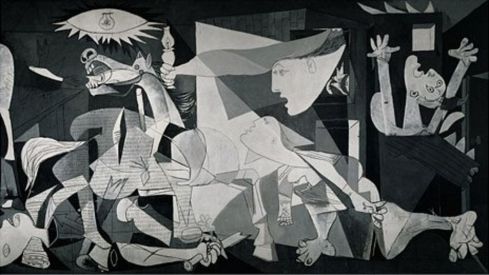
The war drums are beating – again. Quell them.
In a uncanny sort of way the slow motion failure of the US war effort in Afghanistan is a testament to the fiercely stubborn nature of our species. The US has total control of the air, real-time satellite imagery, and soldiers equipped with the best (and most expensive) military equipment known to our species. And yet, they continue to fail. The war in Afghanistan is almost two decades old now, and an favourable end for the West is unlikely.
The US, despite its world leadership, seems to learn little from it mistakes. Vietnam remains a powerful lesson and reminder that ‘big guns, best tech’ military option is not a guarantee of victory. The cost of resisting the US war machine is appalling, some two million(plus) dead, but Vietnam illustrated it is possible to resist. Afghanistan is on a similar course.
This is what happens when a country decides to wage an unpopular war. A disconnect grows between the citizens of the country and the political class that is waging the war. A professional military bears the causalities with little coverage at home, so the war in question can fade out of the public consciousness. Coupled with a lapdog media that should be exposing the tragedy of errors that is the Afghan war, little is said, and the boondoggle can continue.
Alfred McCoy reviews a small slice of the American failure in Afghanistan, focusing on the drug trade, that happens to fuel the Taliban and provide roughly 85% of the world’s heroin. You’d think the biggest guns and the brightest minds could plot victory over a dirt poor nation and peasant farmers…
“Not only did this problematic drug war fail to curtail the traffic, but it also alienated the rural residents the government so desperately needed to win over. Worse yet, in the end it actually encouraged illicit opium production — a frequent outcome in Washington’s worldwide drug war that I once called “the stimulus of prohibition.”
Using sophisticated satellite imagery, Sopko’s team, for example, found a troubling disconnect between areas that received development aid from Washington or its allies and those that were subjected to opium eradication programs. In strategic Helmand and Nangarhar provinces, for instance, satellite photographs clearly reveal that the various drug eradication projects ripped through remote areas where “the population was highly dependent on opium poppy for its livelihoods,” rendering poor farmers destitute. The development aid was, however, lavished on more accessible, largely drug-free districts near major cities elsewhere in Afghanistan, leaving countless thousands of farmers in critical rural areas angry at the government and susceptible to Taliban recruitment.
Even liberal development alternatives to those rip-up-the-poppies programs, claims Sopko, only served to stimulate opium production in surprising ways. The U.S. Agency for International Development (USAID), for instance, spent $36 million on irrigation for a showcase Food Zone project, meant to promote the growing of legal crops in southern Kandahar Province. As it happened, though, this important infrastructure program actually turned out to contribute “to rising levels of opium poppy cultivation” — an unintended outcome that could be seen in similar “irrigation projects in provinces like Nangarhar, Badakhshan, and Kunar.”
Next door to Kandahar in central Helmand Province, another Food Zone program initially helped reduce the opium crop by 60%. But as British agronomist David Mansfield reports, by the spring of 2017 an “unprecedented” proliferation of poppies covered up to 40% of the farmland targeted by that project; guerrillas were back in force; and farmers felt, as one put it, that “the Taliban is better than the government; they don’t ban poppy, they just ask for tax.” By now, of course, given all the years of bungled anti-drug programs, Mansfield concludes that the Kabul government has little hope of wresting “back control of central Helmand.”
USAID programs that emphasized increased wheat production proved similarly counterproductive. “With higher-yielding varieties and improved agricultural technologies,” writes Sopko, “households in the well-irrigated central valleys of rural Afghanistan would be able to meet their family wheat requirements with a smaller part of their land,” allowing “a larger area… to be allocated to [the] high-value… opium poppy.”
An Uncertain Future
Corroborating Sopko’s pessimism, a recent report by Mujib Mashal of the New York Times depicted the worsening Afghan drug situation as the product, in part, of Washington’s failed policies. Fueled by a booming opium harvest, the Taliban has recently expanded from poppy growing into large-scale heroin production with an estimated 500 labs refining the drug inside Afghanistan — part of a strategy aimed at capturing a greater share of the $60 billion generated globally by the country’s drug exports.
Out of the whole opium eradication project, the National Interdiction Unit, an Afghan outfit trained by U.S. Special Forces, is more or less what’s left when it comes to hopes for reducing the traffic in drugs. Yet their nighttime helicopter interdiction raids on mobile, readily reconstructed heroin labs are proving futile and their chief, reports Mashal, was recently sacked for “probably leaking information to hostile forces.” U.S. military commanders now realize that local Taliban bosses, enriched by the heroin boom, have nothing to gain from further peace negotiations, which remain the only way of ending this endless war.
Meanwhile, the whole question of opium eradication has, according to Mashal, gotten surprisingly “little attention in the Trump administration’s new strategy for the Afghan war.” It seems that U.S. counter-narcotics officials have come to accept a new reality “with a sense of helplessness” — that the country now supplies 85% of the world’s heroin and there’s no end to this in sight.
So why has America’s ambitious $9 billion counter-narcotics program fallen into failure again and again? When such illegality corrupts a society as thoroughly as opium has Afghanistan, then drug trafficking comes to distort everything — giving even good programs bad outcomes and undoubtedly twisting Trump’s headstrong plans for victory into certain defeat.
Think of the never-ending war in Afghanistan as Washington’s drug of choice of these last 16 years.”
Most of you don’t know war. I certainly do not know what war is. Nick Turse reports on it, but like reporters, can leave and return to the relative safety of home. But an Libyan citizen nails down what its like in just a few short sentences: “I drive by myself. I don’t know where I’m going and don’t have any place to go. My life has stopped. This is the only way to keep moving, but I’m not going anywhere.”
Crushing. Exhausting. Existential dread and uncertainty in a decidedly untidy package – all part and parcel of what war is.
“One hundred and fifty years after Henry became the first civilian casualty of the Civil War, Libyans began dying in their own civil strife as revolutionaries, backed by U.S. and NATO airpower, ended the 42-year rule of dictator Muammar Gaddafi in 2011. Before the year was out, that war had already cost an estimated 30,000 to 50,000 lives. And the killing never ended as the country slid into permanent near-failed-state status. The current conflict, raging on Tripoli’s doorstep since April, has left more than 4,700 people dead or wounded, including at least 176 confirmed civilian casualties (which experts believe to be lower than the actual figure). All told, according to the United Nations, around 1.5 million people — roughly 24% of the country’s population — have been affected by the almost three-month-old conflict.
“Heavy shelling and airstrikes have become all too common since early April,” said Danielle Hannon-Burt, head of the International Committee of the Red Cross’s office in Tripoli. “Fierce fighting in parts of Tripoli includes direct or indiscriminate attacks against civilians and their property. It also includes attacks against key electricity, water, and medical infrastructure essential for the survival of the civilian population, potentially putting hundreds of thousands of people at risk.”
In this century, it’s a story that has occurred repeatedly, each time with its own individual horrors, as the American war on terror spread from Afghanistan to Iraq and then on to other countries; as Russia fought in Georgia, Ukraine, and elsewhere; as bloodlettings have bloomed from the Democratic Republic of Congo to South Sudan, from Myanmar to Kashmir. War watchers like me and like those reporters atop the Caravelle decades ago are, of course, the lucky ones. We can sit on the rooftops of hotels and listen to the low rumble of homes being chewed up by artillery. We can make targeted runs into no-go zones to glimpse the destruction. We can visit schools transformed into shelters. We can speak to real estate agents who have morphed into war victims. Some of us, like Hedrick Smith, Michael Herr, or me, will then write about it — often from a safe distance and with the knowledge that, unlike Salah Isaid and most other civilian victims of such wars, we can always find an even safer place.
War has an all-consuming quality to it, which is at least part of what can make it so addictive for those blessed with the ability to escape it and so devastating to those trapped in it. A month of war had clearly worn Isaid down. He was slowly being crushed by it.
In the middle of our conversation, he pulled me aside and whispered so his boys couldn’t hear him, “When I go to bed at night, all I can think is ‘What is going on? What does war have to do with me?’” He shook his head disbelievingly. Some days, he told me, he gets into his car and weaves his way through the traffic on the side of the capital untouched by shelling but increasingly affected by the war. “I drive by myself. I don’t know where I’m going and don’t have any place to go. My life has stopped. This is the only way to keep moving, but I’m not going anywhere.”
I kept moving and left, of course. Isaid and his family remain in Tripoli — homeless, their lives upended, their futures uncertain — pinned under the heavy weight of war. “

From Wikipedia:
“Eugene Victor “Gene” Debs (November 5, 1855 – October 20, 1926) was an American union leader, one of the founding members of the Industrial Workers of the World (IWW or the Wobblies), and five times the candidate of the Socialist Party of America for President of the United States.[1] Through his presidential candidacies, as well as his work with labor movements, Debs eventually became one of the best-known socialists living in the United States.
Early in his political career, Debs was a member of the Democratic Party. He was elected as a Democrat to the Indiana General Assembly in 1884. After working with several smaller unions, including the Brotherhood of Locomotive Firemen, Debs was instrumental in the founding of the American Railway Union (ARU), one of the nation’s first industrial unions. After workers at the Pullman Palace Car Company organized a wildcat strike over pay cuts in the summer of 1894, Debs signed many into the ARU. He called a boycott of the ARU against handling trains with Pullman cars, in what became the nationwide Pullman Strike, affecting most lines west of Detroit, and more than 250,000 workers in 27 states. To keep the mail running, President Grover Cleveland used the United States Army to break the strike. As a leader of the ARU, Debs was convicted of federal charges for defying a court injunction against the strike and served six months in prison.
In jail, Debs read various works of socialist theory and emerged six months later as a committed adherent of the international socialist movement. Debs was a founding member of the Social Democracy of America (1897), the Social Democratic Party of America (1898), and the Socialist Party of America (1901).
Debs ran as a Socialist candidate for President of the United States five times, including 1900 (earning 0.63% of the popular vote), 1904 (2.98%), 1908 (2.83%), 1912 (5.99%), and 1920 (3.41%), the last time from a prison cell. He was also a candidate for United States Congress from his native Indiana in 1916.
Debs was noted for his oratory, and his speech denouncing American participation in World War I led to his second arrest in 1918. He was convicted under the Sedition Act of 1918 and sentenced to a term of 10 years. President Warren G. Harding commuted his sentence in December 1921. Debs died in 1926, not long after being admitted to a sanatorium due to cardiovascular problems that developed during his time in prison. He has since been cited as the inspiration for numerous politicians.”











 bleatmop
 Mystro
 The Arbourist


 Dead Wild Roses
Your opinions…