
You are currently browsing the tag archive for the ‘War on the West’ tag.
In an age that demands shame from the West, Douglas Murray deploys the ultimate counterstrike:
“I don’t especially think of myself as being white and don’t particularly want to be cornered into thinking in such terms. But if you are going to corner me, then let me give you an answer to the best of my ability.
“The good things about being white include being born into a tradition that has given the world a disproportionate number, if not most, of the things that the world currently benefits from. The list of things that white people have done may include many bad things, as with all peoples. But the good things are not small in number. They include almost every medical advancement that the world now enjoys. They include almost every scientific advancement that the world now benefits from. No meaningful breakthrough in either of these areas has come for many centuries from anywhere in Africa or from any Native American tribe. No First Nation wisdom ever delivered a vaccine or a cure for cancer.
“White people founded most of the world’s oldest and longest-established educational institutions. They led the world in the invention and promotion of the written word. Almost alone among any peoples it was white people who—for good and for ill—took an interest in other cultures beyond their own, and not only learned from these cultures but revived some of them. Indeed, they have taken such an interest in other peoples that they have searched for lost and dead civilizations as well as living ones to understand what these lost peoples did, in an attempt to learn what they knew. This is not the case with most other peoples. No Aboriginal tribe helped make any advance in understanding the lost languages of the Indian subcontinent, Babylon, or ancient Egypt. The curiosity appears to have gone almost entirely one way. In historical terms, it seems to be as unusual as the self-reflection, the self-criticism, and indeed the search for self-improvement that marks out Western culture.
“White Western peoples happen to have also developed all the world’s most successful means of commerce, including the free flow of capital. This system of free market capitalism has lifted more than one billion people out of extreme poverty just in the twenty-first century thus far. It did not originate in Africa or China, although people in those places benefited from it. It originated in the West. So did numerous other things that make the lives of people around the world immeasurably better.
“It is Western people who developed the principle of representative government, of the people, by the people, for the people. It is the Western world that developed the principles and practice of political liberty, of freedom of thought and conscience, of freedom of speech and expression. It evolved the principles of what we now call ‘civil rights,’ rights that do not exist in much of the world, whether their peoples yearn for them or not. They were developed and are sustained in the West, which though it may often fail in its aspirations, nevertheless tends to them.
“All this is before you even get onto the cultural achievements that the West has gifted the world. The Mathura sculptures excavated at Jamalpur Tila are works of exceptional refinement, but no sculptor ever surpassed Bernini or Michelangelo. Baghdad in the eighth century produced scholars of note, but no one ever produced another Leonardo da Vinci. There have been artistic flourishings around the world, but none so intense or productive as that which emerged around just a few square miles of Florence from the fourteenth century onward. Of course, there have been great music and culture produced from many civilizations, but it is the music of the West as well as its philosophy, art, literature, poetry, and drama that have reached such heights that the world wants to participate in them. Outside China, Chinese culture is a matter for scholars and aficionados of Chinese culture. Whereas the culture created by white people in the West belongs to the world, and a disproportionate swath of the world wants to be a part of it.
“When you ask what the West has produced, I am reminded of the groups of professors assigned to agree on what should be sent in a space pod into orbit in outer space to be discovered by another race, if any such there be. When it came to agreeing on what one musical piece might be sent to represent that part of human accomplishment one of the professors said, ‘Well, obviously, it will be Bach’s Mass in B Minor.’ ‘No,’ averred another. ‘To send the B Minor Mass would look like showing off.’ To talk about the history of Western accomplishments is to be put at great risk of showing off. Do we stay just with buildings, or cities, or laws, or great men and women? How do we restrict the list that we put up as a preliminary offer?
“The migrant ships across the Mediterranean go only in one direction—north. The people-smuggling gangs’ boats do not—halfway across the Mediterranean—meet white Europeans heading south, desperate to escape France, Spain, or Italy in order to enjoy the freedoms and opportunities of Africa. No significant number of people wishes to participate in life among the tribes of Africa or the Middle East. There is no mass movement of people wishing to live with the social norms of the Aboriginals or assimilate into the lifestyle of the Inuit, whether those groups would allow them in or not. Despite everything that is said against it, America is still the world’s number one destination for migrants worldwide. And the next most desirable countries for people wanting to move are Canada, Germany, France, Australia, and the United Kingdom. The West must have done something right for this to be the case.
“So if you ask me what is good about being white, what white people have brought to the world, or what white people might be proud of, this might constitute the mere beginnings of a list of accomplishments from which to start. And while we are at it, one final thing. This culture that it is now so fashionable to deprecate, and which people across the West have been encouraged and incentivized to deprecate, remains the only culture in the world that not only tolerates but encourages such a dialogue against itself. It is the only culture that actually rewards its critics. And there is one final oddity here worth noting. For the countries and cultures about which the worst things are now said are also the only countries demonstrably capable of producing the governing class unlike all of the others.
“It is not possible today for a non-Indian to rise to the top of Indian politics. If a white person moved to Bangladesh, they would not be able to become a cabinet minister. If a white Westerner moved to China, neither they nor the next generation of their family nor the one after that would be able to break through the layers of government and become supreme leader in due course. It is America that has twice elected a black president—the son of a father from Kenya. It is America whose current vice president is the daughter of immigrants from India and Jamaica. It is the cabinet of the United Kingdom that includes the children of immigrants from Kenya, Tanzania, Pakistan, Uganda, and Ghana and an immigrant who was born in India. The cabinets of countries across Africa and Asia do not reciprocate this diversity, but it is no matter. The West is happy to accept the benefits this brings, even if others are not.”
-Douglas Murray from the Conclusion of War on the West.
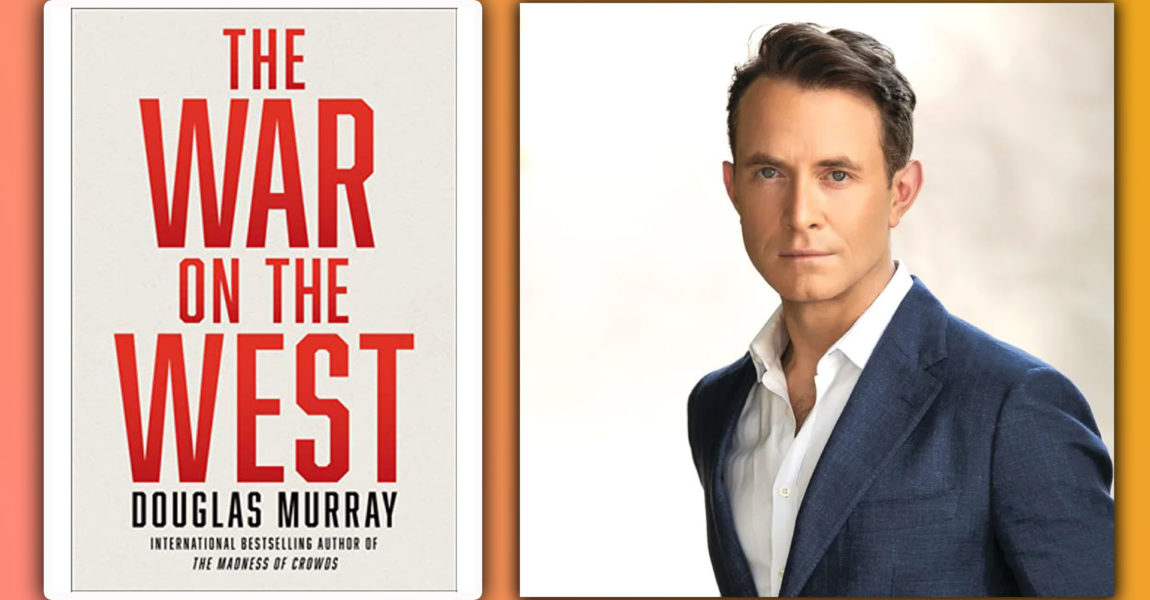
 Douglas Murray’s The War on the West: How to Prevail in the Age of Unreason (2022) is a polemic that surges with conviction, decrying what Murray perceives as a concerted attack on Western civilization. With razor-sharp prose, he skewers ideologies he believes erode the West’s cultural and intellectual foundations. Yet, while his fervor galvanizes, the book’s reliance on selective evidence and occasional factual missteps muddies its truth-seeking ambition. This review outlines Murray’s thesis, summarizes the book’s contents, and critically assesses its claims with precise quotations and citations to ensure rigor.
Thesis: A Civilization Besieged
Murray argues that Western civilization faces an existential threat from within—a cultural war waged by ideologues who vilify its history and values while ignoring its triumphs. He contends that “the West is now the only major power bloc in the world that is talked about as though its very existence is a question, a problem, or a sin” (Murray, 2022, p. 7). This assault, he claims, stems from revisionist narratives—particularly around race, history, and culture—that weaponize guilt to dismantle reason and unity. Terms like “anti-racism” have been “twisted into a desire for vengeance” (p. 53), he asserts, urging a defense of Western principles as universal goods. While compelling, this thesis oversimplifies: Murray’s portrayal of the West as uniquely scapegoated sidesteps global critiques of other powers, such as China’s Uyghur policies, and risks painting dissent as a monolithic conspiracy.
Summary of Contents
The book dissects perceived attacks across multiple domains. In the chapter on race, Murray critiques policies like the English Touring Opera’s 2021 decision to prioritize “diversity” in casting, which he claims led to “the firing of white singers purely because of their race” (p. 64). He also targets America’s early COVID-19 vaccine prioritization for minority groups, arguing it reflects “anti-white racism dressed up as justice” (p. 71). His critique of the 1619 Project is scathing, calling it “an attempt to rewrite American history as a story of unremitting racial oppression” (p. 89), though he engages little with its scholarly debates.
Murray then surveys history, art, and education, lamenting the “erasure” of Western achievements. He cites the 2020 defacement of Winston Churchill’s statue in London as evidence of a “new puritanism” (p. 112) and questions why figures like Kant are condemned for historical racial views while Karl Marx’s anti-Semitic writings escape scrutiny (p. 136). Critical Race Theory (CRT) is a recurring target, branded as “a doctrine that turns anti-racism into a new form of racism” (p. 165). He also critiques intellectuals like Edward Said, accusing them of fostering “anti-Western resentment” (p. 181). While Murray’s defense of Western art and science as universal treasures resonates, his examples—like a Twitter claim that “2+2=4 is Western imperialism” (p. 203)—often amplify marginal voices to inflate the threat.
Critical Assessment
Murray’s passion is undeniable, but his argument falters under scrutiny. A key factual error undermines his credibility: he cites a California ethnic studies curriculum as advocating “counter-genocide” against Christians, a claim traced to activist Christopher Rufo. This is false; the curriculum draft, revised in 2021, contains no such language (California Department of Education, 2021, “Ethnic Studies Model Curriculum”). Similarly, Murray misrepresents a Sandia National Laboratories exercise as forcing white employees to apologize for privilege, when it was a voluntary diversity training with no such mandate (Snopes, 2020, “Did Sandia Labs Force White Employees to Apologize?”). As reviewer Samuel Catlin notes, “Murray’s reliance on such sources makes you seriously wonder about how accurately described the rest of the book is” (Jewish Currents, 2022).
His treatment of the 1619 Project also lacks nuance. Murray dismisses it as “arrogant overreach” (p. 89), yet ignores historians like Gordon Wood, who, while critical, engage its arguments as part of legitimate historiographical debate (Wood, 2020, The New York Review of Books). This selective outrage—condemning Western critics while excusing Marx’s slurs—betrays a double standard. His defense of slavery’s historical context, arguing “every society from Africa to the Middle East had slaves” (p. 98), veers into whataboutism, dodging the West’s unique role in the transatlantic trade’s scale and legacy.
Murray’s broader narrative—framing critics as a unified anti-Western cabal—overreaches. For instance, his claim that mathematics itself is under attack relies on a single, obscure blog post rather than mainstream discourse (p. 203). As The Times review observes, “Murray sometimes picks fights with paper tigers, inflating trivial incidents into existential threats” (The Times, 2022). This hyperbole risks trivializing his case, turning a call for reasoned defense into a culture-war shouting match.
Conclusion
The War on the West is a fervent plea to cherish Western civilization, but its flaws—factual inaccuracies, selective reasoning, and exaggerated threats—corrode its persuasiveness. Murray’s prose shines, and his defense of universal values like reason and liberty is laudable. Yet, as Catlin aptly puts it, “the war he describes is less a clash of civilizations than a clash of rhetorics” (Jewish Currents, 2022). The West’s strength lies in its capacity for self-critique, a trait Murray champions but undercuts with his combative tone. Read it for its vigor, but cross-check its claims: the battlelines are real, but far less tidy than Murray insists.
References
- Murray, D. (2022). The War on the West: How to Prevail in the Age of Unreason. HarperCollins.
- California Department of Education. (2021). Ethnic Studies Model Curriculum. Retrieved from https://www.cde.ca.gov/ci/cr/cf/esmc.asp.
- Snopes. (2020). “Did Sandia Labs Force White Employees to Apologize?” Retrieved from https://www.snopes.com/fact-check/sandia-labs-white-privilege/.
- Catlin, S. (2022). “The War on the West: A Review.” Jewish Currents. Retrieved from https://jewishcurrents.org/the-war-on-the-west.
- Wood, G. (2020). “The 1619 Project: A Debate.” The New York Review of Books. Retrieved from https://www.nybooks.com/articles/2020/11/19/1619-project-debate/.
- The Times. (2022). “The War on the West by Douglas Murray: Review.” Retrieved from https://www.thetimes.co.uk/article/the-war-on-the-west-by-douglas-murray-review.











 bleatmop
 Mystro


 Dead Wild Roses
Your opinions…