
You are currently browsing the tag archive for the ‘Why do they hate us?’ tag.
It seems like so few people understand the context of empire and how it affects American foreign policy. Let’s take a quick peek at Greece and how we treat fellow democracies when it comes to maintaining ‘interests of state’.
“In the case of Spain there is some plausibility to the argument that the United States had to deal with the leader that it found there, even if he happened to be a fascist. But the story was different in Greece. We helped bring the militarists to power there, and the legacy of our complicity still poisons Greek attitudes toward the United States. There is probably no democratic public anywhere on earth with more deeply entrenched anti-American views than the Greeks. The roots of these attitudes go back to the birth of the Cold War itself, to the Greek civil war of 1946 – 49 and the U.S. decision embodied by the Truman Doctrine to intervene on the neofascist side because the wartime Greek partisan forces had been Communist-dominated. In 1949, the neofascists won and created a brutal right-wing government protected by the Greek secret police, composed of officers trained in the United States by the wartime Office of Strategic Services and its successor, the CIA.
[…]
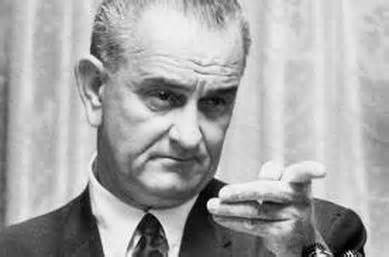
All you need to know from U.S. President Lyndon Baines Johnston about promoting peace and democracy abroad. – “Fuck your parliament and your constitution. We pay a lot of good American dollars to the Greeks. If your prime minister gives me talk about democracy, parliament, and constitution, he, his parliament, and his constitution may not last very long.”
In February of 1964, George Papandreou was elected prime minister by a huge majority. He tried to remain on friendly terms with the the Americans, but President Lyndon Johnson’s White House was pressuring him to sacrifice Greek interests on the disputed island of Cyprus in favour of Turkey, where the United States was also building military bases. Both Greece and Turkey had been members of NATO since 1952, but by the mid – 1960’s the United States seemed more interested in cultivating Turkey. When the Greek ambassador told President Johnson that his proposed solution to the Cyprus dispute was unacceptable to the Greek parliament, Johnson reportedly responded, “Fuck your parliament and your constitution. We pay a lot of good American dollars to the Greeks. If your prime minister gives me talk about democracy, parliament, and constitution, he, his parliament, and his constitution may not last very long.” And they did not.
The CIA, under its Athens station chief, John Muary, immediately began plotting with Greek military officers they had trained and cultivated for over twenty years. In order to create a sense of crisis, the Greek intelligence service, the KYP, carried out an extensive program of terrorist attacks and bombings that it blamed on the left. Constantin Costa-Gavras’s 1969 film, Z, accurately depicts those days. On April 21, 1967, just before the beginning of an election campaign that would have returned Papandreou as prime minister, the military acted. Claiming they were protecting the country from a communist coup, a five-man junta, four of whom had close connections with either the CIA or the U.S. military in Greece, established one of the most repressive regimes sponsored by either side during the Cold War.
The “Greek colonels”, as they came to be known, opened up the country to American missile launch sites and espionage bases, and they donated some $549,000 to the Nixon-Agnew election campaign.
[…]
The leader of the junta, Colonel George Papadopoulos, was an avowed fascist and admirer of Adolf Hitler. He had been trained in the United States during World War II and had been on the CIA payroll for fifteen years preceding the coup. His regime was noted for it’s brutality. During the colonel’s first month in power some 8,000 professionals, students, and others disliked by the junta were seized and tortured. Many were executed. In 1969, the eighteen member countries of the European Commission of Human Rights threatened to expel Greece – it walked out before the commission could act -but even this had no effect on American policies. “
-The Sorrows of Empire – Chalmers Johnson. pp. 204 – 206
Just in case you were unsure of how realpolitik worked and in need of your levels of depression and ennui topped up.
 Democracy, human rights, humanitarian intervention all fall at the wayside when it comes to the West supporting “stability” in the Middle East. We wonder why the residents are so pissed off at us and cheer when bad things happen to the West. I’m guessing it has a little something to do with the fact that while promoting “human rights and democracy” worldwide we simultaneously support vicious authoritarian regimes that cater to our interests while grinding their populace to dust.
Go figure.
Noam Chomsky summarizes the process quite nicely on article excerpted from Alter.net. Here are some of the highlights:
“So that wasn’t very pretty, but what about the other countries? Well, the countries that are most significant to the United States and the West, generally, are the oil dictatorships and they remain very stable. There were efforts to try and join the Arab Spring, but they were crushed, very harshly, with not a word from the Western powers. Sometimes it was quite violent, as in eastern Saudi Arabia and in Bahrain, which were Shiite areas, mostly, but it resulted in at most a tap on the wrist by the western powers. They clearly wanted the oil dictatorships to remain. That’s the center of their power.
In Tunisia, which had mostly French influence, the French supported the dictatorship until the very end. In fact, they were still supporting it after demonstrations were sweeping the country. Finally, at the last second, they conceded that their favorite dictator had to go. In Egypt, where the United States and Britain were the main influences, it was the same. Obama supported the dictator Mubarak until virtually the last minute – until the army turned against him. It became impossible to support him anymore so they urged him to leave and make a transition to a similar system.
All of that is quite routine. That’s the standard operating procedure for dealing with a situation where your favorite dictator is getting into trouble. There is case after case like that. What you do in that case is support the dictator to the very end, regardless of how vicious and bloody he is. Then when it becomes impossible, say because the army or the business classes have turned against him, then ease him out somewhere (sometimes with half the government’s treasury in his pocket), declare your love for democracy, and try to restore the old system. That’s pretty much what’s happening in Egypt.”
Chomsky called it. How long before we can get back to “business as usual?”











 bleatmop
 Mystro
 The Arbourist


 Dead Wild Roses
Your opinions…