
As a proponent of progressive taxation and egalitarian society I still hear about benefits “trickling down” from the top of society to the bottom. This of course is still horsepucky but as a meme still shows a great amount of resiliency as it continues to crop up again and again. Another sticking point is all the doom and gloom being written about the economy, despite a rebound of corporate earnings. Sociological images provides a graph and analysis about the economy.
“Using Bureau of Economic Analysis data, he looked at total U.S. domestic profits, as well as the proportion of all domestic profits earned by the financial sector, between 2001 and the end of 2010. And what we see is that both overall corporate profits, and the finance sector so central to the economic crisis, have bounced back quite well, returning to the levels we saw just before the peak of the boom period:
:
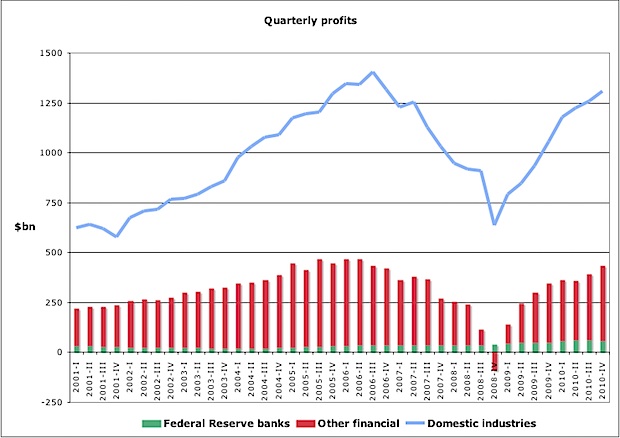
“Point is, it complicates the general perception we might get from news reports that everything in the economy is awful and there are no profits to be made. Ongoing job stagnation and media focus on the negative economic news doesn’t mean all parts of the economy are suffering equally, or that as soon as corporate earnings rebound, the benefits would quickly reach workers in the form of new job opportunities.”
I’m thinking that the workers are not seeing the rebound as quickly or at all if one is to believe the graph. In a country with more redistributive policies in place I would predict that more people would be on the rebound instead of just the corporate elite.











 bleatmop
 Mystro
 The Arbourist


 Dead Wild Roses
13 comments
June 15, 2011 at 7:13 pm
Vern R. Kaine
“doesn’t mean all parts of the economy are suffering equally, or that as soon as corporate earnings rebound, the benefits would quickly reach workers in the form of new job opportunities.”
Are you blaming Big Business for this, Capitalism, or Government? (Or a better question, how much blame do you attribute to each?)
You only see such strong job and financial growth in sectors where government and big business are bedfellows. Shocker. This is what you ultimately get when you have sheep for citizens who prefer 1) reactive to proactive behavior, and 2) prefer to mostly have others take care of them vs. taking care of themselves.
Information isn’t the problem, it’s ignorance, so while you might argue with that graph that “Here’s what so-called ‘Trickle Down Economics’ produces”. I say it’s “Here’s what Citizen Apathy produces.”
Citizens did nothing so this inequality happened and they’re doing nothing now, so it will continue. Post 10 graphs a day with data like this and it still won’t change a thing. Has WikiLeaks changed covert government activity? Did it bring Bank of America down? Is Manning out of jail yet? Has Obama’s promise of Lobbyist Reform been even remotely fulfilled, or has it actually gotten worse? Most importantly – are we doing anything differently because of all this?
You might be, because I suspect you like others here not only think about this, you also act on it through your buying and voting decisions, but the general public, however? I think when you leave peoples’ own responsibility out of the commentary or the equation as is comment with populist posts it just gives people a free pass to more victimhood, which like WikiLeaks, has ultimately lead to more apathy, and ultimately, to more nothing.
LikeLike
June 15, 2011 at 8:29 pm
Alan Scott
You know, you Canadians are so much smarter than we Americans , at this time . You have a more Conservative government than you have had in years . Your unemployment is 7.4% .While we ugly Americans have the most wealth redistributive Government in decades and our unemployment rate is 9.1 % . Yes congratulations . Thank you for proving that Conservatism works .
LikeLike
June 15, 2011 at 9:23 pm
Bleatmop
I would have to concede a point about apathy and responsibilities. Even Truman and JFK talked about people engaging on their own personal responsibility. I’m not sure I agree with your conclusions, though I’m not sure I disagree with them either.
LikeLike
June 16, 2011 at 12:16 pm
The Intransigent One
I’m pretty sure that while Canada has moved in a rightward direction, we still pay more in taxes, and especially more at higher levels, than Americans. And in return for paying those taxes, our government also does more for us than than the US gov’t does for Americans. While our respective governments may be moving closer together on income redistribution, I’m pretty sure Canada is still in the lead on who redistributes more income to the needy.
Also, last I heard, the reason our economy didn’t totally crash and burn in the first place was because our banking system was MORE, not less, heavily regulated, and thus didn’t have such a burden of toxic assets to deal with because they weren’t allowed to deal in them in the first place. Not to mention that Harper rolled out a stimulus program that actually made some work for some people (one of the few things he’s done that I’ve agreed with in principle), while nothing of the sort has happened in the USA.
I’m not entirely clear how Canada’s better current social and economic well-being under some very mildly socialist public policy, comapred to a country with a far more conservative ideology, proves Conservatism works, but whatever floats your boat man. You long ago demonstrated that your test for the validity of an argument is whether or not you agree with it.
LikeLike
June 16, 2011 at 9:26 pm
Vern R. Kaine
“Also, last I heard, the reason our economy didn’t totally crash and burn in the first place was because our banking system was MORE, not less, heavily regulated, and thus didn’t have such a burden of toxic assets to deal with because they weren’t allowed to deal in them in the first place.
I’d be the first to agree that what you say was part of it. Canada forced a higher Tier1 capital ratio. The OFSI has more teeth. But it’s hardly all of it.
Here’s an article that speaks to the benefits of regulation. For the most part, I don’t have a problem with any of it and would agree with most of your point.
http://www.theglobeandmail.com/report-on-business/rob-magazine/julie-dickson-nobodys-saviour/article984376/page2/ However you, and many on the left, miss some major points here in the texts. Particularly:
“But when falling stock markets cause its investment portfolio to shrink, as it did last fall, its ratio also drops. D’Alessandro laid out a strong case to Dickson, arguing that the rules were too strict because the insurer would have years to rebuild its portfolio before it had to make those payments.”
A great example of business and government NOT being in bed together, but actually working together. First point – what works isn’t this anti-corporate, anti-business attitude you seem to have but rather a true partnership that exists between government and business. To say that Canada survived the crash simply because of regulation is untrue. It isn’t government working AGAINST business that ever works.
Second point: Manulife, in this article, tried to maintain ratios of 180% vs 150%. If they were so “evil”, why do that? The fact is there’s many businesses which, through the simple practice of sound management, seek to exceed government regulatory requirements – not actually dodge them.
Third point: check out this passage: “His campaign eventually persuaded Dickson, who then, along with her team, struggled to quickly revise the highly technical rules in order to give Manulife—and other Canadian insurers—some breathing room.
I bet you missed two key words here: struggled and quickly. What the left is clueless about is that both those words are ATYPICAL of government and regulation, not typical of it. Most government regulators are LAZY. How many unionistas are making “late night phone calls” like Dickson is, or actually “rush” to do anything? You’ve got a better chance that they’re taking their 7 weeks holidays (which is basically 9 as they prepare for holidays and get back into the swing of things coming back from them), and good luck getting any phone answered from government past 4:30pm. Dickson appears to be a great exception to the norm, but make no mistake that she’s the exception, and that’s the real beef that most businesspeople have with government as far as regulation goes. Government is mostly stupid and slow in an environment that requires intelligence and speed to survive.
Yes, I agree that Canada deserves credit (a lot of it) for surviving the crisis. However, I think the true credit should go to the partnership that seems to have been demonstrated between regulators and business, and not the regulators VS business approach you seem to promote here.
LikeLike
June 16, 2011 at 9:44 pm
Vern R. Kaine
“You long ago demonstrated that your test for the validity of an argument is whether or not you agree with it.”
Really? Well your man-hating nature probably missed the comment I made before when Arb and I were discussing what I base my opinion on re: business matters, but here it is again:
I actually have an employee business in both Canada and the U.S. and I businesses of all sizes on both sides of the border on a continual basis. Because regulation has a significant impact on the companies I either have, or those that I work with, I read extensively on business matters when and wherever I can. It’s not whether I agree with it, it’s why, and obviously you ignore that at every turn.
So let me turn your question back on you: What makes you qualified to talk about the “evils” of capitalism, or the amount of regulation that business should be subject to? Have you spent one second actually in, owning, or running a business? Based on your discourse I would bet the answer is “no”, because like most who have no clue about business, you seem to lump all business in the “look at the evil corporations” category which not only is largely false, it’s largely hypocritical.
I just cited an article (one of many I have) which is me coming from a largely pro-capitalist position yet arguing FOR regulation. Have you ever, once, given the same sort of consideration for the “other side”? Can you pay any amount of respect to an opinion that varies from yours? I haven’t seen one pro-business comment from you – ever – and yet look at what you’re accusing me of.
LikeLike
June 16, 2011 at 10:41 pm
Bleatmop
I’m pretty sure the comment that you’re responding to was directed at Alan Scott.
LikeLike
June 16, 2011 at 10:49 pm
The Intransigent One
Hey Vern, I was replying to Alan not you – I actually thought you made some pretty good points in your first post.
LikeLike
June 17, 2011 at 5:30 am
Alan Scott
The Intransigent One ,
” You long ago demonstrated that your test for the validity of an argument is whether or not you agree with it. ”
So you believe that makes me unique on this board ?
” Also, last I heard, the reason our economy didn’t totally crash and burn in the first place was because our banking system was MORE, not less, heavily regulated, and thus didn’t have such a burden of toxic assets to deal with because they weren’t allowed to deal in them in the first place. ”
I agree totally . Your Government did not have a Fannie and Freddie and a Barney Frank and a Janet Reno pushing banks to loan to deadbeats , under pain of being investigated . Those bad loans were the basis of the toxic assets . Government caused the abandonment of strict lending standards . Look it up .
LikeLike
June 17, 2011 at 4:03 pm
The Intransigent One
Government compelled lenders to make dodgy loans that they would otherwise have rejected? Not the narrative I’d heard before, and unfortunately my google-fu is failing me because so much has been written and I’m not sure what terms to use to narrow my search. Any suggestions?
LikeLike
June 17, 2011 at 5:51 pm
Bleatmop
Nobody compelled the lenders to loan anything. The lenders lobbied the government to allow them to make those shoddy loans. We can thank both Clinton and Bush for scrapping said laws that ruined the global economy.
LikeLike
June 17, 2011 at 9:58 pm
Alan Scott
Bleatmop,
” Nobody compelled the lenders to loan anything. The lenders lobbied the government to allow them to make those shoddy loans. ”
I beg to differ . When Clinton was in , a whole mechanism sprang up to intimidate Banks into loosening their standards . The threats were that they would be paraded before the public as racists . The Commisars in Government had all kinds of charts showing how banks did not lend in minority neighborhoods . This according to the government showed racism .
The truth is that when it comes to money Banks are blind to all colors but , green . The real problem was minority neighborhoods tended to have more problems which translated into greater losses for the banks . Enter Fannie and Freddie . They began buying the loans from the banks . Now the banks stopped caring about the quality of the loans . Enter then the fly by night mortgage companies, to compete with the banks , who had no standards . Now enter Wall Street brokers who soon bought far more mortgages than Fannie and Freddie did . Wall Street thought up the mortgage backed securities and sold them to suckers the world over . The rest is history .
But it all started with government ordered lending to bad credit risks .
LikeLike
June 18, 2011 at 11:49 am
The Arbourist
Mr.Scott, I do appreciate an artful troll as much as the next blogger, but really you do need to work a little harder on your form and style.
Your unemployment is 7.4% .While we ugly Americans have the most wealth redistributive Government in decades and our unemployment rate is 9.1 % .
By your attribution, that would mean that countries do worse in terms of unemployment with governments with strong egalitarian, socialistic policies. That would mean places like Norway (3.1%), Netherlands (4.3%), Sweden (7.1%), and the UK (7.8%) fit into your your model of reality precisely. Bravo.
Thank you for proving that Conservatism works .
And thanks to you for highlighting the conservative regard for empirical fact.
LikeLike