
You are currently browsing the monthly archive for August 2013.

Pretty much all you need to know about the motivations of your average MRA dude. :)

Reposting because it is important.  Thanks to The Nation for hosting Sheldon Wolin’s article.
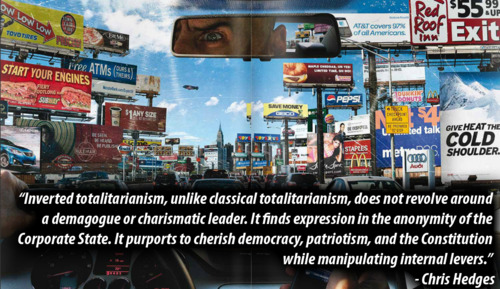
Invertedtotalitarianism“The war on Iraq has so monopolized public attention as to obscure the regime change taking place in the Homeland. We may have invaded Iraq to bring in democracy and bring down a totalitarian regime, but in the process our own system may be moving closer to the latter and further weakening the former. The change has been intimated by the sudden popularity of two political terms rarely applied earlier to the American political system.

“Empire” and “superpower” both suggest that a new system of power, concentrated and expansive, has come into existence and supplanted the old terms. “Empire” and “superpower” accurately symbolize the projection of American power abroad, but for that reason they obscure the internal consequences. Consider how odd it would sound if we were to refer to “the Constitution of the American Empire” or “superpower democracy.” The reason they ring false is that “constitution” signifies limitations on power, while “democracy” commonly refers to the active involvement of citizens with their government and the responsiveness of government to its citizens. For their part, “empire” and “superpower” stand for the surpassing of limits and the dwarfing of the citizenry.

The increasing power of the state and the declining power of institutions intended to control it has been in the making for some time. The party system is a notorious example. The Republicans have emerged as a unique phenomenon in American history of a fervently doctrinal party, zealous, ruthless, antidemocratic and boasting a near majority. As Republicans have become more ideologically intolerant, the Democrats have shrugged off the liberal label and their critical reform-minded constituencies to embrace centrism and footnote the end of ideology. In ceasing to be a genuine opposition party the Democrats have smoothed the road to power of a party more than eager to use it to promote empire abroad and corporate power at home. Bear in mind that a ruthless, ideologically driven party with a mass base was a crucial element in all of the twentieth-century regimes seeking total power.

Representative institutions no longer represent voters. Instead, they have been short-circuited, steadily corrupted by an institutionalized system of bribery that renders them responsive to powerful interest groups whose constituencies are the major corporations and wealthiest Americans. The courts, in turn, when they are not increasingly handmaidens of corporate power, are consistently deferential to the claims of national security. Elections have become heavily subsidized non-events that typically attract at best merely half of an electorate whose information about foreign and domestic politics is filtered through corporate-dominated media. Citizens are manipulated into a nervous state by the media’s reports of rampant crime and terrorist networks, by thinly veiled threats of the Attorney General and by their own fears about unemployment. What is crucially important here is not only the expansion of governmental power but the inevitable discrediting of constitutional limitations and institutional processes that discourages the citizenry and leaves them politically apathetic.

No doubt these remarks will be dismissed by some as alarmist, but I want to go further and name the emergent political system “inverted totalitarianism.” By inverted I mean that while the current system and its operatives share with Nazism the aspiration toward unlimited power and aggressive expansionism, their methods and actions seem upside down. For example, in Weimar Germany, before the Nazis took power, the “streets” were dominated by totalitarian-oriented gangs of toughs, and whatever there was of democracy was confined to the government. In the United States, however, it is the streets where democracy is most alive–while the real danger lies with an increasingly unbridled government.

Or another example of the inversion: Under Nazi rule there was never any doubt about “big business” being subordinated to the political regime. In the United States, however, it has been apparent for decades that corporate power has become so predominant in the political establishment, particularly in the Republican Party, and so dominant in its influence over policy, as to suggest a role inversion the exact opposite of the Nazis’. At the same time, it is corporate power, as the representative of the dynamic of capitalism and of the ever-expanding power made available by the integration of science and technology with the structure of capitalism, that produces the totalizing drive that, under the Nazis, was supplied by ideological notions such as Lebensraum.

In rebuttal it will be said that there is no domestic equivalent to the Nazi regime of torture, concentration camps or other instruments of terror. But we should remember that for the most part, Nazi terror was not applied to the population generally; rather, the aim was to promote a certain type of shadowy fear–rumors of torture–that would aid in managing and manipulating the populace. Stated positively, the Nazis wanted a mobilized society eager to support endless warfare, expansion and sacrifice for the nation.

While the Nazi totalitarianism strove to give the masses a sense of collective power and strength, Kraft durch Freude (“Strength through joy”), inverted totalitarianism promotes a sense of weakness, of collective futility. While the Nazis wanted a continuously mobilized society that would not only support the regime without complaint and enthusiastically vote “yes” at the periodic plebiscites, inverted totalitarianism wants a politically demobilized society that hardly votes at all. Recall the President’s words immediately after the horrendous events of September 11: “Unite, consume and fly,” he told the anxious citizenry. Having assimilated terrorism to a “war,” he avoided doing what democratic leaders customarily do during wartime: mobilize the citizenry, warn it of impending sacrifices and exhort all citizens to join the “war effort.” Instead, inverted totalitarianism has its own means of promoting generalized fear; not only by sudden “alerts” and periodic announcements about recently discovered terrorist cells or the arrest of shadowy figures or the publicized heavy-handed treatment of aliens and the Devil’s Island that is Guantánamo Bay or the sudden fascination with interrogation methods that employ or border on torture, but by a pervasive atmosphere of fear abetted by a corporate economy of ruthless downsizing, withdrawal or reduction of pension and health benefits; a corporate political system that relentlessly threatens to privatize Social Security and the modest health benefits available, especially to the poor. With such instrumentalities for promoting uncertainty and dependence, it is almost overkill for inverted totalitarianism to employ a system of criminal justice that is punitive in the extreme, relishes the death penalty and is consistently biased against the powerless.

Thus the elements are in place: a weak legislative body, a legal system that is both compliant and repressive, a party system in which one party, whether in opposition or in the majority, is bent upon reconstituting the existing system so as to permanently favor a ruling class of the wealthy, the well-connected and the corporate, while leaving the poorer citizens with a sense of helplessness and political despair, and, at the same time, keeping the middle classes dangling between fear of unemployment and expectations of fantastic rewards once the new economy recovers. That scheme is abetted by a sycophantic and increasingly concentrated media; by the integration of universities with their corporate benefactors; by a propaganda machine institutionalized in well-funded think tanks and conservative foundations; by the increasingly closer cooperation between local police and national law enforcement agencies aimed at identifying terrorists, suspicious aliens and domestic dissidents.

What is at stake, then, is nothing less than the attempted transformation of a tolerably free society into a variant of the extreme regimes of the past century. In that context, the national elections of 2004 represent a crisis in its original meaning, a turning point. The question for citizens is: Which way?”

Let us take a good look at how free speech and competing idea’s are treated at a American College.  You wonder why so many people just roll their eyes when the words American and enlightened are mentioned in the same sentence.

What gets me is that these are the supposed emerging ‘educated class’… the new leaders of American society.  Such inanity, such ignorance such dedication to american exceptionalism.   This is really a chilling video.

Speaking the truth, as always, is never well received.

[Full Text of Speech]

I want to speak to you today about war and empire.

Killing, or at least the worst of it, is over in Iraq. Although blood will continue to spill — theirs and ours — be prepared for this. For we are embarking on an occupation that, if history is any guide, will be as damaging to our souls as it will be to our prestige, power, and security. But this will come later as our empire expands and in all this we become pariahs, tyrants to others weaker than ourselves. Isolation always impairs judgment and we are very isolated now.

We have forfeited the good will, the empathy the world felt for us after 9-11. We have folded in on ourselves, we have severely weakened the delicate international coalitions and alliances that are vital in maintaining and promoting peace and we are part now of a dubious troika in the war against terror with Vladimir Putin and Ariel Sharon, two leaders who do not shrink in Palestine or Chechnya from carrying out acts of gratuitous and senseless acts of violence. We have become the company we keep.

The censure and perhaps the rage of much of the world, certainly one-fifth of the world’s population which is Muslim, most of whom I’ll remind you are not Arab, is upon us. Look today at the 14 people killed last night in several explosions in Casablanca. And this rage in a world where almost 50 percent of the planet struggles on less than two dollars a day will see us targeted. Terrorism will become a way of life, and when we are attacked we will, like our allies Putin and Sharon, lash out with greater fury. The circle of violence is a death spiral; no one escapes. We are spinning at a speed that we may not be able to hold. As we revel in our military prowess — the sophistication of our military hardware and technology, for this is what most of the press coverage consisted of in Iraq — we lose sight of the fact that just because we have the capacity to wage war it does not give us the right to wage war. This capacity has doomed empires in the past.

“Modern western civilization may perish,” the theologian Reinhold Niebuhr warned, “because it falsely worshiped technology as a final good.”

The real injustices, the Israeli occupation of Palestinian land, the brutal and corrupt dictatorships we fund in the Middle East, will mean that we will not rid the extremists who hate us with bombs. Indeed we will swell their ranks. Once you master people by force you depend on force for control. In your isolation you begin to make mistakes.

Fear engenders cruelty; cruelty, fear, insanity, and then paralysis. In the center of Dante’s circle the damned remained motionless. We have blundered into a nation we know little about and are caught between bitter rivalries and competing ethnic groups and leaders we do not understand. We are trying to transplant a modern system of politics invented in Europe characterized, among other things, by the division of earth into independent secular states based on national citizenship in a land where the belief in a secular civil government is an alien creed. Iraq was a cesspool for the British when they occupied it in 1917; it will be a cesspool for us as well. The curfews, the armed clashes with angry crowds that leave scores of Iraqi dead, the military governor, the Christian Evangelical groups who are being allowed to follow on the heels of our occupying troops to try and teach Muslims about Jesus.

Hedges stops speaking because of a disturbance in the audience. Rockford College President Paul Pribbenow takes the microphone.

“My friends, one of the wonders of a liberal arts college is its ability and its deeply held commitment to academic freedom and the decision to listen to each other’s opinions. (Crowd Cheers) If you wish to protest the speaker’s remarks, I ask that you do it in silence, as some of you are doing in the back. That is perfectly appropriate but he has the right to offer his opinion here and we would like him to continue his remarks. (Fog Horn Blows, some cheer).

The occupation of the oil fields, the notion of the Kurds and the Shiites will listen to the demands of a centralized government in Baghdad, the same Kurds and Shiites who died by the tens of thousands in defiance of Sadaam Hussein, a man who happily butchered all of those who challenged him, and this ethnic rivalry has not gone away. The looting of Baghdad, or let me say the looting of Baghdad with the exception of the oil ministry and the interior ministry — the only two ministries we bothered protecting — is self immolation.

As someone who knows Iraq, speaks Arabic, and spent seven years in the Middle East, if the Iraqis believe rightly or wrongly that we come only for oil and occupation, that will begin a long bloody war of attrition; it is how they drove the British out and remember that, when the Israelis invaded southern Lebanon in 1982, they were greeted by the dispossessed Shiites as liberators. But within a few months, when the Shiites saw that the Israelis had come not as liberators but occupiers, they began to kill them. It was Israel who created Hezbollah and was Hezbollah that pushed Israel out of Southern Lebanon.

As William Butler Yeats wrote in “Meditations in Times Of Civil War,” “We had fed the heart on fantasies / the hearts grown brutal from the fair.”

This is a war of liberation in Iraq, but it is a war now of liberation by Iraqis from American occupation. And if you watch closely what is happening in Iraq, if you can see it through the abysmal coverage, you can see it in the lashing out of the terrorist death squads, the murder of Shiite leaders in mosques, and the assassination of our young soldiers in the streets. It is one that will soon be joined by Islamic radicals and we are far less secure today than we were before we bumbled into Iraq.

We will pay for this, but what saddens me most is that those who will by and large pay the highest price are poor kids from Mississippi or Alabama or Texas who could not get a decent job or health insurance and joined the army because it was all we offered them. For war in the end is always about betrayal, betrayal of the young by the old, of soldiers by politicians, and of idealists by cynics. Read Antigone, when the king imposes his will without listening to those he rules or Thucydides’ history. Read how Athens’ expanding empire saw it become a tyrant abroad and then a tyrant at home. How the tyranny the Athenian leadership imposed on others it finally imposed on itself.

This, Thucydides wrote, is what doomed Athenian democracy; Athens destroyed itself. For the instrument of empire is war and war is a poison, a poison which at times we must ingest just as a cancer patient must ingest a poison to survive. But if we do not understand the poison of war — if we do not understand how deadly that poison is — it can kill us just as surely as the disease.

We have lost touch with the essence of war. Following our defeat in Vietnam we became a better nation. We were humbled, even humiliated. We asked questions about ourselves we had not asked before.

We were forced to see ourselves as others saw us and the sight was not always a pretty one. We were forced to confront our own capacity for a atrocity — for evil — and in this we understood not only war but more about ourselves. But that humility is gone.

War, we have come to believe, is a spectator sport. The military and the press — remember in wartime the press is always part of the problem — have turned war into a vast video arcade came. Its very essence — death — is hidden from public view.

There was no more candor in the Persian Gulf War or the War in Afghanistan or the War in Iraq than there was in Vietnam. But in the age of live feeds and satellite television, the state and the military have perfected the appearance of candor.

Because we no longer understand war, we no longer understand that it can all go horribly wrong. We no longer understand that war begins by calling for the annihilation of others but ends if we do not know when to make or maintain peace with self-annihilation. We flirt, given the potency of modern weapons, with our own destruction.

The seduction of war is insidious because so much of what we are told about it is true — it does create a feeling of comradeship which obliterates our alienation and makes us, for perhaps the only time of our life, feel we belong.

War allows us to rise above our small stations in life; we find nobility in a cause and feelings of selflessness and even bliss. And at a time of soaring deficits and financial scandals and the very deterioration of our domestic fabric, war is a fine diversion. War for those who enter into combat has a dark beauty, filled with the monstrous and the grotesque. The Bible calls it the lust of the eye and warns believers against it. War gives us a distorted sense of self; it gives us meaning.

(A man in the audience says: “Can I say a few words here?” Hedges: Yeah, when I finish.)

Once in war, the conflict obliterates the past and the future all is one heady intoxicating present. You feel every heartbeat in war, colors are brighter, your mind races ahead of itself. (Confusion, microphone problems, etc.) We feel in wartime comradeship. (Boos) We confuse this with friendship, with love. There are those who will insist that the comradeship of war is love — the exotic glow that makes us in war feel as one people, one entity, is real, but this is part of war’s intoxication.

Think back on the days after the attacks on 9-11. Suddenly we no longer felt alone; we connected with strangers, even with people we did not like. We felt we belonged, that we were somehow wrapped in the embrace of the nation, the community; in short, we no longer felt alienated.

As this feeling dissipated in the weeks after the attack, there was a kind of nostalgia for its warm glow and wartime always brings with it this comradeship, which is the opposite of friendship. Friends are predetermined; friendship takes place between men and women who possess an intellectual and emotional affinity for each other. But comradeship — that ecstatic bliss that comes with belonging to the crowd in wartime — is within our reach. We can all have comrades.

The danger of the external threat that comes when we have an enemy does not create friendship; it creates comradeship. And those in wartime are deceived about what they are undergoing. And this is why once the threat is over, once war ends, comrades again become strangers to us. This is why after war we fall into despair.

In friendship there is a deepening of our sense of self. We become, through the friend, more aware of who we are and what we are about; we find ourselves in the eyes of the friend. Friends probe and question and challenge each other to make each of us more complete; with comradeship, the kind that comes to us in patriotic fervor, there is a suppression of self-awareness, self-knowledge, and self-possession. Comrades lose their identities in wartime for the collective rush of a common cause — a common purpose. In comradeship there are no demands on the self. This is part of its appeal and one of the reasons we miss it and seek to recreate it. Comradeship allows us to escape the demands on the self that is part of friendship.

In wartime when we feel threatened, we no longer face death alone but as a group, and this makes death easier to bear. We ennoble self-sacrifice for the other, for the comrade; in short we begin to worship death. And this is what the god of war demands of us.

Think finally of what it means to die for a friend. It is deliberate and painful; there is no ecstasy. For friends, dying is hard and bitter. The dialogue they have and cherish will perhaps never be recreated. Friends do not, the way comrades do, love death and sacrifice. To friends, the prospect of death is frightening. And this is why friendship or, let me say love, is the most potent enemy of war. Thank you.

btpc-prosperity-gospel-brochure-2010    How you take the rotten carcass of religion to even a more repugnant level?  Mix in the sham-psychology of positive affirmations and the greedy notions of robber baron capitalism.  Mix this these foul artifacts together and you have what is known as the Prosperity Gospel.  We are not here today to get into what the PG is all about and how frakked-up it is and the damage it is doing to the US.


Nope.


We are here to observe a christian who understood the ways of the world and let his faith (partially)inform, but not force his decisions.  Here’s the quote.


   “[..] the first truth is that the liberty of democracy is not safe if the people tolerate the growth of power to a point where it becomes stronger than the democratic state itself.  That, in its essence, is Fascism – ownership of Government by an individual, by a group, or by any other controlling private power.  The second truth of liberty is that the liberty of a democracy is not safe if its business system does not provide employment and produce and distribute goods in such a way to sustain an acceptable standard of living. “


Wow.  I’m sure this individual would be quickly branded a communist traitor or a godless socialist by the standards of  what passes for ‘debate’ in the US.  Care to guess who said the above? 

Yeah, so there was a time when you could be christain and rational, all at the same time.   I pine for those times.


Good video, but I just can’t see a cat on a leash. :)

Are juicy harmonies your thing?  Try this on for size. :)

Just sayn’
perspective

This Blog best viewed with Ad-Block and Firefox!

What is ad block? It is an application that, at your discretion blocks out advertising so you can browse the internet for content as opposed to ads. If you do not have it, get it here so you can enjoy my blog without the insidious advertising.

Like Privacy?

Change your Browser to Duck Duck Go.

Enter your email address to follow this blog and receive notifications of new posts by email.

Join 396 other subscribers

Categories

August 2013
M T W T F S S
 1234
567891011
12131415161718
19202122232425
262728293031  

Archives

Blogs I Follow

The DWR Community

  • Unknown's avatar
  • Unknown's avatar
  • Unknown's avatar
  • Unknown's avatar
  • Vala's avatar
  • Unknown's avatar
  • Widdershins's avatar
  • Unknown's avatar
  • silverapplequeen's avatar
  • Unknown's avatar
Kaine's Korner

Religion. Politics. Life.

Connect ALL the Dots

Solve ALL the Problems

Myrela

Art, health, civilizations, photography, nature, books, recipes, etc.

Women Are Human

Independent source for the top stories in worldwide gender identity news

Widdershins Worlds

LESBIAN SF & FANTASY WRITER, & ADVENTURER

silverapplequeen

herstory. poetry. recipes. rants.

Paul S. Graham

Communications, politics, peace and justice

Debbie Hayton

Transgender Teacher and Journalist

shakemyheadhollow

Conceptual spaces: politics, philosophy, art, literature, religion, cultural history

Our Better Natures

Loving, Growing, Being

Lyra

A topnotch WordPress.com site

I Won't Take It

Life After an Emotionally Abusive Relationship

Unpolished XX

No product, no face paint. I am enough.

Volunteer petunia

Observations and analysis on survival, love and struggle

femlab

the feminist exhibition space at the university of alberta

Raising Orlando

About gender, identity, parenting and containing multitudes

The Feminist Kitanu

Spreading the dangerous disease of radical feminism

trionascully.com

Not Afraid Of Virginia Woolf

Double Plus Good

The Evolution Will Not BeTelevised

la scapigliata

writer, doctor, wearer of many hats

Teach The Change

Teaching Artist/ Progressive Educator

Female Personhood

Identifying as female since the dawn of time.

Not The News in Briefs

A blog by Helen Saxby

SOLIDARITY WITH HELEN STEEL

A blog in support of Helen Steel

thenationalsentinel.wordpress.com/

Where media credibility has been reborn.

BigBooButch

Memoirs of a Butch Lesbian

RadFemSpiraling

Radical Feminism Discourse

a sledge and crowbar

deconstructing identity and culture

The Radical Pen

Fighting For Female Liberation from Patriarchy

Emma

Politics, things that make you think, and recreational breaks

Easilyriled's Blog

cranky. joyful. radical. funny. feminist.

Nordic Model Now!

Movement for the Abolition of Prostitution

The WordPress C(h)ronicle

These are the best links shared by people working with WordPress

HANDS ACROSS THE AISLE

Gender is the Problem, Not the Solution

fmnst

Peak Trans and other feminist topics

There Are So Many Things Wrong With This

if you don't like the news, make some of your own

Gentle Curiosity

Musing over important things. More questions than answers.

violetwisp

short commentaries, pretty pictures and strong opinions

Revive the Second Wave

gender-critical sex-negative intersectional radical feminism


