
You are currently browsing the monthly archive for February 2014.
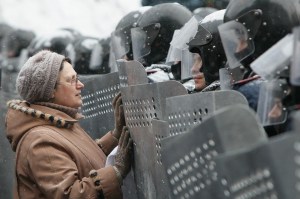 What is so not-awesome about our news media is its propensity to relay to us news and events without the background context necessary have said news event make sense. Go take a look at the CBC’s reporting on what is happening in the Ukraine. I’ll reproduce the headlines here for sake of argument.
- Parliament votes to oust President Viktor Yanukovych
- Security forces now declining to take part in conflict
- Jailed opposition figure Yulia Tymoshenko may be released soon
- President and opposition sign deal meant to end crisis
- President Yanukovych leaves capital for pro-Russian eastern Ukraine
- Yanukoych accuses opposition of conducting a coup
- MPs replace speaker, interior minister
Fascinating stuff. But what does it mean? I mean, who is Yanukovych and what does his party stand for? Heck, what sort of political economic system does the Ukraine possess for starters. You can read all of those articles on Auntie Ceebs and not have even a fog-eyed view of what the hell is actually going on. The reporting we get suffers from what I’ll call the ‘keyhole syndrome’.
 Keyhole Syndrome is when people watching the news are presented with a important event but not the details surrounding said event that would allow them to make a decision, critical or otherwise about said event. Wow there is a coup attempt in Ukraine – how about that. How do we get from the Orange revolution to here? Do you even remember the orange revolution?
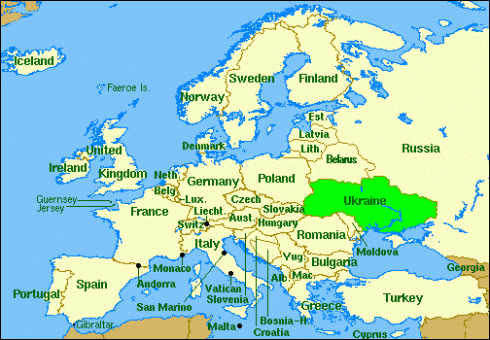
What is needed, honest readers is context, and I strive to provide a slightly larger keyhole looking into the events happening in the Ukraine. Read more in the full report at the Council for Foreign Relations website.
Economic Structure and Policies
Ukraine has a classic rentier curse. Oligarchs and politicians, often one and the same, extract rents from the transit of energy and other scams. Some prices are market based and others controlled, creating huge opportunities for arbitrage. Various licenses and concessions depend on political favor, facilitating corrupt lobbying, and oligarchs have manipulated the political process to ensure a supply of subsidized gas, coal, and electricity. Bursts of market reform in 1994–95 and 2000–2001 were only the minimum necessary to prevent international lenders from withdrawing completely. After 2004, the Orange Revolution’s leaders enacted populist measures rather than tackling systemic problems.
Notwithstanding relatively liberal privatization laws, the process came to benefit oligarchs. Most big enterprises were sold by closed discount cash sales. Today, without an effective legal system, all property remains insecure. Violent corporate raiding is widespread; oligarchs use mafia muscle to take over each other’s firms and scare away most foreign investors. The black economy accounts for 40 to 50 percent of official GDP. Ukraine has received support from international financial institutions, but these funds have been small relative to Ukraine’s GDP. The country’s failure to enact reforms has repeatedly marred its relationship with the International Monetary Fund.
Civil Society and Media
Ukraine’s civil society, though stronger than other aspects of democratic governance, remains weak. After the Orange Revolution, cohesion and engagement quickly disintegrated as people grew disillusioned by elites’ broken promises. Today, only 5 percent of Ukrainians belong to nongovernmental organizations (NGOs). The current Yanukovych government has curtailed freedom of assembly and used the security and tax services to harass activists. Despite this (or perhaps because of it), however, NGO activities are rising. Some elites, exasperated by the divided political opposition, are organizing civil society groups instead of pursuing political power.
Ukraine’s media have generally functioned as an instrument of power rather than an independent force. Many media companies have long been left in private hands under “reliable” oligarchic control, fostering self-censorship. The Orange Revolution allowed a window of media freedom, but today many journalists face bullying and bribery. By contrast, the internet remains lively and free, with growing social media and anticorruption sites.
Legal System and Rule of Law
The law in Ukraine is deliberately capricious and its application arbitrary. Because the population must constantly break the law, authorities can decide whom to prosecute, and they wield this authority to consolidate power. Punishment is used to disable anyone who challenges the system; forgiveness is used as patronage. Most judges are holdovers from the Communist era and continue to respond to instructions from officials. Conviction rates top 99 percent.
Reforms passed in 2010 have increased executive control over the judiciary. Yanukovych created two new courts to bypass relatively independent ones and he purged the Supreme Court and Constitutional Court. Other executive bodies gained control over judicial appointments. The ease with which authorities launched political prosecutions in 2011 and 2012—most prominently against Tymoshenko—showed the new system’s weakness. Today, politicians routinely take bribes from oligarchs or are oligarchs themselves. Members of parliament are immune from prosecution, making public office a gravy train. A place on an electoral list is estimated to cost $5 million in bribes to party leaders.
Government Structure and Division of Power
Ukraine has made almost every mistake imaginable in its institutional design. In the 1990s, it built ministries that recreated bad habits of the Soviet command economy. Prosecutors, tax police, and the former KGB were given too much power. Kuchma also expanded presidential authority but used it to act as the oligarchs’ patron. The constitutional changes to weaken the presidency agreed to during the Orange Revolution were therefore not necessarily bad ideas. However, they were hastily drafted and poorly implemented, allowing oligarchs to build an alternative power center in parliament. Nonetheless, the reversal of these changes in 2010 was unwise. It restored the status quo ante, rather than keeping the best of the reforms, and its aim was not rebalancing the system but entrenching Yanukovych’s administration.
Oh. So the Ukraine, despite its residual media memory as a ‘democracy’ is actually a oligarchy that thrives on looting the country of its wealth and maintaining its power through any means necessary.
A brief aside:this is the kind of system we inhabit here in North America. When you finally come to this conclusion (or not, please continue to consume the bread and circuses arranged for your leisure) the decisions our respective governments make become much more understandable and do have a rational, just not the type this is going to benefit *you*.
Ah, so now we can begin to understand what is going on in the Ukraine and start asking more reasonable questions to further our analysis of what is transpiring over there.
Break out of your browser bubble. I suggest you use duckduckgo as your web browser as they claim it is more private and bubble free browsing experience.
(ed. *update* – added new Mahr video.)
Huh, as I was browsing the weeb, I ‘happened’ to find this video featuring Bill Mahr on the very same subject.
Hungarian Rhapsody No. 2, S.244/2, is the second in a set of 19 Hungarian Rhapsodies by Liszt, and by far the most famous of the set. It offered the pianist to reveal his exceptional virtuoso skills while providing the listener with an immediate musical appeal. Composed in 1847 and first published by Ricordi as piano solo, this work showcases Liszt’s nationalist influences. Its inmediate succes led to the creation of orchestral and duet piano versions.
By the late 19th century, the technical challenges of the piano solo version led to its unofficial acceptance as a standard by which every notable pianist could demonstrate his level. It had become an expected staple of virtually every performance of the greatest pianists. Most unusual is the composer’s explicit invitation for the performer to improvise an original cadenza, an invitation most performers chose to decline.
Reasons For The Lowered Abortion Rate
- Available birth control
- Lessened stigma on birth control
- More education about birth control
- More comprehensive sex education than the past
Things That Barely (If At All) Lowered Abortion Rates:
- Pro-Life harassment and violence
- Sidewalk protesting
- Restricting abortions
- Banning abortions
Things That Will Continue To Lower Abortion Rates:
- Even more comprehensive sex education
- Even better birth control options
- Less stigma on sex, sex ed, and birth control
- More birth control options for those without a uterus
- Available and affordable (or free) birth control
Either Way:
- Abortion is not evil.
- Abortion is a responsible choice.
- Abortion should remain legal, no matter what.
- Sentient pregnant person > non-sentient fetus.
- Do not harass those who want an abortion or those who have had one.
- Abortion needs to be de-stigmatized, for the sake of the people who choose it or who need it.
 When arguing about abortion and other moral topics, one is almost guaranteed to hear this lofty phrase trotted out. Like a a gentle desert sirocco, you only miss it when it isn’t there. People seem to have some very strange ideas about how we regularly treat each other here on Earth.
Realistically speaking, the phrase “sanctity of human life”is a misnomer. We here in the ‘Civilized West’ extinguish human life at a record pace whether actively though war or passively through indifference and neglect.
“But Arbourist!”, says the lay reader of DWR, “we in the West, have technology, capitalism and democracy that raises all of the boats and keeps our people well off. Well yes lay reader but, our relative prosperity is a direct result of our society almost always wielding the bigger stick and vigourously applying it to all of those people around us until they acquiesced or died under our not so gentle ministrations.
We laid waste other civilizations and then built our own in the blood soaked ashes of the wanton slaughter we perpetrated. There was no sanctity of human life then: it was us or them and jebus willing, it had better be them.
Yes, our lovely notions of morality are quickly set aside once it gets down to us vs. them. The best part is that “them” does not even need to be a threat; our benevolent political leadership will kindly manufacture a threat to dehumanize whomever stands in the way of our geopolitical goals (those damn Arabs having the temerity to live on top of our oil, for example). Sanctity of what again? If it wasn’t Churchill gassing the Arabs for being uppity for not subscribing to the benevolent British dictatorship administered by local satraps, it was those same Arabs who needed a good bombing/droning by the enlightened US of A to make them see all the benefits of a US sponsored benevolent dictatorship.
So many flavours of tyranny!
So many people that need to die before they understand what is good for them (us). All this respect for human life, and we’ve covered the ever so smallest part of the active destruction of humanity. For a change of depression let us flit over to the passive neglectful side of our deep commitment to the sanctity of human life.
From the Unicef site:
More than 70 per cent of almost 11 million child deaths every year are attributable to six causes: diarrhoea, malaria, neonatal infection, pneumonia, preterm delivery, or lack of oxygen at birth.
These deaths occur mainly in the developing world. An Ethiopian child is 30 times more likely to die by his or her fifth birthday than a child in Western Europe. Among deaths in children, South-central Asia has the highest number of neonatal deaths, while sub-Saharan Africa has the highest rates. Two-thirds of deaths occur in just 10 countries.
And the majority are preventable. Some of the deaths occur from illnesses like measles, malaria or tetanus. Others result indirectly from marginalization, conflict and HIV/AIDS. Malnutrition and the lack of safe water and sanitation contribute to half of all these children’s deaths.
But disease isn’t inevitable, nor do children with these diseases need to die. Research and experience show that six million of the almost 11 million children who die each year could be saved by low-tech, evidence-based, cost-effective measures such as vaccines, antibiotics, micronutrient supplementation, insecticide-treated bed nets and improved family care and breastfeeding practices.
Neat how that works. So much waste of human life, for what? A slight reduction in the standards of Western living? Well we certainly can’t see their suffering and dying, soooo…it doesn’t really count then right?
Right? Because sanctity of human life is such a important moral precept over here in the West. Because we value life so damn much and it is so important to us.
Bull.
Shit.
Like any habit, consuming pornography can be a hard cycle to break and here is why.











 bleatmop
 Mystro


 Dead Wild Roses
Your opinions…