
You are currently browsing the monthly archive for July 2015.
One of my favourite youtubers is theramin trees, his videos are always coolly narrated and punctuated with slick visual animations that always manage to highlight how incredibly toxic religion is. He recalls how his questions got him in trouble… and the terror of growing up as curious child. So many alarm bells with this video – the stunting of critical thinking, the mental abuse and the emotional blackmail all in the name of believing in magic.
 Here at DWR we’ve been keeping an eye on the Greek economic situation. As early as 2010 we commented that the IMF had been working its magic on the Greek economy:
“Did you ever want to see a society remade into the corporatist mode? Greece is going down that path right now. The IMF is gleefully setting out conditions and ‘austerity measures’ necessary for Greece to qualify for the bailout package. How much would you wager that the Public Sector is going to take a beating? Today’s news is part of a cycle of the forced privatization of the Greek economy.”
Here we are in 2015:
“Greek lawmakers have approved a government motion that allows reform proposals [AUSTERITY] to be used as a basis for negotiations with international creditors, as the country seeks a third bailout.
The 300-member parliament passed the motion by majority vote, with 251 lawmakers voting in favor, 32 against and 8 voting ‘present’ — a form of abstention indicating dissent from their own party line.
In a speech delivered ahead of the vote, Greek Prime Minister Alexis Tsipras sought to persuade lawmakers, including dissenters within his own left-wing Syriza party, to back the proposals and grant his finance minister the authorization to use them as a basis for negotiations with creditors over the weekend.”
You see? The IMF hasn’t stopped its slow destruction of the Greek economy, like slowly metastasizing cancer, the financial skulduggery makes fixing the economy untenable. The recently ousted Greek finance minister Yanis Varoufakis comments:
“Varoufakis explains exactly why he fought for a NO vote and how unfair and irrational the creditors have been in refusing to discuss debt re-structuring. As Varoufakis points out, it is perfectly normal in the world of finance for us to be offered long term loans that suit our budget. It happens every day, yet Greece has not been offered a sustainable debt repayment plan that will enable it to pay back its creditors with interest, without forcing people at home to suffer as they do right now. If Greece has no money left, then how can it possibly pay what the IMF and the ECB expect it to? Varoufakis had suggested that his country pay an increased sum of money back over a longer time period, enabling the economy to grow over time. The creditors refused. When Prime Minister Tspiras announced a referendum would take place, the creditors were absolutely furious. Democracy is not something they understand, it seems.”
This is exactly the no-win situation that Disaster Capitalism sets up. Which leads to this inescapable conclusion:
“And herein lies the problem. We live in a neo-liberal, globalized plutocracy. An elite group of bankers control the global money supply (and the politicians we vote for), and here’s the thing: they do not believe in democracy. They do not believe that ordinary people have the right to an opinion, let alone a vote, on issues as enormous as the one facing Greece. This is all the more infuriating when you consider the fact that it’s regular members of the public who are being forced to bail out private banking debts. Worst of all, rather than listen with interest to Varoufakis’s logical and intelligent argument, corporate journos like Paul Mason prefer to doggedly defend the position of Greece’s creditors, while peddling fear and lies about the consequences of a Greek exit from the Eurozone.”
So what to do in Greece? The proposed “bailout plan” is shite, and the people of Greece have already said no to similar BS:
“The proposed measures, including tax hikes and cuts in pension spending, are certain to inflict more pain on a Greek public who just days ago voted overwhelmingly against a similar plan.”
“The new measures overturn many of the election promises of Tsipras’ left-wing Syriza party, which had vowed to overturn bailout austerity, and come less than a week after 61 per cent of voters opposed similar reforms, proposed by creditors, in last Sunday’s referendum.”
The Greek people have said “No” to Austerity and Greece’s political elite are apoplectically pretzelling trying to make the societal poison known as Austerity somehow palatable to masses.
A quick review of what is coming next:
We need to watch what happens in Greece very carefully now. The forces of international neo-liberal capitalism need to make an example of Greece to scare other countries in similar situations (Spain, Italy) into accepting the resculpting of society for the benefit of the hyper-rich.
Democracy is expected to bend a knee toward this insidious neo-liberal economic paradigm – the will of the people subsumed to corporate interests – an for what?
We all know the answer.
White Cat Fiona hates literacy.

The symphony is in four movements, with the third movement and the finale played attacca:
- Allegretto – Poco allegro – Tranquillo, ma poco a poco ravvivando il tempo all’allegro – Poco largamente – Tempo I – Poco allegro
- Tempo andante, ma rubato – Poco allegro – Molto largamente – Andante sostenuto – Andante con moto ed energico – Allegro – Poco largamente – Molto largamente – Andante sostenuto – Andante con moto ed energico – Andante – Pesante
- Vivacissimo – Lento e soave – Tempo primo – Lento e soave – (attacca)
- Finale: Allegro moderato – Moderato assai – Meno moderato e poco a poco ravvivando il tempo – Tempo I – Largamente e pesante – Poco largamente – Molto largamente
The duration is approximately 45 minutes.
In Finland, this popular work with its grandiose finale was connected by some with the struggle for Finland’s independence, even being popularly dubbed the “Symphony of Independence”, as it was written at a time of Russian sanctions on Finnish language and culture. Sibelius’s reaction to this has been widely debated; some claim that he had not intended any patriotic message and that the symphony was only identified by others as a nationalist composition, while others believe that he wrote the piece with an independent Finland in mind.
Tying in with Sibelius’ philosophy on the art of the symphony (he wrote that he “admired [the symphony’s] severity of style and the profound logic that created an inner connection between all the motifs…”), the work grows almost organically out of a rising three-note motif heard at the opening of the work, which, after appearing in many guises throughout the entire symphony (and indeed forming the basis for most of the material) forms the dramatic theme of the finale. Interestingly this first theme is to be heard in a very similar passage in Rubinstein’s symphony nr. 4 from 1874. This prominent motif has the same melody, rhythm, and orchestration and is repeated in different permutations throughout Rubinstein’s symphony.
 Well you know it is important when Al Gore is in the house:
“Al Gore says there’s a “powerful voice” speaking out about climate change: Mother Nature.
Gore, citing “striking” examples of extreme climate-related conditions, said while scientists have long agreed climate change is real, the real environmental challenges facing people will drive change.”
What you don’t see is the changes being made to our global system of economics and trade that will actually do something to move the planet away from the lovely CO2 oven outcome that we’re building for ourselves. One of the key aspects of the problems surrounding controlling global warm is the compartmentalization of the climate talks and the trade talks.
“Not that there was any question about which side would win should any of the competing pledges to cut emissions and knock down commercial barriers ever come into direct conflict: the commitments made in the climate negotiations all effectively functioned on the honour system, with a weak and unthreatening mechanism to penalize countries that failed to keep their promises. The commitments made under trade agreements, however, were enforced by a dispute settlement system with real teeth, and failure to comply wold land governments in trade court, often facing harsh penalties.
In fact, the hierarchy was so clear that the climate negotiators formally declared their subservience to the trading system from the start. When the U.N. climate agreement was signed at the Rio Earth Summit in 1992, it made clear that “measures taken to combat climate change, including unilateral ones, should not constitute… a disguised restriction on international trade.” (Similar language appears in the Kyoto Protocol.)”
-Naomi Klein. This Changes Everything p. 76 – 77.
So even back in the day we were being screwed over by capitalism (shocked). The notion that we can’t restrict trade in order to preserve our biosphere has underwritten almost every climate agreement the world has put forward. And that is the problem – moving goods all over the globe is carbon intensive and for the necessary work to start in tackling climate change the fundamental economic principles of neo-liberal capitalism and trade need to be rewritten.
So until you see a climate conference that includes the WTO, IMF, and World Bank be prepared for nothing more than important words and no real change in the system.
Ah, the wonders of travelling abroad. Signage, as much as designers would like us to believe it to be true, is hardly universal. In my own voyages, most recently Iceland, exit signs look like this:
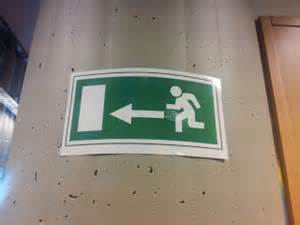
I have to admit, from an ‘objective’ perspective, the sign makes complete sense. Person walking toward door = exit. However, not what my Canadian brain is used to. My brain was like, WTF is does that mean, green is not the colour of exit, not now and not ever!
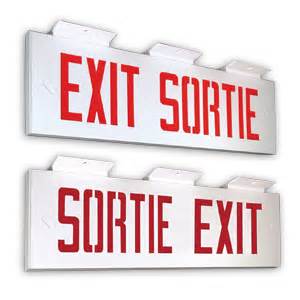
Oh yah, that is what I’m talking about. Red and with words and stuff! Brain Happy! Everything is normal and well! At least from a Canadian point of view. Recently, CBC hosted and article about American tourists on their trip to New Brunswick and their experiences with Canadian signage.
“What began as a minor puzzlement for my wife and me bloomed over the course of a few days into a full-on obsession,” he wrote of the various signs they encountered. “What in the name of Rob Ford were the road signs trying to tell us?”
Burr’s friends and family on Facebook were equally confused by a photo he posted of a green-and-white River Valley Scenic Drive signpost. None of the 2,845 people who weighed in on his post could reportedly identify it.
“The signs of New Brunswick’s highways and byways aren’t exactly done wrong, but they seem to require a cognitive leap of which our American sensibilities, enfeebled by reality TV shows and Katy Perry songs, are incapable,” he explained. “My wife and I found ourselves gazing across a semiotic void, one that necessitated a more elusive process of conversion than miles to kilometres, English to French, or American quarters to Canadian dollars.”
His interpretations are amusing. Here are some gleaned from the article.
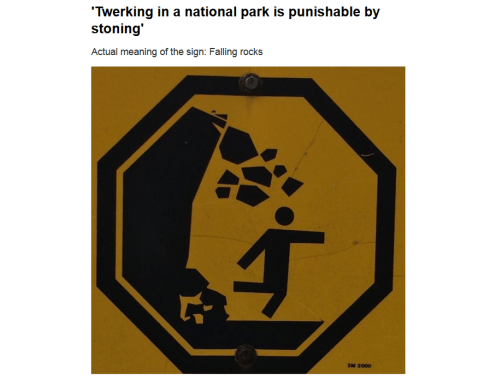
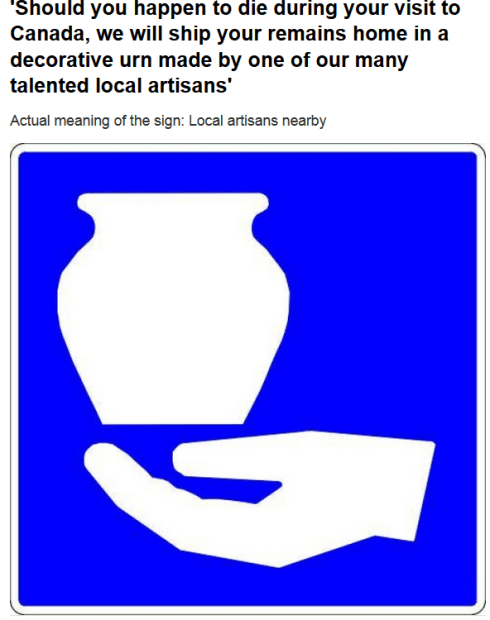

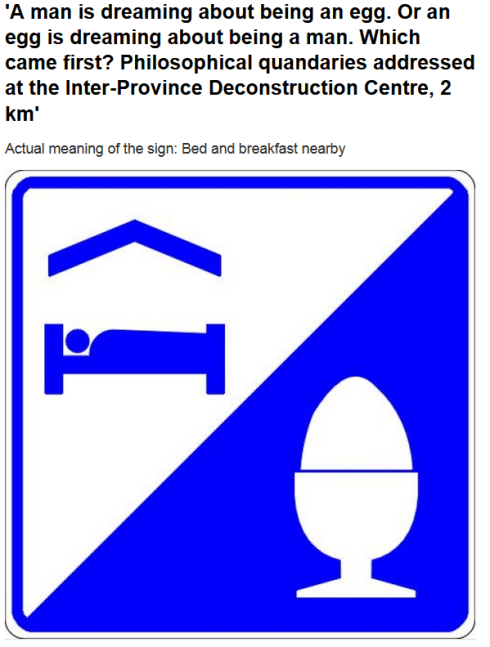

I have my own to add to the list. I saw this on an elevator in Iceland:

Do Not Go into Boxes otherwise angry birds will attack!
Sign universality – one day it will happen I’m sure. :)











 bleatmop
 Mystro


 Dead Wild Roses
Your opinions…