
You are currently browsing the monthly archive for March 2016.
I am very privileged and honoured to host thoughts on prostitution and ‘sex work’ from Emma, a recent addition to the DWR commentariat. Emma takes a hard look at the commercial rape trade and those who support it. With Emma’s permission I am reposting her comment to the main blog, as it is simply made of awesome and unworthy of being buried in a comments section.
Thank you Emma for your words on this topic.
[The message was edited for line breaks, otherwise appearing in its original form]
There is very little in terms of a meaningful convo on this subject with people who insist that having sex is like going to a restaurant.
It’s not just a different outlook on life, it is a different universe altogether, made impenetrable by either a complete absence of conscience (or even “simple” imagination) or its willful (?) shut down . Been there, done that, got tired of debating the gloriousity of “sex work.”
888
But I have yet to meet a girl who dreams of becoming a masturbatory receptacle, a sexual outlet/toilet, for men. Doing “sex work” one day is not something little girls aspire to. When I grow up, I want to make a life for myself by being penetrated in every possible way, often violently, by multiple strange men — many of them disordered and deranged, and unable to find a woman to form a relationship with for obvious reasons — who, after ejaculating into me, will care about me as much as about used tissue –888
said no little girl ever.888
Just like there are no girls who dream of becoming an object to be used and abused (sexually and not), there is no parent who would encourage and champion that kind of “career” for their child(ren). And that includes the johns, pimps, and “sex workers” themselves. I don’t know of a “sex worker,” even a “high class escort” or a “happy hooker,” who would encourage her children to pursue this line of “work.”888
Check out this report, “Welcome to Paradise,” about German legal brothels: http://s.telegraph.co.uk/graphics/projects/welcome-to-paradise/888
Here’s the end paragraph:888
[The brothel] Paradise’s [owner] Jürgen Rudloff appeared in a documentary, “Sex – Made in Germany”, which aired on the German public broadcaster ARD last summer. In one scene he’s sitting in his spacious kitchen dressed in an open-necked white shirt and linen jacket, surrounded by his four shiny-haired, privately-educated children.888
Would he be happy for either of his two daughters to work at Paradise, the interviewer asks. Rudloff turns puce. “Unthinkable, unthinkable,” he says. “The question alone is brutal. I don’t mean to offend the prostitutes but I try to raise my children so that they have professional opportunities. Most prostitutes don’t have those options. That’s why they’re doing that job.”
He pauses and looks away.
888
“Unimaginable”, he repeats. “I don’t even want to think about it.”888
That from a man who knows this “business” as few others do; he runs it, after all.888
He does not even want to think about this option for his daughters, but he has no qualms “encouraging” unrelated women to join his “business.” Like so many johns and pimps and sex “business” owners, he’d do his very best to prevent his daughters from going into this line of “work,” but it does not stop him from exploiting other, powerless young women.888
This peculiar mental split is depressingly common, and one dark aspect of male sexuality that nearly all men are in denial about and unwilling to explore, ever. Any attempts to have them try to even acknowledge and look at it are usually met with violent and/or hysterical reactions, accusing the questioneer of misandry and similar fairy tales, of demonizing male sexuality and trying to shut it down, etc. And, oh, freedom, wouldn’t you know. It’s as predictable as clockwork.888
One thing that’s certain about human beings (apart from their endless stupidity) is their bottomless capacity for rationalization. There is no behavior, no matter how depraved and evil, that cannot be rationalized away by its participants and/or perpetrators.
All slides are from the presentation by Dr. Cathy Higgins.
Given that power works best from the shadows (insert creepy *mou-ah-ah-ah, here), it is always beneficial to bring the artifice of power into plain sight so can be properly evaluated and critiqued. If one doesn’t know what Patriarchy is, then how can it ever be brought down? Finding the root of the problem and working toward solving that problem – what radical feminism is – provides the means not only to criticize our patriarchal society, but to change it.
Lofty goals aside, for the critical work to get done, a common base of knowledge must be established, hence the reason for our 14 slide foray into the land of patriarchy.
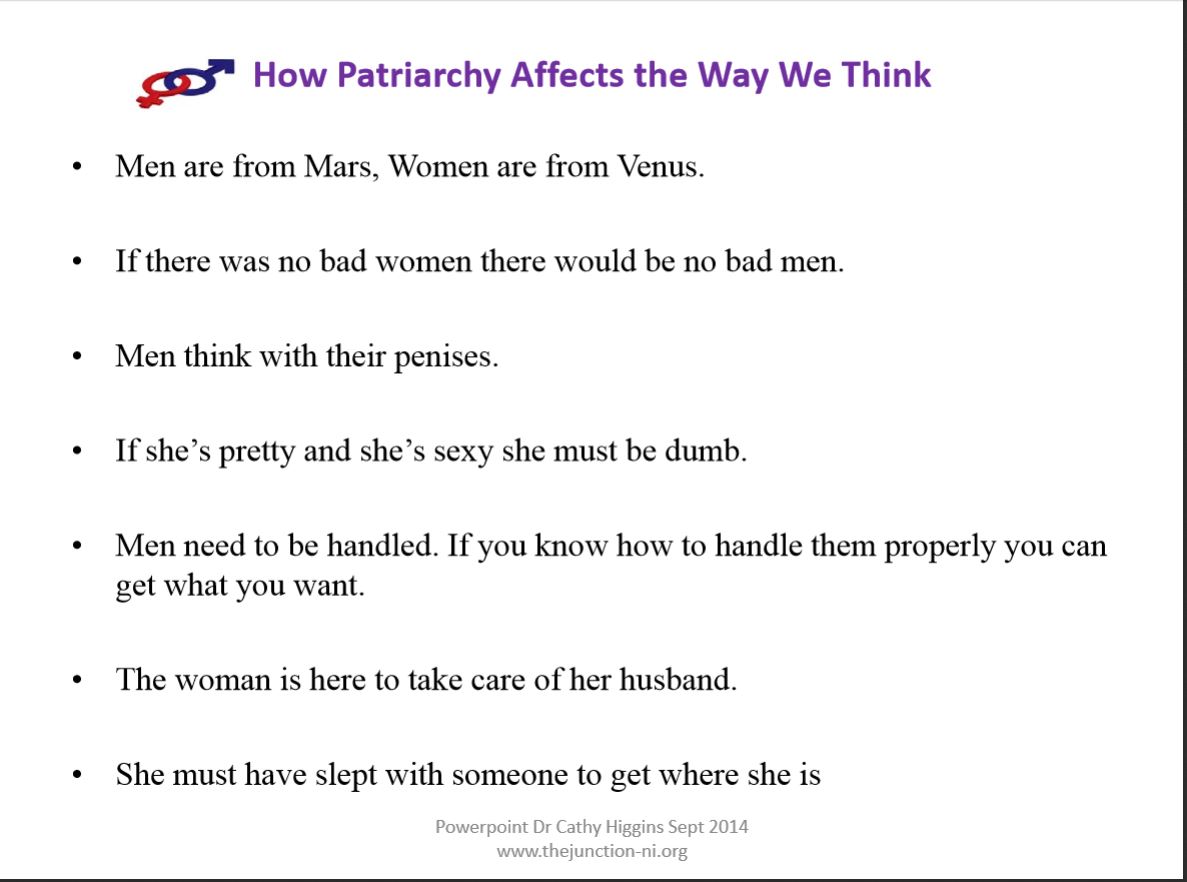
Slide 1 – Patriarchal Gender Stereotypes

Slide 2 – The Patriarchy – How this system comes about.

Slide 3 – The qualities of Patriarchy.
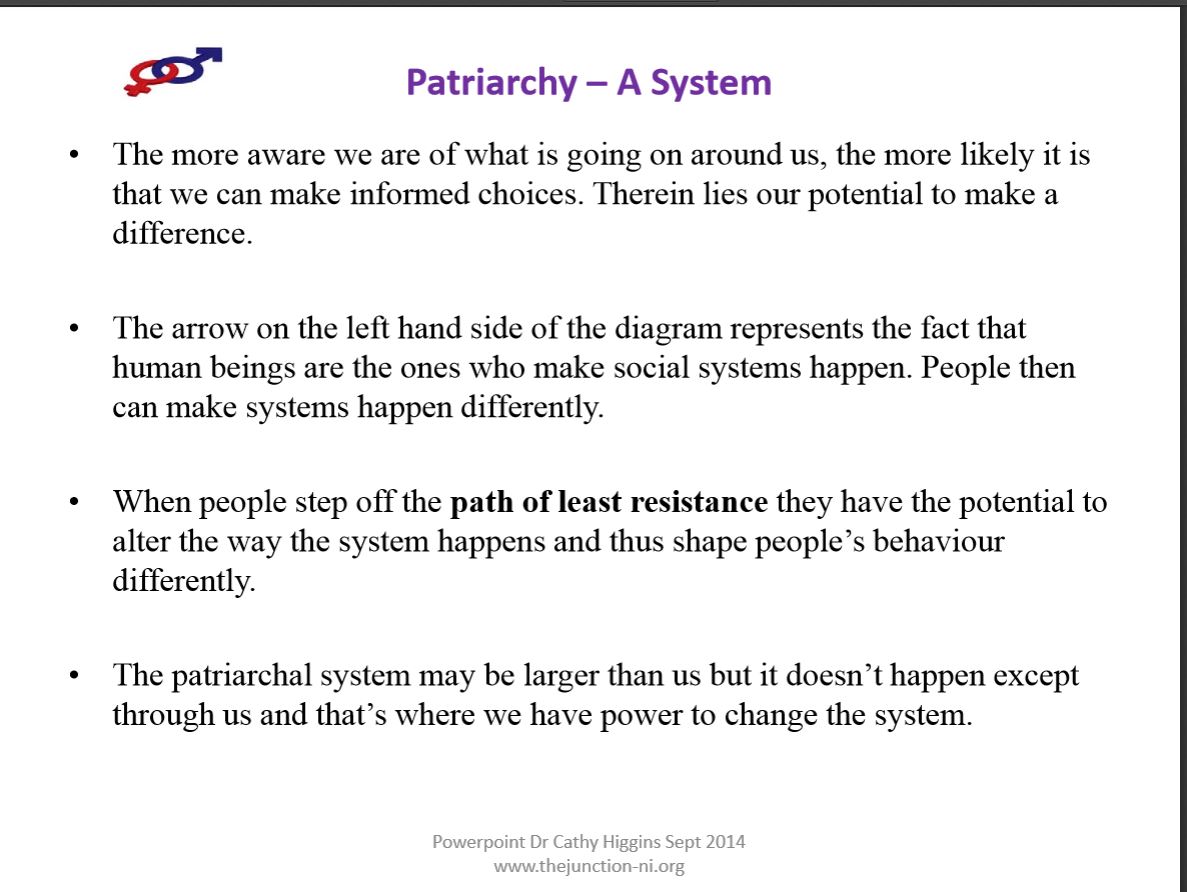
Slide 4 – The role of the individual in the system of Patriarchy.

Slide 5 – Patriarchy – definitions and consequences.
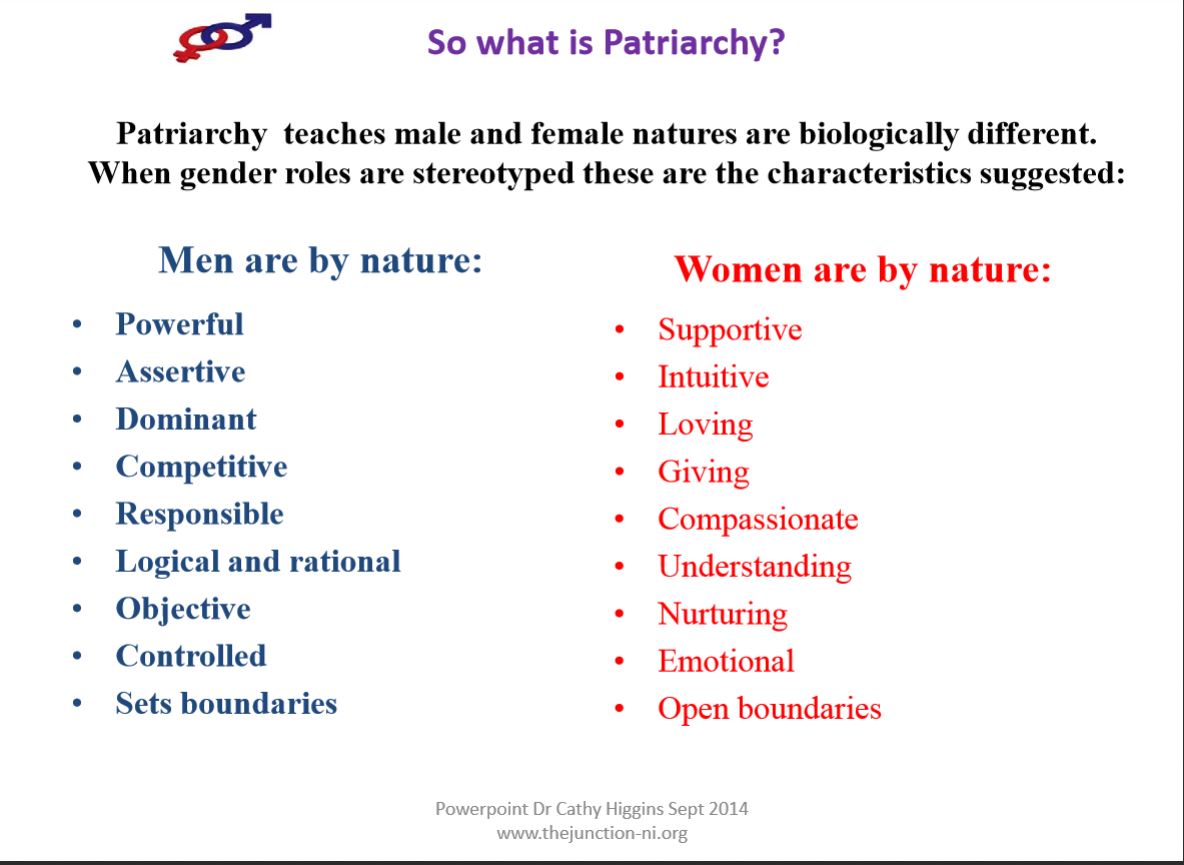
Slide 6 – Patriarchal Stereotypes

Slide 7 – Patriarchy in ‘Western’ Society – What it looks like.
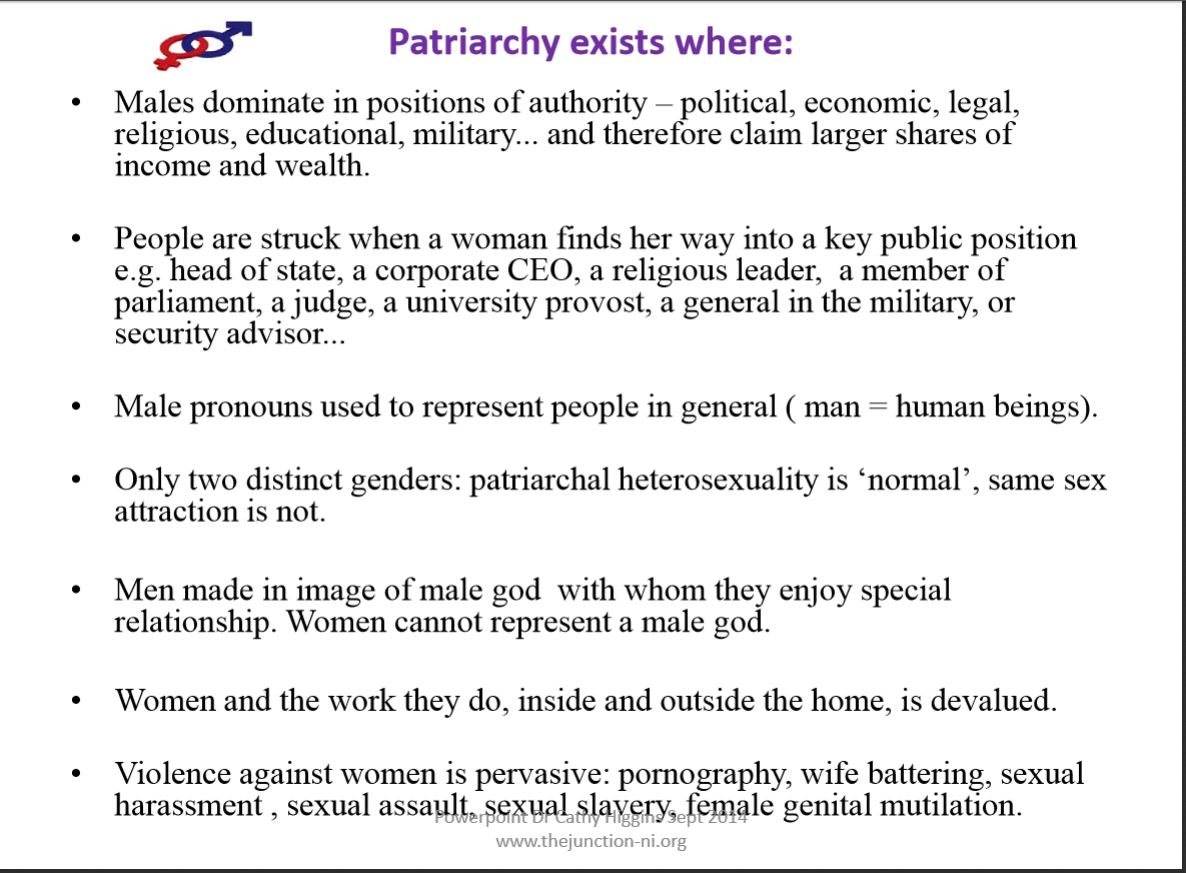
Slide 8 – The specifics of Patriarchy.
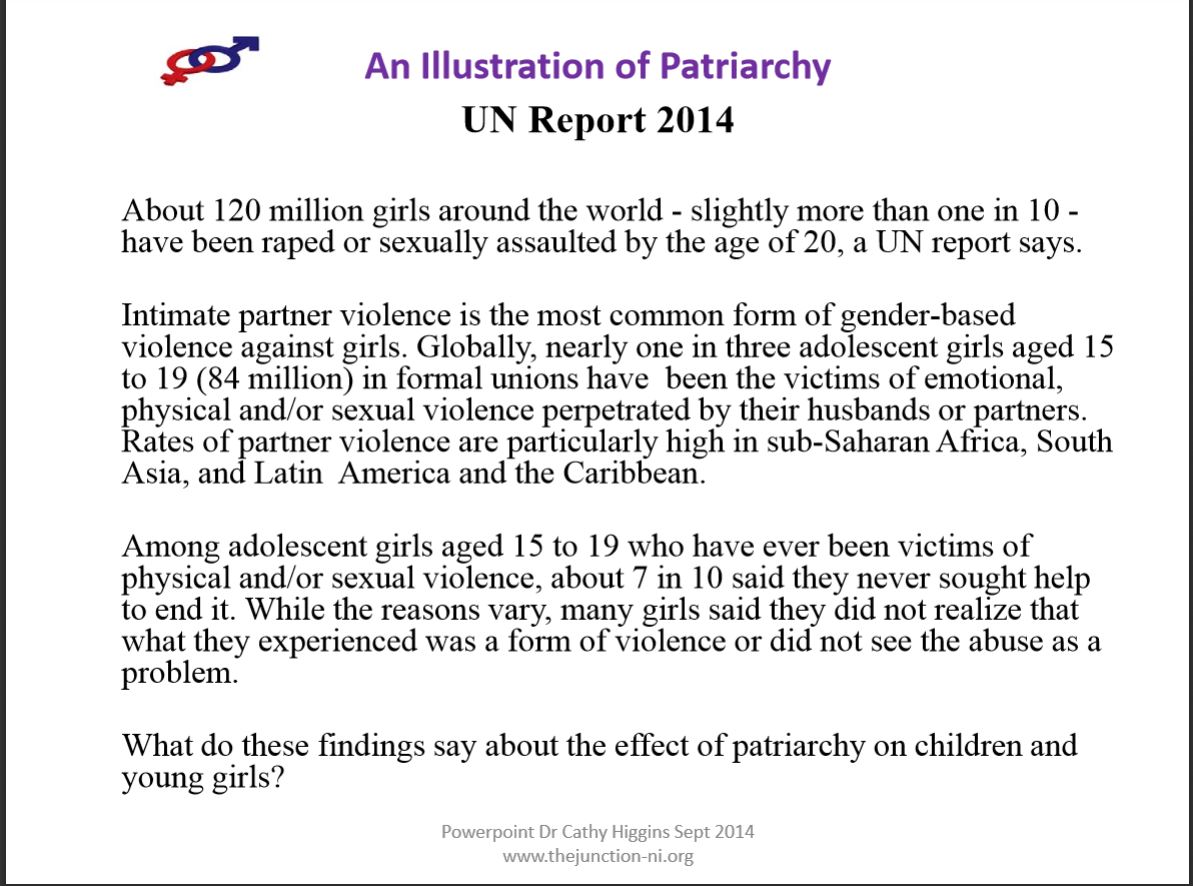
Slide 9 – Patriarchy’s effects on more global scale.
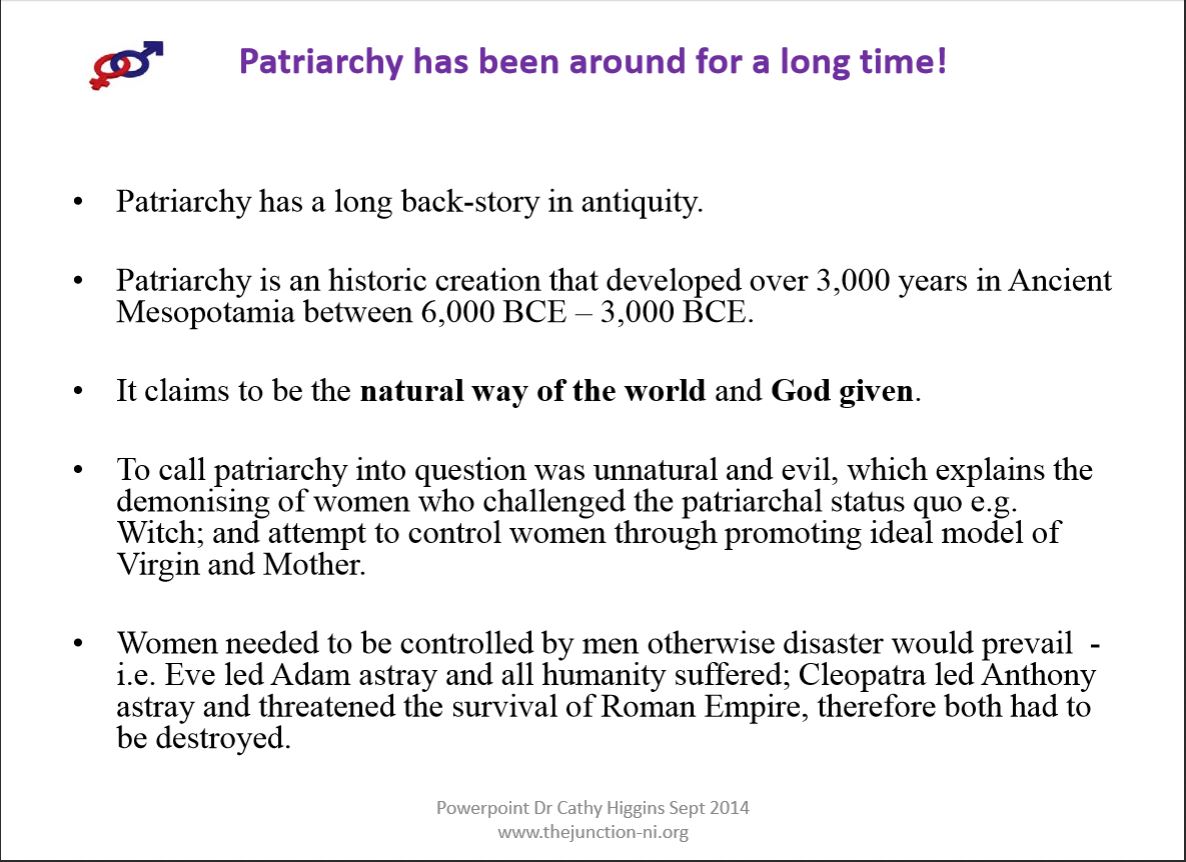
Slide 10 – Historical origins of Patriarchy.
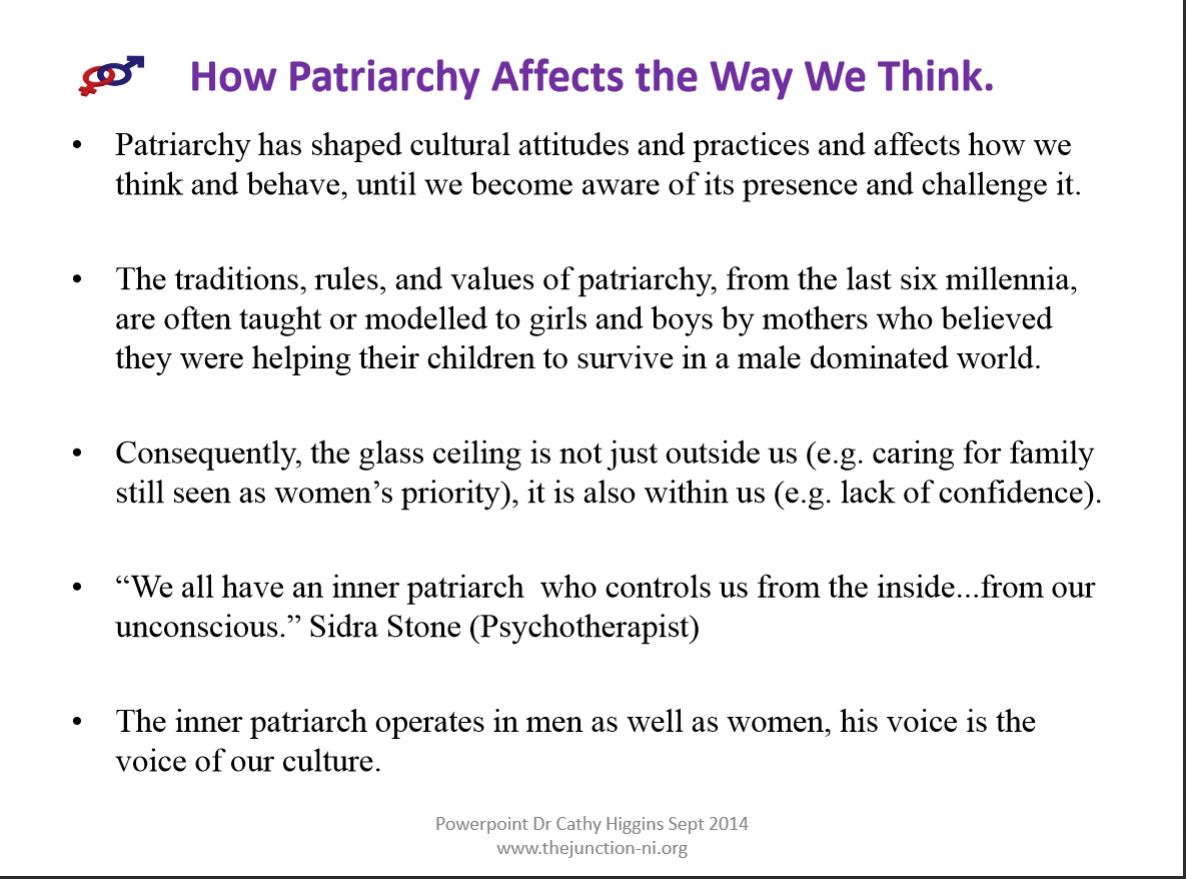
Slide 11 – Patriarchy in society and within ourselves.
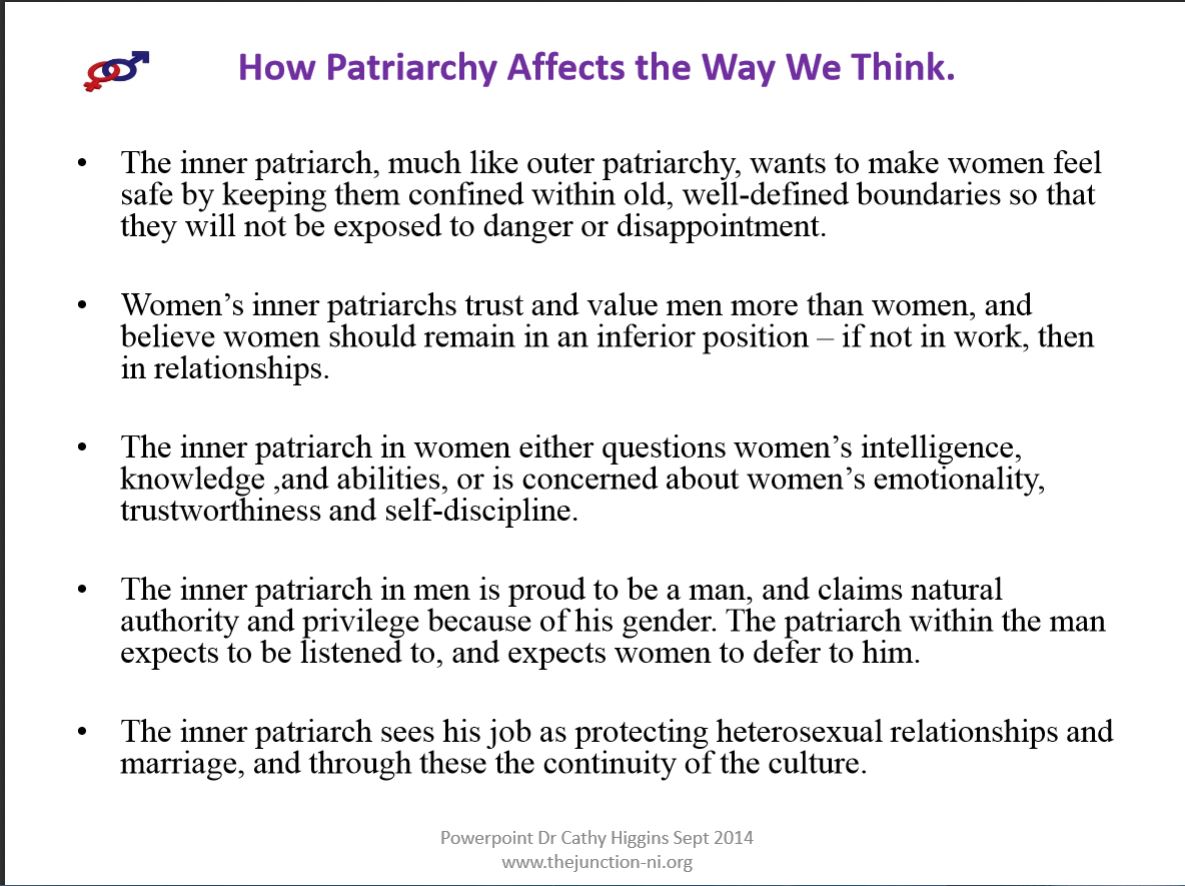
Slide 12 – Patriarchy in society and within ourselves, continued.
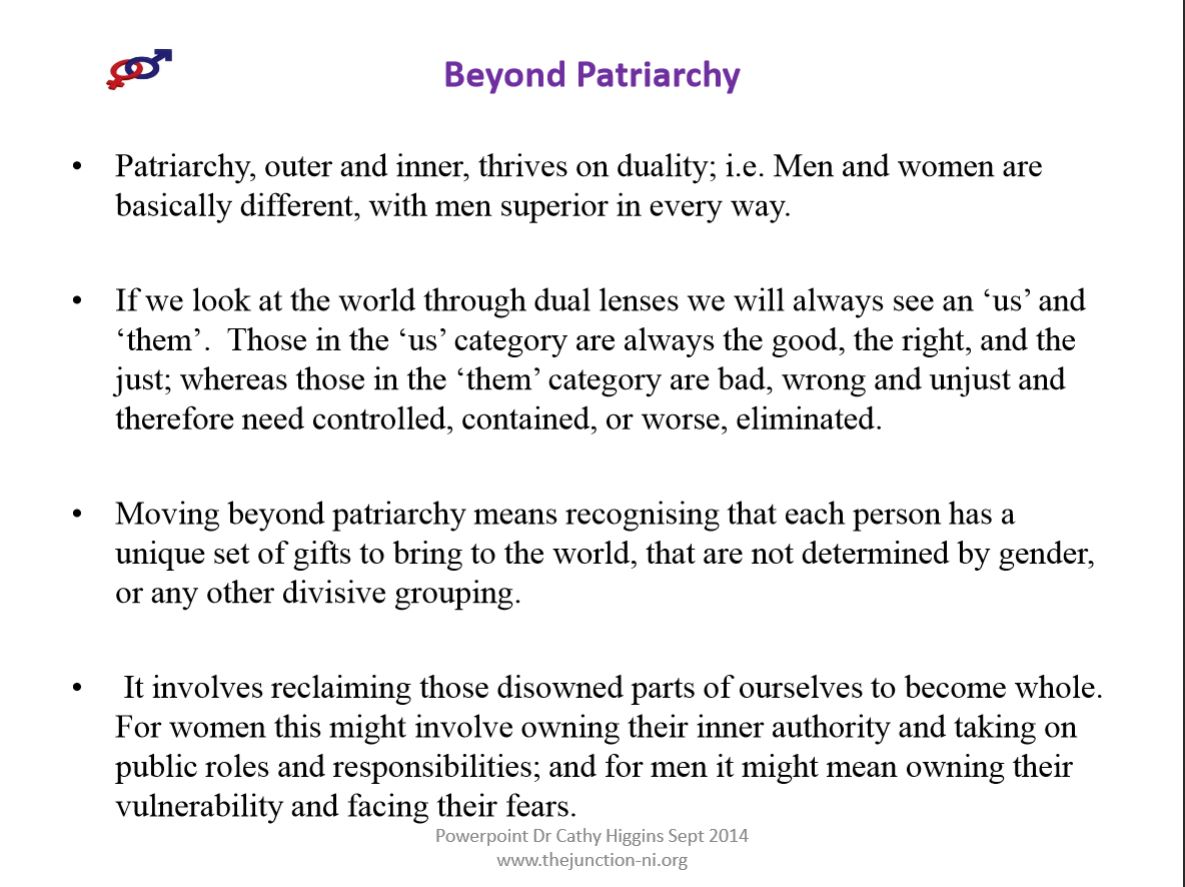
Slide 13 – Fighting the patriarchal paradigm.

Slide 14 – Conclusions and questions to ponder.
Ahh, you can hear the faint hum of the patriarchal machinery gently whirr in the background as it gently churns out non-provocative titles such as this:
“Sexy outfits for female staff may be discriminatory.”
The unabashed use of the qualifier quickly raised this commentators eyebrow and raised the feminist lobes to a strong yellow alert. Was this a sage nod to journalistic principles or just a slavish introduction to (yet another) slap-happy, patriarchally-reinforcing, equality hug-fest?

Objectification? Nah. Double standards for the sexes?
Thankfully, the code yellow lobe condition turned out to be unnecessary as the article found its way and made some crunchy assertions about the sexism women face in the workplace.
“Should you have to dress sexy to keep your job? Many women working at some of Canada’s popular restaurant chains say they do.
But dress codes for female staff at some restaurants — which can include high heels, tight skirts and heavy makeup — may violate women’s human rights, according to some experts.”
Wow, enforced femininity violating human rights? It’s almost like the material conditions forced on one class of people is destructive and not conducive to healthy existence in society.
“CBC Marketplace investigated the dress codes at some of Canada’s top restaurant chains and heard from dozens of female staff who say they felt pressured to wear revealing outfits or risk losing shifts.
“The dress is so tight that you can see your underwear through it,” says a current employee of Joey Restaurants who asked to remain anonymous for fear of losing her job.
She claims she was told not to wear underwear at all in order to avoid this.”
Because wearing a sexy tight dress is the necessary foundation for serving people food and drink. Hmm, seems like there is a societal standard at work here – rhymes with blofectification….can’t quite put my finger on it. I’m sure my fellow blamers will help me out though…
“It is sex discrimination. I have no doubt about it,” she [University of Ottawa law professor Joanne St. Lewis] says. “The male employees are doing exactly the same task as the female employees … And they do not need to sexualize their clothing. That’s the bottom line.”
Yep. The good prof correctly identifies that problem, there is a set of standards for women, and a set of standards for men. Guess which sex has more harmful rules and stipulations?
“Toronto pastry chef Kate Burnham grabbed headlines in 2015 when she spoke out about her alleged sexual harassment while working in the kitchen of a popular downtown restaurant, Weslodge.
Burnham’s case nabbed the attention of Toronto-based restaurant owner Jen Agg, who took to Twitter to say sexism and sexual harassment are major issues in the industry.
It also provoked Agg to organize a conference on the topic called “Kitchen Bitches: Smashing the Patriarchy One Plate at a Time.” The event, which brought both men and women together to discuss the abuse happening in restaurants, sold out.
Agg says what happens in kitchens is shocking.
“Slapping with tongs, snapping bras, relentless grabbing — women chefs learn quickly to crouch, never bend over, when picking up a pot,” she wrote in an op-ed in the New York Times.
St. Lewis suggests sexualized dress codes can send a signal that tolerating harassment is part of the job.
“That is not something that I think any employer has the entitlement to ask in 2016 of any woman in a Canadian workplace,” she says.”
Yep, because being slapped, having one’s bra snapped and being relentlessly grabbed are all hallmarks of a relentlessly egalitarian society. Women systematically being treated as objects, with little or no respect to their autonomy, it’s almost like there is a prevailing social set of norms, some feminists like to call Patriarchy, at work.
There certainly seems to be a great deal of confusion about basic terminology. Let’s see if we can un-muddy the waters a bit. This is taken from Trouble and Strife.
“Debbie Cameron: The purpose of today’s discussion is to try to cut through some of the theoretical and political confusion which now surrounds the concept of gender, and it’s probably useful to start by asking what’s causing that confusion.
Conversations about ‘gender’ nowadays often run into problems because the people involved are using the same word, to mean somewhat the same thing, but on closer examination they aren’t talking about the same set of issues from the same point of view. For instance, when we launched the T&S Reader at the Edinburgh radical bookfair, some women students came up to us afterwards and said they were very pleased we’d produced the book, but surprised it didn’t have much in it about gender. Actually it’s all about gender in the radical feminist sense–power relations between women and men–so this comment did not make much sense to us. Joan was initially completely baffled by it; I realised what they must be getting at only because I’m still an academic, and in the academy you hear ‘gender’ used this way a lot.
What’s going on here is that during the 1990s, queer theorists and queer activists developed a new way of talking about gender: it did have points of overlap with the older feminist way of talking, but the emphasis was different, the theory behind it was different (basically it was the postmodernist theory of identity associated with the philosopher Judith Butler, though I don’t think Butler herself would say that feminists had no critical analysis of gender), and the politics that came out of it were very different. For people whose ideas were formed either by encounter with academic feminist theory or by involvement in queer politics and activism, that became the meaning of ‘gender’. They believed what they’d been told, that feminists in the 70s and 80s didn’t have a critical analysis of gender, or that they had the wrong analysis because their ideas about gender were ‘essentialist’ rather than ‘social constructionist’.
We don’t believe that, and in a minute we’ll explain why. But first it’s worth doing a general ‘compare and contrast’ on the ‘old’ feminist view of gender and the newer version that came out of 1990s queer theory/politics.
‘Old’ gender ‘New’ gender What is gender? A system of social/power relations structured by a binary division between ‘men’ and ‘women’. Categorization is usually on the basis of biological sex, but gender as we know it is a social rather than biological thing (e.g. masculinity and femininity are defined differently in different times and places) An aspect of personal/social identity, usually ascribed to you at birth on the basis of biological sex (but this ‘natural’ connection is an illusion—as is the idea that there have to be two genders because there are two sexes) What’s oppressive about it? The fact that it’s based on the subordination of one gender (women) by the other (men) The fact that it’s a rigid binary system. It forces every person to identify as either a man or a woman (not neither, both at once, something in between or something else entirely) and punishes anyone who doesn’t conform. (This oppresses both men and women, especially those who don’t fully identify with the prescribed model for their gender) What would be a radical gender politics? Feminism: women organize to overthrow male power and thus the entire gender system. (For radical feminists, the ideal number of genders would be… none.) ‘Genderqueer’: women and men reject the binary system, identify as ‘gender outlaws’ (e.g. queer, trans) and demand recognition for a range of gender identities. (From this perspective, the ideal number of genders would be… infinite?) There are both similarities and differences between the two versions. For both, gender is connected to, but not the same as, sex; for both, gender as we know it is a binary system (there are, basically, two genders); and both approaches would probably agree that gender is about power AND identity, but their emphasis on one or the other differs. They also differ because supporters of the queer version don’t think in terms of men oppressing women, they think gender norms as such are more oppressive than power hierarchy, and want ‘more’ gender rather than less or none.”
Woo, that’s probably enough for part one. :)
A good talk on some of the problems facing people who wish to debate sensitive topics in society.
“No idea is above scrutiny and no people are beneath dignity. And what I mean by that is that no idea in Islam, like any other religion and any other philosophy and political thought and creed, is an idea. An idea is by definition adopted voluntary and therefore should be subject to scrutiny. And so I don’t subscribe to any form of blasphemy or censorship when it comes to an intellectual and rigorous debate around any idea. On the other hand, no people are beneath dignity.
So no idea is above scrutiny, no people are beneath dignity. And what I mean by that is, it’s very easy when understanding it in this way to recognize, and you can recognize it in your gut, the difference between somebody who is saying I don’t like the religion of Islam. Let me scrutinize it, you know. I think this whole thing about the literal word of God doesn’t sit comfortable with me. That’s very different to someone saying all Muslims are terrorists and they are a disease in America we must expel them. Your gut can recognize the difference between those two. I think Muslims as a people deserve every dignity like any other human being. But every single idea – Charlie Hebdo is a case in point. People have the right, the absolute right to scrutinize and satirize.”
From Science Daily:
“Now neuroscientists at the University of Sussex’s Sackler Centre and Brighton and Sussex Medical School have identified the brain network system that causes us to stumble and stall just when we least want to.
MRI
Dr Michiko Yoshie and her colleagues Professor Hugo Critchley, Dr Neil Harrison, and Dr Yoko Nagai were able to pinpoint the brain area that causes the performance mishaps during an experiment using functional magnetic resonance neuroimaging (fMRI).
Previous research has shown that people tend to exert more force when they know they are being watched. For example, pianists unconsciously press keys harder when they play in front of an audience compared to when playing alone.
In the new study, published in Scientific Reports, participants’ brain activity was monitored while carrying out a task that required them to exert a precise amount of force when gripping an object.”

Now, can we apply this to women in who just happen to exist in society? – The Deep Woods certainly thinks so.
“Given the fact that women are constantly watched in our society, and we are constantly REMINDED that we are being watched by people making fun of fat, “ugly”, or gender-nonconforming women, it makes me wonder how many women have messed up important tasks or projects or just day-to-day activities because A PART OF OUR BRAIN is permanently being deactivated?
[…]
Women are constantly held under the microscope- whether we are attractive or unattractive, the gaze of patriarchy never ends.”
Can a parallel be drawn between having an audience, and the male-gaze that is ever present in our society? Looks like another study is in order, but the connection, if proven wouldn’t be particularly surprising.
The “Sucker Punch Remix” of Björk‘s “Army of Me” is based upon a trip hop production and “repeatedly pummels via the psychedelic vocal delivery and careening, crushing guitars”.
Did you need to darkly-dangerously rock out? This, gentle readers, is your tune.











 bleatmop
 Mystro


 Dead Wild Roses
Your opinions…