
Consider the Hollywood actor giving the classic “follow your dreams and never give up” line is bad advice and is pure survivorship bias at work. Well what is surviorship bias? Let’s take a look friends and learn. :)
“Survivorship bias, or survival bias, is the logical error of concentrating on the people or things that “survived” some process and inadvertently overlooking those that did not because of their lack of visibility. This can lead to false conclusions in several different ways. The survivors may be actual people, as in a medical study, or could be companies or research subjects or applicants for a job, or anything that must make it past some selection process to be considered further.
Survivorship bias can lead to overly optimistic beliefs because failures are ignored, such as when companies that no longer exist are excluded from analyses of financial performance. It can also lead to the false belief that the successes in a group have some special property, rather than just coincidence (Correlation proves Causation). For example, if three of the five students with the best college grades went to the same high school, that can lead one to believe that the high school must offer an excellent education. This could be true, but the question cannot be answered without looking at the grades of all the other students from that high school, not just the ones who “survived” the top-five selection process.
Survivorship bias is a type of selection bias.”
“During World War II, the statistician Abraham Wald took survivorship bias into his calculations when considering how to minimize bomber losses to enemy fire. Researchers from the Center for Naval Analyses had conducted a study of the damage done to aircraft that had returned from missions, and had recommended that armor be added to the areas that showed the most damage. Wald noted that the study only considered the aircraft that had survived their missions—the bombers that had been shot down were not present for the damage assessment. The holes in the returning aircraft, then, represented areas where a bomber could take damage and still return home safely. Wald proposed that the Navy instead reinforce the areas where the returning aircraft were unscathed, since those were the areas that, if hit, would cause the plane to be lost.[8][9]”
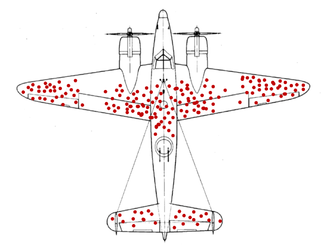
So, they said: the red dots are where bombers are most likely to be hit, so put some more armor on those parts to make the bombers more resilient. That looked like a logical conclusion, until Abraham Wald – a mathematician – started asking questions:
– how did you obtain that data?
– well, we looked at every bomber returning from a raid, marked the damages on the airframe on a sheet and collected the sheets from all allied air bases over months. What you see is the result of hundreds of those sheets.
– and your conclusion?
– well, the red dots are where the bombers were hit. So let’s enforce those parts because they are most exposed to enemy fire.
– no. the red dots are where a bomber can take a hit and return. The bombers that took a hit to the ailerons, the engines or the cockpit never made it home. That’s why they are absent in your data. The blank spots are exactly where you have to enforce the airframe, so those bombers can return.This is survivorship bias. You only see a subset of the outcomes. The ones that made it far enough to be visible. Look out for absence of data. Sometimes they tell a story of their own.
BTW: You can see the result of this research today. This is the exact reason the A-10 has the pilot sitting in a titanium armor bathtub and has it’s engines placed high and shielded.
If you want to think scientifically, ALWAYS ask what data was included in a conclusion. And ALWAYS ask what data was EXCLUDED when making a conclusion.











 bleatmop
 Mystro
 The Arbourist


 Dead Wild Roses
7 comments
March 18, 2017 at 6:56 am
tildeb
This idea is central to the difference between playing beginning level versus really good Bridge – a card game that requires a fair bit of thinking, assessment, and planning to become really good at it. There is an equivalent amount of very useful information (leading to correctly assessing where certain key cards must be and then planning accordingly) to be gained by what an opposing player does NOT play as there is from any cards that ARE played. Assessing what is NOT present and making reasonable guesses why that may be is the difference that provides keen insight. The bias towards plans made on only cards that can be seen is a guaranteed method to being beaten in Bridge every single time against better players who don’t fall into this trap.
LikeLiked by 1 person
March 18, 2017 at 9:13 am
The Arbourist
@tildeb
I enjoy card games, but making the leap to Bridge has eluded me. I thought I could ease my way from Spades to Bridge, but no such luck. I’ve read a few bridge books, and it still seems mostly opaque. :)
LikeLike
March 18, 2017 at 9:33 am
john zande
This made me think about the option available to coroners when filling out Cause of Death: Misadventure.
I would like my death certificate to read, Cause of Death? Misadventure.
LikeLike
March 18, 2017 at 9:37 am
roughseasinthemed
Part of the problem with data analysis (I spent some time in performance management) is that 1) people don’t ask the right questions (if any) and 2) they don’t think laterally. Probably because they aren’t paid to think. Que surpresa.
I’m cool with poker, gin rummy, whist, and extremely good at Snap! Also dominoes and draughts. Bridge is to cards as to chess is to board games (although I did learn that at one point).
LikeLike
March 18, 2017 at 9:46 am
tildeb
Played well, Bridge is a really good game that is very challenging but deeply rewarding. In fact, a university roommate made the mistake of claiming that, like any card game, luck was often the determining factor to win at Bridge.
Umm…
My good friend and often Bridge partner immediately made a bet with my roommate for a hundred buck that we would beat him and whatever partner he chose 50 matches in a row to demonstrate that luck of dealing cards played no part.
He took the bet (obviously, his education was sorely lacking and in need of remedial work. So we started dealing the cards…).
At the cost of studying and sleep, we played day after day, night after night, sleeping only fitfully until we had completed 40 matches and won all before my roommate and his partner quit the competition two weeks later in disgust.
My partner pocketed the 100 bucks and went out and drank it all the following weekend. I stayed back and tried to make up for lost study time. For some weird reason, whenever Bridge is mentioned these days, I become and remain thirsty… until the next weekend passes.
Funny, that.
LikeLike
March 18, 2017 at 12:11 pm
bleatmop
An excellent post. Survivorship bias and confirmation bias seem very closely related. One is only seeing/using the data you want to see because it supports your conclusion and the other is only using the data that seems obvious and not digging to get all the data or misinterpreting the data you have. Either way I have stories that I really cannot share due to privacy laws in where I’ve seen some of the sharpest minds I know fall into these bias traps. It’s an easy road to go down and take a disciplined mind to keep aware that what you believe to be true based on these evidences could be wrong because you haven’t analyzed the data correctly.
On a more discussable topic related to this, it seems that the poll aggregators like Nate Silver’s FiveThirtyEight fell into these traps big time during the past POTUS election cycle. I frequented these sites and if my memory holds true the reason why these aggregators failed so hard was not because the lack of polls showing that Trump could win but in fact because they gave those polls significantly less weight than those that showed Hillary in a big lead. And once the weight scales were tilted to one side, the evidence that contradicted them continued to get weighted less and less and the evidence that confirmed their models continued to get weighted heavier and heavier.
Well, we all know how that worked out. The challenge for people like Nate Silver is how do they move forward and adjust how they weigh polls to better reflect reality. Bias is a sneaky devil but I quite like post hoc analysis of it. Often you can learn more from failure than you can from success.
LikeLiked by 4 people
March 19, 2017 at 2:42 am
makagutu
What bleatmop has said.
LikeLike