
You are currently browsing the monthly archive for September 2017.

I’ve seen it happen, no word of a lie. :)

    I am playing catch up with the recent dust-up around the choice of tactics used by Antifa in the United States in it’s struggle against the proto-fascist elements energized by the current Republican Administration led by Trump.  There are several sources in this brief overview, first from a academic journal to help with the context of state violence, then a rough sketch of the position taken by Hedges and Chomsky, and finally the reply found in Counterpunch.  The last article from Counterpunch, is a retort to Chris Hedges, a voice on the credentialed left who has taken a stance against the violent tactics used by Antifa.

We’ll be visiting Hedges’ article (and criticism)on Truthdig in a later post, but for now, examining the question of violence and how it is used, and by who it is used by in society provides a stepping stone toward providing a more nuanced entry into this debate.  To better understand how (in just one way) the state uses violence to arrange society we turn to an article written by Carol Nagengast, in the Annual Review of Anthropology titled Violence, Terror, and The Crisis of the State (p. 24): 

“The state must be a state of mind that divides people into the purified and honest who do legitimate work and a politically suspect or criminal,
deviant underworld of aliens, communists, loafers, delinquents, even thieves, killers, and drug lords who do not. The violent dissident must be positioned
and repositioned as necessary, “in a negative relationship with middle-class rational masculinity, a model that ensures a relationship of dominance and
subordination … by locking the two into a mutually defaming relationship”

     (16:15,21). In the United States, the presumed idleness of the unemployed, the poverty-stricken, the drug user or gang member, the single parent, gay man or
lesbian woman (all the latter with overtones of promiscuity and contagious disease) is also seen as violence against the social body. It cannot be just any
old work; it must be work that contributes to what dominant groups have defined as the common good (153).

     The hegemony of respectable culture and good taste and the denigration of what is represented as the disgusting, degenerate, worthless, criminal lower
parts of the social body is so strong that, according to a poll conducted by the Washington Post and ABC News in September 1989, 66% of those surveyed
favored random searches of peoples’ houses, cars, and personal belongings, even if the police had no suspicion of any wrongdoing. Seventy-two percent
said they approved of censorship of any film depicting illegal drug use. People have been so inoculated with the fear of evil and with the myth of an essential
relationship of repression to the cure of society, that they are willing to give up some of their own rights for what has been defined as the good of the social
body

The questions the fascist/antifa situation embodies goes back to the genesis of why we have states in the first place and the techniques used (see the myth of the relationship between the use of repression to cure soceity) to maintain order in said States.  The use of fear to discipline society is nothing new, case in point, consider the the fear cultivated in the buildups to the invasions of Iraq and Afghanistan.  The use/misuse of fear as a cultural motivator in Western society is being replayed yet again on the national (within the US) instead of international stage.   Looking toward answering the question of who gets to legitimately use violence in society with regards to the fascist/antifa question Noam Chomsky opines:

     “As for Antifa, it’s a minuscule fringe of the Left, just as its predecessors were,” Noam Chomsky told the Washington Examiner. “It’s a major gift to the Right, including the militant Right, who are exuberant.”  Many activists affiliated with the loosely organized Antifa movement consider themselves anarchists or socialists. They often wear black and take measures to conceal their identity.  Chomsky said, “what they do is often wrong in principle – like blocking talks – and [the movement] is generally self-destructive.”  “When confrontation shifts to the arena of violence, it’s the toughest and most brutal who win – and we know who that is,”

So, it would seem that Chomsky and Hedges, who cites this interview, believe that the antifa use of violence is not the correct course of action.  The counterpoint to their assertion comes in with

     “One crucial question in this regard is why the conversation about violence that is continually re-staged in the media overwhelmingly focuses on tactics of resistance by the underclasses. Among those who are vociferously proclaiming a pure form of “non-violence” as an unquestionable moral principle, who of them is arguing that this principle should be applied to the corporate state and all of its imperial endeavors? Alongside the countless statements reprimanding anti-capitalist activists for street scuffles, where are the articles calling for the dismantling of the military-industrial complex, the dissolution of the police force, or the abolition of the prison system? Why isn’t the debate around non-violence centered precisely on those who have all of the power and all of the weapons? Is it because violence has actually worked successfully in these cases to impose a very specific top-down agenda, which includes shutting out anyone who calls it into question, and diligently managing the perception of their actions? Is violence somehow acceptable here because it is the violence of the victors, who are the ones who presume to have the right—and in any case have the power—to define the very nature of violence (as anything that threatens them)?

     Clearly, the fetishization of non-violence is reserved for the actions of the underlings. They are the ones who, again and again, are told that they must be civil (and are never sufficiently so), and that the best way to attain their objectives is by obeying the moral dictates of those above. Let us recall, in this light, James Baldwin’s powerful statement in the context of the black liberation movement of the 1960s and 1970s: “The only time non-violence is admired is when the Negroes practice it.”

So, what is the answer here?  How effective will violent leftist action be, and will the backlash further empower state repression?   Will the backlash continue to inoculate the citizenry with fear of violent ‘leftist violence’ thus justifying an increase in state use of coercive and repressive force against the left even though the initiators of said violence (aka the proto-fascist/nationalist Right in the US) are ultimately responsible for the situation in question?


Tomaso Albinoni (1671-1751) was an Italian Baroque composer and contemporary of Vivaldi. Albinoni was famous in his day as an opera composer, however he is mainly remembered today for his instrumental music including his Adagio in G Minor.

Life and Music
Born into a wealthy family of paper manufacturers who produced playing cards and owned several shops in Venice, Albinoni squandered his gifts as a young man.

Despite his exceptional talents as a singer, violinist and composer, during his teen years he indulged in the life of a talented ‘amateur’ among artistic friends. The success of his Op. 1 Trio Sonatas in 1694 quickly changed all that.

The Venetian public began to tire of the old operatic formulae, and at this point, Albinoni came close to giving up.

This resulted in a dramatic slowing down of the Albinoni production line during the 1730s and 1740s.

According to his death certificate, Albinoni had been bedridden for the last two years of his life.

Albinoni was pivotal in establishing the fast-slow-fast, three-movement concerto form, and his oboe concertos were among the very first of their kind ever published by an Italian composer.

His technique of opening his faster movements with an insistent motto, which is then used to bind the whole movement together, left its mark on the work of innumerable composers.

Yet by far the most prolific part of his output are his 53 known operas, however only three of these are still intact, most of the others having been lost except a handful of arias.

By the early 1720s, Albinoni had held the position of most popular composer for over a decade.

The fascinating bit here is how easy it is for us to fool ourselves into thinking we’re doing “x”, when in reality we are doing “y”. In this study, all that was required to mirror the bias in our society against women was for a company to have a policy of meritocracy in place. Under the aegis of this policy people in the study tuned out their thoughts and considerations for actual fairness and stopped appraising their actions.

      “When it came time to divvy up $1,000 in bonus money, there was a stark divide between participants in the meritocracy and non-meritocracy conditions. When the fictional company stressed fairness and individual performance, subjects gave men about 12 percent more than equally qualified women on average. When it didn’t mention a focus on merit, there was no significant difference between the bonus for men and women.

     Though the experiment didn’t provide specific insights into the reasons for the different results, based on previous academic work, Castilla and Benard suggest that the variance might have to do with the participants’ confidence in their own judgement. In agreeing with the company’s meritocratic principles, they might have bolstered their sense of their own objectivity or felt they had established their “moral credentials” as non-prejudiced people.

     “An organizational culture that prides itself on meritocracy may encourage bias by convincing managers that they themselves are unbiased, which in turn may discourage them from closely examining their own behaviors for signs of prejudice,” Castilla and Benard write.”

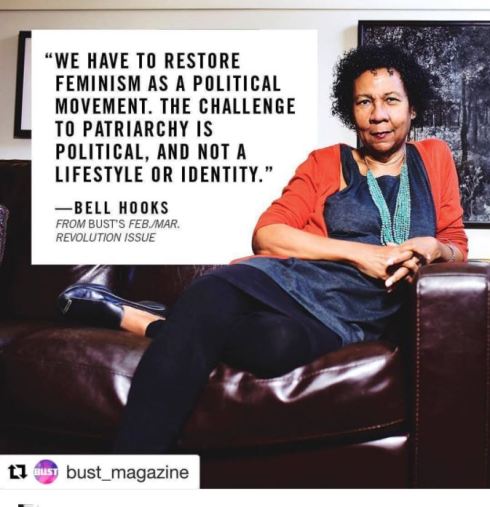
And there be the one of the problems with existing within a society that has normalized patriarchal standards.  It is so very easy to forget that the very societal air we breathe comes with a implicit set of normative attitudes that, when not consciously opposed, take over.  This is why not conforming to patriarchal expectations is tiring because feminists know that the ‘autopilot’ is complete trash and must always be on manual control.
[Source:JSTOR]

  Interesting article from the folks over at JSTOR.


     “According to Willinsky, “The schooled representation of meaning sets language in the hands of those who hold the proper definitions.” In other words, appeals to the dictionary serve a political purpose; they preserve existing power structures, and fortify the way things are at the expense of the way things can be.

     It can appear trivial to expend so much energy on worrying about how we speak, because speech seems less tangible than physical action. But definitions always matter. In the judicial system, for example, they are key in assigning blame. The “reasonable person” standard is applied in self-defense cases to determine culpability; in this context, “reasonable” means average, ordinary. As legal scholar Jody David Armour writes in Negrophobia and Reasonable Racism, this definition of reasonable “takes the merely typical and contingent and presents it as truth and morality, objectively construed,” a pretty low bar for justice. Consider how a “rational person” test or an “omniscient person” test might change the meaning of criminality.

     Similarly, there was a time in the American South when blackness, that thing that determined where one could eat, drink, and sit, was codified into law as having “one drop” of black blood. And migrants fleeing violence in Central America are rarely granted asylum in the United States because of the legal definition of “refugee.” There are profound consequences from definitions, and they should not be ceded to the staff of a reference book.

     Even words without legal import can hold incredible power. Speech can’t bruise skin, but it can break a spirit. Is a feeling any less real because it happens “under the hood?” Is heartbreak not real pain? Why do we describe hurtful words as a punch to the gut or a slap to the face? For so long, the free speech debate has been built upon an incoherent premise: that speech is powerful enough to solve social ills, but can’t inflict as much damage as a fist.

     When is speech violence? It depends on how we define it. If we define violence as a physical act, then speech is never violence. If we choose to define violence as causing harm to a person, then speech is often violence. If we choose to define violence as intentionally causing harm, then sometimes speech is violence.

     If there is to be one takeaway from the work of Wittgenstein, it’s that nothing is essential in language. He spent his entire life feeling around for the atoms of speech, only to discover that he was grasping at an illusion. Language is what we say, what we mean, and what we understand—different meanings for different people in different contexts.”

Interesting stuff.  I think I’ll have to read some more Wittgenstein.

CJ Hopkins writes a polemic about one of the themes that crops up in leftist literature.  The elite, who are our real enemies (of the common people) will employ just about any set of tactics to keep the populace engaged in harmless activity.  Bread and circuses if you will.

The marriage of politics and power is nothing new.  Yet we get hyperbolic essays like the one Hopkins’ penned for Counterpunch.


     “See, up to now, the dilemma we’ve been facing (or some of us have been facing, anyway) is how to respond to the ruling establishment’s concerted campaign to “regime-change” Trump. On the one hand, Trump is a living embodiment of everything the Left opposes. On the other hand, going after Trump has meant carrying water for the fake Resistance, i.e., that global corporatocracy (which, by the way, does not mean “the Jews.” I always like to slip that in to piss off my anti-Semitic readers.) This has been a bit awkward for some of us, restraining our impulse to stick it to Trump (at least on whatever talking points the Resistance is currently putting out) because in doing so we would align ourselves with the ruling establishment’s attempt to demonize, and eventually depose an American president who isn’t playing ball with them properly. If we oppose regime change in other countries, shouldn’t we also oppose it at home? Or do the ruling classes get a pass this time because Trump is such an exceptional monster? But wait … wasn’t Saddam a monster? And Gaddafi? And all the other “Hitlers” that wouldn’t play ball with the corporatocracy? And Assad? Isn’t he a monster?

     You can see how confusing all this gets … when you’re trying to figure out how to oppose both the supranational corporatocracy that is superseding sovereign nations as the hegemonic power in the world and the neo-nationalist reaction against it, which is essentially fascist in nature, and which the corporatocracy also opposes … and desperately wants you to help them oppose by buying their manufactured hysteria about Russians, or Nazis, or whatever scary monster they wave in front of your face. After a while, your brain starts to hurt, and you just want someone to make things simple.

     Charlottesville Nazis to the rescue! How much simpler could it possibly get? Corporatocracy? What corporatocracy? We got goddamned Nazis coming out of the woodwork! Racist Nazis! Confederate Nazis! Nazi apologists! Nazi sympathizers! This is no time to worry about who’s actually wielding political power, or how they’re manufacturing hysteria and otherwise manipulating people (not you, of course … other people). No, what we need to do now is censor the Internet, and other venues for Nazi hate speech, and round up all these racist Nazis and subject them to anti-Nazi therapy, or anti-racist empathy programs, or just gang up on them and beat them senseless.

   OK, sure, that might sound extreme, or authoritarian, or just plain old creepy, but keep in mind that This Is Not Normal! And racism and Naziism is very, very bad. And Love Trumps Hate! And Scope Kills Germs! And we never literally meant that Trump was an actual Russian agent or anything. Forget about all that Russia stuff now. Trump is Hitler. Trump has always been Hitler. America has always been at war with Hitler. America will always be at war with Hitler.”

So what if the shadow elites are orchestrating the rise of token fascist groups in the US?  This evasion is still elevating the consciousness of people who were otherwise indisposed to think about, much less act on a political impulse.

If these are the machinations of the supranational corporatocracy it would seem that their plan has more than a few flaws because galvanizing people into action, even the against token enemies of the state, is still awakening people from their political slumber.


This Blog best viewed with Ad-Block and Firefox!

What is ad block? It is an application that, at your discretion blocks out advertising so you can browse the internet for content as opposed to ads. If you do not have it, get it here so you can enjoy my blog without the insidious advertising.

Like Privacy?

Change your Browser to Duck Duck Go.

Enter your email address to follow this blog and receive notifications of new posts by email.

Join 397 other subscribers

Categories

September 2017
M T W T F S S
 123
45678910
11121314151617
18192021222324
252627282930  

Archives

Blogs I Follow

The DWR Community

  • Unknown's avatar
  • Unknown's avatar
  • Unknown's avatar
  • Unknown's avatar
  • Unknown's avatar
  • windupmyskirt's avatar
  • tornado1961's avatar
  • Unknown's avatar
  • Unknown's avatar
  • Unknown's avatar
Kaine's Korner

Religion. Politics. Life.

Connect ALL the Dots

Solve ALL the Problems

Myrela

Art, health, civilizations, photography, nature, books, recipes, etc.

Women Are Human

Independent source for the top stories in worldwide gender identity news

Widdershins Worlds

LESBIAN SF & FANTASY WRITER, & ADVENTURER

silverapplequeen

herstory. poetry. recipes. rants.

Paul S. Graham

Communications, politics, peace and justice

Debbie Hayton

Transgender Teacher and Journalist

shakemyheadhollow

Conceptual spaces: politics, philosophy, art, literature, religion, cultural history

Our Better Natures

Loving, Growing, Being

Lyra

A topnotch WordPress.com site

I Won't Take It

Life After an Emotionally Abusive Relationship

Unpolished XX

No product, no face paint. I am enough.

Volunteer petunia

Observations and analysis on survival, love and struggle

femlab

the feminist exhibition space at the university of alberta

Raising Orlando

About gender, identity, parenting and containing multitudes

The Feminist Kitanu

Spreading the dangerous disease of radical feminism

trionascully.com

Not Afraid Of Virginia Woolf

Double Plus Good

The Evolution Will Not BeTelevised

la scapigliata

writer, doctor, wearer of many hats

Teach The Change

Teaching Artist/ Progressive Educator

Female Personhood

Identifying as female since the dawn of time.

Not The News in Briefs

A blog by Helen Saxby

SOLIDARITY WITH HELEN STEEL

A blog in support of Helen Steel

thenationalsentinel.wordpress.com/

Where media credibility has been reborn.

BigBooButch

Memoirs of a Butch Lesbian

RadFemSpiraling

Radical Feminism Discourse

a sledge and crowbar

deconstructing identity and culture

The Radical Pen

Fighting For Female Liberation from Patriarchy

Emma

Politics, things that make you think, and recreational breaks

Easilyriled's Blog

cranky. joyful. radical. funny. feminist.

Nordic Model Now!

Movement for the Abolition of Prostitution

The WordPress C(h)ronicle

These are the best links shared by people working with WordPress

HANDS ACROSS THE AISLE

Gender is the Problem, Not the Solution

fmnst

Peak Trans and other feminist topics

There Are So Many Things Wrong With This

if you don't like the news, make some of your own

Gentle Curiosity

Musing over important things. More questions than answers.

violetwisp

short commentaries, pretty pictures and strong opinions

Revive the Second Wave

gender-critical sex-negative intersectional radical feminism


