
You are currently browsing the monthly archive for September 2018.
At first blush, it seems a bit quaint and slightly repulsive to think that a communal bathing facility would be a good thing for our society. I do however, recognize that my initial distaste for the idea is centred on what here in the West we like to call our ‘rugged individualistic’ impulse. But, as Jamie Mackay writes, “It is often forgotten that the Roman baths were a space where people of different social classes would wash side by side. Throughout the Empire, the bathhouse played a democratising role in which different races and ages were brought into contact”. The nascent egalitarian in me likes the idea of the classes of society having a spot in which to mix and mingle and perhaps soften the hard divides of race and class that cause so much strife in our society. Mackay also touches on the humanizing aspects of communal bathing to which promptly started my feminist antenna twitching.
Is there a more perfect way to counteract the bullshite imagery (mostly) women are fed by our society? The experience of being with and seeing other women in their natural state, how people actually are without photoshop, would be a potent bromide against the destructive social and media normative experience that we’ve saddled the female half of the population with. Mackay touches on this thought, “Directly experiencing other real bodies, touching and smelling them, is also an important way of understanding our own bodies which otherwise must be interpreted through the often distorted, sanitised and Photoshopped mirrors of advertising, film and other media.” What an important avenue to reestablish a connection with the tangible, and the actual ‘real’ of society.
“Living in a society where actual nudity has been eclipsed by idealised or pornographic images of it, many of us are, independently of our will, disgusted by hairy backs, flabby bellies and ‘strange-looking’ nipples. The relatively liberal attitude towards such issues in countries such as Denmark, where nudity in the bathhouse is the norm, and in some cases mandatory, exemplifies how the practice might help renormalise a basic sense of diversity and break through the rigid laws that regulate the so-called ‘normal body’.
The bathhouses of the future, by reinventing the historical social functions of their ancient originals and combining their most attractive aspects to build a new model, would compensate for the erosion of public spaces elsewhere. They could serve as libraries or performance spaces, or host philosophical debates or chess championships: they might, like the Moroccan hammam, have gardens, allotments or other green spaces, to bring urban dwellers in touch with plants, flowers and animals.
[…]
It’s churlish to simply disregard the public bath as an object of classical nostalgia. Communal bathing is a near-universal trait among our species and has a meaning that extends far beyond personal hygiene. There are pragmatic reasons to re-invent the practice, to be sure, but its anthropological diversity suggests that there might be a more fundamental need for this ancient and deeply human art.”
I’m thinking that trying out this model may well be worth our time because isolation in our individualistic society is the root cause of a bevy of social ills ranging from loneliness to unrealistic body expectations.

A Hammam
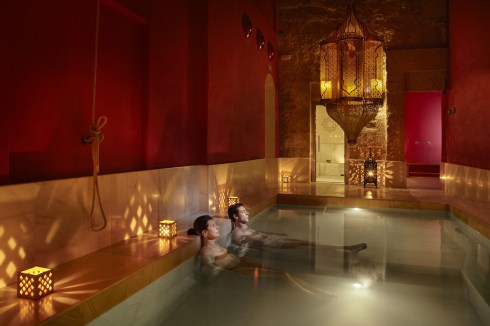
Hammam

Sento in Tokyo Japan
It would seem that a different set of choices were made during the 2008 recession in China than here in the West. I’m having trouble seeing the problem with the economic strategy the Chinese pursued. Of course, it was because the centralized power of China’s government put the needs of the country first, as opposed to the needs of the investor class. China’s growth continues to chug a long while the sclerotic US economy seems unfocused except for the primal urge to grind it’s underclasses into the ground. If as what Clegg says is true about China eclipsing the US in 2030 is true, perhaps a new paradigm might enter our Western consciousness, one that focuses on the welfare of the nation instead of exclusively on the welfare of the wealthy.
“It is clearly hard for any dominant power to accept the need to adjust to a rising power and avoid the ‘Thucydides trap’, but what is all the harder is for the West – the US and its allies – to acknowledge that China’s advance, in contrast to their own sluggish performances, exposes the difference between a system which chooses to bail out the banks and one which sought to bail out the economy; between one that does all it can to boost its financial sector, and one which promoted economic stimulus to boost production; between one which squeezes those poorer in the blind pursuit of profit and one which raises up the poor, organising development in a systematic way; between one that pumps out huge amounts of ‘hot money’ into the world economy to play havoc with other countries’ financial systems and one that offers patient capital to help others manage their financial difficulties to avoid crises.
In the last 10 years, whilst Western economies have endlessly pumped their ‘printed’ money round and round the ether of financial markets in the same exhausted circles, China has become a different country and indeed the world is becoming a different place. Yet the US remains utterly committed to blocking change to keep the world dependent on the American dollar and the American consumer even at the expense of huge trade deficits. And now comes the trade war.
China is on course to overtake the US as the world’s largest economy sometime before 2030, an event which will mark a psychological turning point. However right now, debt levels remain high and a Chinese-style crash is still possible. Can China limit, or failing this, withstand the pressures of a US trade war? In fact, the prospects for the US-economy not that great either – the Trump tax cuts bounce may be short-lived, and the ‘America first’president may have to learn that the US and China need each other.”
Societal norms are mostly patriarchal norms. Being portrayed a certain way, and being expected to act a certain way certainly couldn’t affect one’s prospects in society…
And that is it, right there folks. Unless you take the time to try and understand the situations and particular challenges people face in society from their point of view, your opinions on how they should act, or what they should be doing, just are not that relevant. This should not be a hard concept to understand, but as it seems to be most men cannot, or will not take the time to understand that society *works* differently if you happen to be female.
Like, it would take just a little time to stop and listen to the many female narratives available here on the vast-wideness of the internet, but frack that noise, I’ll just assume that everyone is treated the same as me, and should base all my arguments on that flawed assumption.
https://tallteenageradfem.tumblr.com/post/177622689221/frostbackcat-precious-cinnamon-roll666

The bone jarring stupid is so prevalent in the dude class. Like I can understand that you benefit from the current unjust system and really, because you are not particularly downtrodden, haven’t given any thought to the topic at hand. But, seriously, have the common decency to listen when others tell of a different narrative and experience in society. You may just learn something.











 bleatmop
 Mystro
 The Arbourist


 Dead Wild Roses
Your opinions…