
I’m up to Chapter 3 so far and would highly recommend this book to those who want understand the ‘why & how’ of what is happening in our society. Understanding post-modernism is the first step. This is a short summary gleaned from ‘Goodreads’ is a part of what the book is explaining about Postmodern thought.
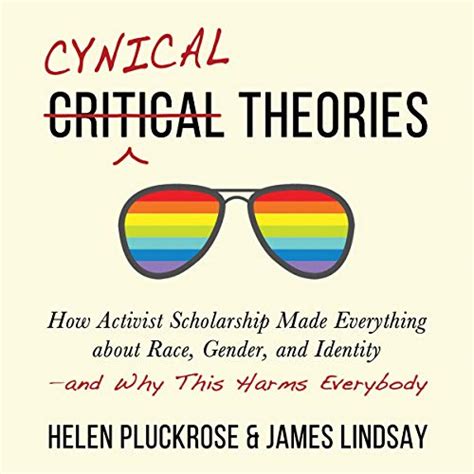
“The online Encyclopedia Britannica defines postmodernism as: “a late 20th-century movement characterized by broad scepticism, subjectivism, or relativism; a general suspicion of reason; and an acute sensitivity to the role of ideology in asserting and maintaining political and economic power.” The authors of this book mentions the two principles and four themes of postmodernism thus:
1. The postmodern knowledge principle: Radical skepticism about whether objective knowledge or truth is obtainable and a commitment to cultural constructivism.
2. The postmodern political principle: A belief that society is formed of systems of power and hierarchies, which decide what can be known and how.
The Four Major Themes
1. The blurring of boundaries
2. The power of language
3. Cultural relativism
4. The loss of the individual and the universalNow, to translate this to words of one syllable.
The first principle means that we can never know the objective truth: indeed, it is doubtful whether it exists at all. The second principle means that what is known as the truth is decided by the power hierarchy inside the system.
Thus, in one fell swoop, postmodernism dethroned science from its pedestal – because if we are not sure whether there is objective truth at all, why spend time looking for it? And in the colonial world, most of the objective knowledge was based upon colonial viewpoints; so a deconstruction of this was essential, especially as Orientalism was holding sway in the West.
(However, this doesn’t negate the power of science – but the fallout of postmodernism has engendered dangerously unscientific attitudes.)
Now let’s move on to the themes.
The blurring of boundaries means categorisations are no longer trusted. Not only the boundaries between objective and subjective and between truth and belief have been blurred, but also those between science and the arts, the natural and the artificial, high and low culture, man and other animals, and man and machine, and between different understandings of sexuality and gender as well as health and sickness. Everything is a spectrum.
The power of language emphasises that it is through language that we define power structures in a society. Under postmodernism, many ideas that had previously been regarded as objectively true came to be seen as mere constructions of language. In postmodern thought, language is believed to have enormous power to control society and how we think and thus is inherently dangerous. It is also seen as an unreliable way of producing and transmitting knowledge. To summarise: we create reality through language.
In a world where there is no objective truth, no boundaries, and where everything is created through how we speak and think, truth and knowledge are different for each and every culture and no one from outside that culture can comprehend it. This is called cultural relativism.
Consequently, to postmodern theorists, the notion of the autonomous individual is largely a myth. The individual, like everything else, is a product of powerful discourses and culturally constructed knowledge. Equally, the concept of the universal—whether a biological universal about human nature; or an ethical universal, such as equal rights, freedoms, and opportunities for all individuals regardless of class, race, gender, or sexuality —is, at best, naive. At worst, it is merely another exercise in power-knowledge, an attempt to enforce dominant discourses on everybody. This leads to the loss of the individual and the universal.
I totally get this. It’s a very nice intellectual exercise: and I must say that in the field of arts, literature and sociology, it has got valid uses. The only place I take the high road while postmodernists take the low road is when it comes to the concept of the individual and the universal, which I do believe are required as valid concepts if we need an equitable world. And also, for all our subjective perceptions, science has discovered many objective truths through its powerful method, which are not dependent upon language and/ or culture.
But now, the authors started talking about Theory (with a capital T: applied postmodernism) and the concept of Social Justice; and I started getting a bit alarmed – because I could now make sense of how I was annoying all those woke people.











 bleatmop
 Mystro


 Dead Wild Roses
3 comments
March 20, 2024 at 7:47 am
tildeb
Apologists for all this nonsense insist that ‘this’ is not being taught in schools, that there is no indoctrination going on, that critics of this slew of idiocy are _______ (fill in whatever pejorative term one uses to dismiss the Really Bad Person raising concerns).
What is being taught throughout ‘education’ – well, actually reeducation – is the activism used to promote each of these goals by assuming they are true. In metaphysical terminology, this is the religious aspect – the a priori premises/conclusions – where students are expected to accept a belief that these ‘critical theories’ are true in fact. And so this belief becomes the starting point for the outlined premises used to ‘prove’ exactly the same preordained conclusions that they are true. They are true only in the sense that they are all based on faith that they are true. Not reality; faith. This is how any and all contrary evidence from reality can be dismissed out of hand first, that any and all people who criticize or complain about this are just as easily dismissed as blasphemers are such non believers are by the religiously devout… accompanied by the same certainty that such people deserve ill-treatment because they are Very Bad People, people who deserve to be dismissed for their moral failing, that they deserve cancellation and social ostracism and punitive professional consequences for daring to undermine the believed-in unity that will magically emerge when every believes properly (so they children must be taught to do so). So throughout education, policies that presume the truth of these premises are set out by Boards to be followed. Or else… punitive consequences where the process alone is punishment.
And so we see exactly the same method being implemented by the federal government to bring back Section 13 from the human rights tribunal kangaroo courts of the early 2000s to be set as legislation over all Canadians to enforce the ideology on everyone.
LikeLiked by 1 person
March 20, 2024 at 8:41 am
tildeb
A perfect example from the National Post published today:
A University of Toronto professor, who held a street epistemology exercise (Likert Scale spectrum across Agree Strongly to Disagree Strongly) in a social event for science students, dared to raise the question, Can Men Become Women, and was later called into her faculty Chair office for ‘correction’: the Chair said, “This was a traumatic statement unworthy of a social event. Students were not suitably prepared, vulnerable to manic episode. These sorts of questions require trigger warnings and safe spaces.” (This was considered by the faculty Chair to be pernicious transphobia unmasked.)
“We can sit here and pretend, but both you and I know that you overstepped the boundaries.”
The professor then explained that this is an acceptable ploy by administrators that is very useful because it completely obviates any need for justification and this is the central point I raised above: the premise that these assumptions are presumed to be true first and so any questioning or justifying them to the non believing Barbarians is a sign of moral depravity. The prof knew her fate was sealed, the judgement passed, the ‘evidence’ incontestable. So she was sanctioned.
This is where we are today, infantilizing students, telling them what to think, and going along with this authoritarian overreach not because of truth value or merit but as a way of social engineering is carried out in thousands of different ways to make the ideology replace reality and demand exactly one version of correct groupthink be carried out on all to make it appear so. It is religious indoctrination to the core.
LikeLiked by 2 people
March 20, 2024 at 7:33 pm
Infidel753
However, this doesn’t negate the power of science – but the fallout of postmodernism has engendered dangerously unscientific attitudes.
That’s the problem. They can’t “dethrone” science, they can only ignore and denigrate it because it’s the study of that objective truth they claim to not believe in.
Light travels at 186,282.4 miles per second. That’s an objective truth. It has nothing to do with any “power hierarchy”. It’s the same regardless of the race, sex, or any other attribute of the people measuring it. It was true before there was any intelligent life on Earth to try to measure it.
If you design an airplane or a power plant on the basis of the objective truths discovered by modern physics, it will work. If you design it on the basis of something else, it won’t. It makes no difference how anybody feels about that. That’s just the way reality is.
Rejecting science on the basis of all this “postmodernist” gobbledygook is just the same as rejecting it on the basis of religious fundamentalism or communism (see Lysenko). Societies that “dethrone” science on the basis of something else will fall behind their wiser competitors and ultimately become backward and irrelevant, regardless of what the “something else” is.
LikeLike