
You are currently browsing the monthly archive for February 2025.
Guess what we’re singing for our year-end concert? :)
The Sanctus from Haydn’s Orgelmesse is a partial example of *imitative polyphony. Listen and watch how he layers the “O sanna in excelsis”.
“In the Sanctus of this mass, Haydn does employ polyphonic elements, but it’s not a full-fledged example of imitative polyphony like you’d find in Renaissance composers (e.g., Palestrina) or Baroque fugues. The texture begins with a homophonic declaration—voices moving together in block chords—on “Sanctus Dominus Deus Sabaoth,” establishing a unified, majestic tone. However, as the movement progresses, Haydn introduces some imitative entries, particularly in the “Pleni sunt coeli” section. Here, the voices don’t strictly mimic a single subject in the way a fugue would, but they do overlap and echo each other to depict the “heavens and earth full of glory.” This lighter, more subtle imitation is characteristic of Haydn’sClassical style, blending polyphony with homophonic clarity rather than leaning fully into dense counterpoint.”
*Imitative polyphony is a musical texture where a melody introduced in one voice is echoed or imitated by other voices in succession, overlapping to create a layered, interwoven effect.
 Oh, bless the hearts of the gender-affirming care activists, still out there waving their rainbow flags like it’s 2015, undeterred by the pesky little detail that the evidence for this stuff is about as solid as a house of cards in a windstorm. You’d think a growing pile of studies—like the Cass Review out of the UK, which basically said, “Uh, guys, we’ve got no clue if this actually works long-term”—might slow them down. But no, they’re still preaching the gospel of hormones and surgeries for kids with the zeal of a late-night infomercial host, insisting it’s all about “saving lives.” Never mind that the data’s a mess—small samples, short follow-ups, and a whole lot of “trust us, it feels right.” It’s activism as performance art, and the show must go on, evidence be damned.
Meanwhile, the science keeps whispering inconvenient truths, like how many kids with gender dysphoria naturally sort themselves out by puberty if you just leave them alone—up to 80% or more, according to some studies. But why let a little thing like biology get in the way of a good narrative? Activists are too busy clutching their pearls over “transphobia” to notice that the American Academy of Pediatrics got caught with its pants down, basing its full-throated endorsement on vibes rather than rigorous trials. The systematic reviews—those boring, gold-standard things—keep coming up empty on proof that this care does more good than harm long-term, yet the megaphones stay on full blast. It’s almost admirable, this dedication to vibes over victory.
So here we are, with clinics still doling out blockers and binders like candy at a parade, while the activists insist anyone questioning the efficacy is just a bigot who hates happiness. Sweden, Finland, and even parts of the UK are pumping the brakes, shifting to therapy-first approaches because the evidence isn’t there—but not our intrepid North American crusaders! They’ve got anecdotes, TikTok testimonials, and a moral superiority complex to keep the train chugging along. Who needs peer-reviewed proof when you’ve got a cause this shiny? It’s not about whether it works—it’s about signaling you’re on the right side of history, even if history ends up laughing at the whole charade. Curtain’s up, folks—don’t expect a plot twist anytime soon.
 Jim McMurtry, a seasoned Canadian high school history teacher with nearly 40 years of experience, found himself at the center of a storm in May 2021 when he dared to question the explosive narrative surrounding the Kamloops Indian Residential School. Following the Tk’emlúps te Secwépemc First Nation’s announcement of 215 “unmarked graves” detected by ground-penetrating radar, the nation erupted in grief and outrage, fueled by claims of mass murder and secret burials. While substituting for a Calculus 12 class at a school in Abbotsford, British Columbia, McMurtry responded to a student’s assertion that priests had tortured and murdered Indigenous children by stating that most deaths at residential schools were due to diseases like tuberculosis—not deliberate killings. Within an hour, he was escorted out of the building by administrators, accused of “extremely serious professional misconduct” for contradicting the district’s message of reconciliation.
McMurtry’s statement wasn’t a wild guess; it aligned with findings from the Truth and Reconciliation Commission (TRC), which spent years documenting that tuberculosis and other illnesses were the leading causes of death among residential school students. Yet, the Abbotsford School District didn’t care about historical accuracy—they wanted a compliant narrative. Suspended indefinitely, McMurtry faced a barrage of allegations, including claims he’d made insensitive remarks, though the only evidence was a vague, handwritten note from a principal relaying a student’s complaint via a counselor. No bodies had been exhumed at Kamloops, no forensic proof of murder emerged, but the district clung to the emotional weight of the story, prioritizing optics over facts. McMurtry, with a master’s in educational history and a Ph.D. in philosophy of education specializing in Indigenous history, was suddenly the villain for refusing to parrot unverified claims.
The injustice deepened as the school board’s disciplinary process unfolded. After a year of suspension, McMurtry spoke out publicly, refusing to be “muzzled” and criticizing the district’s handling of his case. This defiance sealed his fate. On February 21, 2023, the Abbotsford School District fired him, citing his unwillingness to follow orders and his insistence on free speech as reasons he could no longer be employed. The board’s report framed his historical corrections as undermining their “truth and reconciliation work,” as if truth itself was negotiable. Meanwhile, the lack of transparency—denying him a proper hearing for over three years and relying on hearsay—exposed a system more interested in protecting its image than fostering honest discourse.
The fallout didn’t stop with his termination. McMurtry’s teaching regulator, the British Columbia Teacher Regulation Branch (TRB), piled on, pressuring him to retire and threatening to cancel his teaching certificate unless he admitted to misconduct for not labeling residential school deaths as part of a “government strategy of cultural genocide.” His refusal to bend to ideological demands turned him into a pariah, despite his impeccable record, two teaching awards, and stints as a college lecturer and junior college principal. The TRC’s own data supported his classroom comments, yet the establishment doubled down, with figures like NDP MP Leah Gazan pushing for laws to criminalize “denialism” of such narratives—laws that could’ve targeted McMurtry directly. His career was sacrificed not for falsehoods, but for challenging a politically charged myth with inconvenient facts.
This saga reveals a chilling injustice: a teacher punished not for lying, but for teaching. McMurtry’s case underscores a broader cultural shift in Canada, where questioning sacred narratives—however dubious—can end a livelihood. The Kamloops story, still unproven years later with no excavated remains, became a cudgel to silence dissent, leaving McMurtry jobless and vilified. Supported by writers like Conrad Black and Barbara Kay, he’s since found solidarity among those who see his firing as an attack on free thought. Yet, the damage is done—a decorated educator, armed with expertise and evidence, was cast aside by a system that valued conformity over truth, proving that in today’s Canada, history isn’t a subject to explore, but a script to obey.
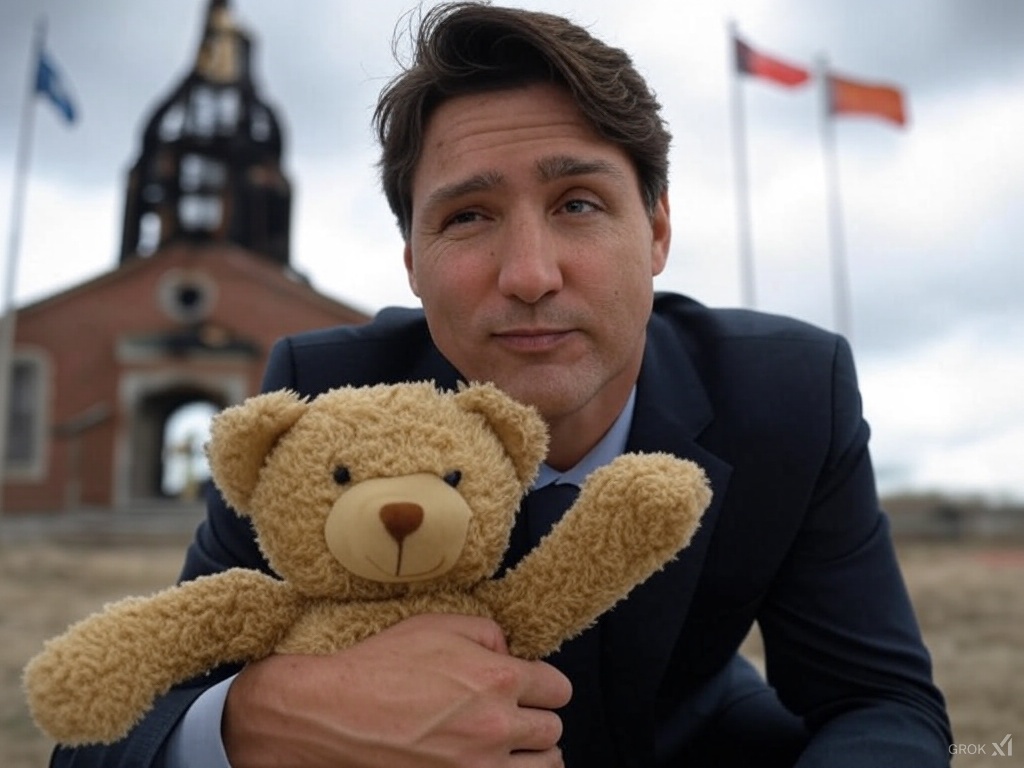
Oh, gather ’round, folks, for the grand tale of the Canadian Kamloops Grave Hoax—a story so gripping it turned the nation into a collective mourning parade faster than you can say “ground-penetrating radar.” Back in May 2021, the Tk’emlúps te Secwépemc First Nation dropped a bombshell: 215 little skeletons supposedly tucked away in an apple orchard near the old Kamloops Indian Residential School, detected by some high-tech wizardry. Cue the nationwide meltdown—flags drooped to half-mast, churches got torched, and the media spun a yarn of mass graves and murdered kids that had everyone clutching their pearls and reaching for the teddy bears. It was a tragedy so perfectly cinematic, it could’ve been scripted by Hollywood, if Hollywood cared about Canadian history.
But wait, plot twist! Turns out, this blockbuster had a few holes—like, say, the complete absence of actual bodies, graves, or, you know, evidence. Academics and skeptics started poking around, pointing out that the radar “anomalies” might just be old septic trenches or tree roots, not a secret kiddie cemetery. No excavations, no forensic digs, just a lot of hot air and $8 million in government cash handed over to the band with no receipts required. The narrative shifted from “mass genocide” to “oops, maybe we got carried away,” but not before the Pope schlepped over for an apology tour and the UN got all huffy about human rights. It’s almost like everyone forgot to check the facts before lighting the match—classic Canada, eh?
So here we are, years later, with the Kamloops saga looking less like a dark chapter and more like a masterclass in collective gullibility. The media’s still patting itself on the back for “raising awareness,” while the Tk’emlúps folks quietly admit those 215 “remains” are now just “anomalies”—no bones, no proof, just vibes. Meanwhile, the nation’s been left with a hangover of shame, a pile of burned churches, and a shiny new holiday to remind us all to feel bad about something that might not have even happened. Moral of the story? Next time someone yells “mass grave,” maybe wait for a shovel to hit dirt before rewriting history—unless, of course, you’re into fiction, in which case, this was a bestseller.












 bleatmop
 Mystro


 Dead Wild Roses
Your opinions…