
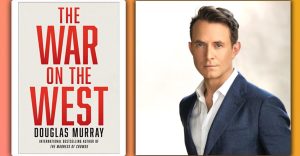
 Douglas Murray’s The War on the West: How to Prevail in the Age of Unreason (2022) is a polemic that surges with conviction, decrying what Murray perceives as a concerted attack on Western civilization. With razor-sharp prose, he skewers ideologies he believes erode the West’s cultural and intellectual foundations. Yet, while his fervor galvanizes, the book’s reliance on selective evidence and occasional factual missteps muddies its truth-seeking ambition. This review outlines Murray’s thesis, summarizes the book’s contents, and critically assesses its claims with precise quotations and citations to ensure rigor.
Thesis: A Civilization Besieged
Murray argues that Western civilization faces an existential threat from within—a cultural war waged by ideologues who vilify its history and values while ignoring its triumphs. He contends that “the West is now the only major power bloc in the world that is talked about as though its very existence is a question, a problem, or a sin” (Murray, 2022, p. 7). This assault, he claims, stems from revisionist narratives—particularly around race, history, and culture—that weaponize guilt to dismantle reason and unity. Terms like “anti-racism” have been “twisted into a desire for vengeance” (p. 53), he asserts, urging a defense of Western principles as universal goods. While compelling, this thesis oversimplifies: Murray’s portrayal of the West as uniquely scapegoated sidesteps global critiques of other powers, such as China’s Uyghur policies, and risks painting dissent as a monolithic conspiracy.
Summary of Contents
The book dissects perceived attacks across multiple domains. In the chapter on race, Murray critiques policies like the English Touring Opera’s 2021 decision to prioritize “diversity” in casting, which he claims led to “the firing of white singers purely because of their race” (p. 64). He also targets America’s early COVID-19 vaccine prioritization for minority groups, arguing it reflects “anti-white racism dressed up as justice” (p. 71). His critique of the 1619 Project is scathing, calling it “an attempt to rewrite American history as a story of unremitting racial oppression” (p. 89), though he engages little with its scholarly debates.
Murray then surveys history, art, and education, lamenting the “erasure” of Western achievements. He cites the 2020 defacement of Winston Churchill’s statue in London as evidence of a “new puritanism” (p. 112) and questions why figures like Kant are condemned for historical racial views while Karl Marx’s anti-Semitic writings escape scrutiny (p. 136). Critical Race Theory (CRT) is a recurring target, branded as “a doctrine that turns anti-racism into a new form of racism” (p. 165). He also critiques intellectuals like Edward Said, accusing them of fostering “anti-Western resentment” (p. 181). While Murray’s defense of Western art and science as universal treasures resonates, his examples—like a Twitter claim that “2+2=4 is Western imperialism” (p. 203)—often amplify marginal voices to inflate the threat.
Critical Assessment
Murray’s passion is undeniable, but his argument falters under scrutiny. A key factual error undermines his credibility: he cites a California ethnic studies curriculum as advocating “counter-genocide” against Christians, a claim traced to activist Christopher Rufo. This is false; the curriculum draft, revised in 2021, contains no such language (California Department of Education, 2021, “Ethnic Studies Model Curriculum”). Similarly, Murray misrepresents a Sandia National Laboratories exercise as forcing white employees to apologize for privilege, when it was a voluntary diversity training with no such mandate (Snopes, 2020, “Did Sandia Labs Force White Employees to Apologize?”). As reviewer Samuel Catlin notes, “Murray’s reliance on such sources makes you seriously wonder about how accurately described the rest of the book is” (Jewish Currents, 2022).
His treatment of the 1619 Project also lacks nuance. Murray dismisses it as “arrogant overreach” (p. 89), yet ignores historians like Gordon Wood, who, while critical, engage its arguments as part of legitimate historiographical debate (Wood, 2020, The New York Review of Books). This selective outrage—condemning Western critics while excusing Marx’s slurs—betrays a double standard. His defense of slavery’s historical context, arguing “every society from Africa to the Middle East had slaves” (p. 98), veers into whataboutism, dodging the West’s unique role in the transatlantic trade’s scale and legacy.
Murray’s broader narrative—framing critics as a unified anti-Western cabal—overreaches. For instance, his claim that mathematics itself is under attack relies on a single, obscure blog post rather than mainstream discourse (p. 203). As The Times review observes, “Murray sometimes picks fights with paper tigers, inflating trivial incidents into existential threats” (The Times, 2022). This hyperbole risks trivializing his case, turning a call for reasoned defense into a culture-war shouting match.
Conclusion
The War on the West is a fervent plea to cherish Western civilization, but its flaws—factual inaccuracies, selective reasoning, and exaggerated threats—corrode its persuasiveness. Murray’s prose shines, and his defense of universal values like reason and liberty is laudable. Yet, as Catlin aptly puts it, “the war he describes is less a clash of civilizations than a clash of rhetorics” (Jewish Currents, 2022). The West’s strength lies in its capacity for self-critique, a trait Murray champions but undercuts with his combative tone. Read it for its vigor, but cross-check its claims: the battlelines are real, but far less tidy than Murray insists.
References
- Murray, D. (2022). The War on the West: How to Prevail in the Age of Unreason. HarperCollins.
- California Department of Education. (2021). Ethnic Studies Model Curriculum. Retrieved from https://www.cde.ca.gov/ci/cr/cf/esmc.asp.
- Snopes. (2020). “Did Sandia Labs Force White Employees to Apologize?” Retrieved from https://www.snopes.com/fact-check/sandia-labs-white-privilege/.
- Catlin, S. (2022). “The War on the West: A Review.” Jewish Currents. Retrieved from https://jewishcurrents.org/the-war-on-the-west.
- Wood, G. (2020). “The 1619 Project: A Debate.” The New York Review of Books. Retrieved from https://www.nybooks.com/articles/2020/11/19/1619-project-debate/.
- The Times. (2022). “The War on the West by Douglas Murray: Review.” Retrieved from https://www.thetimes.co.uk/article/the-war-on-the-west-by-douglas-murray-review.











 bleatmop
 Mystro


 Dead Wild Roses
4 comments
July 5, 2025 at 8:47 am
tildeb
There is very much a war on the west and it is very much from within. Countries by misguided policies and idiotic practices are systemically tearing down liberal democracy and erecting populist tribalism requiring activists in its place. This is what is taught at every level of public education and mandated curriculum, including the egregious historical junk food that is the 1619 Project. This goal of killing the west is accomplished ten thousand different ways every day so your criticism, for example, about ethnic studies tells me you have seen ethnic studies today. This is exactly what it is intended to do. So Murray’s thesis does not falter under scrutiny; sure, some specific trees may not best represent the entire forest but when the whole forest is dying, arguing just how much a specific toxin accounts for a specific percentage of dying is a way to divert from the truth of the thesis. Toxins are present, they are growing, they are killing, and the entire forest is dying from this war on it. There is a war on the west as liberal democracies and the liberal west is, not surprisingly, losing… still losing no matter how often or to what extent people want to look away and argue contentious trivialities in order to believe contrary to what’s true.
LikeLike
July 5, 2025 at 8:53 am
tildeb
“… tells me you have NOT seen ethnic studies today” (I can link you not only to disgusting anti-liberal curriculum across a spectrum of subjects forcibly paired with ES but provide dozens and dozens of zoom ‘meetings’ by various boards and those paid to provide this shit content on what it is they are trying to implement, which is to produce activists. And all of it is deeply racist, deeply anti-liberal, deeply anti-western. Believing otherwise, believing this isn’t happening when it is, is simply a preference to believe a delusion). Ethnic studies is part of the war and so it supports the thesis.
LikeLike
July 5, 2025 at 9:00 am
tildeb
His latest book (Democracies and Death Cults) is an extension of the same thesis but written years later, specifically addressing what a failure to take on Islam looks like in action. In other words, this is what happens from not addressing the war on the west because of diversionary trivialities claimed inaccurately to reveal a faltering thesis.
From Abigail Shier:
“Every high school student in North America, Europe, and Australia should be given this book and prompted to read it; Western civilization would benefit immeasurably. And perhaps the single best thing parents could do for their young adults’ education before they head into the amoral funhouse of the American university would be to give them this book.”
The war continues.
LikeLike
July 6, 2025 at 6:18 pm
tildeb
Look at what the National Education Association is promoting this year and tell me education itself isn’t a major source of attacking the west from anti-liberal, anti-Semitic, anti western pro-Islamic, pro-Maoist ideology absolutely hell bent on turning students into poor dumb-as-rocks ‘progressive’ activists.
This is not ‘clash of rhetoric’; this is a very real ongoing cultural war.
LikeLike