
You are currently browsing the monthly archive for September 2025.
The Edmonton Public School Board’s (EPSB) sweeping book ban has erupted into a quintessential Alberta debacle: a government directive mangled by overzealous implementation, corroding trust in educational oversight.
In July, the UCP government under Premier Danielle Smith ordered schools to remove “inappropriate” materials from libraries, targeting explicit sexual content to protect children. Instead of applying a common-sense filter, EPSB produced a blacklist of more than 200 titles—including The Handmaid’s Tale, The Color Purple, and The Godfather. Even Jaws and works by George R.R. Martin didn’t escape the purge. Critics dubbed it “vicious compliance”: technically following the order, but in a way designed to spark outrage.
Smith quickly condemned the overreach, pausing the ban and pledging clarifications so that classics remain available. The government’s vagueness deserves criticism, but EPSB’s reaction exposed something deeper: Alberta’s educational establishment either failed to grasp the policy’s intent—or chose to deliberately misapply it, then leak the story to embarrass the UCP. In either case, it is professional negligence.
The fallout has been swift. Margaret Atwood ridiculed the move, bookstores report surging sales of “banned” books, and the episode has reinforced suspicions that education officials are more interested in scoring political points than serving students.
Irony abounds: in trying to shield children from explicit content, the government gave its critics ammunition; in trying to follow the directive to the letter, EPSB managed to turn itself into the villain. What should have been a straightforward matter of removing genuinely pornographic material has spiraled into a culture-war sideshow, eroding public confidence in both policymakers and educational leaders.
The lesson is plain: sloppy governance is bad—but bad-faith compliance from those entrusted with education is worse.

James Lindsay’s *New Discourses* podcast (July 9, 2020) contends that Marxist-inspired critical theories—queer theory, critical race theory (CRT), and postcolonial theory—undermine childhood innocence to destabilize Western society. According to this view, “innocence” is not a universal good but a social construct, one that maintains oppressive structures such as heteronormativity and white privilege. In this framing, schools become the frontline where innocence is dismantled, often through social-emotional learning (SEL) and comprehensive sex education, exposing children to adult categories of sexuality and race earlier than previous generations.
This essay acknowledges the conspiratorial risks of Lindsay’s framing but nonetheless argues that there is a coherent intellectual genealogy behind today’s educational shifts. By situating them in the work of Lukács, Marcuse, Gramsci, and Freire, and by engaging primary texts and empirical evidence, the essay concludes that premature sexualization and racialization of children carry measurable psychological risks and are best understood as destabilizing strategies with ideological consequences.
—
Queer Theory: Liberation or Destabilization?
Judith Butler’s *Gender Trouble* (1990) famously argued that identity is performative, “a stylized repetition of acts” rather than a fixed essence.[^1] For advocates, this opens liberatory possibilities, freeing individuals from restrictive norms. Eve Sedgwick similarly contended that destabilizing binaries allows marginalized groups to resist cultural oppression.[^2] In practice, queer pedagogy has translated into inclusive curricula—GLSEN (2022) reports that 43% of LGBTQ students feel safer in schools with gender-affirming materials.[^3]
Yet destabilization comes at a cost. Lindsay connects Butler’s performativity with Herbert Marcuse’s *Eros and Civilization* (1955), where liberation from sexual repression is imagined as a step toward a “non-repressive reality principle.”[^4] Marcuse’s focus was on adult emancipation, but his call for “mature individuals” leaves ambiguity when applied to educational contexts. Graphic materials such as *Gender Queer* (Fairfax County, 2021) in school libraries illustrate how theory, once filtered through activist pedagogy, risks exposing children to sexual content beyond developmental readiness.
Empirical concerns are not negligible: the American Psychological Association (2004) found that early sexualization is associated with depression and anxiety.[^5] While proponents highlight empowerment and reduced bullying, Lindsay’s point stands: identity destabilization in children risks long-term psychological harm.
Sexualization in Schools: Protection or Premature Exposure?
Comprehensive sex education is promoted as a health intervention. The Guttmacher Institute (2022) notes it is implemented in 39% of U.S. states, with studies showing reductions in risky sexual behaviors and teen pregnancy.[^6] Organizations like SIECUS (2021) argue that early, inclusive curricula protect sexual minorities by giving them language and resources.
The counterpoint, however, is about **age-appropriateness**. Some curricula, such as exercises in North Carolina’s 7th-grade program requiring public discussion of bodily changes,[^7] cross into territory that can be experienced as intrusive or shaming. Materials with explicit depictions of sex, regardless of intent, blur the line between protection and premature exposure.
Here Lindsay’s thesis holds: while not designed as “grooming,” the net effect can mimic destabilization. Children’s innocence functions as a developmental safeguard, and undermining it—however well-meaning—risks exploitation rather than empowerment.
Critical Race Theory: Equity or Burden?
Critical Race Theory reframes “racial innocence” as an illusion, a shield for systemic racism. Charles Mills’s *The Racial Contract* (1997) argues that white society maintains domination through unacknowledged compacts.[^8] In educational practice, this has meant materials like Ibram X. Kendi’s *Antiracist Baby* (2022), which encourage young children to see themselves in racial categories early. Advocates such as the American Educational Research Association (2021) claim this reduces bias, and SEL programs aligned with CRT have been adopted in roughly 35% of schools.[^9]
But here too, risks surface. Children may experience racial labeling as destabilizing, especially when framed in terms of guilt or privilege. The National Institute of Mental Health (2022) reports a 25% rise in youth anxiety,[^10] though causation is complex. Lindsay interprets this trend as evidence that CRT primes children for grievance and division. Whether or not one accepts that conclusion, the risk of prematurely burdening children with adult racial narratives deserves scrutiny.
Lukács and the Frankfurt School: The Intellectual Roots
George Lukács’s *History and Class Consciousness* (1923) criticized Christian morality as an impediment to revolution. In the short-lived 1919 Hungarian Soviet Republic, he promoted radical educational reforms, including sexual education programs, which opponents claimed encouraged promiscuity.[^11] While some historians downplay this episode as exaggerated,[^12] it remains clear that Lukács saw morality and family life as barriers to revolutionary consciousness.
The Frankfurt School developed this trajectory further. Marcuse in particular fused Freud with Marx, arguing that capitalism relies on sublimated sexuality.[^13] Though intended for adults, modern applications—whether in SEL or in the normalization of explicit material in schools—echo Marcuse’s suspicion of repression, sometimes at children’s expense.
Gramsci, Freire, and Pedagogical Inversion
Antonio Gramsci’s *Prison Notebooks* (1971) emphasized that family and education sustain cultural hegemony.[^14] Paulo Freire’s *Pedagogy of the Oppressed* (1968) reframed education as a site of liberation, recasting students as oppressed subjects.[^15] These ideas empower marginalized voices, as bell hooks celebrated in *Teaching to Transgress* (1994).[^16]
But Lindsay notes a darker possibility: that reorienting children as political subjects destabilizes family authority and primes youth for activism before they are developmentally prepared. Historical parallels, such as Mao’s Red Guards, show how youth mobilization can lead to intergenerational rupture and social turmoil.[^17]
The Family Under Pressure
Modern legislation such as California’s FAIR Education Act (2019), mandating LGBTQ-inclusive curricula, is framed as inclusive and affirming. Surveys support benefits: GLSEN (2022) found reduced bullying in such schools.[^3] Yet CDC (2023) data also show a steep rise in youth mental health crises—up 30% in a decade—raising questions about unintended consequences.[^18]
Gramsci’s prediction that family would be a central site of ideological struggle seems borne out. When curricula bypass or override parental values, trust between parent and child can erode, leaving children caught between competing moral frameworks.
Addressing Conspiratorial Risks
It is important not to collapse every educational reform into a single Marxist “plot.” CRT, sex education, and SEL are diverse movements with many non-Marxist motivations. Critics such as Angela Harris note that CRT is primarily a legal framework for examining structural racism, not a revolutionary program.[^19] Similarly, sex education advocates highlight empirical successes in health outcomes.
The stronger critique, therefore, is not that Marxists control education, but that Marxist categories—sexual liberation, identity destabilization, cultural hegemony—have been influential in shaping educational trends. Once filtered through activist practice, these categories can be misapplied to children with destabilizing effects.
Conclusion: Safeguarding Development
From Lukács’s early experiments to Marcuse’s liberationist theory and Freire’s pedagogical inversion, critical theory has consistently targeted family, morality, and cultural transmission as barriers to social change. Applied to adults, these ideas invite debate. Applied to children, they risk harm.
The evidence suggests that early exposure to explicit sexual material and premature racial labeling correlate with increased anxiety and depression in youth.[^5][^18] Protecting childhood innocence is not a reactionary fantasy but a developmental necessity.
Parents, educators, and policymakers should insist on transparency in curricula, ensure age-appropriate content, and preserve the family’s role as the primary context for moral and cultural formation. Resistance is less about conspiracy-hunting than about reaffirming a principle as old as education itself: children deserve protection while they grow.

References
[^1]: Butler, J. (1990). *Gender Trouble: Feminism and the Subversion of Identity*. Routledge.
[^2]: Sedgwick, E. K. (1990). *Epistemology of the Closet*. University of California Press.
[^3]: GLSEN. (2022). *National School Climate Survey*. [https://www.glsen.org/research](https://www.glsen.org/research)
[^4]: Marcuse, H. (1955). *Eros and Civilization*. Beacon Press.
[^5]: American Psychological Association. (2004). *Report of the APA Task Force on the Sexualization of Girls*. [https://www.apa.org/pi/women/programs/girls/report](https://www.apa.org/pi/women/programs/girls/report)
[^6]: Guttmacher Institute. (2022). *Sex and HIV Education*. [https://www.guttmacher.org/state-policy/explore/sex-and-hiv-education](https://www.guttmacher.org/state-policy/explore/sex-and-hiv-education)
[^7]: Wake County Public Schools. (2021). *Healthful Living Curriculum*.
[^8]: Mills, C. (1997). *The Racial Contract*. Cornell University Press.
[^9]: National Center for Education Statistics. (2021). *School Survey on Social and Emotional Learning*.
[^10]: National Institute of Mental Health. (2022). *Youth Mental Health Data*. [https://www.nimh.nih.gov](https://www.nimh.nih.gov)
[^11]: Tormay, C. (1920). *An Outlaw’s Diary: The Hungarian Revolution*. London: Allen & Unwin.
[^12]: Anderson, K. (2010). *Marx at the Margins: On Nationalism, Ethnicity, and Non-Western Societies*. University of Chicago Press.
[^13]: Marcuse, H. (1955). *Eros and Civilization*, p. 87.
[^14]: Gramsci, A. (1971). *Selections from the Prison Notebooks*. International Publishers.
[^15]: Freire, P. (1968). *Pedagogy of the Oppressed*. Continuum.
[^16]: hooks, b. (1994). *Teaching to Transgress: Education as the Practice of Freedom*. Routledge.
[^17]: Dikötter, F. (2016). *The Cultural Revolution: A People’s History, 1962–1976*. Bloomsbury.
[^18]: Centers for Disease Control and Prevention. (2023). *Youth Risk Behavior Survey*. [https://www.cdc.gov/healthyyouth/data/yrbs](https://www.cdc.gov/healthyyouth/data/yrbs)
[^19]: Harris, A. (2001). *Critical Race Theory*. International Encyclopedia of the Social & Behavioral Sciences.
In Canada’s high-trust society, the rule of law cannot endure selective enforcement. When certain groups are shielded from consequences while others face harsh penalties for identical actions, the principle of equality before the law collapses. What emerges instead is favoritism by creed or identity—a betrayal that fragments unity and breeds resentment.
Uneven Standards in Practice
Toronto street prayers (August 2024). Hundreds of worshippers staged outdoor prayers at a busy downtown intersection, apparently without permits, halting traffic. Police did not intervene and later described the disruption as lawful. Few doubt how a Christian congregation attempting the same would have been treated: injunctions would be swift, fines inevitable. The point is not hostility toward prayer, but the evident double standard.[1]
Reckless firearm discharge in Muskoka (August 2025). Videos surfaced of men firing rifles and pistols from a snowmobile bridge near MacTier. Ontario Provincial Police confirmed an investigation, warning that careless use of firearms can bring Criminal Code charges. Yet similar celebratory gunfire at cultural festivals, whether at South Asian weddings or Indigenous gatherings, often receives muted responses or “contextual” exemptions. Danger is danger, regardless of tradition.[2]
Pro-Palestinian marches in Toronto (2024–2025). Demonstrations repeatedly blocked major roads, including rallies where smoke bombs were deployed from overpasses. Despite millions spent on policing, arrests remained rare—only 24 across hundreds of events by March 2024. Contrast this restraint with the 2022 Freedom Convoy in Ottawa, where the Emergencies Act was invoked, bank accounts were frozen, and police forcibly dismantled encampments. The contrast is glaring: enforcement appears to hinge less on infractions than on identity and political alignment.[3][4]
Mill’s Warning on Law and Liberty
John Stuart Mill, in On Liberty (1859), emphasized that genuine freedom depends on impartiality of the law. If rules are applied based on popularity or group identity, he argued, society replaces principle with prejudice, inviting arbitrary power. Selective enforcement, Mill warned, is a subtle but corrosive path to tyranny—not only by the state but by favored factions within society.[5]
Restoring Trust
A society built on trust cannot thrive under inconsistent law enforcement. The law must apply equally, regardless of race, religion, or political leaning. To preserve legitimacy, policing standards should be codified and subject to independent oversight. Discretion is unavoidable, but unreviewed discretion becomes favoritism. Equality before the law is not optional—it is the bedrock of Canadian unity. Without it, trust will wither, and division will prevail.

References
- “Toronto residents upset after Hamas supporters blockade busy intersection.” Juno News, Mar 21, 2025. Link
- “Gun video sparks OPP investigation.” MuskokaRadio.com, Aug 28, 2025. Link
“UPDATE: Bracebridge OPP investigating social media videos depicting unlawful firearm use.” MyMuskokaNow, Aug 28, 2025. Link
“OPP seek public help in identifying men firing guns off bridge in Mactier.” Barrie360.com, Aug 30, 2025. Link - “Police arrest two at pro-Palestinian rally that delayed Trudeau event in Toronto.” CityNews, Mar 15, 2024. Link
“Palestine solidarity protesters attacked by police in Toronto.” People’s Dispatch, Apr 3, 2024. Link
“Violent Crackdown at Land Day March.” The Grind Magazine, Mar 31, 2024. Link - “Canada convoy protest.” Wikipedia, accessed Sept 2025. Link
“TD Bank freezes accounts that received money for Canada protests.” Reuters, Feb 12, 2022. Link - Mill, J.S. On Liberty. London: John W. Parker and Son, 1859.
Believing in particular ideas and religions is okay, but try to keep the context of living in the 21st century where we need reality to be at the base of all important decisions.

Just because I can never remember”Post hoc ergo propter hoc” when I need it.

How could one NOT feature this piece?
My apologies for the mix-up. “Take Five” is a jazz standard composed by Paul Desmond, recorded by the Dave Brubeck Quartet for their 1959 album *Time Out*. Its unorthodox 5/4 time signature, driven by Joe Morello’s innovative drumming, defies the standard 4/4 jazz rhythm, creating a hypnotic, swinging groove. Written in E♭ minor with a ternary ABA form, it features a catchy two-chord piano/bass vamp (E♭m–B♭m7) and Desmond’s cool, dry-martini saxophone melodies. Inspired by Brubeck’s 1958 Eurasian tour and Morello’s request for a 5/4 piece, Desmond’s two melodies were arranged by Brubeck after a grueling June 1959 session where the band struggled with the rhythm, finally nailing it in two takes on July 1. Initially a promotional single, it became a sleeper hit in 1961, reaching No. 25 on the Billboard Hot 100 and selling over a million copies—the first jazz single to do so. Its enduring appeal lies in its accessible yet adventurous structure, influencing countless 5/4 compositions and earning a 1996 Grammy Hall of Fame induction. Desmond’s royalties, post-1977, benefit the American Red Cross, averaging over $100,000 annually.[](https://en.wikipedia.org/wiki/Take_Five)%5B%5D(https://www.npr.org/2000/11/19/1114201/take-five)%5B%5D(https://sing.fandom.com/wiki/Take_Five)
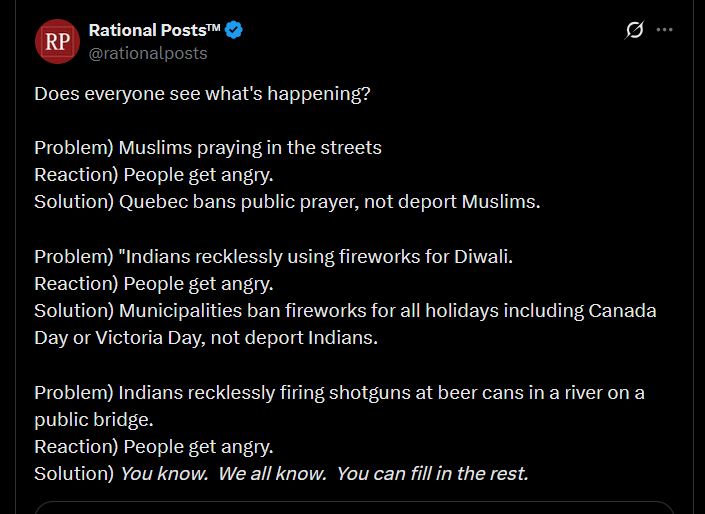
The solution to thwart this insidious strategy of systematically stripping Canadians of their rights lies in enforcing the law with unyielding equality, blind to race or religion, a principle that stands as the bedrock of a just society. The Rational Posts narrative reveals a troubling trend: public outrage over Muslims praying in streets or Indians celebrating Diwali with fireworks, and now shotguns on a bridge, triggers blanket bans, from Quebec’s prohibition on public prayer to municipal fireworks restrictions, effectively punishing entire communities rather than addressing specific transgressions. This corrosive approach, echoing the divisive echoes of Jim Crow or apartheid, corrodes multicultural unity and foments resentment, as social cohesion studies irrefutably demonstrate. Instead, precise legislation targeting reckless acts, such as discharging firearms irresponsibly, must replace these broad edicts, ensuring accountability without stifling cultural expression. Fair laws unite: bans divide. Let us, with urgent resolve, choose the former and reclaim a Canada where justice, not prejudice, prevails.











 bleatmop
 Mystro
 The Arbourist


 Dead Wild Roses
Your opinions…