
You are currently browsing the daily archive for October 13, 2025.
In the context of Alberta’s recent teacher strike, which began on October 6, 2025, following the rejection of a government contract offer, a pertinent question arises. The offer included a 12 percent wage increase for teachers over four years. Rather than applying this raise, what if the equivalent funds were allocated to hire additional educational assistants? Such a reallocation could address classroom support needs directly. This analysis relies on publicly available data to compute the potential impact, prioritizing transparency in figures and assumptions.
Alberta’s education system employs 51,000 teachers under the Alberta Teachers’ Association. Their average annual salary is $85,523. This results in a total annual payroll of approximately $4.36 billion. Implementing a 12 percent increase would add roughly $523 million to this payroll each year, once fully phased in, based on the offer’s structure.
Educational assistants in Alberta earn an average of $33,811 per year. If the $523 million earmarked for the teacher raise were instead used for hiring these support staff, it could fund approximately 15,480 new positions. This figure assumes full-time roles with comparable benefits and no significant overhead variances, focusing on direct salary costs.
This hypothetical redirection highlights trade-offs in education funding. While teachers seek compensation adjustments amid rising class sizes and workloads, bolstering assistant roles could alleviate immediate pressures in classrooms. The calculation underscores the scale of resources involved, inviting scrutiny of priorities in public spending.
Sources and Methodology
To ensure reproducibility, below are the key sources and the step-by-step mathematics used. All data points are drawn from recent, credible reports as of October 2025, with links provided for verification.

Key Data Sources
– Number of teachers: 51,000, from CBC News coverage of the strike (https://www.cbc.ca/news/canada/calgary/calgary-alberta-teacher-labour-strike-monday-1.7650856). Corroborated by Human Capital Magazine (https://www.hcamag.com/ca/specialization/industrial-relations/largest-labour-walkout-ever-51000-alberta-teachers-hold-strike/552206) and Calgary Herald (https://calgaryherald.com/news/politics/potential-teacher-strike-results-vote-tentative-deal-province).
– Average teacher salary: $85,523 annually, from Alberta’s Labour Information Service (ALIS) wage survey (https://alis.alberta.ca/occinfo/wages-and-salaries-in-alberta/elementary-school-and-kindergarten-teachers/41221/). Supported by Statistics Canada data (https://www150.statcan.gc.ca/t1/tbl1/en/tv.action?pid=3710024301).
– Wage increase details: 12 percent over four years (structured as 3 percent annual), from CBC News (https://www.cbc.ca/news/canada/edmonton/alberta-teachers-strike-lockout-questions-9.6934129) and Alberta Teachers’ Association announcement (https://teachers.ab.ca/news/teacher-strike-imminent). Additional context from Canadian Taxpayers Federation (https://www.taxpayer.com/newsroom/alberta-teachers-should-be-ready-for-a-long-strike).
– Average educational assistant salary: $33,811 annually, from ALIS (https://alis.alberta.ca/occinfo/occupations-in-alberta/occupation-profiles/educational-assistant/). Hourly equivalent of $24.53 from the same source (https://alis.alberta.ca/occinfo/wages-and-salaries-in-alberta/elementary-and-secondary-school-teacher-assistants/43100/).
Step-by-Step Calculations
1. Total teacher payroll: Number of teachers × Average salary = 51,000 × $85,523 = $4,361,673,000.
2. Cost of 12 percent increase: 0.12 × $4,361,673,000 = $523,400,760 (annualized, post-phasing).
3. Number of educational assistants fundable: Increase amount ÷ Average EA salary = $523,400,760 ÷ $33,811 ≈ 15,480 (rounded to nearest 10 for practicality).
These steps assume the increase represents a permanent uplift in payroll costs. Variations could occur if considering phased implementation or additional factors like benefits (typically 20-30 percent of salary), but the core estimate holds for illustrative purposes. Readers are encouraged to cross-check with primary sources for any updates.
Found on X here.
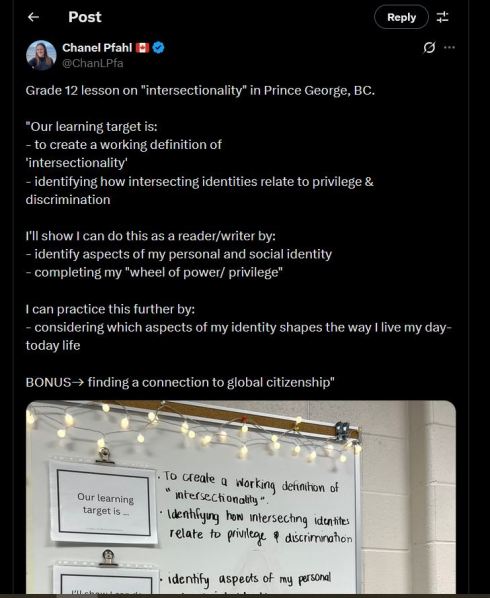
Intersectionality in the Classroom: From Empathy to Indoctrination
Intersectionality, a framework coined by legal scholar Kimberlé Crenshaw in 1989, purports to illuminate how overlapping social categories such as race, gender, class, and sexuality compound experiences of discrimination or privilege. Emerging from Crenshaw’s analysis of Black women’s marginalization within both feminist and civil rights discourses, the term has since evolved into a pervasive lens for examining interlocking systems of power.
In a recent Grade 12 lesson plan from Prince George, British Columbia, students are tasked with crafting personal definitions of intersectionality, mapping their identities onto a “wheel of power/privilege,” and connecting these to daily life and global citizenship. This exercise, ostensibly designed to foster empathy, exemplifies how the theory infiltrates education—reducing multifaceted human experience to a grid of predetermined oppressions and advantages. Yet beneath its academic veneer lies a mechanism for sowing division, one that demands scrutiny for its role in perpetuating grievance over growth.
At its core, intersectionality falters by collapsing the rich tapestry of individual lives into rigid identity matrices, sidelining agency, character, and shared humanity in favor of immutable traits assigned at birth. By framing privilege as an unearned inheritance tied to one’s position on the proverbial wheel, the framework risks breeding resentment among students, who learn to view peers not as collaborators but as bearers of systemic guilt. Empirical observations from social movements underscore this fragmentation: alliances crumble when identity eclipses common purpose, as seen in fractured coalitions where tactical solidarity yields to performative purity tests.
Even within leftist traditions, critics decry how intersectionality dilutes rigorous economic analysis into cultural essentialism, obscuring material inequities under a haze of subjective hierarchies. Far from empowering, this lesson in Prince George transforms the classroom into a theater of suspicion—where adolescents dissect their “intersecting identities” not to build resilience but to catalog wounds, fostering a generation primed for perpetual victimhood rather than principled action.
This pedagogical sleight of hand reveals intersectionality’s deeper allegiance to identity politics, a doctrine that elevates collective affiliation above individual merit and moral accountability. In the lesson’s directive to “identify aspects of my personal and social identity” relative to privilege, students are subtly coerced into prioritizing group-based narratives over personal narratives, echoing a broader cultural shift where loyalty to tribe trumps universal ethics. Such politics, by design, atomizes society into silos of grievance, undermining the Enlightenment ideal of judgment by deeds rather than descent.
The result is not enlightenment but alienation: white students branded as inherent oppressors, marginalized peers cast as eternal victims, all while the lesson’s “bonus” nod to global citizenship rings hollow amid the induced tribalism. Verifiable accounts from educators and observers confirm this corrosive effect, with classrooms devolving into echo chambers of accusation rather than forums for frank exchange.
Worse still, intersectionality’s Marxist undercurrents betray its origins in class warfare, merely repackaging economic antagonism as identitarian strife to sustain endless conflict without resolution. Drawing from dialectical materialism’s emphasis on oppositional forces, the theory substitutes proletariat–bourgeois divides with fluid yet perpetually clashing identity classes—oppressors versus oppressed—fueling a zero-sum battle that mirrors historical agitprop but swaps factories for feelings. Critics within the Marxist canon itself lament this dilution, arguing it retreats from revolutionary class consciousness into liberal fragmentation, where cultural skirmishes supplant systemic overhaul.
In the Prince George curriculum, this manifests as students pondering how their “wheel” positions them in global hierarchies, unwittingly internalizing a narrative of inevitable clash that excuses inaction while justifying radicalism. By promoting such identitarian discord, intersectionality does not liberate; it entrenches a spectral class war, audible in its echoes from the Frankfurt School to contemporary campus upheavals.
In place of this divisive doctrine, educators should pivot to a lesson grounded in universal human rights, drawing from the Enlightenment’s timeless assertion of equality before the law irrespective of ascribed identities. Students might begin by studying the Universal Declaration of Human Rights (1948)—articulating core tenets like dignity and non-discrimination—and then apply them to case studies that transcend identity silos. Group debates could explore how these rights galvanize cooperation in pluralistic societies, extending into civic duties such as community service that bridge divides through shared endeavor.
This alternative, far from ignoring inequities, confronts them through aspirational universality, fostering citizens equipped for concord rather than combat. By centering verifiable principles over subjective grids, such a curriculum honors truth’s pursuit, arming youth against narrative warfare with the unyielding shield of human solidarity.
References
- Crenshaw, Kimberlé. “Demarginalizing the Intersection of Race and Sex.” University of Chicago Legal Forum 1989(1): 139–167.
— Foundational essay introducing intersectionality in the context of Black women’s employment discrimination cases. - Crenshaw, Kimberlé. “Mapping the Margins: Intersectionality, Identity Politics, and Violence against Women of Color.” Stanford Law Review 43, no. 6 (1991): 1241–1299.
— Expanded articulation of intersectional theory applied to social and legal contexts. - Bell, Daniel. The Cultural Contradictions of Capitalism. New York: Basic Books, 1976.
— Influential analysis of how ideological movements replace class analysis with cultural moralism. - Fraser, Nancy. “From Redistribution to Recognition? Dilemmas of Justice in a ‘Post-Socialist’ Age.” New Left Review 212 (1995): 68–93.
— A left-wing critique of intersectionality’s turn toward identity over material class structures. - Marcuse, Herbert. One-Dimensional Man. Boston: Beacon Press, 1964.
— Core Frankfurt School text examining how ideology replaces substantive rationality; relevant to intersectionality’s theoretical lineage. - United Nations. Universal Declaration of Human Rights. Adopted December 10, 1948.
— Primary document grounding an alternative civic and moral education in universalism rather than identity determinism. - Lilla, Mark. The Once and Future Liberal: After Identity Politics. New York: Harper, 2017.
— Liberal critique of identity politics and its corrosive impact on civic cohesion.
Decoding activist language is a tiresome, but important task. I’ll print the original letter, and then an annotated version that identifies that tropes and linguistic warfare undertaken.
“Morgan’s Warriors stands firmly against all forms of denialism that attempt to dismiss, distort, or erase the lived truths of Indigenous Peoples – particularly the truths surrounding the residential school system, Missing and Murdered Indigenous Women, Girls, and Two-Spirit People (MMIWG2S+), and the intergenerational impacts of colonial violence.
Truth Cannot Be Denied
The evidence of abuse, death, and cultural genocide committed in residential schools across Canada is well-documented through survivor testimony, government records, and community-led ground searches.
To deny or minimize these truths is not an act of “critical thinking” – it is an act of racism. Denialism invalidates Indigenous experiences, mocks the pain of survivors, and attempts to erase the memory of children who never made it home.Truth is not a debate. It is a moral responsibility. Every act of denial reopens old wounds and deepens the trauma that Indigenous families and communities have carried for generations.
Denialism Protects Colonial Power
Denialism is not harmless. It protects systems of privilege and power that continue to benefit from Indigenous suffering.
By denying genocide, forced assimilation, and systemic racism, denialists shield the very institutions – churches, governments, and agencies – that carried out these atrocities.
This refusal to accept truth sustains ongoing colonial violence and stands directly in opposition to reconciliation, justice, and healing.
The Human Cost of Denial
Every denial of truth is a denial of humanity.
When someone says the graves aren’t real, or that survivors are lying, they are telling Indigenous peoples that their history, their grief, and their voices do not matter.
This dehumanization is the very essence of racism. It silences survivors and retraumatizes those who continue to live with the scars of Canada’s colonial past.
Reconciliation Demands Truth
Reconciliation begins with truth. It cannot coexist with denial.
We call upon all Canadians — educators, leaders, and citizens — to confront denialism wherever it appears: in classrooms, media, institutions, or conversations.
We must choose truth over comfort, accountability over avoidance, and humanity over hate.To deny truth is to deny the future. To face truth is to heal it.
Our Commitment
Morgan’s Warriors will continue to:
• Uphold the truths shared by survivors, families, and communities.
• Support Indigenous-led investigations into missing children and unmarked graves.
• Confront racism and denialism in public discourse and policy.
• Educate and advocate for truth and justice in alignment with the 231 Calls for Justice and the United Nations Declaration on the Rights of Indigenous Peoples (UNDRIP).Final Words
Denialism is not dialogue — it is discrimination.
Racism is not freedom of speech — it is a wound that silences truth.
We stand with survivors, families, and all truth-tellers.We believe you. We honour you. We will never deny you.”
And now the annotated version:
Morgan’s Warriors stands firmly against all forms of denialism that attempt to dismiss, distort, or erase the lived truths of Indigenous Peoples—particularly the truths surrounding the residential school system, Missing and Murdered Indigenous Women, Girls, and Two-Spirit People (MMIWG2S+), and the intergenerational impacts of colonial violence. [Identitarian Trope: Prioritizes “Indigenous Peoples” as a unified identity group with exclusive claim to “lived truths,” framing external skepticism as erasure; this reinforces identity-based epistemology where group membership grants epistemic privilege.] [Wound Collecting: Lists specific traumas (residential schools, MMIWG2S+, colonial violence) to accumulate moral weight, positioning the group as perpetual victims to justify advocacy.]
Truth Cannot Be Denied. The evidence of abuse, death, and cultural genocide committed in residential schools across Canada is well-documented through survivor testimony, government records, and community-led ground searches. [Leftist Trope: Invokes “cultural genocide” as systemic critique of colonialism, aligning with anti-imperialist narratives that view institutions as inherently oppressive.] To deny or minimize these truths is not an act of “critical thinking”—it is an act of racism. [Leftist Trope: Equates skepticism with racism, a common tactic in progressive discourse to delegitimize opposition by associating it with structural bigotry, shutting down debate.] [Identitarian Trope: Centers racial identity, implying only non-Indigenous or “colonial” perspectives engage in denial, reinforcing an us-vs-them binary.] Denialism invalidates Indigenous experiences, mocks the pain of survivors, and attempts to erase the memory of children who never made it home. [Wound Collecting: Amplifies “pain of survivors” and lost children to evoke emotional response, collecting historical wounds to bolster the argument’s urgency and moral superiority.] Truth is not a debate. It is a moral responsibility. Every act of denial reopens old wounds and deepens the trauma that Indigenous families and communities have carried for generations. [Wound Collecting: Explicitly references “reopens old wounds” and “deepens the trauma,” using intergenerational suffering as a rhetorical device to portray denial as ongoing violence, thereby claiming victimhood as a shield against critique.]
Denialism Protects Colonial Power. Denialism is not harmless. It protects systems of privilege and power that continue to benefit from Indigenous suffering. [Leftist Trope: Frames denial as upholding “systems of privilege and power,” drawing on Marxist-inspired analysis of colonialism as economic and social exploitation persisting today.] [Identitarian Trope: Positions “Indigenous suffering” as central to identity, contrasting it with non-Indigenous “privilege” to highlight power imbalances.] By denying genocide, forced assimilation, and systemic racism, denialists shield the very institutions—churches, governments, and agencies—that carried out these atrocities. [Leftist Trope: Targets “institutions” like churches and governments as agents of “systemic racism,” promoting a narrative of institutional reform or dismantling as necessary for justice.] This refusal to accept truth sustains ongoing colonial violence and stands directly in opposition to reconciliation, justice, and healing. [Wound Collecting: Ties denial to “ongoing colonial violence,” extending past wounds into the present to justify continued activism and demand reparations.]
The Human Cost of Denial. Every denial of truth is a denial of humanity. When someone says the graves aren’t real, or that survivors are lying, they are telling Indigenous Peoples that their history, their grief, and their voices do not matter. [Identitarian Trope: Elevates “Indigenous Peoples” voices as inherently valid, dismissing challenges as dehumanizing, which enforces identity-based hierarchies in discourse.] [Wound Collecting: Focuses on “grief” and invalidated “history” to accumulate emotional injuries, using them to indict critics.] This dehumanization is the very essence of racism. [Leftist Trope: Defines racism broadly as “dehumanization,” encompassing not just overt acts but denial of narratives, aligning with expansive definitions in critical race theory.] It silences survivors and retraumatizes those who continue to live with the scars of Canada’s colonial past. [Wound Collecting: References “scars” and “retraumatizes,” metaphorically collecting physical and emotional wounds to emphasize perpetual harm.]
Reconciliation Demands Truth. Reconciliation begins with truth. It cannot coexist with denial. We call upon all Canadians—educators, leaders, and citizens—to confront denialism wherever it appears: in classrooms, media, institutions, or conversations. [Leftist Trope: Advocates collective action against “denialism” in public spheres, echoing calls for societal re-education and institutional accountability in progressive movements.] We must choose truth over comfort, accountability over avoidance, and humanity over hate. To deny truth is to deny the future. To face truth is to heal it. [Identitarian Trope: Frames “truth” as Indigenous-centered, implying non-Indigenous “comfort” and “avoidance” stem from privilege, reinforcing group-based moral dichotomies.]
Our Commitment. Morgan’s Warriors will continue to: Uphold the truths shared by survivors, families, and communities. Support Indigenous-led investigations into missing children and unmarked graves. Confront racism and denialism in public discourse and policy. [Leftist Trope: Prioritizes “Indigenous-led” efforts and confronting “racism in policy,” advocating for decolonized approaches over mainstream ones.] Educate and advocate for truth and justice in alignment with the 231 Calls for Justice and the United Nations Declaration on the Rights of Indigenous Peoples (UNDRIP).
Final Words. Denialism is not dialogue—it is discrimination. Racism is not freedom of speech—it is a wound that silences truth. [Wound Collecting: Portrays racism itself as a “wound,” inverting the dynamic to collect societal harms as part of the Indigenous experience.] [Leftist Trope: Rejects “freedom of speech” for denialism, prioritizing harm prevention over open debate, a stance common in hate speech regulations.] We stand with survivors, families, and all truth-tellers. We believe you. We honour you. We will never deny you. [Identitarian Trope: Affirms solidarity based on shared identity and experiences, excluding deniers and centering “survivors” as authoritative.]
And here is a handy glossary of why using these tropes is bad for Western Liberal Democratic societies.
Glossary of Leftist Tropes
This glossary enumerates and explicates each Leftist trope identified in the annotated rewrite of the statement. Entries are drawn directly from the annotations, with explanations grounded in observable patterns from political discourse, critical theory, and historical leftist frameworks. Each trope is presented with its core characteristics, contextual application in the text, and verifiable rationale, prioritizing empirical accuracy over ideological endorsement. Additionally, a brief refutation is provided for each, detailing its corrosive effects on Western liberal democratic societies, which emphasize individual liberties, open inquiry, pluralism, and evidence-based governance.
Advocates Collective Action Against Denialism: This trope calls for widespread societal intervention—targeting educators, leaders, and citizens—to suppress denialism in public arenas like classrooms and media. It reflects progressive strategies for re-education and accountability, akin to historical leftist mobilizations against perceived systemic threats, as seen in anti-fascist or decolonization campaigns. In the statement, it manifests as a directive to “confront denialism wherever it appears,” emphasizing communal responsibility to enforce narrative conformity.
Refutation: This trope undermines pluralism by mobilizing collective pressure to stifle dissent, eroding the democratic principle of open debate and risking authoritarian conformity, where majorities or activists impose orthodoxy rather than allowing verifiable evidence to prevail through rational discourse.
Defines Racism Broadly as Dehumanization: Here, racism extends beyond explicit acts to include narrative denial, aligning with critical race theory’s expansive view that subtle invalidations perpetuate oppression. Verifiable in works like those of Ibram X. Kendi or Kimberlé Crenshaw, this trope reframes intellectual disagreement as harm. The statement applies it by asserting that denying graves or survivor accounts equates to telling Indigenous Peoples their “voices do not matter,” thus broadening racism to encompass epistemic violence.
Refutation: By inflating racism to cover mere disagreement, it dilutes the term’s meaning, fostering a chilling effect on free expression and hindering verifiable truth-seeking, as citizens fear reputational harm for questioning narratives, contrary to liberal ideals of tolerance and empirical scrutiny.
Equates Skepticism with Racism: A rhetorical device that links doubt or “critical thinking” to bigotry, effectively closing off debate by moral condemnation. Rooted in leftist critiques of neutrality as complicity (e.g., in anti-racism literature), it delegitimizes opposition. The text uses this by declaring denial “not an act of ‘critical thinking’—it is an act of racism,” positioning skepticism as inherently prejudiced rather than evidence-based.
Refutation: This stifles scientific and intellectual inquiry, core to Western liberalism, by labeling evidence-based doubt as moral failing, which corrodes democratic discourse and invites dogmatic echo chambers where truth is subordinated to ideological purity.
Frames Denial as Upholding Systems of Privilege and Power: Drawing from Marxist analyses of class and colonialism (e.g., Frantz Fanon or contemporary dependency theory), this trope portrays denial as a mechanism sustaining exploitation. It highlights how denial “protects systems… that continue to benefit from Indigenous suffering,” verifiable in leftist scholarship on neocolonialism, where truth denial preserves economic and social hierarchies.
Refutation: It promotes a conspiratorial view of society as perpetually rigged, undermining trust in institutions and individual agency, which erodes liberal democracy’s foundation in meritocracy and rule of law, replacing verifiable accountability with class-based suspicion and division.
Invokes Cultural Genocide as Systemic Critique: This employs the term “cultural genocide” to indict colonialism holistically, viewing institutions as engines of erasure. Aligned with anti-imperialist narratives in leftist thought (e.g., UN definitions influenced by Raphael Lemkin), it critiques inherent oppressiveness. In the statement, it references “abuse, death, and cultural genocide” as documented, framing the residential system as deliberate structural violence.
Refutation: Overuse of loaded terms like “genocide” for historical analysis inflames polarization without nuance, corroding democratic dialogue by equating past injustices with contemporary intent, thus impeding balanced policy-making rooted in verifiable facts rather than emotive hyperbole.
Prioritizes Indigenous-Led Efforts and Confronting Racism in Policy: Emphasizing decolonized, group-specific approaches over universal ones, this trope advocates for policy reforms rooted in marginalized leadership. Echoing leftist decolonization theories (e.g., Linda Tuhiwai Smith’s work), it commits to “Indigenous-led investigations” and alignment with UNDRIP, verifiable as a push against mainstream assimilationist policies.
Refutation: By favoring group identity over individual equality, it fragments society along identitarian lines, undermining liberal democracy’s commitment to universal rights and merit-based governance, potentially leading to exclusionary policies that prioritize ancestry over verifiable expertise or consensus.
Rejects Freedom of Speech for Denialism: This prioritizes harm mitigation over unfettered expression, common in leftist arguments for hate speech limits (e.g., European models or Canadian section 319 of the Criminal Code). The statement declares “Racism is not freedom of speech—it is a wound that silences truth,” framing denial as discriminatory rather than protected dialogue, thus justifying censorship in service of equity.
Refutation: Curtailing speech on subjective grounds erodes the First Amendment-like protections central to Western liberalism, inviting state or social censorship that suppresses verifiable debate, historically leading to tyrannical outcomes where power defines “harm” to silence opposition.
Targets Institutions as Agents of Systemic Racism: By naming churches, governments, and agencies as perpetrators shielded by denial, this trope promotes institutional overhaul or dismantling. Grounded in leftist institutional critiques (e.g., Michel Foucault’s power structures or Antonio Gramsci’s hegemony), it asserts denial “shields the very institutions… that carried out these atrocities,” verifiable in analyses of colonial legacies as ongoing systemic failures.
Refutation: This fosters pervasive distrust in foundational institutions without proportionate evidence, corroding social cohesion and governance in liberal democracies, where verifiable reform through democratic processes, not wholesale condemnation, sustains progress and stability.











 bleatmop
 Mystro
 The Arbourist


 Dead Wild Roses
Your opinions…