
You are currently browsing Mystro’s articles.
This post is dedicated to debunking the whole “harsh punishment on criminals is good” mentality. This post will have nothing to do about ‘prisoner rights’ or ‘criminal coddling’, but rather it will look at the efficacy of ‘harsh punishment’ on crime in general and how efficient longer jail sentences would be. Does it actually work? To what degree? Is that degree of success worth what it costs to citizens? Lets take a look.
 For as long as there have been communities, murderers and thieves have been seen as criminals. Indeed, non-human primates share this with us as they will also punish, banish or kill deviants of this kind. And since the birth of the community, punishment for these crimes has been vast, varied, ingenuitive, brutally painful, and many have been fatal. So what we have is a near perfect case study. Thousands of years worth of experiments where two specific crimes have met with the pinnacle exemplars of the object of our study, harsh punishment. If harsh punishment really had any effect whatsoever on deterring or reducing crime, after those many thousands of years of diligent application we should find that the social problems of murder and theft are all but solved, strange memories of an era long past away. As we don’t seem to be any closer to a crime free utopia than early communities (indeed, most would argue we are further away) the only conclusion is that harsh punishment is contending for the rank of ‘most ineffective idea ever actualized by any government’, which is a highly competitive race. But for those that find this thought experiment a bit too neat, lets break it down a bit and look at our system of imprisonment.
I’m not sure if this is a nation wide project, or even if its province wide, but the MP’s from Edmonton and the surrounding area have been periodically sending out mail to all of their constituents. This piece of mail consists of a single sheet of paper with some Conservative Party message on it as well as a piece you can rip off and mail back to the MP with your response to the aforementioned message. I despise them.
 I am actually in favor of governments letting the people know what its doing and why, but this is not what we’re talking about here. These “political messages” are merely propaganda tools. Further (and I find this insulting) they aren’t very good ones. The message I get from the Conservatives is “We don’t have to try that hard to brainwash such a simple minded public, this should suffice.”
Attacks on other parties either focus on especially weak straw men versions of the target party’s policy or they resort to slander and ad hominem attacks, which never present a political reason why they might be a poor choice for voters. Most of these messages could be replaced by the words “People who are not us are bad,” without losing an ounce of actual content.
The letters used to promote themselves are no better. Most are void of any actual policy and only vaguely refer to some ideal that Conservatives like to attach their policies to. No understanding of Conservative policy would be lost if, instead, they just sent out letters that said, “We are good, believe it!” repeatedly.
These propaganda leaflets have bothered me for some time (especially the “free” return postage, as if it is to be paid out of Conservative pockets instead of by our tax dollars, yeah right) but something odd happened that finally convinced me to write on one of these letters. I received one that actually had a piece of specific information regarding the Conservative plan for Canada: they want to repeal the faint hope clause so those who have received a life sentence will not be eligible for parole for at least 25 years. This, they say, will make Canada safer.
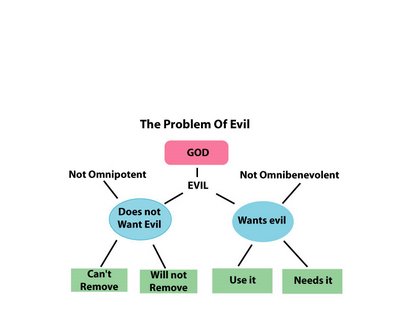 I’m tired of people saying that one cannot prove the non-existence of their god. Not only can one do it, but its already been done. I’m referring to the problem of evil. The fact that evil exists negates the possibility of an omniscient, omnipotent, omnibenevolent, and omnipresent deity. Those are very important qualifiers, the problem of evil does not disprove the existence of any deity that is not completely perfect or is lacking in someway. I admit that the existence of any deity lacking, even slightly, in any perfection, in any way, cannot be disproven. On the other hand, any such deity would then be in the category of leprechauns, the boogey man, the tooth fairy, and the large invisible pink bunny that “actually” created everything, but only reveals this to asylum patients. And while this category, filled with an infinite amount of characters limited only by our imagination, cannot be disproven, no rational person would ever believe in such entities, as there is no evidence to support their existence. Or, if you prefer, they all have equal evidence in their favor, so each has a 1 in infinity chance of being correct. Not exactly zero, but close enough for any one with the cognitive capabilities of a codfish.
 Pro life advocates claim that conception is the beginning of human life, making it the point at which human’s become morally relevant. Birth is just some event that happens later and has no bearing on things like rights. Thus, blastocysts deserve full legal protection that adult humans get and the death of a zygote ought to be weighed equally as the death of people outside the womb. It’s been repeatedly pointed out why this is either incorrect or irrelevant but this has failed to sway most pro lifers. So today I shall explore the implications of pro life reasoning were it actually sound.
What happens if we up the accuracy a bit and apply pro life reasoning? And by ‘up the accuracy’ I mean that we look at the actual beginning of a human’s life cycle. Pro lifers claim that its conception. But any high school biology student could tell you that there is a lot that has to happen before that. An egg has to be released by the female, which must then float down a long tube. During the brief period when this is happening, a sperm cell must travel from the male, through the birth canal, and meet up with the ovum. Only then can conception begin to take place. Thus, human life has an earlier chapter that pro lifers currently ignore.
Now you could point out that each of the gametes only have half the required chromosomes that ‘actual’ people have, but the response is the same as when its pointed out that blastocysts have no brain. According to Pro lifers such things are purely developmental issues, that have no bearing on person-hood. Physiology is nothing to base moral worth on, after all.
In fact any argument you could possibly come up with to say that the gamete is NOT a person, but a zygote is, there is a synonymous argument saying that the zygote is not a person, but a birthed human is. And since, for the purposes of this thought experiment, I’m granting the pro life position that the latter wouldn’t work, then I must also grant that the former wouldn’t work either.
Gametes fulfill the pro life criterion for human life and therefore moral worth. They are 100% human cells and their sole purpose is to develop into a separate human being, they are merely people one step back from zygotes. Conception is just some event that happens later and has no bearing on things like rights.
Can we go a step further? Well, I suppose we could look at oogonia in females and spermatagonia in males (the gametogonium that develop into their respective gametes) , but my grasp of biology starts getting hazy about that point, and so gametes are as far back as I can go right now. No matter, it is sufficient to reveal the absurdity of pro-life arguments.
There is a prevailing view within the “progressive” community that religious tolerance (RT) is a virtue necessary for a just, egalitarian society. This is preposterous. Not only does RT have horrific implications, it is an “ideal” that I seriously doubt is actually held by its proponents. To begin with, lets take a look at what its advocates would like you to think RT means. RT means people are allowed to have whatever faith they want without fear of prosecution, persecution, or any other undesirable ‘ution’ and thus, RT would result in less hate crimes, violence, and a whole bunch of other nasty stuff we would rather be without.
The very first thing I’d like to point out is that all that nasty stuff that RT proponents say they’re trying to reduce can be dealt with much more efficiently. Instead of saying, “You’re not allowed to lynch someone or burn down their house just because they hold to a faith that differs from yours,” it would be much better to simply say, “You’re not allowed to lynch someone or burn down their house at all, for any reason”. The former of these maxims can be interpreted to mean that there are some circumstances which would allow one to lynch another, its just that differences in faith isn’t one of them. The second, however, makes things pretty clear. So this first short bit is just to show that basic protection laws make the common perception of RT irrelevant; if not a markedly inferior approach and a step in the wrong direction. That is just examining the possible benefits of RT. Let us analyze the completely ignored and adverse ramifications of RT.
RT would be a restriction on society, but not on individuals. This is very different from other egalitarian movements and why RT is dangerous. For example, tolerance of alternative sexual orientations is a two way street. Simply speaking, straight people are OK with gay people and gay people are OK with straight people. If it was only a one way street, then the ideal of the freedom to be with the consenting adult of your choice, regardless of their physiology, would be undermined.
RT, however, can only be one way. The community must accommodate the beliefs of the individual, but not the other way around. If one is allowed to adhere to any faith one wants to (as RT says one is) then if someones faith does not include RT, then that feature must be allowed and respected as well. Because RT is presented as a freedom of beliefs/values, and RT is itself a belief/value, proponents of RT cannot enforce RT on anyone without going back on the basic principles of RT.
So lets look at three people, each with very different faiths…











 bleatmop
 Mystro


 Dead Wild Roses
Your opinions…