
You are currently browsing The Arbourist’s articles.

The great part is that you (genderists) really can’t. It’s like well women are like this and this in society (insert toxic gender role here) and men are like this in society (insert toxic gender role)… You see, if your touchstones for your ‘gender identity’ are the fucking patriarchal approved norms of society then what you are doing isn’t ‘progressive’ or ‘queer’ it is replicating patriarchy and the normative values patriarchy supports. Way to support the status quo, appropriate gold stars to be dispensed for your empowerful hyper-individualism.
And then you wonder why feminists that struggle for the emancipation of women (adult human females) are calling bullshit on your claims of ‘gender-identity’. It’s fucking patriarchy all the way through and thus, not good for anyone.
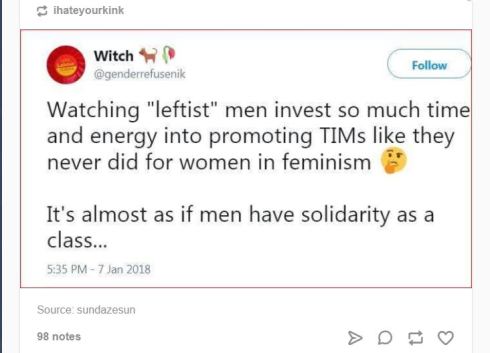
So surprising right? Google trans identified men and a plethora of results showing successful business people, politicians and cultural leaders. What to trans identified women get hits for in google? Looking pretty.
Almost like there is another axis of oppression at work that happens to supersede any individual claims to the construct of gender.
On the level folks, I do use a cellphone – a smart phone even. But I’m not sure I like it. I most certainly enjoy the GPS that comes with it, as finding those schools tucked away in suburban hell can be very tricky, even at the best of times. But, past the land navigation benefits, I’m not too sure.
Owning a mobile phone is not helping me in my struggle to continue to read widely and with depth in the topics I am interested in. The false novelty of the facebook feed is much to easy an out, versus intellectually girding oneself for tackling that next book on feminist theory or the ravages of American imperialism. I read a great deal in my 20’s and have the bookshelves to prove it, but now reading seems on a path that is further and harder away to reach. I remember my voracious reading days and wonder where that zeal went, and how to restoke that desire for knowledge and perspective of the world.
Facebook is open in the other tab, even as I write this post, offering its usual semi-catered beguilement for my consumption. It is truly the ‘ghost feast’ we read about in fairy tales – where you can eat and eat and eat and yet slowly starve to death because the scrumptious food being consumed is a insubstantial, desultory facade.
Much of what Dr.Reed says resonates with me, and I thought I’d share a part of his essay here.
“The decisive reason, however, for me to refuse a cellphone is the opposite of everyone else’s reason for having one: I do not want the omnipresent ability to communicate with anyone who is absent. Cellphones put their users constantly on call, constantly available, and as much as that can be liberating or convenient, it can also be an overwhelming burden. The burden comes in the form of feeling an obligation to individuals and events that are physically elsewhere. Anyone who has checked their phone during a face-to-face conversation understands the temptation. And anyone who has been talking to someone who has checked their phone understands what is wrong with it.
Communicating with someone who is not physically present is alienating, forcing the mind to separate from the body. We see this, for example, in the well-known and ubiquitous dangers of texting while driving, but also in more mundane experiences: friends or lovers ignoring each other’s presence in favour of their Facebook feeds; people broadcasting their entertainment, their meals, and their passing thoughts to all who will bear witness; parents capturing their daughter’s ballet performance on their phones rather than watching it live; people walking down the street talking animatedly to themselves who turn out to be apparently healthy people using their Bluetooth.
The cellphone intrudes into the public and private realms, preventing holistic engagement with what is around us. Smartphones only perfect their predecessors’ ability to intrude.
The disembodying and intrusive effects of cellphones have significant implications for our relationships to the self and to others. Truly knowing and understanding others requires patience, risk, empathy, and affection, all of which are inhibited by cell phones. Cellphones also inhibit solitude, self-reflection, and rumination (formerly known as ‘waiting’ and ‘boredom’), which I think are essential for living a good life.”
Menon’s arguments are quite rational, but with the current American Republican Administration having rational arguments doesn’t count for much.
“Here’s a prerequisite for avoiding war in Korea: stop believing in the North’s denuclearization, attractive and desirable as it might be (if achieved through diplomacy).
It doesn’t follow, however, that war can’t be avoided. Kim Jong-un and his inner circle are not, in fact, irrational beings immune to deterrence. Their paramount aim is to ensure the survival of the North Korean state. Starting a nuclear war would destroy it. Yes, many people have perished in North Korea (whether due to repression or famine), but deterrence worked in the cases of Soviet dictator Joseph Stalin and China’s Mao Zedong, both of whom enacted policies that killed millions. Mao supposedly even boasted that China could survive a nuclear war because of its huge population.
Coming to terms with the reality of a nuclear-armed North Korea and trusting in deterrence may not sound like a perfect ending, but under the circumstances it’s undoubtedly the best way to avert catastrophe. And that, unquestionably, is the urgent task. There are other ways, down the line, to make the Korean peninsula a better place through dialogue between the two Koreas, by drawing the North into the regional economy and reducing troops and weaponry on both sides of the Demilitarized Zone. These shouldn’t be ruled out as infeasible.
For them to happen, though, South Korea would have to separate itself from Trump’s war plans by refusing to allow its sovereign space (land, sea, and air) to be used for such a preventive war. The symbolism would be important even if Trump could strike in other ways.
Seoul would also have to build on two recent positive developments that emerged from a surprise January 9th meeting between the Koreas. The first is the agreement on Kim Jong-un’s proposal (initially advanced by the South last June) to send a North Korean contingent to the February Winter Olympics in Pyeongchang, South Korea. The second flowed from South Korean President Moon Jae-in’s follow-up idea of restoring the hotline between the countries and beginning discussions of how to tamp down tensions on the peninsula. (Pyongyang shut down the hotline in February 2016 after South Korea’s conservative government closed the Kaesong joint industrial zone located in the North, which then employed more than 50,000 North Koreans.) Moon’s suggestion doubtless eased the way for the subsequent agreement to hold future military talks aimed at reducing the risks of war.
There are further steps Seoul could take, including declaring a moratorium on military exercises with the United States — not just, as now (with Washington’s consent), during the February Olympics and the Paralympics that follow and end in March, but without a preset time limit. While such joint maneuvers don’t scare Pyongyang, moves like flying American B1-B bombers and F-15C fighter jets in international airspace off North Korea’s coast do ratchet up the tension. They increase the chances of one side concluding that the other is about to attack.
Trump may continue his threats via Twitter and again denigrate the value of negotiations with Pyongyang, but South Korea is a powerful country in its own right. It has a $1.4 trillion economy, the 11th largest in the world (versus North Korea’s paltry $32.4 billion one), and ranks sixth in global exports. It also has a formidable military and will spend $34 billion on defense in 2017 — more than North Korea’s entire gross domestic product. It is, in short, anything but the Asian equivalent of a banana republic for which Donald Trump should be able to write the script.
Trump’s generals and the rest of the American foreign policy establishment won’t welcome independent initiatives by Seoul, as witness the condescending remark of a former official about the hazards of South Korea “running off the leash.” Predictably, mainstream warnings have already begun. Cunning Kim Jong-un wants to drive a “wedge” between the United States and South Korea. He’s trying to undo the sanctions. Agreeing to talks with Pyongyang will only communicate weakness. The United States must demonstrate its resolve and protect its credibility. And so it goes.
Policies based on these shibboleths, which portray South Korea as an American dependency, have brought us to the brink of war. Continuing them could push us over the edge. “

Men really need to stop trying to make feminism about them.
Women have been fighting for full human status in society for a very long time. You’d think a rational society could do more in a hundred years plus, but we’re still not there yet.
” And yet I find in American newspapers there is a great deal of misunderstanding of the fact that one of the chief minds engaged in conducting the women’s revolution is, for purposes of convenience, located in Paris. It is quite easy for you to understand – it would not be necessary for me to enter into explanations at all – the desirability of revolution if I were a man, in any of these countries, even in a part of the British Empire known to you as Ireland. If an Irish revolutionary had addressed this meeting, and many have addressed meetings all over the United States during the last twenty or thirty years, it would not be necessary for that revolutionary to explain the need of revolution beyond saying that the people of his country were denied – and by people, meaning men – were denied the right of self-government. That would explain the whole situation. If I were a man and I said to you, “I come from a country which professes to have representative institutions and yet denies me, a taxpayer, an inhabitant of the country, representative rights,” you would at once understand that that human being, being a man, was justified in the adoption of revolutionary methods to get representative institutions. But since I am a woman it is necessary in the twentieth century to explain why women have adopted revolutionary methods in order to win the rights of citizenship.
You see, in spite of a good deal that we hear about revolutionary methods not being necessary for American women, because American women are so well off, most of the men of the United States quite calmly acquiesce in the fact that half of the community are deprived absolutely of citizen rights, and we women, in trying to make our case clear, always have to make as part of our argument, and urge upon men in our audience the fact – a very simple fact – that women are human beings. It is quite evident you do not all realize we are human beings or it would not be necessary to argue with you that women may, suffering from intolerable injustice, be driven to adopt revolutionary methods. We have, first of all to convince you we are human beings, and I hope to be able to do that in the course of the evening before I sit down, but before doing that, I want to put a few political arguments before you – not arguments for the suffrage, because I said when I opened, I didn’t mean to do that – but arguments for the adoption of militant methods in order to win political rights.”
-Emmeline Pankhurst in Hartford Connecticut, on November 13, 1913











 bleatmop
 Mystro
 The Arbourist


 Dead Wild Roses
Your opinions…