
You are currently browsing the category archive for the ‘Canada’ category.
This except from the essay “Intimidation Masquerading as Virtue is Chilling Free Speech” by Chanel Pfahl
Brief overview of CRT
In the simplest of terms, CRT is a particular way of looking at race relations in society. The term was originally coined by legal scholar Kimberlé Crenshaw, in the 1980s, and its goal was to examine the ways in which racism continued to present itself in America despite the advances that were made during the civil rights movement.
Though slavery in the United States was officially abolished in 1865, Jim Crow laws (enforcing racial segregation), and other discriminatory practices, such as prohibiting black people from living in certain neighbourhoods, remained for nearly another century. The US, and Canada, to a lesser extent, have a history of racism that cannot be denied, and exploring the ways this history might have lingering effects on people of colour today is therefore a noble endeavour.
CRT does this in a flawed, counterintuitive way, however. It rejects the “common humanity” approach to achieving social justice – the very approach that has allowed us to overcome racist attitudes and race-based discrimination in the West to the degree that we have. Further, it is explicitly opposed to liberal principles like individual rights and civil liberties. Derrick Bell, the first African American tenured law professor at Harvard, and one of the founders of CRT, stated in his 1987 book that “progress in American race relations is largely a mirage obscuring the fact that whites continue, consciously or unconsciously, to do all in their power to ensure their dominion and maintain their control”. Indeed, for CRT supporters, racism is viewed as the ordinary, permanent state of affairs in our society.
This cynical view is shared by contemporary CRT advocates like author Robin DiAngelo. In her book White Fragility, which sat on the New York Times Best Seller list for a year in 2020, she claims that “anti-blackness is foundational to our very identities as white people” (p.91) and says “to be less white is to be less racially oppressive” (p. 149). She even argues, in this paper, that “raising white children to be white is a form of child abuse”. Beyond revealing her own racist attitudes, which she also projects onto every other white person, DiAngelo’s “insights” are not overly illuminating. Are Canadian taxpayers aware that they have been paying for her to share her views at “antiracist” events, like this one just last month?
According to CRT, racial identity is of primary importance when it comes to determining one’s position in society. Rather than saying “you are black, I am white, but most importantly, we are both human beings, and we should therefore be treated equally”, it says “you are black, I am white, and as such you are an oppressed victim, and I am a privileged oppressor; your experience of the world is completely different from mine, and the way to bring about positive change is to draw attention to the ways in which we are different”.
Indeed, based on the CRT framework, treating everyone the same regardless of skin colour (i.e., “colourblindness”) is actually a form of covert racism, as this approach does not “centre” racial identity. This is directly opposed to the unifying message of Martin Luther King, who famously stated his dream for his four children to see the day when people would be judged not by the colour of their skin, but by the content of their character.
In fact, even racial segregation is being brought back into fashion by proponents of CRT. They say it is for the “safety” of people of colour — a space to be free from white people, or from “whiteness”, as they like to call it. Have a look at this Chicago church that decided that they were “fasting from whiteness” for Lent this year… and proudly advertised it on their front lawn!

Language games breed self-censorship
With many elements of postmodern thought baked into the theory, CRT is more concerned with “dismantling” abstract “systems of power” through “deconstructing” language than it is with actually finding material solutions to real-world problems using evidence-based analysis. This manifests, notably, as an obsessive focus on what words we should and shouldn’t use (if we are to avoid “harm” and “microaggression” accusations, or worse).
How does knowing the current “accepted” term, say between “racial minority”, “coloured people”, “racialized people”, “Black”, “BIPOC”, and “people of colour” translate to any change for this particular group of individuals? It doesn’t.
But when it becomes such a grave, racist offence to use the “wrong” words, most people would rather not mess it up. This hyperfocus on language, which does not present any real world benefit for black people, simply keeps us guessing, and stops us from saying what it is we think. It is chilling free speech.
At the same time, this insistence on politically correct terminology provides incentives for certain ambitious types to master these language games and become self-appointed members of the thought police. Generally, it is white, university educated, middle and upper class women, who have discovered that between being accused of using the wrong words — i.e., “perpetuating white supremacy” — and accusing others of using the wrong words, while benefiting from a sense of moral superiority, the latter is preferable.
It isn’t clear whether they ever stop to wonder “who is this helping, anyway?” — they simply stay up to date on the latest woke beliefs, and enforce them onto others, ruthlessly at times, while claiming to be the compassionate and inclusive ones. They probably actually believe it.
These ideologues are encouraged not only by the innocuous sounding language that covers up this divisive ideology – like “equity”, “anti-racism”, “inclusion”, etc. – but also by the complex-sounding explanations below the surface. Of course, the underlying ideas are deceptively shallow and straightforward, but being able to virtue signal by using words like “hegemony” or “intersectionality” and cite academic papers (ignoring the fact that rigour is severely lacking in these fields) is addictive for some.
Escaping the burden of proof
“Anti-racist” or “CRT” activists claim that racism permeates our society at every level in a subconscious and/or systemic way. This is tremendously useful for anyone who champions the ideology, as it allows for an easy way out of having to show evidence for their claims. After all, the alleged racism is hidden, so how are they supposed to prove its existence? Why should they be expected to? (And also, you must be racist if you think proof is required.)
If you are brave enough to ask them to substantiate their beliefs, or voice genuine disagreement, many will immediately disengage, label you or accuse you of “harm” for your truth-seeking ways.
The hollow shell of ‘progressive’ virtue signalling rings a bit hollower as here in Canada, there is no one on the list to remember.
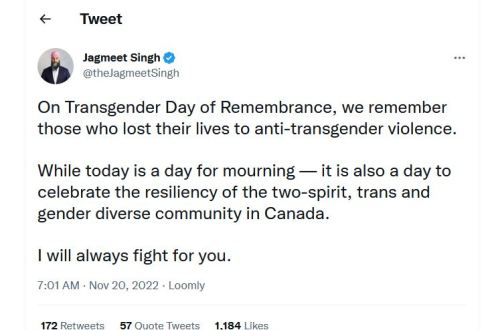
As in for the last three years…
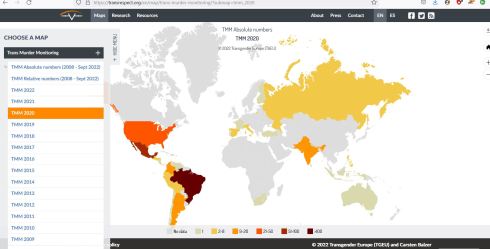


Although at the very same time those pesky uterus-havers and menstruators are dying at a rate of 1 woman every 2.5 days. Yet here were are celebrating the manufactured victimhood of gender deluded males.
Transgender ideology cloaks its misogyny in false narratives of oppression and trauma – while doing its very best to erase females and female boundaries,spaces, and sports from society.
Bill C-16 has to be repealed and then we can start repairing the damage done to female trust in our government and institutions.

This is the madness that parents and sane teachers are up against. Read and learn so you can pick apart their bullshite and get to the truth.
Go to Colin Wright’s Substack for the full essay.
Question: How are the terms “man” and “woman” and “boy” and “girl” defined?
Kyle: “Oh wow, this question is going to be difficult to answer ‘cause it’s a bit philosophical.”
Jessie then answers:
Well that’s a great question. So I did an undergrad and a masters in Gender Studies, and like, I don‘t know if I could even tell you that, right? Like, because part of it, it’s, you cannot get away from social constructionism and language. So we define these terms based on many different things, but they’re always defined by the current context in which we live, like culture, time, all of these pieces, right? I think, and in that, we also define it by things like hormones, and things like anatomy, right? It’s like, how do we decide, um, you know, when we assign somebody male or female at birth, what is that based on? That’s based on anatomy, right? But there’s actually so many things, um, that are, that we’re not kind of looking at, right? That we also have to take into account. So, I mean, I honestly can’t answer those questions.
Um, you know, it’s, when we talk about gender identity, right, people, uh, say like ‘How do you know you’re trans?’ kind of almost like ‘How do you know you’re gay?’ It’s like, how do you know you’re straight? Right? It’s just kind of like, it’s often times like an internal feeling, but we define these things in terms of like biological factors, social factors, psychological factors, um, and they change from, like, different eras, different centuries, and mean different things at different times. I don’t know, that’s a hard one.
You read that correctly: Jessie did both an undergrad degree and completed a masters degree in Gender Studies, yet cannot even provide definitions for the two “genders” that children are identifying with and away from that serve as the basis for removing and modifying their body parts.
Kyle then adds:
We spoke a bit earlier about this idea of like labels and alphabet soup, and sometimes I think like yeah, these ideas of what is man and what is woman, what is boy what is girl? They’re just like arbitrary words to describe, you know, experiences and labels to put on people. And like who really knows what it means to be man, to be woman, to be masculine, to be feminine? I think it is what you say it is.
If “man” and “woman” and “boy” and “girl” are indeed only “arbitrary words to describe experiences,” then how can we possibly justify any medical interventions for children describing themselves in these terms? This concern leads to my next question.
Question: If we can’t understand these concepts, why do we think children can grasp them?
Kyle responds that’s because the real experts are the children themselves!
I think that we need to give way more credit like, when I’m, as I said when I’ve run these workshops it’s like students who are the ones being like “We don’t care that you’re trans and telling your story because, like, that’s fine, you be you.” I get asked so many times “Why were people ever mean to you for being trans? Like, it’s just you.” And it’s like, yeah, they get it way more, like I think it’s the unraveling that we are doing presently, the peeling of the onion, has already happened for them. They’re there with this fresh onion already, like crying away and being like “Cool,” like this radical acceptance of like this is how things are, and it is like an unlearning that has already been happening, um, and so we’re catching up, I think.
Jessie echoes Kyle’s sentiment about how children are the true experts because they’ve yet to be corrupted by socialization, whereas adults are perpetually engaged in a “process of unlearning” their biases, phobias, and preconceptions about what it means to be a man or woman.
These are challenging ideas, and we can get into philosophy and all these things, but you have to remember the way that we were all socially kind of, like, you know, taught about these concepts, and so we’re very much in a process of unlearning, where you know, there’s almost like a simplicity to kids, right? Like around, um, just being who they are, and being accepting, and loving of themselves and other people, and then, you know, and then bias kind of comes into play, and a lot of hat is taught, actually.
“Climate activists in Vancouver said they threw maple syrup on a painting by one of Canada’s most iconic artists at the Vancouver Art Gallery Saturday to bring attention to the global climate emergency”

“The group is demanding an end to the Coastal GasLink Pipeline project, currently under construction from Dawson Creek to Kitimat on B.C.’s north coast.
The group told media that they, along with other protesters around the world, are targeting works of art because too little is being done to stop the progress of human-caused climate change.”
Stunts like these are setting a precedent for more irresponsible ‘activism’ in the future. Eventually they will target a work of art that isn’t behind class or similarly protected and then their bullshit antics will destroy a work of art permanently.
“Police said no arrests have been made, but officers are investigating the incident.”
The authorities are gladhanding this incident, as usual it seems, with little or minor consequences for the perpetrators of criminal actions.
Canada needs to brace for more insipid activism as we have a class of children coming up who are not prepared to deal with reality or how to live peacefully in the current society.
Source: cbc.ca
This is a guest post written by former teacher Chanel Pfahl.
I recently came across a collection of lesson plans for K-8 teachers. I didn’t intend to spend hours rummaging through them, but one thing led to another.
Created in July 2022, the lesson plans are featured in a “Back-To-School Kit” on a website called “Welcoming Schools”. The site is produced by the HRC Foundation — the largest LGBTQ advocacy group in the United States — and it is recommended as a resource for educators by the Ontario elementary teachers’ union (ETFO).
As a former teacher who is currently being subjected to a formal investigation by my licensing body (the Ontario College of Teachers) for voicing what I believe are reasonable concerns about indoctrination in schools in a private Facebook group, I am drawn to these kinds of resources because however depressing their existence, they also carry hope. Hope that thousands more fellow Canadians might awaken and help put an end to this nonsense.
I’d like to believe most of us have a breaking point when it comes this illiberal ideology that calls itself inclusive and compassionate. My wake up call came from seeing a respected professor denounced by the university community and ultimately canceled for an innocent comment made online.
Others might start to think about this “gender” and “race” fanaticism in a different way when they come across a 19 year old who has had her breasts removed, her voice permanently altered, and her fertility stolen from her because as a teenager, she was led to believe that she was born “in the wrong body”, and later realized it was all a giant, irreversible error.
For some, evidence that the teachers’ union considers these lessons appropriate for kindergarteners might just be the drop that makes the glass overflow.
This particular lesson is based on the book “They, She, He, easy as ABC”, by queer activist Maya Gonzalez. The story introduces 26 characters — one for each letter of the alphabet — each one referred to by special “pronouns”.

The first page of the lesson plan shows it is in line with some legitimate “academic standards” (see below). This 40 minute lesson, which also requires “1-2 periods for the art project”, corresponds to the curriculum expectations, in other words.

Nowhere does it mention any connection to the Health/Phys Ed curriculum, where these concepts might be explored with some degree of transparency in later years, however. Instead, the lesson seemingly aligns with the “Common Core State Standards” for English language arts (CCSS.ELA) — standards that are used throughout K-12 education in the US.
In fairness, the students are indeed interpreting a story and participating in conversations about it.
Then again, concepts such as gender identity are completely developmentally inappropriate for elementary students, not to mention pseudoscientific. These ideas downplay or downright ignore biological reality — a child’s physical body — in favour of stereotypes and feelings, leading some to believe their body might truly be a monumental mistake. What exactly could be good about that?
And yet it appears this politicized story time is getting the green light.
If you don’t like it, you’d better have a strong capacity to withstand cognitive dissonance or a very thick skin.

The next page of the lesson plan (above) says the students—aged four to seven—are asked to “list pronouns and write them on a piece of chart paper” before the book is read. They are told to pay attention to pronouns in the story, and reminded that we can’t tell “if someone is a girl, boy, both or neither by how they look”. (Again, we are promoting an idea that is untrue, namely that more than two sexes exist. Human beings are a sexually dimorphic species: this is a well-established fact.)
The teacher starts reading. The first character introduced uses the pronoun “they”.
The second one has no pronoun. The teacher asks for a pronoun anyway. Oups, tricked ya — Brody only goes by Brody, kids.
Then we learn about Diego: “Diego drums and dances. Tree has all the sounds”.
“What pronoun does Diego use?”, asks the teacher.
Tree? Good job!

So it continues… One character uses “ze” pronoun, another uses “more than one” pronoun, and one uses “all” pronouns.
Then students are asked to write their name and pronoun on a sheet, and draw a self-portrait.
As if this wasn’t enough lunacy for one day, the teacher is also instructed to “let students know that if they have always wanted to wear a bow tie with rainbow suspenders, that they can draw themselves this way”, or that they can “change their hair to a style that represents their true selves”.
Their true selves. Hmmm.

What can I say?
This all ends when enough of us choose to speak the truth.
“The refusal to take sides on great moral issues is itself a decision. It is a silent acquiescence to evil.” — Fulton J Sheen.











 bleatmop
 Mystro
 The Arbourist


 Dead Wild Roses
Your opinions…