
You are currently browsing the category archive for the ‘Culture’ category.
We’ve had a few pieces on the disconnect between the public and the political process. This essay by Richard D. Wolff looks to answering the question why, despite there being two different political parties in the US, that the overall arc of the US body politic maintains the same general direction.
“In short, “democracy” has been applied to societies whose political/residential sphere was at least formally democratic but whose economic sphere was decidedly not.
The ideological rigidity of most brands of anti-statism across US history served nicely to keep the focus forever on state/public versus individual/private in thinking and acting about social change. Democracy was redefined in practical terms as the liberty of the individual/private from the intrusion of the state/public. The democratic quality of the individual/private enterprise – the central structure of the economy – was exempted from analysis or even from view in terms of its structural incompatibility with democracy. Legalistic equations of capitalist corporations with individual personhood also helped to distract attention away from the undemocratic structure of the corporation. Likewise, the US government’s commitment to a “democratic foreign policy” fostered the reproduction elsewhere of the same undemocratic economic structure that characterized the US.
The right wing of US politics has long understood and responded to social movements for equality and democracy as threats to capitalism. Its leaders built their coalitions by working to mobilize public opinion against those movements as threats to the “American way of life.” It built its ideology on the notion that democracy meant a state kept from intruding on the lives and activities of persons and enterprises rendered as equivalently “individuals.” Equality to them meant equality of opportunity, not outcomes: and then only if opportunity was strictly disconnected from the wealth, income and social position each individual was born into.
The left wing of US politics has always tried hard to sustain the notion that capitalism was not only compatible with egalitarianism and democracy. It would also be strengthened, not threatened, by moving capitalist society closer to equality and democracy. In practical terms it contested against the right wing by insisting that the mass of people – the workers in capitalist enterprises – would become disaffected from and disloyal to capitalism if it indulged its anti-egalitarian and anti-democratic tendencies. Capitalism, it argued and argues, will be strengthened not threatened by less inequality and more democracy.
Both left and right – and their expressions in the leaderships of the Republican and Democratic Parties – live in fear, conscious or otherwise, that the mass of people, the working class, will become disaffected from capitalism. “Populist” is the currently popular epithet that expresses this fear. Both parties contest for the support of the leaders of capitalism – major shareholders and the corporate boards of directors they select – by offering their alternative strategies for avoiding, controlling, or safely channeling mass disaffection with capitalism.”
Want to know moar, citizen? Check out Manufacturing Consent by Noam Chomsky.
In case you were unfamiliar. :)
Ryan T. Anderson discussing what he sees as some of the contradictions in the methodology of Transactivists. Read the full piece here. (Note – Not particularly fond of the source – The Daily Signal (via the Heritage Foundation) in the US – but the arguments presented are worth examining.)
“On the one hand, they claim that the real self is something other than the physical body, in a new form of Gnostic dualism, yet at the same time they embrace a materialist philosophy in which only the material world exists. They say that gender is purely a social construct, while asserting that a person can be “trapped” in the wrong gender.
They say there are no meaningful differences between man and woman, yet they rely on rigid sex stereotypes to argue that “gender identity” is real, while human embodiment is not. They claim that truth is whatever a person says it is, yet they believe there’s a real self to be discovered inside that person.
They promote a radical expressive individualism in which people are free to do whatever they want and define the truth however they wish, yet they try ruthlessly to enforce acceptance of transgender ideology.
It’s hard to see how these contradictory positions can be combined. If you pull too hard on any one thread of transgender ideology, the whole tapestry comes unraveled. But here are some questions we can pose:
If gender is a social construct, how can gender identity be innate and immutable? How can one’s identity with respect to a social construct be determined by biology in the womb? How can one’s identity be unchangeable (immutable) with respect to an ever-changing social construct? And if gender identity is innate, how can it be “fluid”?
The challenge for activists is to offer a plausible definition of gender and gender identity that is independent of bodily sex.
Is there a gender binary or not? Somehow, it both does and does not exist, according to transgender activists. If the categories of “man” and “woman” are objective enough that people can identify as, and be, men and women, how can gender also be a spectrum, where people can identify as, and be, both, or neither, or somewhere in between?
What does it even mean to have an internal sense of gender? What does gender feel like? What meaning can we give to the concept of sex or gender—and thus what internal “sense” can we have of gender—apart from having a body of a particular sex?
Apart from having a male body, what does it “feel like” to be a man? Apart from having a female body, what does it “feel like” to be a woman? What does it feel like to be both a man and a woman, or to be neither?
The challenge for the transgender activist is to explain what these feelings are like, and how someone could know if he or she “feels like” the opposite sex, or neither, or both.
Even if trans activists could answer these questions about feelings, that still wouldn’t address the matter of reality. Why should feeling like a man—whatever that means—make someone a man? Why do our feelings determine reality on the question of sex, but on little else? Our feelings don’t determine our age or our height. And few people buy into Rachel Dolezal’s claim to identify as a black woman, since she is clearly not.
If those who identify as transgender are the sex with which they identify, why doesn’t that apply to other attributes or categories of being? What about people who identify as animals, or able-bodied people who identify as disabled? Do all of these self-professed identities determine reality? If not, why not?
And should these people receive medical treatment to transform their bodies to accord with their minds? Why accept transgender “reality,” but not trans-racial, trans-species, and trans-abled reality?
The challenge for activists is to explain why a person’s “real” sex is determined by an inner “gender identity,” but age and height and race and species are not determined by an inner sense of identity.
Of course, a transgender activist could reply that an “identity” is, by definition, just an inner sense of self. But if that’s the case, gender identity is merely a disclosure of how one feels. Saying that someone is transgender, then, says only that the person has feelings that he or she is the opposite sex.
Gender identity, so understood, has no bearing at all on the meaning of “sex” or anything else. But transgender activists claim that a person’s self-professed “gender identity” is that person’s “sex.”
The challenge for activists is to explain why the mere feeling of being male or female (or both or neither) makes someone male or female (or both or neither).
Gender identity can sound a lot like religious identity, which is determined by beliefs. But those beliefs don’t determine reality. Someone who identifies as a Christian believes that Jesus is the Christ. Someone who identifies as a Muslim believes that Muhammad is the final prophet. But Jesus either is or is not the Christ, and Muhammad either is or is not the final prophet, regardless of what anyone happens to believe.
So, too, a person either is or is not a man, regardless of what anyone—including that person—happens to believe. The challenge for transgender activists is to present an argument for why transgender beliefs determine reality.”
I have yet to see a TRA answer any of these objections.
I think, perhaps, the American public – so disassociated with what democracy actually is – has already begun the labourious task of wallpapering over the elephant in the room.
Is there a more obvious example of how undemocratic a supposedly democratic national is (hmm..18 years of being at war racking up trillions of dollars of war debt that will cripple their future *and* creating more terror and instability in the world)?
The current system will remain until change is forced on the powers that be.
If there is anything that will enrage men more is women speaking out against their view of the world. The first class citizens get mighty mad when the second class start challenging their assertions and interpretations of the world.
This post delves into the war of words that is currently raging between transactivists and radical feminists in the wake of the Vancouver Women’s March.
It starts with one courageous individual at the Women’s march who expressed herself via a sign which, of course, was immediately labelled ‘transphobic’ and caused much consternation for certain trans identified males involved with the march.
Keep in mind the woman’s only ‘crime’ is expressing her opinion while at a Women’s march.

So then this happened. One fine TIM (trans identified male) decided he wanted to go after this woman carrying a sign at the protest. This next screen shot is from The Feminist Current.
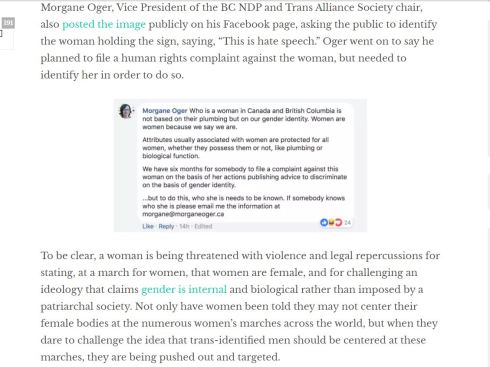
We pick up the conversation on twitter between Meghan Murphy and Morgane Oger.

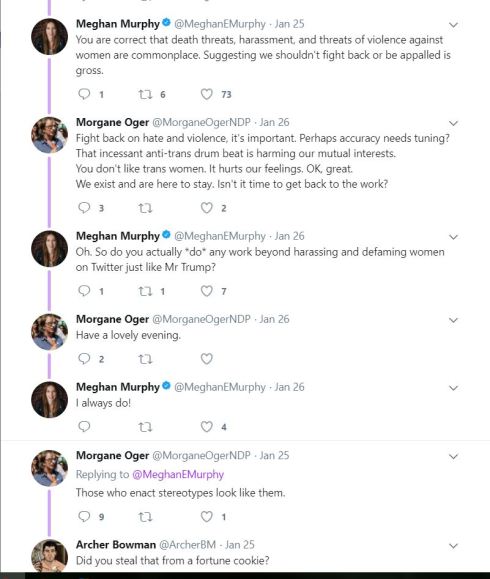
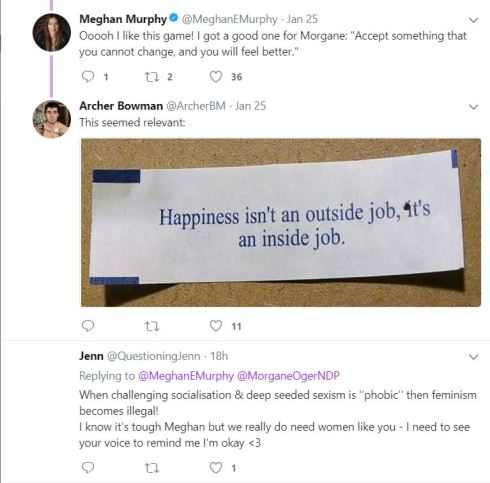
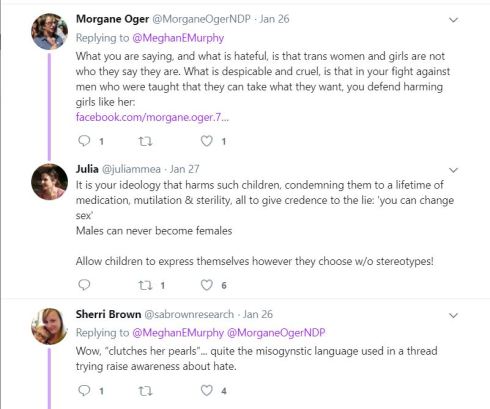

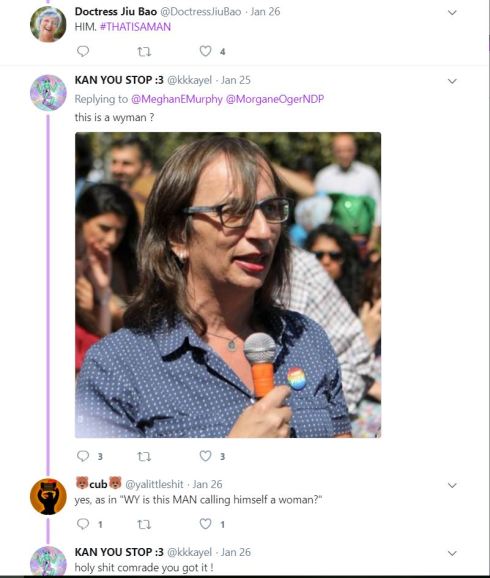
The battle against transactivism is being fought now. Patriarchy 2.0 is happening and Meghan Murphy along with other feminists are on the front lines defending women and the right to speak the truth about their bodies and experiences.
On the level folks, I do use a cellphone – a smart phone even. But I’m not sure I like it. I most certainly enjoy the GPS that comes with it, as finding those schools tucked away in suburban hell can be very tricky, even at the best of times. But, past the land navigation benefits, I’m not too sure.
Owning a mobile phone is not helping me in my struggle to continue to read widely and with depth in the topics I am interested in. The false novelty of the facebook feed is much to easy an out, versus intellectually girding oneself for tackling that next book on feminist theory or the ravages of American imperialism. I read a great deal in my 20’s and have the bookshelves to prove it, but now reading seems on a path that is further and harder away to reach. I remember my voracious reading days and wonder where that zeal went, and how to restoke that desire for knowledge and perspective of the world.
Facebook is open in the other tab, even as I write this post, offering its usual semi-catered beguilement for my consumption. It is truly the ‘ghost feast’ we read about in fairy tales – where you can eat and eat and eat and yet slowly starve to death because the scrumptious food being consumed is a insubstantial, desultory facade.
Much of what Dr.Reed says resonates with me, and I thought I’d share a part of his essay here.
“The decisive reason, however, for me to refuse a cellphone is the opposite of everyone else’s reason for having one: I do not want the omnipresent ability to communicate with anyone who is absent. Cellphones put their users constantly on call, constantly available, and as much as that can be liberating or convenient, it can also be an overwhelming burden. The burden comes in the form of feeling an obligation to individuals and events that are physically elsewhere. Anyone who has checked their phone during a face-to-face conversation understands the temptation. And anyone who has been talking to someone who has checked their phone understands what is wrong with it.
Communicating with someone who is not physically present is alienating, forcing the mind to separate from the body. We see this, for example, in the well-known and ubiquitous dangers of texting while driving, but also in more mundane experiences: friends or lovers ignoring each other’s presence in favour of their Facebook feeds; people broadcasting their entertainment, their meals, and their passing thoughts to all who will bear witness; parents capturing their daughter’s ballet performance on their phones rather than watching it live; people walking down the street talking animatedly to themselves who turn out to be apparently healthy people using their Bluetooth.
The cellphone intrudes into the public and private realms, preventing holistic engagement with what is around us. Smartphones only perfect their predecessors’ ability to intrude.
The disembodying and intrusive effects of cellphones have significant implications for our relationships to the self and to others. Truly knowing and understanding others requires patience, risk, empathy, and affection, all of which are inhibited by cell phones. Cellphones also inhibit solitude, self-reflection, and rumination (formerly known as ‘waiting’ and ‘boredom’), which I think are essential for living a good life.”
Meghan Murphy is one of Canada’s leading Feminists. This quote is from her article – “Thanks to trans activism, 2017 saw a return to old-school, sexist dismissals of women and women’s rights.” Definitely worth your time to go and peruse the entire article. What I would like to focus on is how well this quote highlights one aspect of the feminist struggle against the various incarnations of patriarchy and men’s rights activism.
Feminists (those who struggle for the emancipation of women from patriarchy) are being attacked for merely naming the problem that they face. Gender is a problem, it is a toxic hierarchy that hurts both women and men. The liberal mainstream won’t have any of it though (quelle suprise~!~). Instead, the notion of gender identity is being enshrined in law and shoehorned into society which of course is good for men, but bad for women. Women brave enough to challenge the ideology of ‘gender identity’ are are routinely misconstrued, harassed, and marginalized. Why?
Questioning the dominant patriarchal narrative – and yes the transactivist narrative is inherently patriarchal – is challenging male dominance in society, and will always be vilified and marginalized.
The good news is that the dictates of reality defying ‘gender-identity’ platform, even if just superficially examined, are unpalatable to not only to the so-called ‘mainstream sensibilities’, but also to those who value rational arguments based on material reality and fact.
Feminists have known this pretty much since the beginning and the radical vanguard are now slowly being joined by those who appreciate the strength of radical feminist arguments and analysis.
Let us hope this trend continues and intensifies, because Patriarchy 2.0 is in dire need of a serious blaming.
“The notion that “gender identity” exists at all flies in the face of feminist analysis, which says being born female is what forces women into an oppressed class of people, regardless of whether or not they identify with that position. But this point, as well as the concerns women have expressed around the impact of writing something as vague and as regressive as “gender identity” into legislation, including questions around whether males should be permitted in female prisons, change rooms, and transition houses, go unacknowledged and unaddressed by trans activists and queer theorists like Barker. Instead, she paints challenges to this ideology as nothing more than a hateful, unfounded, irrational attack on trans-identified individuals, writing:
“A moral panic is the process of arousing social concern over an issue. Moral panics often involve scapegoating a particular group as the ‘evil’ responsible for a range of societal ills.”
Indeed, Barker sounds no different than the anti-feminists over at Spiked, who claim the #MeToo campaign is a “harassment panic” that demonizes men unfairly. She claims trans-identified people are vilified by challenges to and questions about transgenderism, trans activism, and policies that allow men to enter into women-only spaces, simply based on self-identification, intentionally declining to acknowledge that what women fear is not an abstract trans-identified person, but men, specifically. No one has argued, as Barker claims, that trans-identified people are specifically dangerous or violent. What has been argued is that males are a threat to females, regardless of how they identify. If this fact is indeed considered a “moral panic” in the eyes of people like Jones and Barker, then they are better suited for the alt-right crowd than they are among progressives.
Barker says that this kind of “moral panic” (commonly known as “feminism”) exists to “enable us to attack a specific group for problems we’re all implicated in”… As though we have no idea who is doing all the raping and beating in this world and as though women are equally as culpable…”











 bleatmop
 Mystro


 Dead Wild Roses
Your opinions…