
You are currently browsing the category archive for the ‘Culture’ category.
How does one seek justice through the ‘justice system’ when it has been formatted in certain situations not to not produce just results? Case in point: Sexual Assault in our society. Our system of laws surrounding this area are broken and need to be fixed because justice is not being served.
https://suhailauniverse.tumblr.com/post/178376061673
The link to the Neurobiology of Sexual Assault
This is the problem, heroic male defenders of rule of law. Your system doesn’t serve and protect half of the damn population. So before the words equality and justice pass in from your lips, take a goddamn reflective moment and see the systemic problems affecting the entire process and realize that ‘due process’ seems only to work reliably when you happen to be white and male.


How many more personal testimonies do we need before we tear down the current current justice system and rebuild it with an artifice that actually serves the cause of Justice? We don’t believe women when they speak and women pay the price for it – often with their lives. Take action folks, as Ms.Williams suggests, it is the only way fix this systemic problem.
A good piece, by John Tasioulas but I’m left wanting more.
“But is it enough to rely on the supposed fact that human rights are embedded in a liberal democratic culture? Or do we need to be able to step back from that culture and offer an objective justification for the principles embedded in it, as the philosophers have long supposed? The problem is that social expectations and cultural assumptions not only vary significantly across societies, but that they are fragile: various forces ranging from globalisation to propaganda can cause them to change dramatically or even wither away. Would rights against gender or racial discrimination disappear if sexist or racist attitudes come to predominate?
The question is not fanciful. Once apparently settled beliefs about the impermissibility of torture or the rights of refugees have recently suffered a backlash. There can be backsliding as well as progress, with no guarantees either way. Social expectations and deep cultural assumptions are no more a sufficient basis for human rights than the law is. There is a fatal contradiction in defending human rights against the rising authoritarianism of a ‘post-truth’ era while simultaneously abandoning the belief that our commitment to those rights is itself grounded in the truth, and being prepared to defend it on that basis.
My own view is that human rights are rooted in the universal interests of human beings, each and every one of whom possesses an equal moral status arising from their common humanity. In other words, in defending human rights, we will need to appeal to the inherent value of being a member of the human species and, in addition, the interests shared by all human beings in things like friendship, knowledge, achievement, play, and so on. And we will need to ask whether these considerations generate duties that are owed to each and every human being. This proposal is hardly uncontroversial. The appeal to the inherent value of humanity will be contested by some as a brute prejudice – a ‘speciesism’ on a par with racism. Similarly, the appeal to universal interests will be contested by those who think that human rights are ultimately about respecting individual freedom regardless of whether it advances the right-holder’s well-being.
Whether I’m right or not, I am convinced that we cannot sustain our commitment to human rights on the cheap, by invoking only the law or the assumptions of our liberal democratic culture. Only a deeper justification can explain why we are right to embody them in the law, or maintain a liberal democratic culture, in the first place. This has precisely been the aim of philosophical defences of human rights from the 12th century up until very recent times. To keep our human rights culture in good order, we cannot avoid engaging with the question of justification.”
Tasioulas has some lofty notions about the universal interests of human beings, I would in argue that the societies in our culture/world systematically devalue the intrinsic worth of individual human beings, whether it be in the pursuit of racist or monetary ends, it leads to the same grim conclusion – your humanity is dependent on what social class you inhabit and the colour of your skin and what sex you are.
At first blush, it seems a bit quaint and slightly repulsive to think that a communal bathing facility would be a good thing for our society. I do however, recognize that my initial distaste for the idea is centred on what here in the West we like to call our ‘rugged individualistic’ impulse. But, as Jamie Mackay writes, “It is often forgotten that the Roman baths were a space where people of different social classes would wash side by side. Throughout the Empire, the bathhouse played a democratising role in which different races and ages were brought into contact”. The nascent egalitarian in me likes the idea of the classes of society having a spot in which to mix and mingle and perhaps soften the hard divides of race and class that cause so much strife in our society. Mackay also touches on the humanizing aspects of communal bathing to which promptly started my feminist antenna twitching.
Is there a more perfect way to counteract the bullshite imagery (mostly) women are fed by our society? The experience of being with and seeing other women in their natural state, how people actually are without photoshop, would be a potent bromide against the destructive social and media normative experience that we’ve saddled the female half of the population with. Mackay touches on this thought, “Directly experiencing other real bodies, touching and smelling them, is also an important way of understanding our own bodies which otherwise must be interpreted through the often distorted, sanitised and Photoshopped mirrors of advertising, film and other media.” What an important avenue to reestablish a connection with the tangible, and the actual ‘real’ of society.
“Living in a society where actual nudity has been eclipsed by idealised or pornographic images of it, many of us are, independently of our will, disgusted by hairy backs, flabby bellies and ‘strange-looking’ nipples. The relatively liberal attitude towards such issues in countries such as Denmark, where nudity in the bathhouse is the norm, and in some cases mandatory, exemplifies how the practice might help renormalise a basic sense of diversity and break through the rigid laws that regulate the so-called ‘normal body’.
The bathhouses of the future, by reinventing the historical social functions of their ancient originals and combining their most attractive aspects to build a new model, would compensate for the erosion of public spaces elsewhere. They could serve as libraries or performance spaces, or host philosophical debates or chess championships: they might, like the Moroccan hammam, have gardens, allotments or other green spaces, to bring urban dwellers in touch with plants, flowers and animals.
[…]
It’s churlish to simply disregard the public bath as an object of classical nostalgia. Communal bathing is a near-universal trait among our species and has a meaning that extends far beyond personal hygiene. There are pragmatic reasons to re-invent the practice, to be sure, but its anthropological diversity suggests that there might be a more fundamental need for this ancient and deeply human art.”
I’m thinking that trying out this model may well be worth our time because isolation in our individualistic society is the root cause of a bevy of social ills ranging from loneliness to unrealistic body expectations.

A Hammam
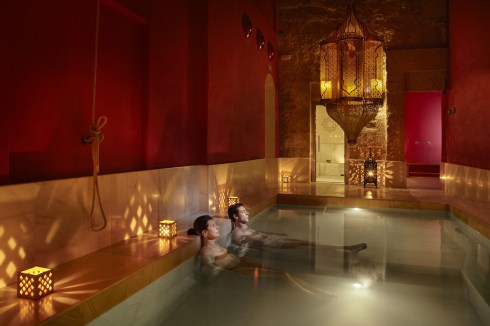
Hammam

Sento in Tokyo Japan
The bone jarring stupid is so prevalent in the dude class. Like I can understand that you benefit from the current unjust system and really, because you are not particularly downtrodden, haven’t given any thought to the topic at hand. But, seriously, have the common decency to listen when others tell of a different narrative and experience in society. You may just learn something.











 bleatmop
 Mystro
 The Arbourist


 Dead Wild Roses
Your opinions…