
You are currently browsing the category archive for the ‘Culture’ category.
 I’m not sure what the author of the review was thinking… Actually, on second thought I might have an idea – this is the liberal left dude deciding to be ‘edgy’ and take on an issue that feminists, especially radical feminists, like to rattle on about. One would hope that with a title of a book like ‘Why Rape Culture is a Dangerous Myth – From Steubenville to Chad Evans” one might, at the very least raise a cursory skeptical eyebrow at the presumptive nature of the work. Perhaps this is just my own bias showing through, but I think that it would be a good idea to least familiarize oneself with the topics at hand before presenting a review that would have worth to someone outside the liberal circle of ‘progressive’ dudes who think that they ‘get it’ and can speak with authority on the topic(s).
So there are two dimensions to this review of a review, the tone deafness of the review and the astonishing amount of cluelessness posited by the author of the book in question. Both will be tackled as the cocksure nature and faux-authoritative pronouncements being made about the experience of women in patriarchal culture – as interpreted by men – in this ‘review’ sadly illuminates how far we have to go to becoming a decent culture, and one that doesn’t rely on marginalizing half of the population based on their private bits.

The RPOJ cometh for thee.
The Red Pen of Justice has been under wraps for a very long time now and has been agitating to let loose once again on the blogosphere. I cannot deny the RPOJ discontents anymore, so gentle readers, suit up, sit back and prepare for a radical feminist analysis of the important words going on over at David Marx:Book Reviews.
“It has sometimes been said that sex and intimacy can mean what we ultimately want them to mean; which, for all intents and self-gratifying purposes, can more often than not entail the go-ahead (regardless of one hundred per cent consent). The ‘go-ahead’ that is, amid a resounding variant of ways in the eyes of the law, not to mention society at large.”
 *Blinks* On first reading I have no idea what the fuck he is saying. Let’s look again… Okay, this requires further parsing.
“”It has sometimes been said that sex and intimacy can mean what we ultimately want them to mean; […]”
Who said this and when? I think this defaults to what David Marx thinks on this particular topic, as no references are made to any relevant sociological source. This could be interpreted as David, with artless academic-ese construction, trying to authoritatively make a point.
My eyebrow raised because it looks like David is making the case for non-consensual relations somehow being a-fucking-okay because we can define consent out of the occasion. Funny how a review about the purported mythological status of rape culture is actually affirming its existence.
“The ‘go-ahead’ that is, amid a resounding variant of ways in the eyes of the law, not to mention society at large.”
Sentences missing objects/clauses don’t make sense. Charitably, I think David means that the ‘go-ahead’ or consent is somehow related to what is agreed on in society.
“Either of which can, and often does trigger dire and detrimental consequences.”
I’m done playing parse the sentence fragment – make your best guess here – thanks Dave for being unfathomable in your writing style.
“That we live in a society, where so-called honour killings (usually by men) are on the unfortunate rise; and a vacuous dirt-bag of Tunisian descent feels it’s in his right to attack a mother and her two daughters with a machete at a summer resort in France – because, in his eyes ”they weren’t wearing enough clothes” – is a both a sad and a very, very serious indictment of today’s moral fabric.”
Almost always by men, as they are upholders of honour/subjugators of women. Why mention that the killer dude was Tunisian? One should try to curtail the impulse toward xenophobia and racism in a serious review. And how is this one incident a serious indictment of anything other than horror we all know and love as organized religion; the big three and the various tributaries of fail almost always reinforce the patriarchal status-quo. Name the problem Dave.
“The fact that such vile and callous behaviour is entwined with varying degrees of religiosity, only accounts for the latter being something of an idiosyncratically laughable indictment.”
So you spend the words to make a point and then dismiss it as ‘idiosyncratically laughable’ in the next paragraph? Coherence is a thing Dave, more of it would make what you’re trying to say easier to understand.
“Yet as Luke Gittos points out in Why Rape Culture Is A Dangerous Myth – From Steubenville to Ched Evans: ”The argument that we live in a rape culture encourages a deeply harmful notion of inherent vulnerability, which adds to a worrying problematisation of intimacy in wider society. This is likely to have a significant effect on the young, who are often taught that intimate relationships are potentially dangerous”
What? A Jaw dropping non-sequitur after a word salad of an introduction, this review has legs!
Let’s look at the content after you massage your jaw for a bit, I should have warned you gentle reader, limber up those oral hinges it only gets worse from here.
“”The argument that we live in a rape culture encourages a deeply harmful notion of inherent vulnerability, which adds to a worrying problematisation of intimacy in wider society.”
The fuck it does. The argument we live in a rape culture threatens the status-quo notion that women should always be sexually available to men. Rape culture threatens the normative idea that women are not really fully autonomous, that they do not share the same rights to their personhood and autonomy, rights that men, under patriarchy enjoy by default.
Problematisation? Is problematic too ordinary a construction for you? Jeezus. A dudes ability to fuck females with impunity is not synonymous with ‘intimacy’. Luke Gittos is riding high on the Misogyny Train, and a decent review would call his shit out for what it is.
Tell me Dave, how is treating a woman like she has rights and a full human being a fucking problem with regards to intimacy? It’s only suffers from ‘problematisation’ if you are in favour of the current toxic environment that women are forced to inhabit.
“If such is the case, which, throughout various parts of the world it most certainly is, does this mean intimacy and ultimately love, should be denied?”
If love and relations can only be had with the shitty patriarchal overlay that shafts both men and women, then yes it should be denied. But you are not arguing that, are you Dave, your faffing on with Gittos about how denying women their agency (consent) is making it hard for dudes to feel intimacy. This is a primal man-baby argument – if we can’t have sexy times *my dudely way* then everything is wrong with the world and the feminist sponsored end times are here.
“Immediately prior to the above, Gittos also writes: ”Recent decades have seen the expansion of the law around rape to cover many new areas of sexual behaviour. The impact of the hysteria around rape has been the shutting down of debate around this expansion and the demonisation of anyone who seeks to question it.”
Hysteria? Man-children really can’t help themselves when it comes to patriarchal tropes. But let’s get back to what he’s saying – the broadening of laws to protect the integrity and autonomy of women is making his boner sad. Gittos (emphasis on ‘git’) is also sad that he gets shit on for harkening back to the good ole’ days where beating and raping your wife was just the norm and everything was hunky dory – if you happened to be in the same class as Gittos…
“That the ”hysteria around the rape has been shutting” down it’s ”debate,” is surely cause for alarm, which to a certain degree, these 140 pages do tackle head-on. But, as Graham Matthews recently wrote in Will Self and Contemporary British Society: ”The language used in rape cases is of the utmost importance since, according to Lyn Higgins and Brenda Silver, ‘whether in the courts or in the media, whether in art or criticism, who gets to tell the story and whose story counts as ”truth” determines the definition of what rape is.”
Why in a review of the GIT are you talking about Will Self and Contemporary British Society? Is foisting non sequitur after non sequitur on your reader a stylistic choice? It’s a bad one, let me assure you.
“There again, as Luke Gittos has categorically stated in Why Rape Culture Is A Dangerous Myth’s Introduction: ”this book is not about rape. It is not about the hideous criminal offence that takes place every day, and is the subject of arrests, court cases and prison sentences up and down the country […]. This book is about the contemporary panic around ‘rape culture’ that […] often bears little resemblance to the reality of rape.”
Translation: The idea that rape culture exists and is working in my favour is unpalatable to my sensibilities, thus the problem must be with the hysterical women and their risible claims… *facepalm*
“The argument of the book is that intimate life is suffering under the panic around rape and rape culture. This panic has arisen in the context of a society which is less sure of the parameters of intimate life than ever before. “
Oh consent is necessarily a roaring tempest filled with vapours purposefully designed to confuse the man-brained. The idea that women are struggling toward agency is an affront to needs of the ‘peen and patriarchy and must be done away with because my male right to unfettered access to female bodies is at stake – and this unfettered access – is what is important.
“As old narratives of intimate life die away, what has replaced them is not a new, individualised sense of what intimate life is, but a ream of laws, regulations, guidance and expertise about how we should conduct the most private aspects of our lives. This presents a serious challenge to the status of individual judgement about intimacy and, accordingly, the future of intimate life in general.”
I thought it couldn’t get worse, but Dave also seems to aspire to the swaggering, self-aggrandizing pile of mule-feces that Libertarianism is. Where white males are the only ones who can have the *true* feelings of oppression while simultaneously wielding power in society. If you cannot handle intimacy with a female that has autonomy and full human being status – then the only females of the blow-up variety will fit your particular bill. So go forth, find your inflatable Sally, and kindly fuck the hell off.
“Herein lies something of a literary juxtaposition, surely?”
*rolls eyes* – Dave, sounding smart and being smart have never been so clearly demarcated.
“For as pronounced and well analysed as this resoundingly tough and rather taurine book is, rape will always remain what it fundamentally is. Rape.”

A fucking equals A? This is the epic conclusion mic-drop you’ve assiduously been setting up. Step aside Machiavelli, Word fucking salad Dave is in the house! You are brought this review to close with a tautology? I have another for you, hold on it is earth shattering level of awesome – “stupid people are stupid people”.
And do you know ‘taurine’ means? It is a goddamn amino acid. Another meaning, common in the 17th century is ‘of or like a bull’. So is this a bullish book on rape culture, or did your thesaurus go to the dark side and led you astray with it?
“Regardless of judicial interpretation, sexual intimacy or, dare I say it, ”individual judgement.”
Did you eat alphabet soup and are just burping this shit up and then writing it down?
And also: Subjects, what the fuck are they?
The double shot of tautology and quasi-coherent sentence structure ends this review with an unsatisfying, stultifying dribble that offers offence not only to feminism, but the English language as well.
RPOJ out.
 Don’t feel bad about this, we are all in the same boat when it comes to making bad decisions or being unduly influenced. The science behind advertising and persuasion has come a long ways, and knowing how they manipulate you and the rest of the public is valuable knowledge. James Garvey lists three of the ways we are vulnerable to persuasion the Representative Heuristic, the Availability Heuristic, and the Anchoring Effect. Before we can discuss these systems though a brief overview of how we think and the short cutting our brain does that makes life generally go well but not always thoughtfully.
[…] by distinguishing between two kind of thinking:fast, automatic, intuitive thinking and slow, reflective, rational thinking. You can imagine that these two kinds of mental activities are the work of two parts of your mind, two systems that swing into different kinds of action to accomplish different tasks. The part that is responsible for first kind of thinking is called system 1 or the Automatic System, and the part the engages in slower, more careful thought is called system 2 of the Reflective System.
System 1 operates quickly and automatically, This feels instinctive and intuitive, and it requires no effort on your part. System 1 is in charge when you orient yourself to a sudden sound, wince involuntarily when you see something that disgusts you, read anger in the lines on someone’s face, and recognize written words in your native tongue – it all just clicks fluently and automatically, without you thinking about it at all.
The work of System 2, the Reflective system, takes effort, an act of deliberate concentration on your part. Your deliberative efforts are limited and cannot be sustained for very long without degradation, a phenomenon called ego depletion. System 2’s work is voluntary, slower that your gut reactions, and associated with the experience of choice and agency.
[…]
The two systems interact with each other in a number of surprising ways, System 1 typically engages in a kind of constant monitoring, throwing up a series of impressions and feelings that System 2 might endorse, ignore, check, focus on, act upon, or simply go along with. Much of the time System 2 is in a low power state, aroused only when the Automatic system encounters something it cannot handle.
[…]
Our mental resources are therefore limited. It is an effort to bring System 2 into play, and it can be overloaded by trying to do too much. So evolution has taught us a number of shortcuts, rules of thumb or heuristics, which conserve our mental energies and serve us well most of the time.
[…]
But it also means that we go wrong in systematic, predictable ways – we are constitutionally susceptible to cognitive biases, and in turn, we can be nudged.
[…]
We use shortcuts to arrive at judgments too. […] It’s a large part of the theoretical framework behind contemporary persuasion, and it’s already shaping our world and changing our lives.
Consider this description of Steve.
‘Steve is very shy and withdrawn, invariably helpful, but with little interest in people, or in the world of reality. A meek and tidy soul, he has a need for order and structure, and a passion for detail’
What do you think Steve does for a living? Is he more likely to be a farmer, salesman, airline pilot, librarian, or physician? Once you have an answer to that question , ask yourself what job he is least likely to have.
[…]
Very many people, including me when I first read that description , conclude that Steve is most likely a librarian – how could this shy guy like that possibly be a salesman? – and in coming to this conclusion we make use of what Kahneman and Tversky call the representativeness heuristic. We let our automatic faculties rip and take a short cut to an answer. If one slows down and thinks about it, though, there are a lot more farmers than librarians in the world. That’s extremely pertinent information if you are trying to guess which job on a list is most likely for anybody, and it should lead us to conclude that it’s most likely Steve is a farmer, maybe a shy and withdrawn farmer, but still a farmer. The probability that Steve is a librarian is instead assessed by the extent to which the description of Steve matches up with or is representative of stereotype of a librarian we have in our heads.
[…]
We do this entirely automatically, and it has an effect on a host of judgments – how likely we think politicians are to be good leaders, how likely a new business is to succeed, and how likely our doctor is to be competent.
[…]
People who understand persuasion will take care to fit the right stereotype and make it easier for us to come to conclusions about them automatically.
A second set of biases result from what Kahneman and Tversky call the availability heuristic. When we think about how likely some even is, we’re affected by how readily examples come to mind.
[…]
We are likely to over-estimate the number of wayward politicians, shark attacks and meltdowns at nuclear plants because we can probably easily recall instance of such things. The problem is that how easily we can recall something has less to do with how likely or common or worrying an occurrence is and more to do with what we happen to have heard about in the news recently and how striking that news was to us. The news you choose to watch therefore has a lot of power over you, The stories it repeats reinforce your susceptibility to the availability effect.
[…]
We over-react at first, then under-react as time goes on. […] Because of its salience, we think homicide is more common that suicide, but it isn’t. In fact, Americans are more likely to take their own lives than be murdered or die in a car crash, but because murder and car accidents are more newsworthy, dramatic and available that suicide, we concern ourselves more with home alarm systems and airbags than the signs of depression.
A final kind of bias identified by Kahneman and Tversky, perhaps the most interesting and difficult to accept of the three, is called the anchoring effect. When people first think about a number and try to estimate an unknown quality, the initial number affect their guess, anchors it – the estimate they make tends to stay near by. Again, the rule of thumb in play isn’t too bad a guide, and we use it all the time. What’s the population of Pittsburgh? If you don’t know, but you do know that Philadelphia is the largest city in Pennsylvania, and it has about 1.5 million people in it, you might feel able to guess about Pittsburgh. It’s certainly smaller than Philadelphia – maybe it’s half the size, so perhaps Pittsburgh has a population of few than 750,000, Maybe 600,000?
There are two very weird facts about this familiar process of guessing a quantity, First we tend to undercook the adjustments we make from the original guess. Once we have a number and begin adjusting in the direction we think is right, we tend to stay too close to the anchor, possibly because once we find ourselves in uncertainty, we can’t think of a good raise to carry on, so we play it safe and stop too soon. Pittsburgh is smaller that Philadelphia, so we adjust downwards, but how far downwards? In fact, this example we stayed much too close to the anchor, as we usually do. Just 300,000 people live in Pittsburgh.
Second, it doesn’t matter where the first figure comes from, it will still anchor our estimates, even it has nothing at all to do with the domain in question. According to at least one understanding of what’s going on in such cases, sometimes System 2 is in charge, finding what it hopes to be a reasonable anchor and adjusting off it to estimate an unknown quantity. But sometimes System 1 gets hooked on an anchor and freely associates, without our conscious control, and the cascade of associations ends up affecting our later estimate, whether it’s reasonable or not.
Tversky and Kahneman illustrated this second kind of anchoring with a rigged roulette wheel – it showed numbers from 0 to 100 but it actually stopped on either 10 or 65. They spun the wheel and asked a group of students to write the number down, and then answer two questions.
‘Is the percentage of African nations among the UN members larger or smaller than the number you just wrote?’
‘What is your best guess of the percentage of African nations in the UN?’
The average guess of those who saw the number 10 was 25 percent. The average guess of those who saw the number 65 was 45 percent. A roulette wheel is not a particularly informative thing if you’re trying to work out how many African nations are members of the UN, but still, those who saw the high number guessed higher than those that saw the low number. Even ludicrous anchors have an effect on us”
-James Garvey. The Persuaders pp. 55 – 66

Yeah, so being wary of your System 1 answers is probably a good thing. Bad news for the anchoring effect, as even when you’re told about it, it still works on you. :/
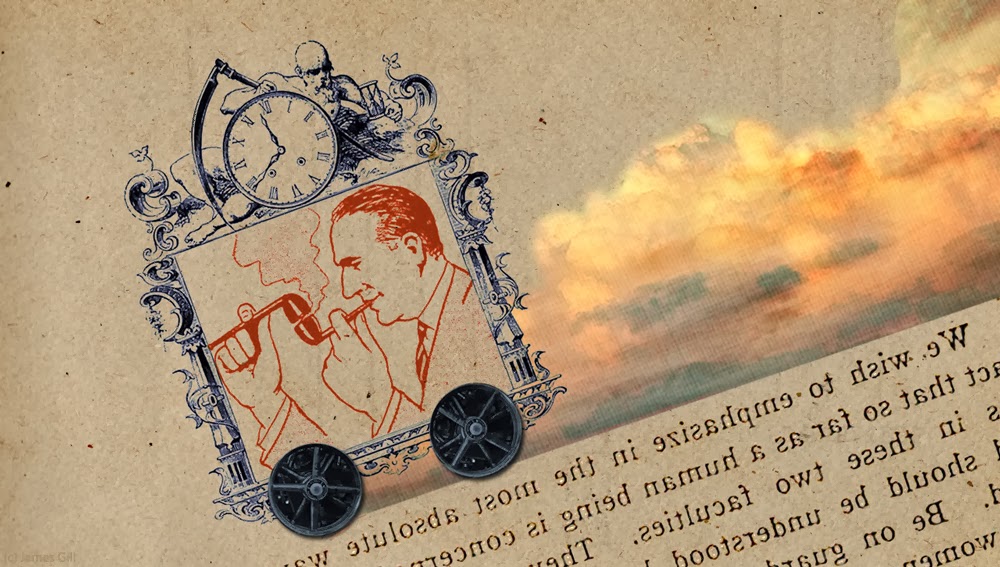
Headless, mouth slightly open, long hair, white, frilly uncomfortable dress and flowers – A Weak object for consumption/desire.
“Women aren’t hated for being feminine, femininity is forced on us because we are hated. we don’t naturally apply make up, wear constricting clothing, shave our natural body hair and stay quiet even when we are upset with something. we are conditioned to do this because women are supposed to take up as little space as possible and erase traces of our growth both physically and mentally. women who refuse to perform femininity demand their space and they demand to be heard. they cannot be neutral in a highly gendered society; they are punished for not conforming.”

Femininity literally is weakness forced upon us. Being quiet, serving and submissive is not anything that can be reformed into some good, new kind of gender. We literally modify our bodies. We are trained to serve and be available. We are trained to hate ourselves and not strive too far, lest our oppressors may be displeased.
Femininity is the socialization of the oppressed class.
 Some peoples lives are worth more than others.
In the context of American society one of the deciding factors of how much your life is worth is determined by the colour of your skin. Here in Canada a similar skin tone gradient applies as being First Nations in Canada gets you the special police attention you don’t deserve. Bonus features of being in First Nations in Canada include (but are not limited to), poverty, limited access to potable water, and an hostile educational system. Make no mistake, we have much to do in Canada to address the needs of our people. We have a Canadian Highway of Tears that sullies our escutcheon and is indicative of the racism that still permeates our society.
The inherent racism present in Canada pales before the horrendous shitshow that is running south of the border. Racial divisions and discrimination represent a clear and present danger to fabric of the civil society of the United States (necessarily so). The scale of protests against the racial violence of the white establishment is increasing – fuelled by social media that circumvents mainstream media and offers a small gory window into the lives of black people who are being murdered by the security apparatus of the state.
I cannot imagine the horror of witnessing your partner being shot to death in your car, having to be polite to the individual that just inflicted moral wounds on our loved one while having your child witness the entire blood spattered episode from the backseat.
…
Violence breeds violence.
The unidirectional nature of the violence was reversed as an individual who proclaimed his hatred for white police, killed five white police officers in Dallas. The shooter was a reservist and had seen a tour of duty in Afghanistan. Lives are being lost because we have tied how much humanity you’re allotted to the colour of your skin.
Madness. It is sheer madness that we have allowed our societies to be shaped by racism and that the status quo is in fact racist. Is this series of murders in the US the tipping point? It certainly seems like people have had enough and are willing to entertain a large spectrum means to achieve their ends. It should be (like the constant stream of black people being murdered by police hasn’t been) a wake up call to the American congress and its legislative position on systemic racism and gun control. Henry Giroux paints a darker picture when he says:
“In the increasingly violent landscape of anti-politics, mediation disappears, dissent is squelched, repression operates with impunity, the ethical imagination withers, and the power of representation is on the side of spectacularized state violence. Violence both at the level of the state and in the hands of everyday citizens has become a substitute for genuine forms of agency, citizenship, and mutually informed dialogue and community interaction.”
The response of the law makers will tell the tale though, because the disconnect between public opinion and public representatives is being brought into stark relief. Congress has been mostly bought and paid for – but they have to at least look like they are serving the needs of the public on occasion, will the murder of five police officers stir the sycophants into action? I really don’t know, because getting reelected seems to override important qualities of being a decent human being. Qualities like empathy, compassion, and morality seem strangely missing when it comes to societal issues that threaten idea of moving toward a just society.
The cynical side of me contemplates this question: Would the US have gun control if members of Congress were similarly subjected to the murder/assassination program the rest of America is being subject to?

It is a good test.
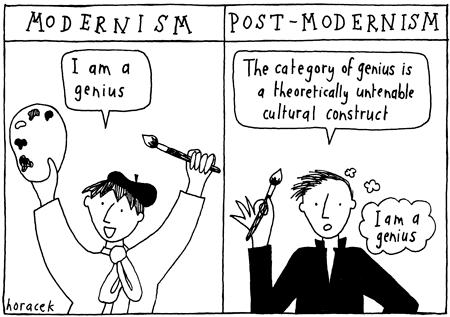 “How We Reached the Point Where We Can’t Hear Each Other” is a article on Counterpunch by Joseph Natoli. I’ve excerpted some of the beginning bits for context, but the best is when he focuses on what is happening in Education and how people are taught to think these days. I’m also a fan of his borrowing of radical feminist methodology that focuses on the the material reality of the situation and the naming of the problem. I heartily recommend you read the full article, as it suggests reasons why we are becoming less social despite ‘social’ media and the corrosive effect that identity politics, one of the crown jewels of post-modern theory, is having on our society.
[…]
“The intent of a past analog world to put us all on the same page so we could all direct ourselves in common to our common, societal problems is something now disseminated into an infinitude of self-designed enclaves. We have connectivity between the like-minded, or opinionated, but not conjunction which Bifo Berardi defines “as a way of becoming other.” (And: Phenomenology of the End, 2015)
If you want to reflect beyond the entrapment of your own personal experiences and the personal opinions derived from such, you are desiring something that has been superseded.
If you want not to be the blind man who feels the tail of an elephant and pronounces the elephant to be shaped like a snake, you are hoping for a door that leads out of the room of your own limited experience.
Unfortunately, there is no longer any need to leave that room because cyberspace has designed the whole world to be your room. You can blog, tweet, text. Video, emoji your reflections online without any intent to augment social knowledge or understanding or to encounter a counter-punch that will cause you to adjust your views.”
[…]
“We exist now within narratives, not impeccable logics and sound proofs, air-tight arguments or binding adjudications. For reasons too elaborate to condense, we have accepted Nietzsche’s view of reason as a pawn of power and have retreated to our own personal reasoning.
This retreat to personal arbitration of all matters is expressed in the politics of identity, a politics concerned with the full emancipation of the individual not as defined within any cultural, religious, historical, or anthropological notion of the individual, but defined by each and every variety of individual. It is as if the individual is a knowledge within itself.”
[…]
Education is also in a special dilemma considering the mission here is get a student to put his or her personal opinions and preferences and different experiences out of sight and attend to a rationally validated collective representation of a subject.
Nathan Heller points out that elite colleges find that the cultivation of the individual is not an easy matter when students will not leave their personal “experiential authority” at the door. (“The Big Easy,” The New Yorker May 30, 2016) One is not reading to extract eternal verities, the Enlightenment dream, or to deconstruct the pretenses of those same verities. In the climate that Heller describes, no content can be permitted to transgress the personally defined identity of the reader or listener.
An Oberlin student who Heller describes as “a trans man …educated in Mexico, walks with crutches, and suffers from A.D.H.D. and bipolar disorder …lately on suicide watch” objected to a discussion of Antigone without a trigger warning, i.e., characters in the play committed suicide. Identity-based oppression is responded to with a theory of intersectionality, which contends, “who knows what it means to live at an intersection better than the person there?” Thus, personal experiential authority now contends with a pedagogic tradition of minimizing the effects of personal experiential authority on objective, rational reflection.
Education attempts to respect individual arrangements of the results of critical thinking but not allow those arrangements to taint the process of critical thinking. This long standing agreement is no longer in effect. We have reached the point where we cannot engage in any way what may “trigger” our personal dislike or what may upset a private space we have self-designed. Long standing notions of both education and society are dissolving.
We now listen to our own voices and our clones in “social” media, a pathological condition that undermines much needed social and political communication and interrelationships. The way out, as with all pathologies, is to first recognize the condition, observe the point we have reached and reorient our compass.”
Teaching critical thinking in public education has always been a revolutionary activity, as this article confirms, it looks like it shall continue to be in the revolutionary category for quite some time.
 How I experience the internet is vastly different depending on whether I am at work, or at home. At work, wherever I go, I experience pop-ups, obtrusive ads, and auto-play movies/noise. Let me assure you, that while teaching, having all the distracting advertising going on in the background does not help the learning experience. But meanwhile, at home I can browse the web unencumbered by any of the annoyances listed above. Pages load quickly and are appealing to read with little clutter to distract the eye and the mind. This peaceful repose is achieved primarily through the use of two program plugins that are available to the Firefox browser – Ad Block Plus and Ghostery. Ad block screens out most of the ads and Ghostery stops websites from tracking your movements and preferences as you browse on the internet (oh, and duck duck go is a nice start to increase your privacy while browsing as well). The powers that be though, are not amused by individuals taking control of their internet experience.
“Global ad spending is expected to reach $600 billion US by the end of next year, according to eMarketer, and grow at an annual rate of about five per cent until the end of the decade. Much of that growth is being fuelled by digital advertising, particularly on mobile devices.
But there was one session in Cannes where some very dark clouds managed to intrude on the sunny forecast. It was a panel devoted to the current scourge of the digital advertising industry — ad blocking.
According to a report by PageFair and Adobe, more than 200 million people worldwide have downloaded software that can block virtually all online advertising.
The number of people blocking ads increased by more than 40 per cent last year, and it is estimated that blocking cost cash-starved publishers more than $22 billion last year.”
Oh my goodness. People not wanting advertising to be part of every facet of their life, not a choice, but a scourge.
“Almost everyone in the ad industry acknowledges that most of the wounds that have led to the rise in ad blocking are self-inflicted.
Advertisers got greedy by assaulting users with too many low quality, untargeted ads, too many auto play videos, too much click bait.
Last fall, the IAB launched an initiative called L.E.A.N. Ads (light, encrypted, ad choice supported, non-invasive).
The IAB hopes that by following the L.E.A.N. guidelines, advertisers will create ads that consumers will be happy to see.”
Hmm, so we alienate people to the point where ad blocking is necessary to have a good browsing experience and then complain that ad-blocking is ‘killing’ the internet. Other entities have decided that they won’t let the user in, if ad-blocking is enabled.
“Sites like Forbes and GQ won’t allow access to their content unless users turn them off. At Cannes, Mark Thompson, the president and CEO of the New York Times, announced that his newspaper would soon be offering an ad-free edition to subscribers at a premium price.
Other publishers are appealing to their readers’ sense of fairness and justice, asking them to turn off their blockers and reminding them they are a critical part of the ecosystem that has powered the internet for the past 20 years. Without ads, there would be no free content online.”
Well, GQ and Forbes you can go frack yourself sideways as the content you produce will be reproduced elsewhere on the web without your restrictions. :) The counterpoint to this though is the insidious beast known as ‘native advertising’.
“So-called “native advertising” has been growing in popularity over the past several years. Also known as “sponsored content,” it looks and feels like editorial content, but it comes from advertisers rather than journalists.
Native advertisements can often pass through ad blocking filters because the filters don’t recognize it as advertising. Many readers seem to prefer this kind of content over traditional advertising, provided it’s properly labelled, although there’s no consensus on what constitutes proper labelling.”
Watch your daily paper, there is more this native advertising junk in there everyday. If there is a scourge to be named, it should be that of the advertising editorial or advertorial.
“But the real victims of the ad blocking surge may not be advertisers and publishers, but the “free” web itself.
The money to pay for content has to come from somewhere, and if you take advertising revenue out of the equation, readers will have to pick up the slack themselves, something they have historically been reluctant to do. Without ads, the web may be a poorer and less interesting place.”
Breaking news: The sky is indeed falling. Also: A-Booga-Booga-Booga! The heart of the very internet itself will crumble if ad-blocking continues!
The advertising industry may piss-off right the frack off with their hyperbole; starting yesterday. If the amount of stultifying drek available on the interweebs is halved tomorrow, not a soul would notice. So I say bring on the next internet apocalypse.











 bleatmop
 Mystro
 The Arbourist


 Dead Wild Roses
Your opinions…