
You are currently browsing the category archive for the ‘Debate’ category.
Did you ever just boggle at a comment? This snippet is from the ‘Dear the People’ blog. DtP and I are having a discussion of sorts about radical feminism and what it purportedly is, and is not. The discussion is quite, erm… interesting as DtP doesn’t seem to realize that they live withing a patriarchal society and it has, whether they acknowledge it or not, shaped who they are and how they act within said society.
Read the quote, the statements in bold are mine.
“Feminists realize though that each woman must strike her own patriarchal bargain within society and do what she must to survive.”
Will you die if you don’t strike a bargain with this purported patriarchy? I’m a female. I don’t find myself harmed by the so-called patriarchy.
“The choice women face is how to deal with the fact that they are treated as the submissive class in society and their base humanity is always in question
Really? When in American history did women ever face a question to their humanity? If women are viewed as so sub-human, why is it that crimes against females are considered much more horrifying than those committed against men? Yes, women are submissive – to the law. Men, women, children, adults, old, and young must submit to authority of one form or another.
*record skip…*
How does one even get to this place? Asserting that patriarchy hasn’t harmed them personally and what is the big deal with it? Where does one even start with that and what society did you grow up in? I want in.
Let’s be clear here, this is not to criticize DtP for the views she holds. That is not our place, but rather, how can the case be made respectfully to illustrate how patriarchy affects us all, and there is little to be gained from not acknowledging its role in society.
I think that in many cases it is easier to choose not to see the systematic obstacles and biases that severely curtail the experiences and life trajectories of women in our society. After all, who wants to plumb the depths of their subordinate status, witness their oppression, and realize that they are not regarded as fully human in society? Certainly not happy rainbows and unicorns revelations, but is it worth the psychic energy necessary to sublimate these societal realities into a happy patina of ‘things are okay in society and I’m mostly not a part of class of people who are treated as less then human’?
Patty Ramsen wrote this on internalized misogyny:
“Women all over the world are dealing with internalized misogyny that puts them in opposition with other women and themselves. Some of them think less of women as a whole and place their faith in the opinions of men. Others have been raised to believe that men are superior and women are inferior. Women receive misogynistic messages from all fronts, so battling against it is constant. The fight never ends. You can excise your misogyny, but first, you have to admit that you have it so that you can pinpoint the toxic behaviors and belief systems that created it in the first place.”
And of course, Andrea Dworkin from Right Wing Women:
“Right-wing women have surveyed the world: they find it a dangerous place. They see that work subjects them to more danger from more men; it increases the risk of sexual exploitation. They see that creativity and originality in their kind are ridiculed; they see women thrown out of the circle of male civilization for having ideas, plans, visions, ambitions. They see that traditional marriage means selling to one man, not hundreds: the better deal. They see that the streets are cold, and that the women on them are tired, sick, and bruised. They see that the money they can earn will not make them independent of men and that they will still have to play the sex games of their kind: at home and at work too. They see no way to make their bodies authentically their own and to survive in the world of men.
They know too that the Left has nothing better to offer: leftist men also want wives and whores; leftist men value whores too much and wives too little. Right-wing women are not wrong. They fear that the Left, in stressing impersonal sex and promiscuity as values, will make them more vulnerable to male sexual aggression, and that they will be despised for not liking it. They are not wrong. Right-wing women see that within the system in which they live they cannot make their bodies their own, but they can agree to privatized male ownership: keep it one-on-one, as it were. They know that they are valued for their sex— their sex organs and their reproductive capacity—and so they try to up their value: through cooperation, manipulation, conformity; through displays of affection or attempts at friendship; through submission and obedience; and especially through the use of euphemism—“femininity, ” “total woman, ” “good, ” “maternal instinct, ” “motherly love. ”
Their desperation is quiet; they hide their bruises of body and heart; they dress carefully and have good manners; they suffer, they love God, they follow the rules. They see that intelligence displayed in a woman is a flaw, that intelligence realized in a woman is a crime. They see the world they live in and they are not wrong. They use sex and babies to stay valuable because they need a home, food, clothing. They use the traditional intelligence of the female—animal, not human: they do what they have to to survive.”
I couldn’t find who said the quote about women not wanting to accept the reality of their situation, only because in doing so would only reveal how deeply misogyny is rooted in society. Feel free, kind readers to help me out. :)
Yelling at each other online is cool and what not (see the RPOJ) but past cartharisis for the writer, I’m thinking, not much is really accomplished. Understanding the context and where people are coming from is an important skill to foster, and as Alexander Bevilacqua (from his essay on the Aeon Website) says, we should not entirely replace the adversarial aspects of our intellectual culture, but perhaps temper our expectations with a bit of empathy and appreciation for where the arguments are coming from.
“The call for empathy might seem theoretically naive. Yet we judge people’s intentions all the time in our daily lives; we can’t function socially without making inferences about others’ motivations. Historians merely apply this approach to people who are dead. They invoke intentions not from a desire to attack, nor because they seek reasons to restrain a text’s range of meanings. Their questions about intentions stem, instead, from respect for the people whose actions and thoughts they’re trying to understand.
Reading like a historian, then, involves not just a theory of interpretation, but also a moral stance. It is an attempt to treat others generously, and to extend that generosity even to those who can’t be hic et nunc – here and now.
For many historians (as well as others in what we might call the ‘empathetic’ humanities, such as art history and literary history), empathy is a life practice. Living with the people of the past changes one’s relationship to the present. At our best, we begin to offer empathy not just to those who are distant, but to those who surround us, aiming in our daily life for ‘understanding, not judging’.
To be sure, it’s challenging to impart these lessons to students in their teens or early 20s, to whom the problems of the present seem especially urgent and compelling. The injunction to read more generously is pretty unfashionable. It can even be perceived as conservative: isn’t the past what’s holding us back, and shouldn’t we reject it? Isn’t it more useful to learn how to deconstruct a text, and to be on the lookout for latent, pernicious meanings?
Certainly, reading isn’t a zero-sum game. One can and should cultivate multiple modes of interpretation. Yet the nostrum that the humanities teach ‘critical thinking and reading skills’ obscures the profound differences in how adversarial and empathetic disciplines engage with written works – and how they teach us to respond to other human beings. If the empathetic humanities can make us more compassionate and more charitable – if they can encourage us to ‘always remember context, and never disregard intent’ – they afford something uniquely useful today.”
There isn’t much to lose in trying a slightly different approach to arguing with other people, I think it is worth a shot.
Defending against the Echo Chamber effect is difficult as we naturally seek familiar points of view that reinforce our own. Discourse has always been the key factor in helping people check their views against others and find the experts that they can put their confidence in. Engaging with others, especially with differing points of view, is important to one’s intellectual health.
This quote from C Thi Nguyen writing for Aeon magazine describes the experience of what reasoning within an echo chamber or epistemic bubble is like:
“This is an explanation in terms of total irrationality. To accept it, you must believe that a great number of people have lost all interest in evidence or investigation, and have fallen away from the ways of reason. The phenomenon of echo chambers offers a less damning and far more modest explanation. The apparent ‘post-truth’ attitude can be explained as the result of the manipulations of trust wrought by echo chambers. We don’t have to attribute a complete disinterest in facts, evidence or reason to explain the post-truth attitude. We simply have to attribute to certain communities a vastly divergent set of trusted authorities.
Members of an echo chamber are not irrational but misinformed about where to place their trust
Listen to what it actually sounds like when people reject the plain facts – it doesn’t sound like brute irrationality. One side points out a piece of economic data; the other side rejects that data by rejecting its source. They think that newspaper is biased, or the academic elites generating the data are corrupt. An echo chamber doesn’t destroy their members’ interest in the truth; it merely manipulates whom they trust and changes whom they accept as trustworthy sources and institutions.
And, in many ways, echo-chamber members are following reasonable and rational procedures of enquiry. They’re engaging in critical reasoning. They’re questioning, they’re evaluating sources for themselves, they’re assessing different pathways to information. They are critically examining those who claim expertise and trustworthiness, using what they already know about the world. It’s simply that their basis for evaluation – their background beliefs about whom to trust – are radically different. They are not irrational, but systematically misinformed about where to place their trust.
Notice how different what’s going on here is from, say, Orwellian doublespeak, a deliberately ambiguous, euphemism-filled language designed to hide the intent of the speaker. Doublespeak involves no interest in clarity, coherence or truth. It is, according to George Orwell, the language of useless bureaucrats and politicians, trying to go through the motions of speech without actually committing themselves to any real substantive claims. But echo chambers don’t trade in vague, ambiguous pseudo-speech. We should expect that echo chambers would deliver crisp, clear, unambiguous claims about who is trustworthy and who is not. And this, according to Jamieson and Cappella, is exactly what we find in echo chambers: clearly articulated conspiracy theories, and crisply worded accusations of an outside world rife with untrustworthiness and corruption.
Once an echo chamber starts to grip a person, its mechanisms will reinforce themselves. In an epistemically healthy life, the variety of our informational sources will put an upper limit to how much we’re willing to trust any single person. Everybody’s fallible; a healthy informational network tends to discover people’s mistakes and point them out. This puts an upper ceiling on how much you can trust even your most beloved leader. But inside an echo chamber, that upper ceiling disappears.
Being caught in an echo chamber is not always the result of laziness or bad faith. Imagine, for instance, that somebody has been raised and educated entirely inside an echo chamber. That child has been taught the beliefs of the echo chamber, taught to trust the TV channels and websites that reinforce those same beliefs. It must be reasonable for a child to trust in those that raise her. So, when the child finally comes into contact with the larger world – say, as a teenager – the echo chamber’s worldview is firmly in place. That teenager will distrust all sources outside her echo chamber, and she will have gotten there by following normal procedures for trust and learning.
It certainly seems like our teenager is behaving reasonably. She could be going about her intellectual life in perfectly good faith. She might be intellectually voracious, seeking out new sources, investigating them, and evaluating them using what she already knows. She is not blindly trusting; she is proactively evaluating the credibility of other sources, using her own body of background beliefs. The worry is that she’s intellectually trapped. Her earnest attempts at intellectual investigation are lead astray by her upbringing and the social structure in which she is embedded.”
Nguyan suggests at the end of his article that the expression of earnest good will toward others inside echo chambers is the most successful way of freeing people from their convictions, as often, those within echo chambers are defended against the presentation of contrary evidence.
There are lots of problems with how most of society treats transgendered people. Trying to sort out how best to rectify this has lead to many unproductive clashes. A major disagreement centres around whether biologically male transgendered people are actually women. My question to the BioMaleTrans is this: Why do you think you’re a woman?
I commonly see two answers to this question. The first of which is ‘I identify as a woman’. This doesn’t actually provide any information and is, therefore, not actually an answer. It is merely restating the original position that was being questioned in the first place. In this case, “I think I am” is perfectly synonymous to “I identify as”.
The second common answer is pretty much the same: ‘I feel like I’m a woman’. Still no new information, still synonymous with the original. Still not an answer.
So let’s get specific. Let’s do away with the vague, the obscure, and the etherial. Let’s dispose of brevity and confusion. Let’s look at some possible detailed answers as to why you think you are / feel you are / identify as a woman.
Do you like to wear skirts, dresses, and/or lingerie?
Well, that may be common in women, but it is in no way tied to them being women.
There are women who don’t like to wear any of those thing, but that does not mean they are somehow not women.
There are non-women who do like to wear some or all of those things, but that does not magically turn them into women.
Do you like having long hair and/or wearing make up.
Well, that may be common in women, but it is in no way tied to them being women.
There are women who don’t like either of those things, but that does not mean they are somehow not women.
There are non-women who do like both of those things, but that does not magically turn them into women.
Do you speak with what today’s society might consider a “feminine” lilt?
Well, that may be common in women, but it is in no way tied to them being women.
There are women who don’t speak with such a lilt, but that does not mean they are somehow not women.
There are non-women who do speak so, but that does not magically turn them into women.
Do you like the colour pink, romantic comedies, stuffed toys, spa days, looking at attractive men and/or any other thing that fits some version of the “feminine” stereotype?
Well, that may be common in women, but it is in no way tied to them being women.
There are women who don’t like any of these things, but that does not mean they are somehow not women.
There are non-women who do like many of these things, but that does not magically turn them into women.
Do you more easily connect with women than you do with men?
Well, that may be common in women, but it is in no way tied to them being women.
There are women who get along better with men, but that does not mean they are somehow not women.
There are non-women who get along better with women, but that does not magically turn them into women.
Do you express emotions in what much of our culture would call a “feminine” manner?
Well, that may be common in women, but it is in no way tied to them being women.
There are women who express their emotions in non “feminine” ways, but that does not mean they are somehow not women.
There are non-women who express themselves in all kinds of “feminine” ways, but that does not magically turn them into women.
Do you constantly get bullied, ostracized, and/or mistreated by entitled fuckwit men?
Well, that may be extremely common in women, but it is in no way tied to them being women.
There are a few women who aren’t consistently mistreated, but that does not mean they are somehow not women.
There are non-women who do suffer unimaginably because of these bastards, but that does not magically turn them into women.
Any reason, or combination of reasons, a BioMaleTrans could possibly give for ‘being a woman’ would necessarily be tied to a gender stereotype. That is, any claim of actually being a woman is inextricably rooted in harmful bullshit gender roles. There is only one valid claim to womanhood, and it is one that a BioMaleTrans is inherently excluded from: biology.
Welcome to part 5 of my in depth exposition on why I don’t want to have children.
I. Intro + Stage 1: Initial Shock
II. Stage 2: The Demand for Answers part A
III. Stage 2: The Demand for Answers part B
IV. Stage 2: The Demand for Answers part C
V. Stage 3: The Rebuttal + Wrap up
We’ve done quite a lot to show that reproduction is a very bad idea. Despite all the reasons explored in Stage 2, parts A, B, and C, The Breeder is resilient. Privy to the other side of the coin, they are ready to share all the reasons I ought to be poppin’ out youngin’s. Let’s look at the most common of these in:
Stage 3: The Rebuttal
“You change when you have one / it’s different when it’s your own”
To my ear, this translates to, “if you let biology mess with you, biology will mess with you”. Oh boy! Hormones will make me lower my standards, scramble my values, but make me think I’m happy about it? I’ll pass, thanks. The effect is analogous to that of heroine. Before you have any, you can clearly see all the negatives. As soon as you try it yourself, though, your biology gets you hooked on it. From then on your happiness is dependant on keeping up your habit. It doesn’t matter how objectively anyone demonstrates how much the child/heroine is detrimental to your life, nothing can make you give it up.
“You’ll regret not breeding/You won’t be fulfilled until you do”
This is just another version of the very first initial reaction back in Stage 1. Like responsibility, fulfillment can be realized in a multitude of ways. Your zeal for this one source does not devalue all others. Check your arrogance and tunnel vision at the door.
“What if the love of your life wants to have children?”
By now it should be clear that there is a pretty big difference between how The Breeder and I see the world. Thus anyone who wants kids cannot possibly be the “love of my life”. The Breeder might insist, ‘but what if, otherwise, she is THE ONE?? You’d be giving up life long happiness just because you’re stubborn’. No. Caving to values I don’t share would be giving up life long happiness just to get a constant companion to accompany me in my poorer life. Further, the entire concept of‘The one’ is total bullshit. Relationships are built, not discovered. That is, success depends on partners finding someone who is more or less aligned with each other. Then, through work, communication, and experience, each grows into the little gaps that used to separate them. The One perfect match is a naive fairy tale. Time to grow up.
“What if your parents thought like you do? You wouldn’t be here.”
This is pretty ridiculous, but I hear it all the time. My knee jerk reaction is to point out that people benefit from the bad choices of others all the time. That in no way obliges you or makes it desirable to repeat those bad choices.

Best bumper-sticker ever
For any shining examples of happy parents with happy children who all make the world a better place by their very existence, I point once again to the survivor bias. I consider myself unimaginably fortunate and I am filled with gratitude for the people and circumstances that have saved me from countless terrors that plague so many people. There’s no reason to think any foray into the child-rearing world I undertake will go anywhere near as well. And finally, the argument simply doesn’t follow. Let’s try the form with a substitution, say the first interracial couplings. ‘What if your parents went abroad for a mate instead of finding each other in their own country? You wouldn’t be here, thus it’s a bad idea’. Doesn’t sound so clever any more, does it? So much had to happen for me to be here, it would be impossible to respect and replicate all of it. Further, me being here isn’t that special. Sure, I personally think it’s pretty important, but I also recognize that that sentiment is quite heavily biased.
“Who will look after you when you’re old?”
The $250,000.00+ I saved by not procreating. Next?

“I think you’d make a great parent.”
And if you committed 20 years and $250k to scrubbing out portable toilets with your own toothbrush, I’m sure you’d get pretty good at that, too.
“You have no fitness, evolutionarily speaking.”
Yes, I’ve actually had someone say this to me. Why would anyone consider their own fitness from an evolutionary standpoint? One of the greatest side effects of the capacity for abstract thought that our species has developed is that we are now the orchestrators of meaning and purpose. Instead of being slaves to instinct, we have within us the potential to point our efforts in any direction, to any goal we deem worthy of our attention. There are no mosquitoes working on ways to reduce the spread of malaria, so as to treat their food sources more ethically. There are no angler fish fighting for the end of sex inequality. There are no stand up comedian squirrels. To reduce my ambitions to what my biology urges want from me is to deny my humanity. But on top of being misguided, this point is also uninformed. As a member of society I interact with a great many people. These interactions will leave impressions and influence future behaviour of those I encounter. Behavioural adaptation is just as key to evolution as its physical counterpart. If anything, it’s more important, as I will show in answering a related rebuttal:
“No one will carry on your name”
It amuses me when a group claiming moral superiority uses an appeal to vanity to justify their position. I can think of no greater example of hubris than the thought, “Humanity needs MY genetics, or the world is lost!” And it’s just so very stupid. Humans are all related and it doesn’t matter.
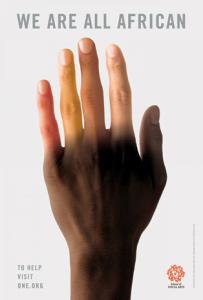
Milton Glaser poster
Like “races”, names are superficial and empty divisions. As a species, we get a common ancestor for all humanity every 2000 years or so. That is, a couple millennia ago there was a person that everyone alive today is related to. There is someone alive today that will be related to every single person alive in the year 4000 (assuming we last that long). On top of that, an individuals genetics is completely washed out of the gene pool in about 1000 years. For a species that’s around 300,000 years old, that’s a pretty quick reset rate. Thus, individually, you breeders will have about as much affect on future generations as I will. Or perhaps, as I go about my day trying to make the world a better place while you’re busy cleaning up poop, my life efforts will be more long lasting and beneficial to the species than yours will.
“If everyone followed your lead, humanity would end!”
This one overestimates my leadership to an embarrassing degree. It is never the case that everyone follows my lead. It doesn’t matter how often I’m right, or how much I support my position, people just don’t want to listen. Even if, somehow, this is the one time in my life I end up being a global trend setter, humanity will not be in danger. Biology will ensure there will still be accidental conceptions. The rare few people who actually should be parents and who want to be parents will still go ahead. The only possible result of my views being well received is that there are fewer humans born, especially fewer humans doomed to an existence of pain and misery. “Yeah, but what if??” Ok, fine. Humanity ceases to be. So what? It’s not like we’re the nicest species about. From a very interesting anti-natalism article, David Benatar writes, “If any other species caused as much damage as humans do, we would think it wrong to breed new members of that species”. Or, if you’re more inclined towards pop culture references
While this might be considered a bit pessimistic, the reasoning is fairly solid. The human race will eventually die out. The question of ‘when’ only really matters to whatever organisms that happen to continue to exist after our demise. From their point of view, would it be better if our inevitable extinction came sooner or later? And from our perspective, would we rather come to some abrupt horrific end, or gradually dwindle our population to zero? I’d say the latter sounds more pleasant by far.
Wrap Up
And there are the three stages dealt with. The Breeder’s grab bag of cookie cutter responses and anecdotal reasoning is nothing more than a flimsy veil, covering arrogance and insecurity. To the rare exceptions out there that actual do well at parenting and truly enjoy it, I must tip my hat. Their contributions to their children, and ultimately society as a whole, cannot be understated. But to The Breeder, I say this: those great parents are in the minority. Most people should never breed, especially if they must be coerced into doing so. The raising of children is just too critical a job to be placed in the hands of the inept. Forsake your romantic notions and myths surrounding procreation. At the very least, leave us non-breeders be while you mindlessly multiply us into oblivion.
Welcome to part 4 of my in depth exposition on why I don’t want to have children.
I. Intro + Stage 1: Initial Shock
II. Stage 2: The Demand for Answers part A
III. Stage 2: The Demand for Answers part B
IV. Stage 2: The Demand for Answers part C
V. Stage 3: The Rebuttal + Wrap up
So far in Stage 2 we’ve looked at why I personally don’t want kids and why the world would be better off if I didn’t. Today, we will look at one last key figure. I am ashamed to say, although I’ve had this discussion regularly, I was about to overlook this entirely for this series. Many thanks to The Intransigent One for reminding me to write of the ones who suffer the most from our culture’s addiction to procreation: mothers.
They are Life Threatening
I have never understood how a woman can look at someone going through a pregnancy, with all its aches, pains, discomforts, swelling, nausea, reduced mobility, exhaustion, hormonal imbalances, and think to themselves, “Now THAT is something I need to try”. And this is the best case scenario in a developed nation with some of the best medical care in the world. World wide, 830 women die every single day due to pregnancy or birthing complications. In Canada the maternal mortality rate is 7 deaths out of 100,000 births.
Even for those fortunate to live in a developed country and not die, things can, and often do, go wrong. From the CDC, common health issues of pregnancy include anemia (low red blood cell count), urinary tract infections, depression, hypertension, gestational diabetes, and obesity. It doesn’t stop there. Other health issues can include ectopic pregnancies (egg implanting in the fallopian tube) causing bleeding pain and dizziness; hyperemesis gravidarum – morning sickness that doesn’t go away resulting in weight loss, faintness, and dehydration; and placental abruption (separation from uterine wall) causing bleeding cramping and pain. There are also a slew of infections to be on the watch for, including Bacterial vaginosis, Cytomegalovirus, Group B strep, Hep B, and Influenza. Each can pose serious risk to the mother and/or the unborn child.
And before you brush off that listing of depression, it is a leading cause of new mother fatalities, with violent suicides.
All that and we haven’t addressed the actual birthing process yet. It carries many risks of serious pain and injury which are often ignored or even unknown by a lot of parents (I’m especially looking at you, fathers). Let’s start by talking about labour pain.
You know what? No. Fuck that. Let’s start by watching some labour pain.
I told a bit of lie just now. That wasn’t true labour pain. The thing is, these guys were in control. The severity and duration of their pain was adjustable and avoidable. They could have opted out at any time. With a flick of a switch or a pulling of a plug, all their pain would immediately cease. Think of a time you endured pain because you wanted to prove a point. Contrast that with a time that you endured pain because there was absolutely nothing you could do about it. I can think of no way to precisely quantify that difference, but it’s huge. Recognize and respect that difference.
Oh hey, did you know there’s something called ‘eclampsia’? It’s a life threatening condition where high blood pressure causes pregnant women to get massive headaches, and get blurred or double vision. Or they could just suddenly go into seizures or a coma.
What’s that? You never heard of it? Neither had I until I was researching this piece. Just another horrifying thing that most people don’t know about going into pregnancy. Sure, it’s rare, but it still happens and an important thing to consider if one wants to make an informed decision about giving birth. There’s another thing that many people don’t think about, but this is far more common.
Tearing.
Or, iffin you wanna get all technical, Obstetric trauma: fourth-degree perineal lacerations; laceration of the cervix, vaginal wall or sulcus; injury to bladder or urethra; and repair of obstetric lacerations of the uterus, cervix, corpus uteri, bladder, urethra, rectum and sphincter.

It’s like this, but a little bit lower, if you know what I mean.
Now fellas, I really want you to think about this the next time you consider the ‘joys of fatherhood’. Imagine shoving a scalpel up your ass and slicing yourself open, sphincter to shaft.
That, my friends, would be the male equivalent of an episiotomy. It’s a procedure done in an effort to reduce the harmfulness of obstetric trauma. Again, that’s cutting yourself from your stink-hole to your pee-pee in an attempt to REDUCE harm. It is even more unpleasant and insane than you imagine.
After you’re done cringing and have composed yourself, recognize that serious obstetric trauma is a reality for 16.9 out of every 100 mothers giving birth in Canada. Probability wise, thats a little bit higher than a roll of a dice. Is that a chance you want to take? Is that a chance you want your significant other to take?
Such a serious injury does not go away quickly and can have some long term effects. For instance, postpartum urinary incontinence is fairly common yet rarely addressed.
Let’s sum up, shall we?
…except for one tiny little detail. Despite all the health issues that come with vaginal births, cesarians are far from desirable. The risks are as numerous as they are severe. There’s chance of infection (incision site, bladder, uterus), haemorrhage or extreme blood loss, injury to bowel or bladder, and scar adhesions. The list goes on, but you get the idea.
Now, this may be a bit presumptuous of me, but I feel that most people are at least amicable with those they are planning to have a child with. And if you care about someone, how can you want them to endure this kind of pain and take these kinds of risks? I wouldn’t even wish it upon an enemy.
And if all that wasn’t enough, it turns out that pregnant women are twice as likely to be murdered than not-pregnant women. This makes murder the leading cause of death for pregnant women. A societal fuck-you-cherry atop a biological shit-sundae women have to risk just by “playing their role” in biology’s plan for them.
I cannot fathom why anyone would voluntarily endure a pregnancy with all this physical and mental duress threatening their wellbeing. At the very least, I think we owe it to the future mothers of the world that information about these risks be more readily available, making their chances at an informed decision more likely.
They are Legion
I have one final reason to not have children before I move on to Stage 3. If I undergo a complete change in values and personality, as the Breeder often predicts I will, and suddenly have an uncontrollable urge to be a parent, there is still no reason to make my own. In fact there are millions of reasons not to. There are so many parentless, homeless children in the world all in desperate need of people to care for them. That is to say, there is already too much need for society to handle as it is. Why create more? It just further demonstrates how much the drive to be a parent is based on biological manipulations.
I think that about covers it. Some are powerful reasons why I personally would never want to reproduce. Some are excellent reasons I should not bear spawn even if I wanted to. Many are both – my case is iron clad. The Breeder, however, will not be dissuaded. Of course, the Breeder never tackles any of my objections head on. In the face of solid reasoning, there’s nothing for them to say. As denying isn’t an option, I’m met instead with an attempt to devalue and deflect. It’s time to look at the other side of the coin. All my objections, *cough* while technically accurate*cough* don’t actually carry much weight when compared to all I would lose out on by not having children. Next time, I’ll look at the Breeder’s most common reasons I ought to reproduce in Stage 3: The Rebuttal.
Welcome to part 3 of my in depth exposition on why I don’t want to have children.
I. Intro + Stage 1: Initial Shock
II. Stage 2: The Demand for Answers part A
III. Stage 2: The Demand for Answers part B
IV. Stage 2: The Demand for Answers part C
V. Stage 3: The Rebuttal + Wrap up
In part A of Stage 2 I discussed my personal reasons as to why I just don’t want to have kids of my own. Today’s post looks at the practice of breeding on a more global scale. With just a few considerations, it soon becomes clear that many others should be following my example.
They are Fragile
I have never understood how some people consider it a virtue when something is delicate. Delicate means structurally weak. Why on earth do people even bother making thin drinking vessels made of brittle glass when sturdy, droppable, hard plastic is an available alternative?
“Ooh, look how thin the stem is on this wine glass is!”
“Wow, that thing would probably shatter in a strong breeze.”
“You’re right. We had better buy a lot of them.”
On a related note, I am also clumsy. If it wasn’t for my martial arts training, providing some basic coordination and some toughness, I’m sure I would have killed myself a dozen times over by now. A newborn would not have any such training, severely reducing its chances of surviving my attempts at parenting. I have been handed an infant twice, once a sibling, once a nephew. They both happened exactly the same way and were both occasions of great terror and duress. Holding my breath, not blinking, I held it at arms length, my hands rigid, straining to ensure I could not possibly drop or crush them. An eternity passed in the 15 seconds it took for someone to relieve me of the infant. I was mocked, but I didn’t care. We both survived and that was all that mattered. “Oh, you’ll get used to it and you’ll learn. Don’t worry, there isn’t a ‘Self-Destruct’ button you could accidentally push.” They’re right, there isn’t a Self-Destruct button. It’s more like a Self-Destruct mine field. And getting used to it is the last thing I want to do. My guard would slowly be let down. I would begin to think that it’s all ok. Then, due to this relaxed vigilance, calamity will sneak through the cracks and then I’d suddenly be responsible for a newborn falling off the edge of a cliff. No thank you. And even despite all these worries, a floundering care taker is not a child’s only danger.
Canadian stats have 1-2 children in every 25 will be born with some kind of birth defect and 28 in every million it will be fatal. When I see stories of dedicated parents who give up their lives to look after their disabled child in the news or in my life, I do not feel inspired. I feel dread. Nature is so cruel, making these families either chose to abandon the child, which will result in grief, an even worse off child, and quite possibly social ostracization; or they can keep it and endure unimaginable stress and strain on their lives. The ones who make it might tell you that it was hard, but they found a way to make it work. First, red flags jump out and sirens wail, “Survivor bias, survivor bias!” Second, even if these “success” stories are the norm, they are no success to me. I do not want to so completely convolute my notions of a happy life and lower my standards to such a degree that they are no longer recognizable. “Oh, it will just take a shift in perspective”, says The Breeder, as if that somehow makes it a good thing. When faced with starvation, a shift in perspective on cannibalism may be required for your survival. While it is technically better than everyone in the dire situation dying, that does not make it a happy turn of events. Anyone with even the tiniest bit of sense can see that it’s a situation that ought to be avoided, whether or not there’s a lesser of multiple evils.
Not only do they break easy, the care with which the young must be cultivated is extraordinary. Failure to live up to this can result in disastrous consequences for both the parent and the child. There are so many horribly wrong ways to raise, educate, discipline, feed, house, entertain, and engage your child. And everyday, parents everywhere are finding new bad ways to do these things. Quite often the bad decisions are systemic, but sometimes it can be just one bad call. To be a parent is to accept the risk that, as you cannot be perfect, it is entirely possible that, despite all your best efforts, you will completely fuck up your child’s life. There are many days when I feel I shouldn’t trusted with my own well being, much less that of a defenceless child. Perhaps I’m being pessimistic/overly self-critical/paranoid, but even if the odds are of me doing irreparable damage to an innocent life are only 1% of what I imagine, they are still much too high to warrant me having a child.
E) They are Bad for the Environment
It’s fairly simple. Humans are causing climate change, procreation results in more humans, therefore having children harms the planet. Bearing spawn is placing one’s own self-indulgent conceit over the importance of the entire world. That’s right, I’m throwing that ‘being selfish’ charge right back in The Breeder’s face. Just how much do these little bundles of “joy” harm?Here is a link to an article that looks at a study which compares the efficacy of climate change reduction measures. It looks at recycling, efficient light bulbs, going carless, eating a plant based diet, flying less, and having one less child.

The one less child was so massive compared to everything else on the list that it required not only a break in the illustration, but an entirely new scale for the graph. Consider two hypothetical people. Person A flies regularly, drives a gas guzzling car, never recycles, and eats enough meat to make an American blush. Person B never flies, doesn’t even own a car, recycles everything, and is devoutly vegan. Based on that, Person B’s carbon footprint is substantially less than Person A’s. But if Person A remains childless while Person B sires just one offspring, suddenly Person A is doing about 10-15 times more for the environment than Person B. And if Person B has two kids…forget about it. But so strong is the Breeder’s hold on our cultural ethos that the value of not having kids was barely mentioned, despite it being a scale of magnitude more impactful than anything else on the list combined. This level of societal blindness is Bond-villain worthy, as it is truly destroying the planet.
F) They are Going to Starve
 Probably not any children I would hypothetically produce, as I happen to be one of the world’s fortunate: not destitute in an industrialized society. However, considered globally, this conclusion is inescapable. One of my favourite books is called “Ishmael”, written by Daniel Quinn. In it, the main characters address the fact that our “advanced” culture still has its myths and what many of those myths entail. The one that is relevant to this discussion is our myth concerning world hunger. Our culture tells us that we could solve the problem of hunger if only we could produce enough food and distribute it to those in need. We have everything from local drives to international organizations tirelessly working toward this end and they have been doing so for generations. Yet, somehow, our planet is still filled with starving people. Are all these caring, giving people completely inept? Are they really so incompetent that with all their numbers and donations that they still can’t make any progress? Not at all. Food production today is staggering compared to what was possible in the past. Food distribution is likewise occurring at an incredible rate. So what gives, Culture? You said that should solve everything. All it takes to unveil this myth of ours is some high school biology.
Ecosystems 101 shows us that increasing the food supply of any given species will increase its population. The population will continue to grow until it cannot be supported by the increased food supply. At that point, some of the population will starve. They will continue to starve and die off until they reach numbers that the food supply can support. This makes sense to most people and they easily see how it applies to all species. Except themselves. Culture tells us that we are exempt from these rules of nature, but the harsh truth is, we aren’t. With a global population of 5 billion, there were people starving. So, we made enough food for 5 billion. But this lead to the population growing to 6 billion, and people were starving. Then we made food for 6 billion, so the population grew to 7 billion, and people were starving. Now we’re making food for 7 billion and the population continues to rise, and people are still starving. Throw in some imperialism and global market capitalism to take the problem up a couple notches, and eternal population growth with millions starving is guaranteed. Of course, this cannot go on forever. This is a finite planet and there is only so much food we can produce. What are our options? We could stop trying to produce more food and stop distributing it to those in need. Hunger would then be more in line with all other species. In good years we would grow, in bad years we would die off a bit. This option is obviously less than ideal. Not only is it heartless, it fails original goal of eliminating hunger, and merely manages it. The other option is to stop our rampant breeding. Unlike the need for food, bearing offspring is not necessary for an individual’s survival. If, through birth control, we reduced our population down to a few billion, our current food production would be more than sufficient to feed everyone alive. This also applies to any other limited resource. As competition is reduced, scarcity diminishes. This will be difficult to achieve, considering the grip the Breeder has over the world. But I shall do my part and lead by example. Once enough people follow, we will save the world.
You’re welcome.
G) They are Doomed to Suffer
We are a biased and optimistic race, especially when our biology wants something from us. I already talked about mate selection, but the blinders get turned up to 11 when people think about the future for their offspring. They ignore rates of sexual abuse, mental illness, violent crime, or poverty, despite them having caused untold millions to suffer unimaginably. Any thoughtful person could be dissuaded from procreation just to avoid casting their offspring into a such cruel world. I won’t explain further, as I’m sure anyone who has read this far can fill details themselves. Instead, I will focus only on the big one.
Death.
100% of all people born will suffer from death. It is inescapable. Yet the Breeder doesn’t consider that they condemn every one of their precious progeny to death simply by birthing them. I’ve seen the quote “No parent should have to bury a child” echoed many places throughout art and pop culture, and it betrays this oversight. If it were conscious, this attitude could be expressed as, ‘I’m totally fine with you dying, as long as it happens after I’m no longer around to suffer the consequences myself.’ It wouldn’t surprise me if the parental desire to protect one’s offspring comes, at least partially, from a sense of guilt over the suffering and death they themselves have sentenced their child to endure.
Although I’ve held my position for almost my entire life, I have only just learned of the term ‘anti-natalism’ in doing research for this post. That research had me stumble upon a wonderful little narrative by The Prime Directive in a post entitled, “The joys of existence.” It’s a dialogue between a freshly formed embryo and its creators/soon-to-b parents. When you get a chance, definitely read the whole thing and check out more posts, but for now, here’s an excerpt that opens up the dialogue and relates well to this point on suffering:
parents: Congratulations, little boy or girl! You’re going to exist!
embryo: Oooh, what does that entail?
parents: So many things! You’re going to be sentient, first of all. You will experience pleasure and pain. You will feel a wide variety of emotions, some of which will be augmented by your human intelligence!
embryo: That sounds complicated.
parents: It will be! The human experience is such a complex one, due to our high intelligence combined with our primitive instincts! We are probably the only creatures on the planet that have existential woes!
embryo: …
parents: In fact, we’re creating you to help alleviate some of our existential woes! You will make us feel immortal and significant in the universe, even though we’re not. You will give us a illusory sense of purpose in life!
embryo: Gee, parents, I’m not sure I like the sound of existence.
Spoiler alert: the parents fail to convince the embryo that being born is a good idea.
So now we see that having a child is not a good idea for me, for the child, or for the world at large. In part C, we’ll look at how having a child is not a good idea for one more person. One who’s wellbeing gets far too often overlooked.











 bleatmop
 Mystro
 The Arbourist


 Dead Wild Roses
Your opinions…