
You are currently browsing the category archive for the ‘Education’ category.
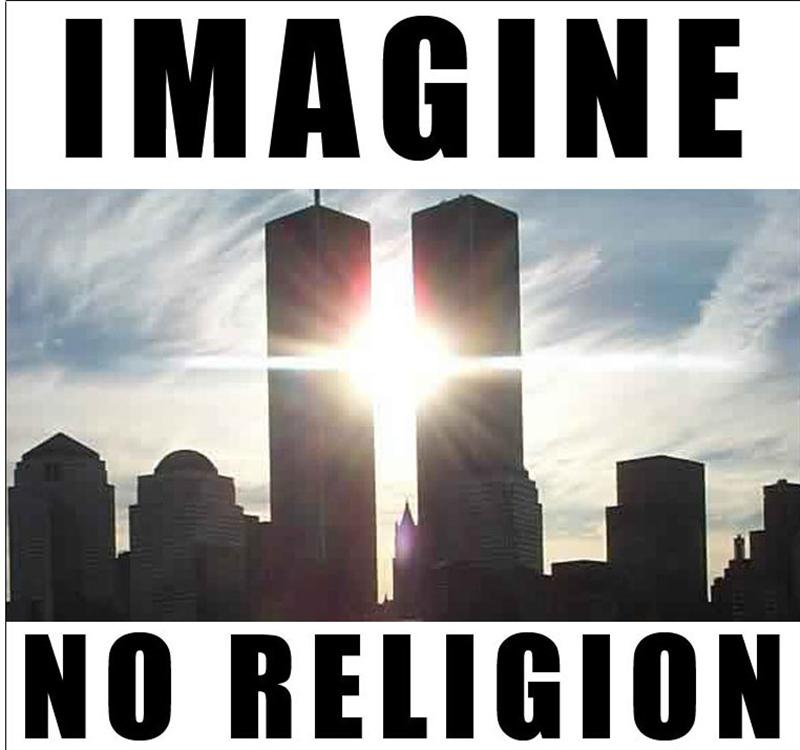
Yes, we do mock religion here. Necessarily so.
Today on the Disservice we look at the burning question (heh) of knowing if your magical sky fairy is indeed the correct sky fairy to be spending your time worshipping. I can think of a few possible responses from the deluded that always crop up when asked this question.
1. The magic book says so.
2. I know in my heart it true.
3. How dare you even ask such a thing, did you want to burn forever for such blasphemy?
Argument 1 – “My magic book says so” is fairly easy to dismantle because the reasoning involved is circular.
Believer – The bible is infallible.
Skeptic – Errr..okay why?
Believer – Oh easy, because it says so in the bible.
Skeptic – *brain lights on fire….melts*
Arguing circularly does not advance your case on iota. The idea we can trust the ramblings of mostly semi-literate shepherds from some 2000 years ago *should* raise some very pointed, very large, very red, red, red flags. Red flags aside, every other religion can make similar claims about their magic book, so why is yours the one true special snowflake of the pack? There are zillions of other reasons, but I’m just mentioning a few for now as we trundle on to the next point.
Argument #2 – “x” is true because I know it in my heart.”
*kerchuk* That was the sound of your rational mind being shat out the airlock. Claims of veracity and truth require a corresponding amount of evidence to balance the nature of the claim. The more grandiose the claim, the more evidence that is required to back it up. You can claim in your heart all day your goldfish gives you hot tips for the stockmarket; but until you can get little Bucky to talk to someone else, your claim to the truth is worthless. The same reasoning applies to religion – Jebus talks to you at night? Okay prove it. He died and was resurrected? – Okay, prove it. Buring bushes give advice and condemnation…errr… Okay pro.. You get the idea. There is little to religious claims that are not open to skeptical inquiry.
Argument #3 – “How dare you offend me and my religion?”
This is a verbal dodge rather than any any sort of reasonable argument. The religious hope to cash in on some of the social taboos about religion, the notion that we cannot criticize and mock religion is still strong in many parts of the world. Bad news for people who don’t believe in magic. Fortunately, the internet provides a forum where many people have the freedom to voice their thoughts without religious censorship. It is through free marketplaces of ideas such as the internet that the folly of religious belief can be brought to light and properly mocked.
Mocking and deriding religion is a purposeful and necessary job of free thinkers everywhere. Of course we can argue with the believers, but the dyed in the wool faithful have long ago given up their access to their critical faculties, so arguing only works to point. Humour, comedic criticism, satire are all fronts that need to be pushed because religion is so strongly ingrained in our consciousness. Religion belief needs to be mocked to the point where indeed it can be a “personal choice” and not talked about, as opposed to the social dynamo that it currently is today.
I have no problem with religion, but it seems like religion will always have a problem with me as true believers attempt to frame and remake the society around me into their nightmare reality based on the ‘teachings fom the Good Book’. When religion starts poking its purulent head into matters of state and secular democracy and demanding people respect its bronze age wisdom, it is then I have a problem.

I know where I would lay in the above graph. Yet I continue, and hope others find the courage and conviction to follow in my footsteps.
Being intimidated by the religious thugs threatening violence seems to be a growing fad. This needs to stop. I mirror this video that was taken down by youtube for a terms of use violation – (being offensive to the deluded). Here it is again on the blog.
You and your dogma can go away, the sooner, the better.
 Seeing history from a different perspective is often an enlightening experience. Noam Chomsky is a excellent guide to a historical narrative that makes sense and fits the facts of the situation, as opposed to what we are told by approved sources. It is a long read, somehow sadly classified as a radical perspective, but well worth your time. The media in the US often do not publish Chomsky’s work despite its accuracy and veracity, because publishing it might actually stir public opinion and motivate people to get involved with their government. It is left to alternative media organizations and Al Jazeera to find insight on how the world really works without the usual mainstream blinders.
“Significant anniversaries are solemnly commemorated – Japan’s attack on the US naval base at Pearl Harbor, for example. Others are ignored, and we can often learn valuable lessons from them about what is likely to lie ahead. Right now, in fact.
At the moment, we are failing to commemorate the 50th anniversary of President John F Kennedy’s decision to launch the most destructive and murderous act of aggression of the post-World War II period: the invasion of South Vietnam, later all of Indochina, leaving millions dead and four countries devastated, with casualties still mounting from the long-term effects of drenching South Vietnam with some of the most lethal carcinogens known, undertaken to destroy ground cover and food crops.
The prime target was South Vietnam. The aggression later spread to the North, then to the remote peasant society of northern Laos, and finally to rural Cambodia, which was bombed at the stunning level of all allied air operations in the Pacific region during World War II, including the two atom bombs dropped on Hiroshima and Nagasaki. In this, Henry Kissinger’s orders were being carried out – “anything that flies on anything that moves” – a call for genocide that is rare in the historical record. Little of this is remembered. Most was scarcely known beyond narrow circles of activists.
When the invasion was launched 50 years ago, concern was so slight that there were few efforts at justification, hardly more than the president’s impassioned plea that “we are opposed around the world by a monolithic and ruthless conspiracy that relies primarily on covert means for expanding its sphere of influence” and if the conspiracy achieves its ends in Laos and Vietnam, “the gates will be opened wide”.
Elsewhere, he warned further that “the complacent, the self-indulgent, the soft societies are about to be swept away with the debris of history [and] only the strong… can possibly survive”, in this case reflecting on the failure of US aggression and terror to crush Cuban independence.
By the time protest began to mount half a dozen years later, the respected Vietnam specialist and military historian Bernard Fall, no dove, forecast that “Vietnam as a cultural and historic entity… is threatened with extinction…[as]…the countryside literally dies under the blows of the largest military machine ever unleashed on an area of this size”. He was again referring to South Vietnam.
When the war ended eight horrendous years later, mainstream opinion was divided between those who described the war as a “noble cause” that could have been won with more dedication, and at the opposite extreme, the critics, to whom it was “a mistake” that proved too costly. By 1977, President Carter aroused little notice when he explained that we owe Vietnam “no debt” because “the destruction was mutual”.
 There are important lessons in all this for today, even apart from another reminder that only the weak and defeated are called to account for their crimes. One lesson is that to understand what is happening we should attend not only to critical events of the real world, often dismissed from history, but also to what leaders and elite opinion believe, however tinged with fantasy. Another lesson is that alongside the flights of fancy concocted to terrify and mobilise the public (and perhaps believed by some who are trapped in their own rhetoric), there is also geostrategic planning based on principles that are rational and stable over long periods because they are rooted in stable institutions and their concerns. That is true in the case of Vietnam as well. I will return to that, only stressing here that the persistent factors in state action are generally well concealed.
The Iraq war is an instructive case. It was marketed to a terrified public on the usual grounds of self-defense against an awesome threat to survival: the “single question”, George W Bush and Tony Blair declared, was whether Saddam Hussein would end his programs of developing weapons of mass destruction. When the single question received the wrong answer, government rhetoric shifted effortlessly to our “yearning for democracy”, and educated opinion duly followed course; all routine.
Later, as the scale of the US defeat in Iraq was becoming difficult to suppress, the government quietly conceded what had been clear all along. In 2007-2008, the administration officially announced that a final settlement must grant the US military bases and the right of combat operations, and must privilege US investors in the rich energy system – demands later reluctantly abandoned in the face of Iraqi resistance. And all well kept from the general population.
Gauging American decline
This is a repost from askepticrtn.com it is important concisely written work that needs to be shared and amplified in the Canadian Blogosphere.
Another Resignation at Statistics Canada
February 12, 2012 in General Science by askeptic
On February 01, Philip Cross, Chief Economic Adviser at Statistics Canada announced his leaving the agency. He follows the head of the agency, Munir Sheikh, who resigned last year over Government plans to redesign the Census. Mr. Cross is leaving for much the same reason.
At issue is replacing a compulsory census questionnaire with a voluntary questionnaire. In essence, this means replacing a random sample with a discretionary sample. Discretionary samples have their applications, but making inferences about the population isn’t one of them. Unfortunately, making just these types of inferences is whole point of the Census. That’s why Mr. Sheikh wrote in an open letter to the Government:
“I want to take this opportunity to comment on a technical statistical issue which has become the subject of media discussion … the question of whether a voluntary survey can become a substitute for a mandatory census . . . It can not.” “Under the circumstances, I have tendered my resignation to the Prime Minister.”
Mr. Cross is quoted in the Globe and Mail as expressing concern “that the free exchange of ideas at the agency is diminishing, and that internal dissent is no longer being tolerated by senior managers – particularly when it comes to discussions about the 2011 census and new national household survey.” He goes further by saying: “a lot of good can be offset if you get one big thing wrong – and the big thing in this instance is census and NHS.”
At least we know the two people at Statistics Canada (well, formerly at StatsCan) with some sense of public service and responsibility. Now that they’ve left, StatsCan should be free from such annoyances.
Long form census data is worthless. The efforts to gather it, a waste of taxpayers money. Minister Tony Clement claims that he has his magic mojo working, enabling StatsCan to overcome the limitations of the mathematical and statistical sciences. I hope he shares it with the rest of us.
One question remains though, who will be rewriting all those science textbooks?
Short, sweet and to the point –
“Pornography is the graphic representation, not just of violence against women, but of male supremacy. It degrades all women. It erodes the humanity of all women. Porn use fetishizes violence and supports male supremacy. Porn is the expression of patriarchy. Porn use is the practice of patriarchy.”
-Twisty, from I Blame the Patriarchy.
Discuss in the comments section.
Creationism is low hanging fruit, I realize this, but this video by potholer54 is just too funny to miss.
Gaining a better understanding of the reality which we inhabit aka doing Science. Brian Greene takes us on a light, generalist cosmological journey. Enjoy. :)











 bleatmop
 Mystro


 Dead Wild Roses
Your opinions…