
You are currently browsing the category archive for the ‘Education’ category.
Noam Chomsky again pushing debate to the margins where you get a glimpse of how the world works and how we have allowed our debate to be warped by the radical priorities of corporate culture.
 The verdict has been in for a long time now, but still the message is not getting through. Harsh sentences and a punitive justice system do not work. “The best way to turn a non-violent person”, says prison psychologist James Glligan, “into a violent one is to send him to prison.”
The official reasons for incarceration and imprisonment are described as the following –
“[…] while imprisonment is generally believed to have four ‘official’ purposes – retribution for crimes committed, deterrence, incapacitation of criminals and the rehabilitation of criminals, in fact three other purposes have shaped America’s rates and conditions of imprisonment. These unofficial purposes are class control – the need to protect honest middle-class citizens from the dangerous criminal underclass; scapegoating – diverting attention away from more serious social problems (the growing inequalities in wealth and income [for example].); and using the threat of the dangerous class for political gain.
-Irwin, John. Federal Bureau of Investigation, Crime in the United States 2006.
Washington, DC:Us Government Printing Office, 2006.
So, when do we wake up and begin to make the connection that punishment does not fix people and begin to structure our penal systems to reflect this fact?
“95 percent of economics is common sense deliberately made complicated.” – Ha-Joon Chang
Thing One. There is really no such thing as a free market.
Thing Two. Companies should not be run in the interest of their owners.
Thing Three. Most people in rich countries get paid more than they should.
Thing Four. The washing machine has changed the world more than the internet.
Thing Five. Assume the worst about people, and you get the worst.
Thing Six. Greater macroeconomic stability has not made the world economy more stable.
Thing Seven. Free-market policies rarely make poor countries richer.
Thing Eight. Capital has a nationality.
Thing Nine. We do not live in a post-industrial age.
Thing Ten. The US does not have the highest living standard in the world.
Thing Eleven. Africa is not destined for under-development.
Thing Twelve. Government can pick winners.
Thing Thirteen. Making rich people richer doesn’t make the rest of us richer.
Thing Fourteen. US managers are over-priced.
Thing Fifteen. People in poor countries are more entrepreneurial than people in rich countries.
Thing Sixteen. We are not smart enough to leave things to the market.
Thing Seventeen. More education in itself is not going to make a country richer.
Thing Eighteen. What is good for the General Motors is not necessarily good for the US.
Thing Nineteen. Despite the fall of Communism, we are still living in planned economies.
Thing Twenty. Equality of opportunities is unequal.
Thing Twenty-one. Big government makes people more, not less, open to changes.
Thing Twenty-two. Financial markets need to become less, not more, efficient.
Thing Twenty-three. Good economic policy does not require good economists.
The capitalist system is not working, despite what elite opinion says. Starting with these points is a great place to look into our perceptions of what Capitalism is.
Ahh, if only the war on woo was going so well. Relax with Mr.Minchin as he disassembles the irrational in his poetry and bask in his defence of the real and the rational.
 As I am often told by my free market indoctrinated friends the market will solve societies problems, if….(insert the big whingy diatribe about government interfering here) it was just left to its own devices.
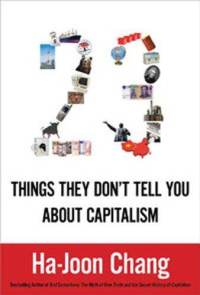
A sample of the pap I usually hear, coherently summarized by Mr.Chang and his book I happen to be reading right now.
“We should leave markets alone, because, essentially, market participants know what they are doing – that is, they are rational. Since individuals (and firms as collections of individuals who share the same interests) have their own best interests in mind and since they know their circumstances best, attempts by outsiders, especially the governement, to restrict freedom of their actions can only produce inferior results. It is presumptuous of any government to prevent market agents from doing things they find profitable or force them to to do things they do not want to do, when it possesses inferior information.
What they don’t tell you…
People do not necessarily know what they are doing, because our ability to comprehend even matters that concern us directly is limited – or, in the jargon, we have “bounded rationality”. The world is very complex and our ability to deal with it is severely limited. Therefore, we need to, and usually do, deliberately restrict our freedom of choice in order to reduce the complexity of the problems we face. Often, government regulation works, especially in complex areas like the modern financial market, not becaues the government has superior knowledge but because it restricts choices and thus the complexity of the problems at hand, thereby reducing the possibility that things may go wrong.”
-Excerpt from 23 Things they don’t tell you about Capitalism – Ha – Joon Chang. pp. 168-169
People always seem to forget that the rational self maximizing actors they talk about in economics text books are merely theoretical constructions and do not figure prominently in the real world. We are neither rational nor do we have complete information when it comes to making economic decisions. Therefore, as Mr. Chang implies government regulation can be a good, even helpful thing, when it comes to market conditions.
 Canadians support their political parties economically as each vote a party receives is worth two dollars. Also in Canada we have a First Past the Post federal electoral system which often favours larger more established parties, so when you throw your vote away voting for a electoral long shot (any other party than the conservatives here in Alberta) then at the very least, the party will receive some financial backing.
“The Chrétien government created the per-vote direct subsidy in 2004, when it banned corporate donations to parties and limited contributions to ridings or candidates to $1,000 per year. Individual donations were capped at $5,000, down from $10,000.
In 2006, the new Harper government dropped the individual limit to $1,000 (adjusted to inflation; it was $1,100 in 2010 and 2011) and imposed a complete ban on donations from corporations, unions and organizations.”
The public funding of parties is a good thing, it (at least on the surface) keeps some of the corporate money out of the electoral process. I look at the recent money = free speech decision by the SCOTUS and shudder as the political corruption Olympics ascend to even a greater level in our neighbour to the South. And of course Steven Harper want to get rid of this nod to democracy:
“Harper, who has long opposed the $2-per-vote subsidy, said political parties enjoy “enormous tax advantages” even without the additional subsidy and taxpayers should not financially support political parties that they don’t support with their votes.
“I’ve wanted to change this. But we were very clear: unless we have a majority government we will never attempt to change it because we know in a minority government you can never move this forward,” Harper said.
Harper tried to scrap the funds in 2008, a move that led to a revolt by all three opposition parties.”
Not particularly surprising given the Conservative’s general contempt of the democratic and parliamentary processes.
Given the polls right now, it looks like we are heading for another minority situation although I am hoping that the numbers support a Coalition of the Liberals and the NDP because we need a change from the reckless, ideological based course we have been frogmarched down these last couple of years.











 bleatmop
 Mystro
 The Arbourist


 Dead Wild Roses
Your opinions…