
You are currently browsing the category archive for the ‘Feminism’ category.
Tyler Cowen once tried to name the biggest “revolutions” he’s lived through—moon landing, collapse of communism, the internet, and now AI. In the middle of that list he drops one that most people still don’t treat like a revolution at all: “Feminization.” (Marginal REVOLUTION)
That word isn’t a complaint. It’s a category. It says: a long-run compositional change is underway, and it matters.
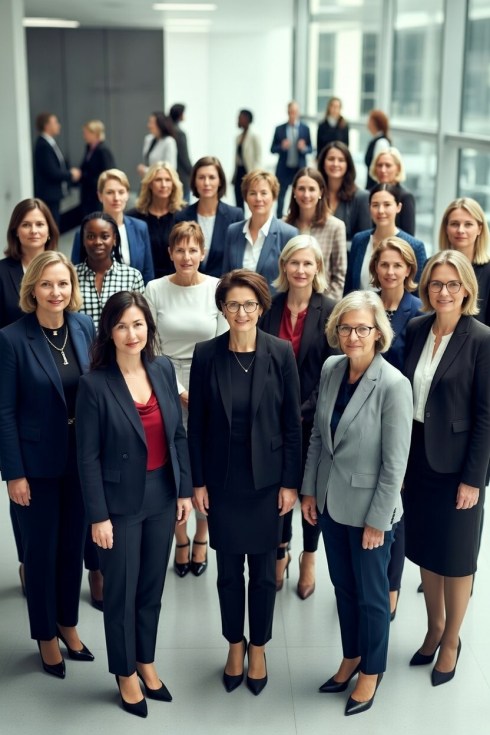
Helen Andrews’ “Great Feminization” thesis—popularized in a talk and elaborated in her Compact essay—takes the next step: as women become a larger share of institutions, institutions don’t merely “include” women; they become substantively feminized, and what we call “wokeness” is basically the cultural exhaust of that process. (Compact)
Here’s my position up front: the demographic shift is real and measurable in Canada; the “feminization = wokeness” equation is an overconfident master key.
It explains too much, too easily, by psychologizing demographics instead of interrogating incentives.
Canadian anchors: the shift is measurable (not vibes)
Start with a handful of Canadian facts you can actually point to.
- Parliament: the House of Commons sits at 104 women out of 343 MPs (30.3%). (IPU Parline)
- Judiciary: the share of federally appointed judges who are women rose from 43.8% (2021) to 46.7% (2023), per Statistics Canada. (Statistics Canada)
- Universities: women are 43.7% of full-time teaching staff in 2024/2025, up from 15.9% in 1984/1985. (Statistics Canada)
- Management: women are 51.9% of public-sector managers but 35.2% of private-sector managers (2023), and hold 42.7% of middle management vs 30.8% of senior management (2021). (Statistics Canada)
- Psychology (Alberta snapshot): Job Bank puts psychologists at 81% women / 19% men in Alberta. (Job Bank)
You don’t need to think any of this is good or bad to recognize the basic point: elite and semi-elite Canadian pipelines have changed composition in living memory. The “Great Feminization,” at minimum, names something real.
Why composition changes institutions (and why noticing this isn’t misogyny)
Here’s the move that poisons discussion: someone observes a demographic shift and asks what it does to norms; the response is to treat the question itself as hatred.
That’s not an argument; it’s a veto.
Institutions aren’t just rulebooks. They are reward systems: what gets you promoted, what gets you ostracized, what gets you hauled into a meeting, what everyone learns not to say out loud. When composition changes, the informal equilibrium can change too—sometimes for the better, sometimes not.
Before anyone reaches for the “misogyny” stamp, three obvious distinctions:
- Descriptive claims aren’t moral verdicts. Saying “X is now 47% female” is not saying “women ruined X.”
- Group averages aren’t destinies. Even if differences exist on average, overlap is huge. Plenty of women are rule-first and combative; plenty of men are harmony-first and censorious.
- The target is incentives, not women. If a system rewards reputational risk-avoidance and punishes open conflict, it will drift toward soft enforcement and speech management—regardless of who staffs it.
Those distinctions don’t sanitize the topic. They make it discussable.
Where Andrews helps—and where her thesis becomes a master key
Steelman Andrews first: she’s right that the shift is large, and she’s right that institutions can be remade through changes in who occupies them. If you pretend otherwise, you’re pretending humans don’t do social enforcement.
Where she overreaches is the claim (often treated as self-evident) that “feminization = wokeness.” (Compact)
Two problems.
1) One variable can’t carry a multi-cause phenomenon
The rise of “woke” managerial dynamics tracks at least four forces that are not reducible to gender composition:
- social media: instant reputational escalation; permanent records of mistakes; a public audience for internal disputes
- liability culture: institutions optimizing to avoid lawsuits, complaints, and scandal
- bureaucratic expansion: more compliance, more policy, more internal language policing
- credential sorting: ideological clustering in certain professional strata
In Canada, you can see the basic direction without naming villains: risk management becomes a career track; “process” becomes protection; disputes become “incidents”; leaders learn to value quiet over truth because quiet is legible as safety.
You can believe feminization is one contributor. But treating it as the engine is an interpretive leap, not an established causal law.
2) It tempts essentialism even when it gestures at nuance
If “wokeness” is “women’s morality,” you’ve turned a complex institutional pathology into a personality profile of half the species. That’s analytically brittle and politically stupid: it hands critics the easiest rebuttal (“you’re essentializing women”) and it blinds you to male-led versions of the same pathologies (purges, conformity spirals, status policing), which history supplies in bulk.
If you want to criticize a norm regime, criticize the regime. Don’t smuggle in contempt.
What the evidence can support—more modestly
A defensible claim, one that doesn’t require you to psychologize women as a class, looks like this:
- Some sex-linked preference gaps show up in some contexts, especially around speech, conflict, and social sanction. For example, a Knight Foundation/College Pulse study reports large gender differences among U.S. college students: 41% of college women prioritized protecting free speech versus 71% of college men, while women were more likely to prioritize promoting an inclusive society.
- Institutions are sensitive to preference distributions because norms are enforced socially, not just formally.
- Incentives decide which preferences become “policy.” Liability, reputation, and managerial bureaucracy amplify harm-avoidance.
And this is the part Andrews gestures at, but doesn’t fully own: if you want to understand modern speech policing, HR creep, and the new professional fearfulness, start with incentives. The incentives turn every controversy into a corporate emergency; then people behave accordingly.
On that view, feminization isn’t the whole story. It’s a relevant input—and its effects depend on the system it enters.
The real Canadian question: can we preserve hard virtues mid-transition?
Canada is useful here because we’re visibly mid-shift rather than at some imagined endpoint. Parliament is at 30% women, not parity. (IPU Parline) The federal judiciary is closing on parity. (Statistics Canada) Universities have moved dramatically since the 1980s, but remain below parity in full-time teaching staff. (Statistics Canada) Management splits sharply by public vs private sector, and senior leadership remains male-skewed. (Statistics Canada)
So the live question isn’t “should women be here?” They are here, and they belong here.
The question is narrower and more urgent:
As composition changes, what norms do we want to protect because they are fragile?
A short list:
- due process and evidence standards (law)
- viewpoint tolerance and intellectual risk-taking (academia)
- candid disagreement and non-performative conflict (organizations)
- the capacity to make decisions that feel “unkind” but are necessary (policy)
If you think those virtues are real and fragile, you don’t need to scapegoat women. You need to design institutions that reward truth-telling and competence more than “harm management” and reputational prophylaxis. That means fewer performative “values” rituals and more procedural backbone: clear standards, clearer speech norms, and leaders who can say “no” without laundering it through therapy language.
Verdict and prediction
The Great Feminization is real in Canada. The numbers are not subtle. (IPU Parline)
But “feminization = wokeness” is a bad master key. It explains too much, too easily, by psychologizing demographics rather than interrogating incentives. (Compact)
My bet is that the next decade won’t be settled by shouting “misogyny” or shouting “women did this.” It will be settled by whether our institutions relearn a difficult skill: distinguishing “this feels harmful” from “this is false,” and building cultures where adults can endure disagreement without turning every conflict into a moral emergency.
Glossary
- Confounders — other factors that could be the real cause, making cause-and-effect hard to prove.
- Essentialism / essentialize — treating a group as if it has one fixed “essence” (“women are X”), ignoring variation.
- Epiphenomenon — a byproduct; something that looks important but is really “exhaust” from a deeper cause.
- Monocausal — blaming one cause for a complex outcome.
- Pathology (institutional pathology) — a recurring dysfunctional pattern inside an institution.
- Prophylaxis — preventative action; here, pre-emptive “avoid scandal” behavior.
- Psychologizing — explaining political/institutional behavior by reducing it to personality traits or “mental makeup.”

In October 2025, Brighton witnessed a stark confrontation between feminist and trans activist groups, culminating in the vandalism of the FiLiA conference venue by the direct-action group Bash Back. This incident has sparked widespread debate over the boundaries of free speech, the safety of women-only spaces, and the tactics employed in the defense of trans rights.
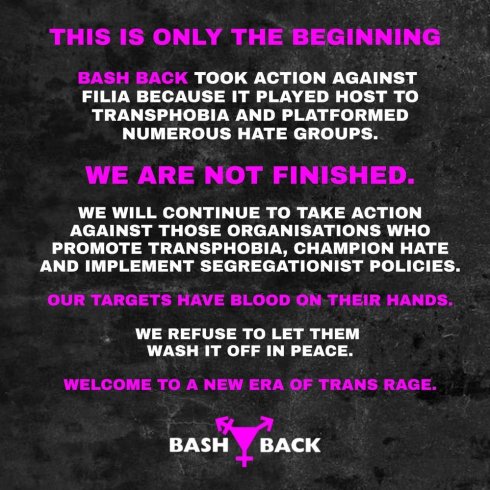
In the seaside city of Brighton, where the English Channel laps against shores long synonymous with progressive ideals, a gathering of women became the target of deliberate aggression last weekend. The FiLiA conference—Europe’s largest feminist event, drawing over 2,400 delegates from around the world—convened from October 10 to 12, 2025, to confront the unyielding realities of women’s lives: domestic abuse, sexual violence, lesbian safety, anti-racism, health equity, and political organizing. What should have been a sanctuary for sisterhood instead became a stage for intimidation, vandalism, and moral inversion, carried out by activists who cloaked their belligerence in the guise of righteous victimhood. This was no spontaneous protest; it was an orchestrated assault on women’s autonomy, executed through the psychological tactic known as DARVO—Deny, Attack, Reverse Victim and Offender—flipping aggressor and victim roles to confuse and shame the true defenders.
FiLiA, the Feminist International Leadership and Action charity, has championed women’s voices and sex-based rights since its founding in 1982 as Feminists in London. Rebranded in 2019, the organization organizes workshops, advocacy campaigns, and international solidarity events, explicitly excluding male speakers to foster unmediated discourse. Alumni include figures like J.K. Rowling, and sessions routinely interrogate male violence without apology. In Brighton, hosted at the council-owned Brighton Centre, FiLiA aimed to advance this mission amid escalating threats to female-only spaces. Organizers preemptively requested a Public Spaces Protection Order from Brighton and Hove Council to mitigate anticipated disruptions, only to be rebuffed—a decision that left delegates exposed to the very dangers the conference sought to address.
The aggression began hours before the conference doors opened on October 10. Activists associated with the direct-action group Bash Back vandalized the venue: windows were shattered, purple paint—symbolizing queer defiance—splashed across entrances, and graffiti labeled FiLiA “transphobic” and worse. As women arrived on Saturday, masked protesters surrounded them, chanting, jeering, filming without consent, and blocking access to the entrance. One man was bundled into a police van amid the chaos. Sussex Police launched an investigation, but the damage was done: a conference on male violence against women had itself been disrupted by male violence.
This incident exemplifies DARVO in practice. Attacks were simultaneously denied or minimized as mere “direct action,” while FiLiA was cast as inherently bigoted for prioritizing biological sex in discussions of oppression. Reversal of victimhood followed swiftly: women convening to safeguard their rights were recast as provocateurs, deserving retaliation. Green MP Sian Berry’s comments faulting organizers for “inflaming division” exemplify this inversion, as if women’s speech is a privilege revocable at the whim of the offended. Online, Bash Back celebrated targeting “hate groups” like the LGB Alliance and Transgender Trend, further amplifying the narrative of moral righteousness while eroding accountability. Eyewitness reports indicate that many of the aggressors were male, cross-dressing in the guise of protest—a striking irony in a city branding itself a “City of Sanctuary.”
The Brighton disruption is part of a broader pattern of hostility toward women’s spaces, where the veneer of inclusivity is used to justify exclusion. Militant transactivism often prioritizes gender self-identification over material sex realities, demanding access to refuges, prisons, and sports at the expense of female safety. By framing sex-based protections as inherently “transphobic,” these tactics erode the foundations of feminism: the recognition that sex is the axis of patriarchal power and a critical factor in protecting women from violence. The FiLiA delegates were not debating abstract theory—they were strategizing for survival against rape, trafficking, and erasure. To disrupt their forum is to reinforce the patriarchal dynamics they resist.
The path forward requires vigilance and clarity. DARVO’s manipulations must be unmasked; women’s sex-based rights defended without apology; and discourse reclaimed from those who mistake volume and spectacle for moral authority. Only then can women gather safely, unmolested, to build the liberation FiLiA envisions—a liberation grounded in reality, accountability, and the enduring fight against male violence.
📚 References
- “Council refused feminists security after trans activists smashed venue.” The Times, October 10, 2025. (The Times)
- “Trans activists vandalise feminist conference.” Yahoo News Canada, October 10, 2025. (Yahoo News)
- “Trans group ‘BASH BACK’ targets Brighton Centre – FiLiA has ‘blood on their hands’.” Scene Magazine, October 10, 2025. (Scene Magazine)
- “FiLiA Conference Sparks Trans Rights Protests In Brighton.” Evrimagaci, October 10, 2025. (Evrim Ağacı)
- “FiLiA.” Wikipedia, October 2025. (Wikipedia)
- “Bash Back!” Wikipedia, October 2025. (Wikipedia)
People should be consistent about their beliefs. Let’s put a bodily autonomy situation to the test.
-
Major Premise: Any moral principle protecting a woman’s bodily autonomy and safety must be applied consistently to all areas where her biological sex is directly relevant.
-
Minor Premise 1: Abortion rights protect a woman’s bodily autonomy.
-
Minor Premise 2: Female-only spaces protect a woman’s safety and dignity, which are inseparable from her biological sex.
-
Conclusion: Therefore, just as abortion is morally protected for bodily autonomy, the right of women to control access to female-only spaces must also be morally protected
Let’s consider a possible counter –
-
Trans inclusion claim: Some argue trans women should access female spaces.
-
Counterpoint: Biological sex, not gender identity, determines risk factors (e.g., privacy violations, physical safety concerns), which are the basis for female-only spaces. Moral protection of women’s autonomy and safety therefore cannot be overridden by gender identity claims.
This (and logic generally) only works if you belief in objective truth and a shared common reality. Social constructivists are bound by neither, so this argument probably wouldn’t work well with them.

The Taliban’s gender apartheid in Afghanistan has erased decades of women’s rights, yet Western feminists remain largely mute. This selective outrage undermines global solidarity and demands scrutiny.
The Plight of Afghan Women
Since the Taliban’s 2021 return, Afghan women live under the harshest restrictions in the world. Girls are banned from schooling beyond sixth grade. Women are barred from most employment, forbidden from traveling without male chaperones, and compelled to wear full coverings. More than 80 edicts—54 targeting women—have stripped them of agency.
The results are devastating: suicide rates among Afghan women now exceed those of men, a stark marker of despair. The UN describes Afghanistan as the most repressive state for women globally, with its system of gender apartheid potentially amounting to a crime against humanity. Afghan women themselves say they feel “invisible, isolated, suffocated.”
The Silence of Western Feminists
Where is the outrage? Western feminists—so vocal on reproductive rights, pay gaps, and representation—have been notably quiet. In 1997, the Feminist Majority Foundation spearheaded a campaign against Taliban “gender apartheid,” mobilizing U.S. media and Congress. No such mobilization exists today.
Instead, Western feminist discourse remains centered on domestic struggles. Social media cycles amplify abortion battles or workplace equity, while Afghanistan’s crisis rarely trends. A 2022 Human Rights Watch panel highlighted Afghan women’s sense of abandonment—forgotten by those who once claimed solidarity. The silence is more than neglect; it erodes the credibility of a movement that champions global sisterhood.
The Opposition’s View
Defenders argue Western feminists are rightly focused on where they wield influence—local policy fights over abortion or workplace equity. Others fear that advocating for Afghan women risks repeating colonialist “savior” narratives, as post-9/11 rhetoric did.
But caution has curdled into apathy. Silence neither elevates Afghan voices nor restrains Taliban oppression. If anything, Western feminism’s past complicity in militarized “rescue” campaigns demands more careful, accountable solidarity—not retreat.
The Takeaway
Irony abounds: a movement quick to decry domestic patriarchy turns mute before a regime that has locked women in their homes. Afghan women are not asking for saviors, but for allies who will amplify their voices and challenge their erasure.
Consistency is the true test of principle. Championing equality at home while ignoring gender apartheid abroad is not solidarity—it is privilege. The Taliban’s repression is their crime, but Western feminim’s silence is a stain on its conscience.
References
- UN Women. Women in Afghanistan: From Almost Everywhere to Almost Nowhere. Link
- Human Rights Watch. Afghan Women and Western Intervention: A Conversation. Link
- Atlantic Council. In Afghanistan’s Gender Apartheid. Link
Introduction
The dialectic—Hegel’s clash of ideas, Marx’s material struggles—slices through history’s haze, exposing contradictions that propel transformation. In this final installment, we probe whether the tension within third-wave feminism and queer theory-based gender ideology sustains their revolutionary spark or risks their co-optation in history’s relentless churn. These movements, once antitheses to rigid norms, have reshaped Western society, challenging traditional discursive representations of gender and identity[^3], yet their outcomes—marked by institutional absorption and fierce backlash—suggest a complex dialectical fate. We examine concrete examples of their use and potential discardment, situating them within the broader corrosion of classical liberal values: individual liberty, equality before the law, empirical rigor. The question is not whether these movements endure but whether their radical potential survives the dialectic’s unyielding spiral.
Current Status of Third-Wave Feminism in 2025
Third-wave feminism, born in the early 1990s, remains a potent force in 2025, its intersectional ethos—championing the interplay of race, class, and gender—shaping academic discourse and social justice activism. Figures like Kimberlé Crenshaw and Rebecca Walker drove its critique of second-wave feminism’s homogeneity, demanding inclusivity for marginalized women. Yet, its strength—diversity—has become its Achilles’ heel. Elizabeth Evans notes its “confusion” as a defining trait, with “feminism” now a nebulous catch-all, lacking the unified punch of earlier waves (Evans, 2015). This fragmentation, coupled with mainstream co-optation, threatens its coherence.
The movement’s radical edge has been blunted by corporate commodification. The “girl power” mantra, once a rallying cry, now adorns consumer products—Nike’s empowerment-themed ads, Dove’s body-positive campaigns—often devoid of systemic critique (Snyder-Hall, 2010). Such co-optation transforms feminism into a marketable aesthetic, not a call to dismantle patriarchy. Radical feminists like Sheila Jeffreys argue that third-wave’s embrace of fluid identities, including transfeminism, dilutes focus on sex-based oppression, creating internal contradictions (Jeffreys, 2014). Despite this, third-wave ideas persist in policy—like workplace diversity quotas—and activism, suggesting a synthesis where inclusivity is celebrated but often superficially, leaving structural inequities intact.
Current Debates on Gender Ideology in 2025
Queer theory-based gender ideology, rooted in Judith Butler’s deconstruction of gender as performative and David Halperin’s definition of “queer” as “whatever is at odds with the normal, the legitimate, the dominant… an identity without an essence” (Halperin, 1995, p. 62), remains a lightning rod in 2025. Its challenge to binary norms has driven cultural shifts, like non-binary passport markers in Canada and Germany. Yet, its radicalism faces co-optation and backlash. “Rainbow capitalism”[^1]—corporations like Target flaunting Pride-themed merchandise—reduces queer liberation to a seasonal marketing ploy, stripping its subversive core (Fraser, 2009).
The backlash is fierce. In January 2025, a U.S. executive order, “Defending Women From Gender Ideology Extremism,” rescinded prior gender-identity protections, prioritizing biological sex and framing gender ideology as a threat to empirical truth (White House, 2025). Critics like Helen Pluckrose and James Lindsay decry its rejection of biology as anti-scientific, arguing it undermines rational discourse (Pluckrose & Lindsay, 2020). Radical feminists, like Rosemary Hennessy, contend it sidelines materialist concerns[^2]—capitalism, patriarchy—for discursive battles, weakening feminist unity (Hennessy, 1995). Amnesty International highlights how “gender ideology” is weaponized to curb rights to bodily autonomy and expression, signaling a potent antithesis from traditionalists and liberals alike (Amnesty International, 2025). Yet, gender ideology’s influence endures in cultural visibility—think Laverne Cox’s media presence—though its dogmatic assertions, like dismissing critics as “bigots,” risk alienating allies.
Outcomes of Third-Wave Feminism: Used and Discarded?
Third-wave feminism’s dialectical journey reveals both triumph and erosion. Its antithesis to second-wave homogeneity—embodied in the Riot Grrrl movement’s punk defiance and digital activism’s global reach—yielded a synthesis: a broader, more inclusive feminism. Yet, this inclusivity has been co-opted. Corporate campaigns, like Always’ #LikeAGirl, repackage feminist rhetoric for profit, offering empowerment without challenging systemic power (Snyder-Hall, 2010). Diversity initiatives, such as corporate quotas, often prioritize optics over structural change—tokenism masquerading as progress. A 2023 study found that 60% of U.S. companies with diversity programs reported no significant increase in women’s leadership roles, underscoring this superficiality (McKinsey, 2023).
Has third-wave feminism been discarded? Not wholly. Its ideas permeate academia and activism, influencing policies like paid parental leave. Yet, its fragmentation—where “feminism” spans corporate branding to radical protest—suggests a partial discardment. Radical feminists argue its focus on identity over material conditions has sidelined women’s collective struggle, aligning with Marx’s view of ideology being co-opted by capitalist structures (Evans, 2015). The dialectic has moved: fourth-wave feminism, driven by #MeToo and social media, has emerged as a new antithesis, addressing sexual violence but often bypassing third-wave’s broader intersectional lens, indicating a shift rather than obliteration.
Outcomes of Gender Ideology: Co-optation or Collapse?
Gender ideology’s dialectical path mirrors this pattern. Its antithesis to binary norms—evident in gender-neutral bathrooms and non-binary legal markers—has forged a synthesis: societal acknowledgment of gender diversity. Yet, co-optation looms large. “Rainbow capitalism”[^1] exemplifies this: corporations like Bud Light’s 2023 Dylan Mulvaney campaign leverage trans visibility for profit, often without supporting systemic change (Fraser, 2009). Such moves dilute the radical critique of normative structures Halperin envisioned, turning queerness into a consumer trend.
The backlash is a formidable antithesis. The 2025 U.S. executive order reflects a growing push to reassert biological sex, echoed by scholars like Pluckrose who critique gender ideology’s rejection of empirical science (Pluckrose & Lindsay, 2020). Radical feminists, like Jeffreys, argue it erodes sex-based protections, citing conflicts over women’s sports and prisons (Jeffreys, 2014). Public opinion is shifting: a 2024 Pew Research poll found 65% of Americans oppose trans women competing in women’s sports, signaling declining favor (Pew Research, 2024). This suggests a partial discardment: while gender ideology’s cultural impact persists, its dogmatic stances—dismissing biology or silencing dissent—have alienated segments of society, risking marginalization.
Western Society and Classical Liberal Values: A Corroding Framework
Third-wave feminism and gender ideology challenge classical liberal values—individual liberty, equality before the law, empirical rigor—by prioritizing group identities and systemic inequities. Their emphasis on intersectionality and fluid identities clashes with liberalism’s universal principles. Affirmative action, rooted in third-wave’s intersectional ethos, is seen by critics like John McWhorter as undermining meritocracy, a cornerstone of liberalism (McWhorter, 2021). Gender ideology’s rejection of biological sex provokes similar critiques, with scholars arguing it corrodes rational discourse by prioritizing subjective identity over objective truth (Pluckrose & Lindsay, 2020).
The current synthesis is a form of “liberal multiculturalism,” where diversity is celebrated within liberal frameworks—think corporate DEI programs or legal non-binary recognition. Yet, this synthesis is superficial: it absorbs radical ideas without dismantling power structures, aligning with Marx’s view of capitalism co-opting dissent (Fraser, 2009). The antithesis is robust: classical liberals, like Jonathan Haidt, argue these movements foster collectivism, eroding individual autonomy (Haidt, 2018). Radical feminists and traditionalists form another antithesis, defending sex-based rights and empirical science against identity-based ideologies. This tension suggests Western society’s liberal foundations are not collapsing but corroding—stretched by competing visions of justice.
Conclusion
Third-wave feminism and gender ideology, once radical antitheses, have been partially co-opted, their transformative power blunted by corporate commodification and institutional absorption. Examples like “girl power” branding and “rainbow capitalism” illustrate their use as tools for profit, not revolution. Backlash—from radical feminists, scientists, and classical liberals—signals a partial discardment, as their contradictions alienate allies. Yet, their influence persists in fragmented forms, shaping policy and culture. The dialectic churns on: a synthesis of liberal multiculturalism clashes with an antithesis defending liberal principles, corroding Western society’s foundations. The future demands scrutiny—will these movements reignite their radical spark, or dissolve into history’s spiral?

Table: Dialectical Outcomes of Third-Wave Feminism and Gender Ideology
| Aspect | Third-Wave Feminism | Queer Theory-Based Gender Ideology |
|---|---|---|
| Initial Antithesis | Critique of second-wave homogeneity | Rejection of binary gender norms |
| Synthesis | Inclusive, fragmented feminism | Acknowledgment of gender diversity |
| Co-optation Example | “Girl power” in advertising | “Rainbow capitalism” in Pride campaigns |
| Backlash | Radical feminists prioritizing sex-based rights | Scientists, feminists defending biology |
| Status in 2025 | Fragmented, influential in academia/activism | Contentious, culturally influential but contested |
Footnotes
[^1]: Rainbow capitalism refers to the practice where corporations use LGBTQ+ symbols, particularly during Pride Month, to market their products and appear supportive of the community, often without genuine commitment to LGBTQ+ rights. It’s a form of commodification of queer identity for profit (Wikipedia, 2022).
[^2]: Materialist concerns in social theory focus on tangible, economic, and structural factors that affect people’s lives, such as class, labor, and access to resources. In feminism, it emphasizes the economic and social structures that perpetuate gender inequality, rather than just cultural or ideological aspects (Hennessy, 1995).
[^3]: Discursive representation in social theory refers to how social phenomena, identities, or ideas are constructed and represented through language and discourse. It’s about the way we talk about and conceptualize things, which shapes our understanding and reality (Matus, 2018).
Sources
- Amnesty International. (2025). WHAT IS GENDER? AND WHY UNDERSTANDING IT IS IMPORTANT.
- Evans, E. (2015). The Politics of Third Wave Feminisms: Neoliberalism, Intersectionality, and Hegemony. Palgrave Macmillan.
- Fraser, N. (2009). Feminism, Capitalism, and the Cunning of History. New Left Review, 56, 97–117.
- Haidt, J. (2018). The Coddling of the American Mind. Penguin Books.
- Halperin, D. M. (1995). Saint Foucault: Towards a Gay Hagiography. Oxford University Press.
- Hennessy, R. (1995). Queer Visibility in Commodity Culture. Cultural Critique, 29, 31–76.
- Jeffreys, S. (2014). Gender Hurts: A Feminist Analysis of the Politics of Transgenderism. Routledge.
- Matus, P. (2018). Discursive Representation: Semiotics, Theory, and Method. Semiotica, 2018(225), 103–127.
- McKinsey & Company. (2023). Women in the Workplace 2023.
- McWhorter, J. (2021). Woke Racism: How a New Religion Has Betrayed Black America. Portfolio.
- Pew Research Center. (2024). Public Opinion on Transgender Issues.
- Pluckrose, H., & Lindsay, J. (2020). Cynical Theories: How Activist Scholarship Made Everything about Race, Gender, and Identity. Swift Press.
- Snyder-Hall, R. C. (2010). Third-Wave Feminism and the Defense of “Choice”. Perspectives on Politics, 8(1), 255–261.
- White House. (2025). Defending Women From Gender Ideology Extremism and Restoring Biological Truth to the Federal Government.
- Wikipedia. (2022). Rainbow Capitalism.
Introduction
The dialectic—Hegel’s clash of ideas, Marx’s material struggles—cuts through the fog of social change, exposing contradictions that forge new realities. In this second installment of our series, we wield this lens to dissect third-wave feminism and queer theory-based gender ideology, two movements that have corroded entrenched norms around gender and identity. By defining their origins, principles, and tangible impacts, we reveal their roles as dialectical antitheses: challenging rigid structures, igniting conflict, and birthing new social orders. Yet, their trajectories—shaped by the neoliberal churn of the 1990s—are fraught with contention, from feminist schisms to charges of anti-science dogma. We must probe their material roots and critiques to grasp their dialectical force, setting the stage for our final inquiry into whether these movements, absorbed by institutions or still radically potent, persist in history’s unyielding spiral.
Third-Wave Feminism: A Dialectical Force for Inclusivity
Third-wave feminism, emerging in the early 1990s, arose as a fierce critique of second-wave feminism’s homogeneity. The second wave (1960s–1980s) secured legal victories—reproductive rights, workplace protections—but often centered white, middle-class women, marginalizing others. Third-wave feminists, galvanized by Kimberlé Crenshaw’s 1989 concept of intersectionality (Crenshaw, 1989), which posits that oppressions like race, class, and gender interlock, sought to rectify this. Judith Butler’s Gender Trouble (1990) deconstructed gender as performative, while Patricia Hill Collins’ Black Feminist Thought (1990) amplified Black women’s voices. This wave embraced diversity and individual agency, challenging the second wave’s universalist bent.
Dialectically, third-wave feminism is an antithesis to the second wave’s thesis. The thesis—legal equality—harbored a contradiction: its narrow scope ignored compounded oppressions. The antithesis, third-wave’s intersectional critique, exposed this flaw, pushing for a synthesis: a fragmented yet inclusive feminism. This corrodes the second wave’s monolithic framework, but critics—radical feminists like Sheila Jeffreys—argue it dilutes focus on sex-based oppression, prioritizing fluid identities over material realities (Jeffreys, 2014). Liberal feminists, meanwhile, clash with its poststructuralist leanings, favoring pragmatic reforms over theoretical deconstructions.
The material conditions of the 1990s—global capitalism, neoliberal individualism, and media saturation—fueled this shift. Second-wave gains, like increased economic power for women, created space for diverse voices, while neoliberalism’s emphasis on personal choice shaped third-wave’s focus on identity politics (Evans, 2015). Yet, this context also introduced contradictions: the commodification of feminism risked co-opting its radical edge, a tension that persists.
Concrete Examples
The Riot Grrrl movement, a feminist punk subculture born in Olympia, Washington, in the early 1990s, exemplifies third-wave feminism’s dialectical force. Punk’s male-dominated culture (thesis) was challenged by Riot Grrrl’s fierce activism (antithesis)—bands like Bikini Kill and zines like Girl Germs championed DIY ethics and female empowerment. The synthesis: a punk scene more inclusive of women, influencing broader cultural gender representations (Gottlieb & Wald, 1994). Digital activism, via 1990s blogs and e-zines, further challenged traditional feminist discourse (thesis) with decentralized voices (antithesis), yielding a globalized feminist movement amplifying marginalized perspectives (Evans, 2015). Yet, this digital sprawl fractured unity, a critique levied by radical feminists who see it as diluting feminist goals.
Queer Theory-Based Gender Ideology: Disrupting Binary Norms
Queer theory-based gender ideology, rooted in 1990s scholarship, rejects fixed gender and sexuality categories as socially constructed. Judith Butler’s Gender Trouble (1990) argued gender is performative, while David Halperin defined “queer” as “by definition whatever is at odds with the normal, the legitimate, the dominant. There is nothing in particular to which it necessarily refers. It is an identity without an essence” (Halperin, 1995, p. 62). This oppositional stance—antithetical to normative structures—drives its dialectical role, advocating for fluid identities and reshaping social, legal, and cultural landscapes. Its rise, however, ignites fierce debate, with critics decrying its rejection of biological realities.
Dialectically, gender ideology is an antithesis to traditional gender norms (thesis), which enforce a binary system rooted in biological sex. By deconstructing these norms as constructed, it pushes for a synthesis: inclusive policies and cultural shifts accommodating diverse identities. This synthesis, however, is contested. Helen Pluckrose and James Lindsay (2020) argue in Cynical Theories that queer theory’s dismissal of biology as “bollocks” misrepresents scientific facts to prioritize political disruption, undermining empirical rigor. Feminist critics like Rosemary Hennessy (1995) contend it sidelines materialist concerns—capitalism, patriarchy—focusing on discursive representations over systemic oppressions. Radical feminists, like Andrea Dworkin, reject queer theory outright, arguing its fluidity erases sex-based categories essential for addressing women’s oppression (Dworkin, 1994).
The 1990s neoliberal context—marked by consumer culture and identity commodification—amplified queer theory’s rise. Global capitalism’s emphasis on individual expression aligned with its focus on fluid identities, but institutional absorption (e.g., corporate pride campaigns) risks diluting its radical critique, a tension mirroring third-wave feminism’s challenges (Fraser, 2009).
Concrete Examples
The push for gender-neutral bathrooms challenges binary facilities (thesis) with inclusive spaces (antithesis), yielding a synthesis: institutions adopting such facilities, though resistance persists (Engenderings, 2017). Legal recognition of non-binary gender markers on passports in countries like Canada and Germany negates binary legal frameworks (thesis) with fluid identities (antithesis), fostering inclusive systems (synthesis), despite pushback from biological essentialists (Butler, 2019). Media visibility of transgender figures like Laverne Cox challenges traditional representations (thesis) with diverse portrayals (antithesis), shaping inclusive media landscapes (synthesis), though backlash underscores ongoing contradictions.
Conclusion
Third-wave feminism and queer theory-based gender ideology embody the dialectic’s relentless drive: contradictions expose flaws, ignite conflict, and forge new realities. Third-wave feminism, through intersectionality and movements like Riot Grrrl, negated second-wave limitations, birthing an inclusive yet fragmented feminism. Gender ideology, rooted in queer theory’s oppositional stance, drives changes like gender-neutral bathrooms—yet its anti-science critiques and feminist tensions invite skepticism. Rather than facing obsolescence, these movements navigate a tension between institutional absorption and radical potential, integrated into mainstream discourse yet still pushing boundaries. In our final installment, we’ll probe whether this tension sustains their transformative power or risks their co-optation in history’s dialectical churn.
Table: Dialectical Analysis of Third-Wave Feminism and Gender Ideology
| Aspect | Third-Wave Feminism | Queer Theory-Based Gender Ideology |
|---|---|---|
| Thesis | Second-wave feminism’s universalist focus | Traditional binary gender norms |
| Antithesis | Intersectionality and diversity critiques | Fluid, non-binary gender identities |
| Synthesis | Inclusive, fragmented feminist movement | Inclusive policies and cultural shifts |
| Examples | Riot Grrrl, digital activism | Gender-neutral bathrooms, non-binary passports |
| Contention | Dilutes sex-based focus (radical feminists) | Anti-science, sidelines materialist concerns |
| Material Context | Neoliberalism, global capitalism | Consumer culture, identity commodification |
Sources
- Butler, J. (1990). Gender Trouble: Feminism and the Subversion of Identity. Routledge. [https://www.routledge.com/Gender-Trouble-Feminism-and-the-Subversion-of-Identity/Butler/p/book/9780415389556]
- Butler, J. (2019). Gender Trouble: Tenth Anniversary Edition. Routledge.
- Collins, P. H. (1990). Black Feminist Thought: Knowledge, Consciousness, and the Politics of Empowerment. Unwin Hyman.
- Crenshaw, K. (1989). Demarginalizing the Intersection of Race and Sex: A Black Feminist Critique of Antidiscrimination Doctrine, Feminist Theory and Antiracist Politics. University of Chicago Legal Forum, 1989(1), 139–167. [https://chicagounbound.uchicago.edu/uclf/vol1989/iss1/8]
- Dworkin, A. (1994). Letters from a War Zone. Lawrence Hill Books.
- Engenderings. (2017). Gender Ideology: Tracking Its Origins and Meanings in Current Gender Politics.
- Evans, E. (2015). The Politics of Third Wave Feminisms: Neoliberalism, Intersectionality, and Hegemony. Palgrave Macmillan. [https://link.springer.com/book/10.1057/9781137295279]
- Fraser, N. (2009). Feminism, Capitalism, and the Cunning of History. New Left Review, 56, 97–117. [https://newleftreview.org/issues/ii56/articles/nancy-fraser-feminism-capitalism-and-the-cunning-of-history]
- Gottlieb, J., & Wald, G. (1994). Smells Like Teen Spirit: Riot Grrrls, Revolution, and Women in Independent Rock. Microphone Fiends: Youth Music and Youth Culture, 25–44.
- Halperin, D. M. (1995). Saint Foucault: Towards a Gay Hagiography. Oxford University Press. [https://global.oup.com/academic/product/saint-foucault-9780195093711]
- Hennessy, R. (1995). Queer Visibility in Commodity Culture. Cultural Critique, 29, 31–76. [https://www.jstor.org/stable/1354519]
- Jeffreys, S. (2014). Gender Hurts: A Feminist Analysis of the Politics of Transgenderism. Routledge. [https://www.routledge.com/Gender-Hurts-A-Feminist-Analysis-of-the-Politics-of-Transgenderism/Jeffreys/p/book/9780415539401]
- Pluckrose, H., & Lindsay, J. (2020). Cynical Theories: How Activist Scholarship Made Everything about Race, Gender, and Identity—and Why This Harms Everybody. Swift Press. [https://www.swiftpress.com/book/cynical-theories]
Introduction
The dialectic—a philosophical method as dynamic as history itself—reveals change as a clash of opposites, forging new realities from their wreckage. It’s not mere argument but a structured process where contradictions propel progress, whether in ideas or societies. Crafted by Georg Wilhelm Friedrich Hegel and reshaped by Karl Marx, this framework illuminates how tensions—between freedom and order, or wealth and labor—drive transformation. For those new to these thinkers, the dialectic is a lens to see society’s churn as neither random nor inevitable but as a dance of conflict and resolution. This post, the first of a three-part series, traces the dialectic’s history through Hegel and Marx, highlighting its role as a cornerstone for social constructivists who view society as malleable, sculpted by human action. By grasping this method, we equip ourselves to dissect social movements—like third-wave feminism and gender ideology, the latter fraught with contention[^1]—probing whether they rise, clash, and fade in history’s relentless dialectical churn [Hegel’s Dialectics, Stanford Encyclopedia of Philosophy, https://plato.stanford.edu/entries/hegel-dialectics/].
Hegel’s Dialectic: The Pulse of Ideas
Georg Wilhelm Friedrich Hegel (1770–1831), a German philosopher, saw the dialectic as reality’s heartbeat, pulsing through ideas and history. Contrary to popular myth, Hegel never used the terms “thesis, antithesis, synthesis”—a simplification attributed to Johann Fichte. Instead, his method is a fluid interplay where concepts contain contradictions that demand resolution, birthing new, richer concepts. Take “Being,” pure existence: it’s so abstract it collapses into “Nothing,” its negation; their unity forms “Becoming,” capturing change itself. This process, which Hegel called Aufhebung (sublation), both negates and preserves what came before. His dialectic—less a formula, more a metaphysical rhythm—suggests that every idea or social stage carries the seeds of its own undoing, pushing toward a grander truth, the Absolute. Critics like Karl Popper decry its abstraction as mystifying, yet its influence endures, offering a lens to see history’s ceaseless evolution [Hegel’s Dialectics, Stanford Encyclopedia of Philosophy, https://plato.stanford.edu/entries/hegel-dialectics/].
Marx’s Materialist Revolution
Karl Marx (1818–1883), a radical thinker and Hegel’s intellectual heir, found idealism wanting—too ethereal, too divorced from gritty reality. He forged dialectical materialism, grounding change in material conditions: economics, labor, class. For Marx, history advances through contradictions in the mode of production—like capitalism’s clash between bourgeoisie (owners) and proletariat (workers). The exploitation of labor for profit creates inequality, a contradiction that foments class struggle, potentially sparking revolution toward socialism. Unlike Hegel’s dance of ideas, Marx’s dialectic is rooted in tangible conflicts: the factory’s grind, the worker’s plight. This materialist lens sees society’s “base” (economic system) shaping its “superstructure” (politics, culture), offering a blueprint for analyzing power dynamics. Though critics like Mario Bunge call it reductionist, Marx’s framework electrifies social constructivists, arming them to dissect and challenge societal structures [Dialectical Materialism, Wikipedia, https://en.wikipedia.org/wiki/Dialectical_materialism].
The Dialectic as a Social Constructivist Tool
Social constructivists—those who see society as a human creation, not a fixed truth—wield the dialectic to decode and reshape social realities. They view norms, like gender roles or racial hierarchies, as stages ripe for contradiction and transformation. For example, the Black Lives Matter movement, sparked by police violence in 2020, identified contradictions between America’s egalitarian ideals and systemic racism, pushing for reforms like defunding police or restructuring criminal justice. This mirrors the dialectic’s rhythm: a dominant structure (legal equality) meets its negation (racial injustice), yielding a synthesis (policy reform). Hegel’s idealism informs the conceptual evolution, while Marx’s materialism highlights economic and social forces driving change. Yet, the dialectic’s critics—Popper among them—warn it risks oversimplifying complex realities, potentially fostering dogmatic solutions. For constructivists, though, it’s a scalpel: contradictions are not flaws but catalysts, empowering movements to forge new social orders [Social Constructionism, Wikipedia, https://en.wikipedia.org/wiki/Social_constructionism].
Conclusion: A Lens for Social Dynamics
The dialectic—Hegel’s idealistic churn, Marx’s materialist struggle—offers a profound framework for understanding change. It reveals history and society as dynamic, driven by contradictions that demand resolution. Social constructivists harness this method to challenge norms and envision progress, seeing tensions as opportunities, not dead ends. Yet, its abstraction and potential for oversimplification invite scrutiny, demanding rigorous application. In the next posts, we’ll apply this lens to third-wave feminism and gender ideology, probing whether their contradictions—fragmentation, anti-science stances—mark them as tools used and discarded in history’s dialectical march. This foundation equips us to dissect social movements with precision, resisting divisive simplifications in pursuit of unifying truths.
Table: Hegel vs. Marx on the Dialectic
| Aspect | Hegel’s Dialectic | Marx’s Dialectical Materialism |
|---|---|---|
| Focus | Evolution of ideas toward the Absolute | Material conditions and class struggles |
| Driving Force | Internal contradictions within concepts | Economic contradictions and class conflicts |
| Example | Being → Nothing → Becoming | Bourgeoisie vs. Proletariat → Socialism |
| Outcome | Conceptual progress toward ultimate truth | Social revolution toward classless society |
| Criticism | Overly abstract, mystifying | Reductionist, overly economic-focused |
Footnotes
[^1]: Gender ideology’s contentious nature is evident in polarized debates, with proponents advocating for self-identification and critics citing conflicts with empirical science and women’s rights. See, for example, policy reversals like the UK’s 2024 decision to ban puberty blockers for minors, reflecting growing skepticism [NHS England, Cass Review, https://www.england.nhs.uk/commissioning/spec-services/npc-crg/gender-dysphoria-clinical-programme/implementing-advice-from-the-cass-review/].
Sources
- Hegel’s Dialectics, Stanford Encyclopedia of Philosophy, https://plato.stanford.edu/entries/hegel-dialectics/
- Dialectical Materialism, Wikipedia, https://en.wikipedia.org/wiki/Dialectical_materialism
- Social Constructionism, Wikipedia, https://en.wikipedia.org/wiki/Social_constructionism
- NHS England, Cass Review, https://www.england.nhs.uk/commissioning/spec-services/npc-crg/gender-dysphoria-clinical-programme/implementing-advice-from-the-cass-review/











 bleatmop
 Mystro
 The Arbourist


 Dead Wild Roses
Your opinions…