
You are currently browsing the category archive for the ‘Gender Issues’ category.
No idea is sacred in a society that values freedom of speech and expression. Yet, if one questions the tenets of trans-ideology then seemingly all bets are off. Disrupting one’s professional career, receiving threats, losing opportunities to speak are all possible consequences of questioning trans-ideology. That fact in itself should give pause to anyone who fancies calling themself progressive. Robert Jensen writing for commondreams.org writes eloquently on this topic.
“To be clear: Humans do create cultural meaning about sex differences. Humans who have a genetic makeup to produce sperm (males) and humans who have a genetic makeup to produce eggs (females) are treated differently in a variety of ways that go beyond roles in reproduction.
In the struggle for women’s liberation, feminists in the 1970s began to use the term “gender” to describe the social construction of meaning around the differences in biological sex. When men would say, “Women are just not suited for political leadership,” for example, feminists would point out that this was not a biological fact to be accepted but a cultural norm to be resisted.
To state the obvious: Biological sex categories exist outside of human action. Social gender categories are a product of human action.
This observation leads to reasonable questions, which aren’t bigoted or transphobic: When those in the transgender movement assert that “trans women are women,” what do they mean? If they mean that a male human can somehow transform into a female human, the claim is incoherent because humans cannot change biological sex categories. If they mean that a male human can feel uncomfortable in the social gender category of “man” and prefer to live in a society’s gender category of “woman,” that is easy to understand. But it begs a question: Is the problem that one is assigned to the wrong category? Or is the problem that society has imposed gender categories that are rigid, repressive, and reactionary on everyone? And if the problem is in society’s gender categories, then is not the solution to analyze the system of patriarchy—institutionalized male dominance—that generates those rigid categories? Should we not seek to dismantle that system? Radical feminists argue for such a radical change in society.
These are the kinds of questions I have asked and the kinds of arguments I have made in writing and speaking. If I am wrong, then critics should point out mistakes and inaccuracies in my work. But if this radical feminist analysis is a strong one, then how can an accurate description of biological realities be evidence of bigotry or transphobia?
When I challenge the ideology of the transgender movement from a radical feminist perspective—which is sometimes referred to as “gender-critical,” critical of the way our culture socially constructs gender norms—I am not attacking people who identify as transgender. Instead, I am offering an alternative approach, one rooted in a collective struggle against patriarchal ideologies, institutions, and practices rather than a medicalized approach rooted in liberal individualism.
That’s why the label “TERF” (trans-exclusionary radical feminism) is inaccurate. Radical feminists don’t exclude people who identify as transgender but rather offer what we believe is a more productive way to deal with the distress that people feel about gender norms that are rigid, repressive, and reactionary. That is not bigotry but politics. Our arguments are relevant to the ongoing debate about public policies, such as who is granted access to female-only spaces or who can compete in girls’ and women’s sports. They are relevant to concerns about the safety of puberty blockers, cross-sex hormones, and surgical interventions. And radical feminism is grounded in compassion for those who experience gender dysphoria—instead of turning away from reality, we are suggesting ways to cope that we believe to be more productive for everyone.
Now, a final prediction. I expect that some people in the transgender movement will suggest that my reproduction/respiration analogy mocks people who identify as transgender by suggesting that they are ignorant. Let me state clearly: I do not think that. The analogy is offered to point out that an argument relevant to public policy doesn’t hold up. To critique a political position in good faith is not to mock the people who hold it but rather to take seriously one’s obligation to participate in democratic dialogue.
In a cancel culture, people who disagree with me may find it easy to ignore the argument and simply label me a bigot, on the reasoning that because I think a certain ideology within the transgender movement is open to critique, I obviously am transphobic.“
It’s nice to see the gender religious arguments carefully examined, this cribbed from Peaktrans.org.
“Trans women are women and trans men are men”
 “This is the core tenet of trans ideology and is the fundamental reason why transgenderism is problematic for women. I believe that if males were content to define themselves as transwomen rather than insisting they are “‘real’ women – as much as any cis woman is” (see below) and accept that, as transwomen, there will inevitably be limitations placed on their “womanhood” and the degree to which they can be accepted as women, then there would be much less impetus to fight back.
An article that appears on the website laughingly known as Everyday Feminism provides a wonderful illustration of the logical fallacy known as ‘begging the question’ – a form of circular reasoning where the conclusion is assumed in the premise.
Trans Women Are Real Women
There is a simple truth that a lot of folks, even allies (even queer and genderqueer ones!), tend to forget or misunderstand when thinking about how trans women are affected by privilege/oppression: We are “real” women – as much as any cis woman is.
And if we are women, that means we can not receive male privilege – because male privilege is by definition something that only men and masculine-identified people can experience.
To say trans women receive male privilege implies that we are partially male, or less female than cis women, or falsely female. All of the above are incorrect and offensive, because trans women are women.
No ifs, no ands, no buts!
This is so bad, it’s almost funny. Why waste so many words when you can just say: “trans women aren’t men because they’re women”? No need for explanations, reasoning or evidence – just suck it up.

To assert that transwomen are real women is nothing more than an opinion phrased as a slogan and one that, logically, makes no more sense than saying “pantomime horses are real horses”. Yet so many people think it’s enough to simply state it without any attempt to offer any reasoning – apart from circular reasoning as in the example above – and, if our reaction is to contradict it, we are deemed to be transphobic and should just shut the hell up.
In their dreams.
One advantage of this slogan is that it gives trans allies an easy way to practise what is known nowadays as ‘virtue signalling’, as well as an excuse to close down debate and shout down those who might embarrass them with rational counter-arguments.”
Do you think referring to a man as a she/her is stupid? Yeah, well you may have to watch your step and bite your tongue in Canada or face the consequences. Write your MP and get them started on amending these laws to include a lick of common sense.
‘Back in 2016, I fought tirelessly just to publish anything, anywhere, explaining my concerns about Bill C-16, Canada’s gender identity legislation. Almost no outlet would consider it (certainly not our publicly-funded CBC), except, finally, The National Observer, who did me the favour. As a result, I was invited (via a Conservative senator) to testify against the bill at the Senate — I and Pour les droits des femmes Quebec (PDF), a Quebecois feminist group, were the only women and feminists invited to speak against the bill, and I suggested a representative from Vancouver Rape Relief and Women’s Shelter also make a presentation, to put forward a feminist argument in favour of women-only space.
Our arguments were completely ignored by our left wing political representatives in the NDP, as well as by the Liberal government that proposed the bill, and Bill C-16 passed almost unchallenged. I had suspected as much, but wanted it to at least be on record that there was some push back from women/feminists. The only person who really received any traction on his arguments was Jordan Peterson, who expressed concerns about “compelled speech.”
This trend has persisted ever since. Women’s concerns about the sexism and danger of gender identity ideology have been almost completely ignored by Canadian media and politicians, and the debate has been consistently framed as one of “good, progressive, open-minded people who care about the rights and safety of marginalized groups” vs “evil, religious right bigots who hate gays, lesbians, and trans-identified people.”
This has played out yet again in our attempts to challenge amendments to the “conversion therapy” bill proposed by the Liberals.
Last year, David Lametti, the Minister of Justice and Attorney General of Canada, reintroduced proposed amendments to the Criminal Code, which would criminalize “conversation therapy,” commonly understood to be the practice of attempting to turn gay people straight. But the proposed amendments in Bill C-6 (which later became Bill C-4) conflated this homophobic practice with the practice of affirming “gender identity.” Lametti told the Canadian House of Commons that “conversion therapy refers to misguided efforts to change the sexual orientation of bisexual, gay, and lesbian individuals to heterosexual [or to] change a person’s gender identity to cisgender.”
By adding “gender identity” to the bill, the Liberals succeeded in conflating homosexuality with the postmodern notion that one can “feel” like the opposite sex, and that this feeling in fact means you literally are the opposite sex. The new legislation will criminalize those who profit from or advertise “conversion therapy,” including therapists and medical practitioners who do not practice the “affirmative model” — which means confirming an individual’s “trans identity” unquestioningly. Because adults do have the right to make their own choices about their bodies and whether they wish to undergo cosmetic surgery, what we are really talking about here are children and teens — individuals who are not equipped to understand the long-term consequences of medical transition on their bodies and lives, and are sent to therapists before proceeding to hormone blockers, hormone treatment, then surgery. Indeed, therapists should encourage these youth to wait it out, not to rush forward on a path to medical transition — this is the responsible thing to do. Instead, they are now obligated to take the opposite approach.
Yesterday, the Senate passed Bill C-4 with no objections, which means it will be essentially illegal in Canada to question or challenge a child’s declaration of transgender identity and their desire to socially and/or medically “transition” to the opposite sex.
This time around, feminist groups (and many other concerned individuals) did attempt to organize and speak against the bill, but were again ignored by the media, and clearly not taken seriously by politicians.
It is already difficult to question the legitimacy of gender identity ideology in Canada, and already practically impossible to access therapy that might allow a teen to grow out of their desire to transition, as so many do. This new legislation ensures it is now impossible to offer therapy that does not approach transition as the best path.
Moreover, the Liberal government is currently working to push through legislation criminalizing so-called “hate speech” online, which would surely include challenges to gender identity ideology and, for example, make it illegal to use correct pronouns to describe someone who prefers to use the pronouns traditionally reserved for the opposite sex.
Essentially, the Canadian government, considering itself ever-so-progressive, is criminalizing not only feminist speech, but free speech and critical thought as a whole. One will no longer be permitted to challenge government orthodoxy in Canada, and dissenters will not only be silenced, but punished under the law.
It is terrifying, and means an end to democracy and civil liberties in Canada.
The only solution is non-compliance — with all of it, though my solution has been to leave Canada, with the knowledge that I can no longer work and exist in my country without persecution. I will absolutely continue to speak and work for women’s rights and constitutional freedoms everywhere, including in Canada, but not based out of my home country. It is difficult for me to envision a free future when so few are standing up and fighting back, and when our political representatives refuse to respect and hear our concerns, voices, and rights. We the people are our only hope — and I hope we fail to comply.’
You can always tell in a argument with the gender religious when you are about to hit one of the many contradictions inherent in the ideology, it’s when the accusations of being a bigot or being transphobic or the slur ‘terf’ is leveled at you.
Here’s a big ‘ole controversial issue: Is being transgendered a mental health condition?
Actually it is, and often presents with a host of serious comorbidities that can drastically affect an individuals well being. But often, we’re not allowed to even get this far, as the word ‘transgender’ is almost always defined vaguely and uniquely in the moment and framing ‘trans’ in terms of the mental disorder literature is met with cries “bigotry & transphobia”. It shuts down conversation because who wants to be called a bigoted transphobe? Just imagine if people who have anorexia pulled the same evasive denial bullshit – you’d be a body-shaming bigot in seconds for rightly pointing out an obvious discontinuity between reality and the anorexic’s self image. The tactic is bullshit in both cases.
This returns to another one of the fundamental problems with transgender ideology – the absolute lack of definitional clarity. The terms “trans” and “gender-identity” are nebulous. Who qualifies as an authentic transgender person? Who the fuck knows? The person in question often doesn’t know. Does being trans require having gender dysphoria (sometimes)? Is it autogynephilia (in many cases)? It is a crap-shoot, but almost always you never get to the point to where you can nail down what being ‘trans’ is.
The evasiveness isn’t helping anyone, especially the people who call themselves trans as said earlier being trans comes with a host of linked conditions that can severely impact an individuals mental health. Yet here we are stuck arguing over definitions while people are injured.
Why? Because a small subset of the trans community demands that society renounce the physical reality we all share and adopt gender religious mantra’s like ‘trans women are women’. If you respect science, and material reality, then the previous mantra must be regarded as patently false.
Human beings cannot change sex. Men, cannot become women, no matter how much genderfeelings-magic they invoke. But rather than have a real conversation about how trans people fit into society the low road is taken and any questions or concerns with transgender ideology are shouted down and the person making the inquiries personally attacked.
A lose/lose situation for everyone involved.
A recent study from Denmark looked at 359 transgender patients. In 75% of them, cross-gender identification was interpreted as a byproduct of other psychiatric illnesses, notably personality, mood, dissociative, and psychotic disorders. Major mood disorders, dissociative disorders and psychotic disorders were reported in 79% of transgenders.
Likewise in Sweden, a separate study found that “Persons with transsexualism, after sex reassignment, have considerably higher risks for mortality, suicidal behavior”
In fact, 30% of transgenders commit suicide. Suicide.org says that 90% of all suicides are the direct result of untreated mental illness. A 2013 U.S.-based study showed 90% of transgenders have mental disorders consisting of depression and anxiety–known causes of suicide.
The World Health Organization (WHO) states that transgender people often experience disproportionately high levels of mental health conditions.
The 2015 U.S. Transgender Survey (USTS) is the largest survey specifically looking at the experiences of transgender people in America. 27,715 people responded from all fifty states, the District of Columbia, American Samoa, Guam, Puerto Rico, and U.S. military bases overseas. 39% reported serious psychological distress. Only 5% of the general United States population reports the same. Alarmingly, 40% of the transgender survey respondents indicated they had attempted suicide at some point in their lifetime.
The 2019 Trevor Project National Survey was the largest survey of LGBTQ youth mental health ever conducted. It had more than 34,000 respondents. The results indicate more than half of transgender youth have seriously considered suicide and that nearly 70% of transgender youth show symptoms of a major depressive disorder.
Dr. Paul R. McHugh, the former psychiatrist-in-chief for Johns Hopkins Hospital and its current Distinguished Service Professor of Psychiatry, says that transgenderism is a “mental disorder” that merits treatment. He also says that people who promote sexual reassignment surgery are collaborating with and promoting a mental disorder, rather than treating it. Dr. McHugh is no casual observer. He is the author of at least 125 peer-reviewed medical articles and six books.
The Diagnostic and Statistical Manual of Mental Disorders (DSM) defines transgenderism as a mental disorder.
The American College of Pediatricians joins other experts in condemning gender reclassification in children. They mince no words, making the bold statement that transgenderism in children amounts to child abuse.
As a result, ThinkProgress, a left-wing activist group, labeled The American College of Pediatricians as a hate group. They aren’t a hate group. They are medical doctors who treat and speak with children every day. Their opinion, like this column, is not transphobic; they don’t fear transgender individuals.
I certainly don’t advocate bullying transgender individuals or anyone for that matter, and I’m sure the American College of Pediatricians doesn’t either, but as a society, we can’t look at a group of folks clearly exhibiting mental illness and ignore it. We can’t pretend it’s normal. It’s not. Any condition with sky-high incidents of suicide must be given care and concern, must be treated and must be corrected. Not bullied, not dismissed but most certainly not ignored under the pretense they are just fine.”
These are the things I want to say to you. The things I want you to truly hear. When I decided to conceive you, I changed my life. I studied. I gave up alcohol, cigarettes, caffeine, sugar, processed foods, etc. I exercised, drank lots of water, attended to getting good sleep. You see, I wanted to give you the healthiest foundation possible. And you were born this perfect, achingly beautiful little being. A girl. My girl. I’ve tried to think of ways to refer to my children that don’t use possessive language, but now I realize that’s not helpful. You are my child. And Rapid Onset Gender Dysphoria, aka ROGD, doesn’t happen in a vacuum.
For the first two years of your life, we co-slept and you nursed. We cuddled through the night in a mother/baby dance that bonded us forever. I rejected all the advice to put you in a crib, to let you “cry it out”, to give you formula. Instead, when you were upset and needed comfort, I put you to my breast. I always came to you when you cried. I knew through instinct that I was your lifeline and you wouldn’t learn to trust if I didn’t respond to your cries. Child development experts would say we became “attached.”
It was hard. I convinced myself I wasn’t cut out to be a stay-at-home-mom. It was easier to think about a career and live the typical lifestyle that those around me had embraced. Dad got laid off, and I went back to work. In my tendency to get absorbed by my career, I became distracted from our bond. I wasn’t paying close enough attention to the influences in your life. I saw you spending time on the internet teaching yourself artistic skills, to play instruments, to develop imaginative characters. I saw you and your friends bonding over shared interests like Anime, and…well, Anime. And your preteen angst seemed normal. When you told me you were anxious and depressed, I offered alternative framing and solutions instead of truly listening.
And now here we are. It guts me to know you’re binding the once healthy breasts needed to nurture your own future babies. My heart aches to think you want to have them removed and to take medicine that will sterilize you. I feel deep rage when I think of a culture that has groomed you to believe that your perfect, female form is somehow wrong, and that the self-harm you’re engaged in is somehow manifesting your “authentic self.” I am stunned by how our government, schools, media, and other institutions are fully captured by these misogynistic lies.
But, I have to also say that I am so very grateful. I had no idea our culture was being transformed by these poisonous ideas. That the safeguarding of women and children would be so easily sacrificed for the whims of a few powerful men. You brought this insidious movement into my awareness and now I feel compelled to be a soldier in the fight to stop it.
I also have to say that I understand. Since you opened up this world to me, I see the misogyny I truly didn’t realize existed. I see how scary it must be to imagine inhabiting womanhood. It makes perfect sense that, when given the opportunity, you would choose to opt out of the perceived horrors of being an adult human female in the fucked up world the internet has shown you. I also appreciate the allure of having full control over how you present yourself to the world, to be able to recreate yourself as a less vulnerable being, an avatar to shield your heart. I get it. I still see you. You can’t hide from me, but if you need to keep hiding from everyone else, I understand.
I also think you recognize and are intimidated by, even terrified of, the incredible power of the blossoming woman inside you. These entitled men see that power too. They recognize an elusive and beautiful state of being that their insatiable greed demands they conquer for themselves. It must be intolerable to know that a weak impersonation of womanhood is all they can ever accomplish. And so they’ve convinced themselves and others that they are victims and appeal to the generous nature of the hearts of women. They paint themselves as the “oppressed” because it gets them just a little closer to the experience they covet. These billionaires who throw their might around. They aggressively threaten to rape and kill us because they want us to shut up and stop reminding them they will never be women. Their testosterone shows. We see it. Some of us. Others are trying so hard to be virtuous. To be inclusive. To be good. And they’re so deep in it now, they can’t allow themselves to see what’s really happening. They’ll have to double-down because it will be too painful to realize the devastation that has spread because they allowed themselves to be groomed. Too painful to realize that they’ve participated in the grooming. She/her/hers. He/him/his. Beep/boop/bop.
I will be a soldier in this army. This is what I want to model for you. That womanhood is SO precious that I will fight for it. I will fight for your birthright to it even as you reject it. I will stand against this movement that is calling for the mutilation and sterilization of our children for the lie of “transgender.” I will not be shut up. I will not surrender women’s sports or safe places. I will not rest until the surgeons profiting from cutting healthy breasts off of teenage girls are held accountable. I will call for the dismantling of professional organizations that have shut down scientific inquiry that would illuminate their complicity in this monstrous movement.
I am also grateful for the call back to intentional motherhood. Your pain and your rejection of your female form has reflected back to me the work I still need to do. Nurturing our connection and being an example of a powerful woman who flows through Life’s exhilarating highs and tragic lows with as much grace as possible while also finding pleasure in the mundane. These are my priorities now. It’s a tall order, one that I know I fall far short of. But that’s it too, isn’t it? Modeling being an imperfect human with her own feelings and needs. You inspire me to continue to learn, and practice, and make mistakes, and ask for feedback and get defensive, and then come to believe that I failed you again, and feel the feelings that go with all of that because that’s what life is. It’s ALL OF THAT and so much joy and so much pain, and it’s the most amazing experience when you embrace the richness of it all instead of avoiding life’s intensity. I found ways to hide when I was your age too. Adolescence is precarious for the divergent thinkers; disintegration is inevitable.
Yet, I believe in the foundation I gave you. My therapist reminded me once, “She’s your daughter.” We are enmeshed whether you like it or not. When you harm your otherwise healthy body, it strikes me at such a deep level, it cannot be explained to someone who has not known what it’s like to nurture another human in her womb. I know you need to individuate. I also know our connection is deeper and stronger than the messages coming at you from a broken civilization. I know the intensity of your determination. I recognize strength and courage in you and I trust in your intellect. Will you break free of the cognitive dissonance that’s exhausting you before you “consent” to further harm your body? God, I hope so, but I don’t know. I know you will one day look back and see through all the bullshit and I hope you will not be too hard on yourself. You were a vulnerable teenage girl trying to shield your heart. I’m sorry I didn’t see it coming. I’m sorry I didn’t know you’d need me to teach you and keep reminding you what was always just obvious, basic knowledge throughout time. The difference between a boy and a girl. I’m sorry I didn’t know to protect you from the lies. There’s part of me that is sorry I can’t lie now.
We will both be forged in this fire.
Obtaining definitional clarity when dealing with the gender religion (ists) is like trying to find the gills on a chicken. But let’s look at what Genevieve Gluck has to say about the straitjacket that is conformity to gender roles and the misogyny that goes along with it.
“Gender ideology represents the literal embodiment of male entitlement to women, and the sexualized power hierarchy that feminists once described as gender, or sex role stereotypes. This eroticization of power and powerlessness has the effect of naturalizing women’s subordinate role in society. When men perform a parody of femininity and claim this farce is what women truly are, they are fundamentally deconstructing women’s humanity, reducing half the human population to a demeaning and objectified fantasy; but crucially, they are redirecting women back to the restrictive roles that afforded them power over the female sex in the first place.
The belief that womanhood can be attained through a combination of desire reframed as devout suffering, alongside the purchasing of products — clothing, cosmetics, surgeries — is, at its core, a belief that women are commodities which men are entitled to possess. It is a belief system that attempts to define women as fetish objects and reduces women to the Freudian castrated male.
As Janice Raymond explained in her 1979 book The Transsexual Empire, the definition of the word “fetish” reveals the connections between religion, objectification, and a sadomasochistic sexuality:
“Webster’s Dictionary defines fetish in several ways: First, as an object believed among a primitive people to have magical power to protect or aid its owner; broadly: a material object regarded with superstitious or extravagant trust or reverence; an object of irrational reverence or obsessive devotion; an object or bodily part whose real or fantasied presence is psychologically necessary for sexual gratification and that is an object of fixation to the extent that it may interfere with complete sexual expression. Second, as a rite or cult of fetish worshipers. Third, fetish is simply defined as fixation.
From these definitions, it is clear that the process of fetishization has two sides: objectification, and what might be referred to as worship in the widest sense. Objectification is largely accomplished by a process of fragmentation. The fetish is the fragmented part taken away from the whole, or better, the fetish is seen to contain the whole. It represents an attempt to grasp the whole. For example, breasts and legs in our society are fetish objects containing the essence of femaleness. Thus the fetish contains and by containing controls.”
In decades past, the overwhelming majority of those claiming to suffer ‘gender dysphoria’, or a strong wish to inhabit the body of the opposite sex, were adult men with transvestic fetishism. These days, gender dysphoria is used broadly to refer not only to a male preoccupation with his status in society and the size or shape of his own genitalia, but to a discomfort with one’s sexed body in general. In this way, the male sexual practices of feminization and castration — whether surgical, chemical, or metaphorical — have been expanded to include women and children.
Feminists had previously initiated a societal conversation about the ways unrealistic beauty standards and objectification led to body image issues. However, now it is taboo to acknowledge that women and girls account for the vast majority of those diagnosed with body dysmorphic disorders, or to suggest that in women and girls, what is called ‘gender dysphoria’ may be a modern rebranding of the self-loathing and self-harm seen in anorexia and cutting.
The reasons that women and girls experience discomfort with their bodies are profoundly different from the ways adult men express their desires to become “sissy sluts”, to “grow boobs” or get “girl skin”, or to otherwise inhabit female bodies for the purpose of arousal at being treated like, and degraded as, a woman. Therefore, I propose that what is really meant by “inclusivity” is the forced integration of women and children into male fetishistic proclivities in order to normalize them. In this, women and children are being treated as collateral damage.”
From the Canadian Government’s news realease –
“The legislation proposes four new Criminal Code offences that would prohibit:
- causing another person to undergo conversion therapy
- removing a minor from Canada to subject them to conversion therapy abroad
- profiting from providing conversion therapy
- advertising or promoting conversion therapy
The proposed legislation would also authorize courts to order the seizure of conversion therapy advertisements or to order their removal from computer systems or the Internet.
This bill expands on Bill C-6, adopted by the House of Commons in the previous Parliament. It does so by protecting all Canadians—regardless of their age—from the well-documented harms of conversion therapy practices.
Conversion therapy practices aim to change an individual’s sexual orientation to heterosexual, to change an individual’s gender identity to cisgender, or to change their gender expression to match the sex they were assigned at birth. They harm and further stigmatize sexual and gender-diverse persons and undermine their equality and dignity. They reflect myths and stereotypes about lesbian, gay, bisexual, transgender, queer and Two-Spirit (LGBTQ2) communities, particularly that their sexual orientation, gender identity or gender expression are wrong. These harmful practices also reinforce heteronormative and cis-normative ideas, as well as gender-conformity on LGBTQ2 individuals.
The practice can take various forms, including counselling and behavioural modification. Conversion therapy practices are discriminatory and have been proven to be harmful to the physical, mental and social well-being of the victim, even for adults who consented to it.
Criminal law reform is an important step in protecting the equality and dignity of LGBTQ2 persons, but more remains to be done. The Government of Canada is committed to working with provinces, territories, municipalities, survivors and stakeholders to ensure that Canada is a country where everyone—regardless of their gender expression, gender identity, or sexual orientation—can live equally and freely.”
The Federal Liberals are going full steam ahead with the gender ideology bullshit. It just passed the in the House of Commons unanimously – because our Conservative opposition has jello instead of a spine.
It looks like we’re trying to codify the ‘gendered soul’ into law in Canada. Of all the nebulous concepts that don’t need the state backing them up, it at the head of the list. This bill had better not be lumping the therapy that actually helps children be comfortable in their own body without surgery of hormones into an unlawful category. The notion that watchful waiting and other material reality confirming therapies are unlawful is just fucking crazy.
From The Canadian Gender report:
“Ken Zucker, Ph.D. C.Psych and Professor of Psychiatry at the University of Toronto presented a discussion of the differences in developmental trajectories for children with gender dysphoria at the 24th Congress of the World Association of Sexual Health, in October 2019, Mexico City. The following information is summarized and quoted from his presentation.
Dr Zucker based his analysis on a review of a number of follow up studies for persistence and desistance rates. He categorized therapeutic approaches designed to reduce gender dysphoria into 3 different types:
- Treatment 1: Assessment, “watchful waiting”
- Treatment 2: Assessment, active treatment of many kinds (recommendations to parents to implement in the naturalistic environment, behavior therapy, play therapy, psychodynamic psychotherapy, group therapy, etc., etc.)
- Treatment 3: Gender Social Transition
“The follow-up studies summarized so far, by and large, collected data on children who were assessed (and sometimes treated) prior to the emergence, around the mid-2000s, of pre-pubertal gender social transition as an alternative type of psychosocial treatment designed to reduce gender dysphoria: a treatment that parents may have instituted on their own, in consultation with a clinician, or on the advice of a clinician or some other type of professional (e.g., a teacher).”
The very low persistence rates in the case of Treatments 1 and 2 show that gender identity becomes more congruent with birth-assigned sex in the majority of cases.
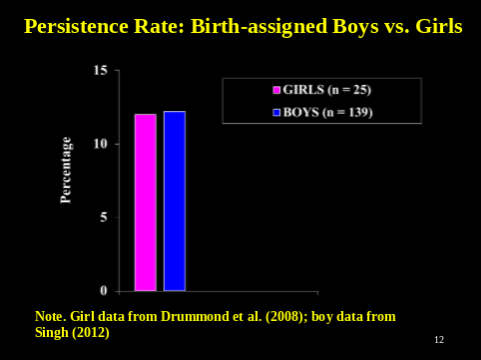
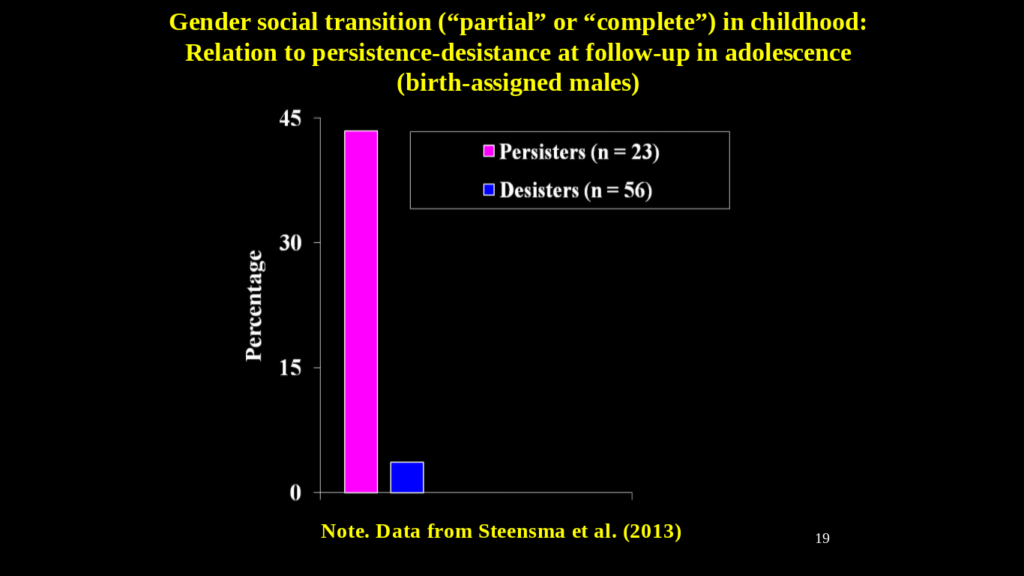
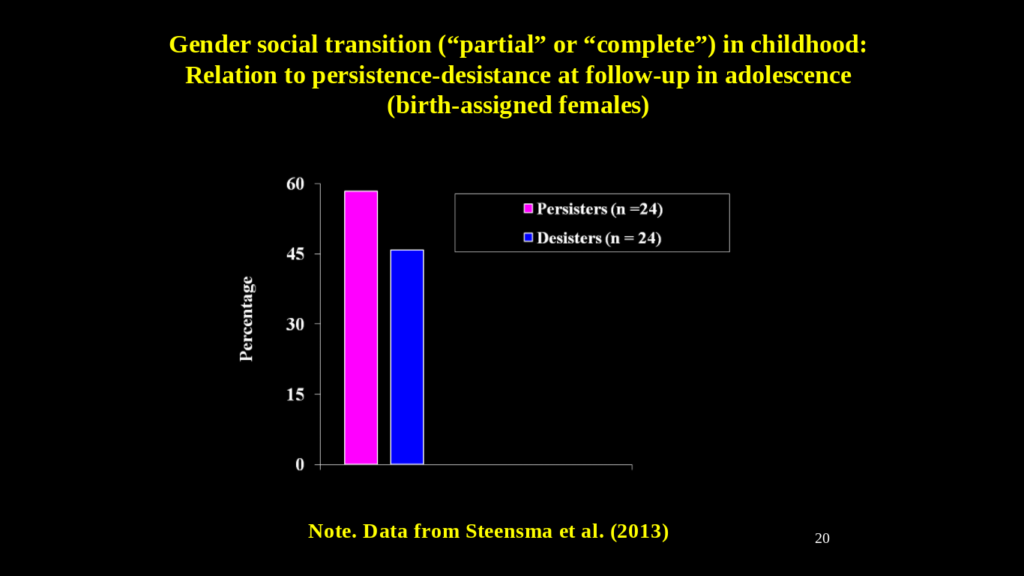
To compare the persistence and desistance rates of children who received a gender-affirming care approach characterized by social gender transitioning, Dr Zucker used data from Steensma et al. (2013) which reported a systematic follow-up study of children in which some children were classified as having had either a partial or a complete social transition prior to puberty.
The relationship between social gender transition and the follow-up persistence and desistance rates is striking. Among desisters, almost none of the natal boys had socially transitioned. Almost 45% of the persistors, however, had partially or completely socially transitioned, yet their gender dysphoria had not resolved.
Social transition in relation to persistence and desistance was not as strong among the girls. Almost 60% of the persistors had socially transitioned. A significant number of desisters had socially transitioned as well, although Dr Zucker cautioned that the definition of social transition used by Steensma probably captured some girls where the social transition metric may have been very broad (e.g., change in hair-style or clothing style).
Dr Zucker predicts that as new samples of socially transitioned children become available, the rate of persistence will be much higher when compared to the older studies, where most of the children received either Treatment 1 or Treatment 2. Of the 3rd type of treatment, social gender transition, he commented that it offers a different approach that leads to desistance: the gender dysphoria dissipates because the child is now living in the “desired” gender; however, for desistance to remain stable, it will often, if not always, require biomedical treatment (life-long hormone therapy with or without gender-affirming surgery).
There are many possible pathways to desistance, which leads to the parental conundrum: which therapeutic approach does one take to reduce gender dysphoria? This is what the contemporary parent (and clinician) must decide.”
This is some authentically scary shit. Parents could be arrested for wanting effective means of treatment for their children. This isn’t good my fellow Canadians, and let us hope that the Senate can add some clarity to this proposed nightmare of a bill.











 bleatmop
 Mystro
 The Arbourist


 Dead Wild Roses
Your opinions…