
You are currently browsing the category archive for the ‘Gender Issues’ category.

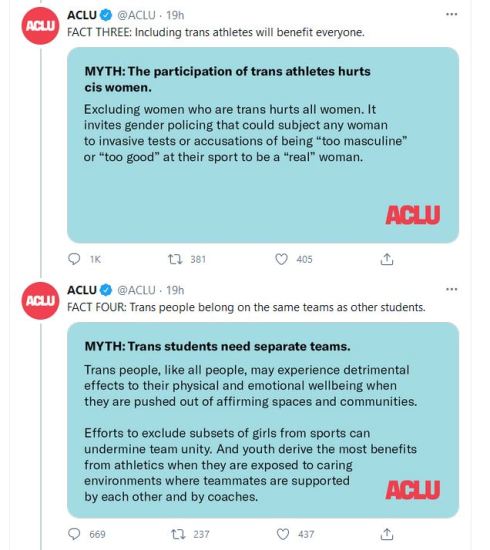
Welcome to the world of male-centric alternative facts. The ACLU have well and truly lost their grip on reality and are inhabiting the same world now as Donald Trump when it come to ‘fake news’ and the willing repetition of falsehood.
Welcome to 2021. :(
The GRA of 2004 gave trans people the ability to change legal sex via a GRC, but only if they had a psychiatric diagnosis of dysphoria and only after having lived in role for 2 years. The spousal veto gave spouses a chance to annul or obtain a favourable divorce.
While this ultimately created the loophole in women’s rights that we’ve been fighting against in the last few years, it catered for a tiny number of dysphoric transsexuals and so did not have an enormous impact.
Discussions with trans friends and allies make it clear that, although surgery wasn’t a requirement for a GRC, the diagnostic procedures were expected to trap and exclude males who did not want surgery, thereby preventing fetishists and opportunists from exploiting a GRC.
The Equality Act of 2010 defined the various protected characteristics, including both sex and ‘gender reassignment’, and provided for sex-based exemptions, under the auspices of which it is legal to exclude trans people from some single-sex spaces and services.
The campaign to reform the GRA to remove medical gatekeeping and make changing gender a matter of self-id was where women put our foot down. The GRA gave a very limited group of MtF transsexuals access to our spaces. Self-id would have made this any man who said he was a woman.
In addition, transactivists were demanding the removal of sex-based exemptions from the Equality Act. This would have left women with no ability to exclude males from any space on any basis, thereby removing every protection gained in the last century of feminism.
This is the effect of self-identified ‘gender identity’ (the ideological concept on which this rides) combined with the deliberate conflation of gender identity with sex. There is no possible point at which women can draw a line.
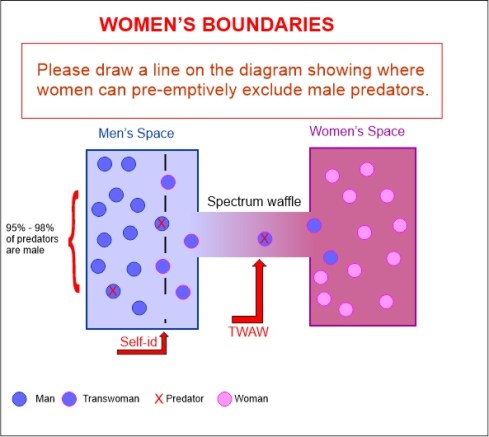
Our resistance to this campaign was successful; I think most people recognise that it isn’t reasonable to allow any male to identify into women’s spaces on his say-so. It was, however, self-id which was rejected, leaving women’s rights open to further attacks.
Transactivists claim that the current process for obtaining a GRC is invasive and onerous, and continue to push for a reform they claim is ‘merely administrative’ (this doesn’t gel with the attacks on the Eq2010 sex-based exemptions, though: https://t.co/MpxjXv5IoL)
They use the struggles of dysphoric people as a weapon, and by pushing back against self-id we replicate this. Personally I think the best place to attack the ideology is on the conflation of gender identity with sex: https://t.co/zN0ziAZzyM.
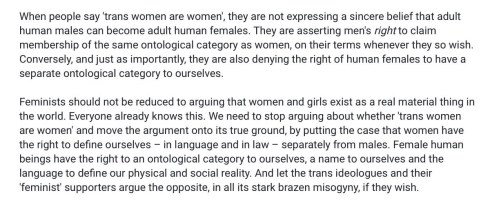
If we want fair play for both women and trans women, then it is time to confront the “trans women are women” mantra head-on, highlight why it is misogynistic and deeply harmful to women, and refuse to tolerate its use.
— Caroline – Real Feminists XX \U0001f1ff\U0001f1e6 (@radicalhag) January 16, 2018
This means that we say yes to all the demands of transactivists *except* the one which conflates TW with W, which effectively forces the declaration of a third (and possibly fourth) gender and the provision of facilities for them.
It means we’re onboard with self-id, access to medical care, non-discrimination, ability to serve in the military etc, which of course we should be in any case. We do NOT want to get gaslit into a kneejerk rejection of anything trans, which makes us sound like rightwingers.
BUT it also means we insist on a positive, sex-based definition of woman, and force TRAs to show their hand. We know perfectly well what we’re dealing with here; we want to force them to demonstrate to the public that their agenda is access to women’s spaces, not trans rights.
This worked like a bomb when the UK govt provided a trans prison wing so they could remove MtFs from the female estate. The squawking and wailing about being ‘othered’ and ‘caged’ was epic, and Joe Public went “Yeah, right.”
Basically it’s a position which says: you’re free to have a gender identity. You’re not free to tell me *I* have a gender identity. And you are definitely not free to tell me that your gender identity is in any way comparable to my sex.
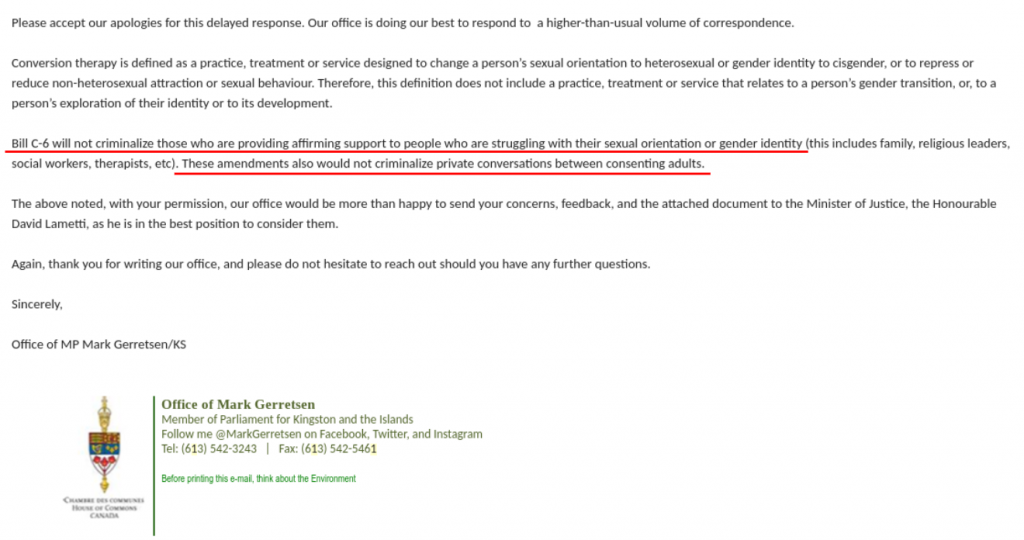
Contact your MP and get them to stop this bill. Pronto. (Text from the Canadian Gender Report)
“Liberal MP Mark Gerretsen has confirmed in an email to one of our members that Canada is about to impose criminal penalties for parents, therapists and other healthcare professionals who do not offer “affirming support” to children who are experiencing gender dysphoria. The proposed Bill C6 will amend Canada’s federal criminal code that purports to ban conversion therapy. As we can read from the admission of MP Gerretsen, Members of Parliament do not understand the implications of “affirmation” with respect to the type of support offered to youth struggling with their gender identity. The effect of Bill C6 will impose the narrow and poorly understood medical transition pathway recently coined “gender-affirming care”.
What is “affirming”?
The usage of the word “affirming” to qualify the type of support that can be provided to children and youth is very deliberate and needs to be explained as distinct from other clinical approaches.
Affirmation is a new treatment approach to children and adolescents experiencing gender dysphoria. The “affirming care” protocol dictates that medical interventions such as puberty blockers, cross-sex hormones and irreversible surgeries be provided to youth based on their self-directed gender “goals”.
The previously established clinical protocol of watchful waiting provided a supportive approach whereby children can be gently questioned about why they’ve started to identify as a different gender so that parents, clinicians and others can develop a complete picture of the child’s needs and keep all options open to help the child resolve feelings of gender dysphoria without pushing them towards irreversible medical interventions. This more cautious model of care has been phased out in favour of “affirmation” at Canadian gender clinics.
The affirming model of care is an extremely risky approach because it does not allow a healthcare professional to explore how underlying factors may be contributing to a young person’s newly adopted gender identity and feelings of gender dysphoria. Issues such as childhood trauma, psychiatric symptoms such as cutting or self-harm behaviours, autism or ADHD, feelings of shame due to same-sex attraction and many other issues a young person may be struggling with are often entangled with symptoms of gender dysphoria.
An “affirming” approach to care hides these other issues and does not allow for the possibility that other factors may be the cause of a young person’s new-found gender identity and be driving the need to medically transition as a coping mechanism.
The distinction between the previous, more cautious model of care and the new “affirmation” model is that children could be supported in their gender exploration without the need for all adults to agree and “affirm” that, in reality, the child actually “is” the opposite sex or a gender of their choice and provide them with whatever medical means they desire to transform their bodies to match their gender identity.
Gender activists promote affirmation and social transition because this is viewed as supportive to transgender adults who have transitioned. “Affirming support” is designed exclusively for the needs of this group, not the needs of young people who are struggling to find appropriate care for their complex and individual needs and where social and medical transition may not be appropriate for their long-term well being.
From “Affirming Support” to Puberty Blockers and More
The assessment process in place in Canadian gender clinics has become more and more narrow in scope over the past few years. The requirement for any type of mental health assessment has been removed completely in over 50% of the gender clinics in Canada. The only purpose of the remaining assessment process is to validate whether youth meet very minimal criteria to proceed with hormones and seem to be capable enough to sign a consent form.
In fact, we were shocked that SickKids considered the long wait time to access an initial appointment at their gender clinic as an advantage as children would have this time for “considering options”. This is an admission that the assessment process at Canada’s largest gender clinic is not intended to determine who may be a good candidate for medical transition, but in fact, all children with a gender identity that does not match their biological sex are considered candidates for medical transition and it is only their “goals” and ability of the child to “reflect on their gender journey” that might determine otherwise.
“Affirming support” as a treatment protocol removes safeguarding and impacts informed consent
Gender-affirming care is a narrow treatment pathway that does not allow the clinician to explore other options with young people as a means for managing their gender dysphoria. Today, youth are being referred to pediatric endocrinology clinics by their GP’s while it’s unclear to both the patients and the referring physicians that these clinics have adopted a pro-medical transition policy whereby the onus of responsibility is placed on the child or adolescent to guide the assessment process. In many cases we are aware of, it is up to the young person to refuse invasive hormonal interventions when these are offered as the treatment pathway by the presumably “expert” staff at the gender clinic.
Consider, for example, these scenarios that erode proper safeguarding for youth who are considering medical gender transition:
It is not considered “affirming” to help young people find mental health support for managing their gender dysphoria as an alternative to medical gender transitioning. We have heard several scenarios of young adolescents expressing doubt over transitioning to their healthcare team, including telling them that they are experiencing anxiety and/or depression. As a matter of course, young people are being told that these symptoms will subside once they start their prescriptions of Lupron or testosterone and are not being offered any further help to understand the root cause of their anxiety, depression or other factors they later realize have led them to believe they needed to transition.
It is not considered “affirming” to be honest with young people considering medical gender transtition that many adolescents become comfortable in their own bodies and re-identify with their natal sex given time, and that some adults express regret at having transitioned. This information is not considered “affirming” of the group of people who have transitioned and are living as a different gender because it casts doubt at whether their lived experiences as the opposite sex has permanence and validity.
“Affirmation” has become an ideologically driven philosophy of care that effectively removes safeguards including the ability for youth to be informed of the risks and consequences of medical transition necessary to be able to consent to these experimental interventions.
Further evidence that medical gender transitioning of children in Canada has become a matter of personal autonomy can be found in this policy document of CPATH, the Canadian arm of the World Professional Association of Transgender Health, which clearly advocates for a ban on “gender conversion therapy” (Bill C6) in order to ensure that transgender people do not face any barriers to medical transition services. CPATH does not consider the age of the person making the decision to transition as relevant.
This position presumes a “one-size-fits-all” affirmation and transition approach for children and adolescents which ignores the experience of desistors, a majority of cases where young people become comfortable in their natal sex.
Why has the treatment protocol changed?
It’s unclear why the treatment protocol has evolved to an “affirmation” approach rather than a more cautious clinical approach although the WPATH organization that sets the standard of care has gone through a significant change in leadership and approach over the past decade and has become advocates for transitioners rather than an objective organization that is free from conflicts of interest.
The affirmation model (treatment with puberty blockers followed by cross-sex hormones and gender-affirming surgeries) comes from the Dutch Protocol developed to support children with early-onset childhood dysphoria who did not desist from intense and persistent feelings of gender dysphoria with the onset of puberty. One of the key authors of that model has issued a warning in Pediatrics that it was never intended for the new population of adolescents that are being unquestioningly “affirmed”. Dr Annelou DeVries acknowledges the phenomenon of ROGD (recent-onset gender dysphoria with no documented history in early childhood) which was not a part of the previous studies on hormone blockers.
Finland and Sweden have conducted systematic reviews of gender treatment of children and both came to the conclusion that there was insufficient evidence for an affirmative approach. Finland developed their own clinical guidelines for treating children which includes significant caution compared with the “affirming” approach in place in Canadian gender clinics.
The UK now requires a best-interest court order prior to any youth being referred to a gender clinic. This has become the strictest requirement in the world to ensure that children are not being medically transitioned if there isn’t clear evidence that it’s in their best interests. The UK National Health Service is also conducting a review of the medical treatment protocol for transgender youth. This was prompted by detransitioner Kiera Bell’s second lawsuit which challenged the MOU on Conversion Therapy, a document similar to Bill C6, because she was unquestioningly affirmed as a boy and was irreversibly harmed by this approach.
Do Children Have the Capacity to Consent?
The underlying assumption of gender affirming care is that children and youth are capable of informed consent to an experimental pathway of medical treatments. Kiera Bell challenged this assumption in a judicial review last year and won her case. A key factor in the landmark decision by the UK High Court in December 2020 which now requires a “best-interest court order” to be in place prior to children being referred to gender clinics is that the clinics themselves do not understand the risks or benefits of hormone interventions including puberty blockers and cross-sex hormones on children and youth, therefore it is not likely that children are capable of consenting to medical interventions that will have such life-changing effects.
Conclusion:
It is already extremely difficult for parents, trans-identified youth and detransitioners to access non-invasive and agenda-free healthcare options in order for them to receive a differential diagnosis prior to medical transitioning or to receive support to manage symptoms of gender dysphoria without being medicalized.
We are asking for the following exemption to be added to Bill C6 to ensure healthcare professionals are able to support youth effectively:
For greater certainty, this definition does not apply to any advice or therapy provided by a social worker, psychologist, psychiatrist, therapist, medical practitioner, nurse practitioner or other health care professional as to the timing or appropriateness of social or medical transition to another gender, including discussion of the risks and benefits and offering alternative or additional diagnoses or courses of treatment.
Without this exemption, Bill C6 will further entrench the doctrine of “affirmation” in the Canadian healthcare system. While all individuals should be treated with dignity and respect, the poorly understood approach of gender-affirming care is being challenged around the world for leading children down a narrow treatment pathway of invasive and often irreversible medical interventions. Our government should be protecting the interests of all youth by conducting an independent review of gender transition services including a review and evaluation of whether children possess the ability to consent to the life-altering treatments that are being offered to them under the mantra of “affirming”.
Wow. The better idea might be to dispense with the toxic notion of gender (sex stereotypes) altogether and let men and women dress however they please. Wouldn’t that be nice?

See the entire list here.

3 – JK Rowling
JK Rowling is almost certainly the greatest writer of English children’s fiction of her generation, and a remarkable humanitarian. It turns out she writes exhilaratingly powerful prose too.
In a blog about the transgender debate, she offended many people. Offence is the price of free speech. Those offended felt she was questioning their identity and even attacking their human rights, which they argue is a form of discrimination or hate speech.
I take absolutely no view whatsoever on the issues that she raises.
I do take an issue on abuse and trolling, and Rowling has achieved the inglorious honour of topping many a league table for those. The deluge of hatred that she faced before writing this blog made it brave, and it was nothing compared to what came after. Talking about bravery, so too, by the way, was Suzanne Moore’s engrossing, long, personal essay for Unherd on why she left the Guardian.
We should all applaud bravery in writers – even those with whom we disagree. And Rowling’s essay contained moments of both real beauty and piercing honesty, as when she revealed that she is a survivor of domestic abuse and sexual assault.
What the judges – that is, the voices in my head – most admired about the writing was the plain English. It is an interesting fact about rhetoric that if you want people to understand something, plain, mono-syllabic words are usually your best bet: “Ask not what your country can do for you; ask what you can do for your country”.
Or think of the final line from Enoch Powell’s most notorious speech: “All I know is that to see, and not to speak, would be the great betrayal.”
I’m not endorsing the argument; but the rhetorical power of that line comes from the fact that there are 16 words, the first 15 of which have one syllable, and the last of which has three.
Compare it with this line in Rowling’s essay: “So I want trans women to be safe. At the same time, I do not want to make natal girls and women less safe.”
The rhetorical power from those two sentences derives partly from the plainness of the English. Only “women” (twice) and “natal” contain more than one syllable.
If you’re ever editing copy that seems verbose, go through it and think about cutting syllables while conveying the same meaning. Plain English has power. JK Rowling gets that.
The mask has been at least partially ripped off in the UK. The use of puberty blockers on children has been stopped and now requires the court approval to prescribe the experimental drugs (with no evidential link to their benefit) to children.
“Now, it may be that there is a genuine unmet medical need among adolescent girls of which clinicians had previously been unaware. It may also be that gender dysphoria and autism are co-morbidities that require an integrated approach to treatment. The problem, however, is no-one has done any research, so whether or not either is the case is simply unknown. It is entirely plausible for Tavistock to return in future litigation with a much stronger argument. For that to happen, however, research simply has to be done. You and I may be able to fly by the seat of our pants, but courts cannot and doctors should not.
Relatedly, the administration of puberty blockers progressed with a grim inevitability to the use of cross-sex-hormones; they did not provide “space to think” but rather seemed designed to ensure that future surgical interventions were more effective. Evidence from the Netherlands indicated, of the adolescents who started puberty suppression, only 1.9% did not proceed to cross-sex-hormones. Tavistock offered no alternative treatment paths, an aspect of the modern (and similarly unevidenced) fashion for “affirmative” treatment of gender dysphoria.
It’s worth making an aside here and noting the general problem of poor record-keeping and cavalier attitudes to evidence and data across a number of British institutions. Over and over again the EHRC, in its report on Labour anti-Semitism, observed a failure to complete the most basic administrative tasks. The same issue emerged in the Home Office during the Windrush scandal, and — as I wrote last year — in the Government’s frankly contemptuous behaviour before the Supreme Court in last year’s prorogation case.
A number of commentators noted that charities Mermaids and Stonewall were refused permission to intervene, and said this looked unfair. They made these observations without realising interveners are there to assist the court, and must provide evidence that is different from that already tendered. If all they do is repeat what Tavistock has already said, they serve no purpose apart from wasting court time, and court time is expensive.
What Mermaids and Stonewall wished to enter into evidence were accounts of positive experiences from young trans people treated with puberty blockers. However, Tavistock had already provided these; they are quoted at length in the judgment. Much of the would-be interveners’ argument was based on the idea that “the voice of the child” must be heard, repeatedly if necessary.
Bell’s lived experience was a tiny part of her case — and, indeed, by choosing judicial review rather than medical negligence, she made her personal circumstances (and those of other people) even less salient. A tort claim would have put her on the witness stand and investigated her treatment pathway because “pain and suffering” (one of the traditional heads of damage) is assessed subjectively when calculating potential damages in such a case.
It has become fashionable, of late, to valorise ‘lived experience’ from people keen to parade both their victimhood and their virtue. Unfortunately, lived experience by itself is not evidence in a court of law. Nor is the argument made by Mermaids that “every young person has the right to make their own decisions about their body” – something more is needed.
It is the role of medicine to heal the sick and leave the well alone, which is only possible via careful recourse to the scientific method and disinterested research. If this does not happen, it then becomes the law’s duty to ensure each and every litigant gets his or her due.”
This gender bullshit has to stop. The sooner the better. I only hope that Canada wakes the heck up and looks to the court precedent set in the UK before passing any more disastrous legislation (bill C-6).











 bleatmop
 Mystro


 Dead Wild Roses
Your opinions…