
You are currently browsing the category archive for the ‘Gender Issues’ category.
Wow. All of this. Thank you Jane Clare Jones.
“That identity necessarily involves relation all becomes painfully, politically obvious in how this whole thing is playing out in practice. Someone can claim that trans people have an absolute right to determine their identity, but were that actually a simple ontological truth, then we wouldn’t be in an endless, fraught spiral about pronouns and misgendering and the world’s recalcitrant refusal to offer up the correct ‘validation.’ Being what you are is not merely a matter of a feeling, or of a ‘feeling of some fundamental essence.’ It’s a matter of being recognised by other human beings as the thing that you think you are.[2] It’s a matter of social relations. And this is why we’re in this whole fucking nightmare mess. Because we have a political movement claiming, on the one hand, that this is just a matter of identity, and it doesn’t affect anyone else, and anyone who thinks otherwise is just a nasty evil bigot, while, at the same time, because identity is all about social relations, they’re throwing a ton of their political weight into trying to control people’s speech, and behaviours, to enforce the validation of those identities.
[…]
The issue about the conflict over spaces, and the conflict about competing rights, is, in some sense, simply an amplification of this fundamental ontological issue. The trans rights movement is committed to claiming that trans people’s access to spaces, and trans people’s rights, has no impact on women’s spaces, or women’s rights, in just the same way as they claim that trans people are the sole and singular arbiters of their own identities, and it doesn’t affect anyone else. Were any of this actually true, this god-awful scrap wouldn’t be happening, because, despite the daily bullshit turned out by the trans rights movement, none of it is happening because a bunch of left-wing feminist women were suddenly afflicted by a plague of inexplicable hatred. The fact that it’s manifestly untrue that this doesn’t affect anyone else – and that, despite quintupling-down, the advocates of the ideology know that it’s untrue – is entirely given by the exhaustive efforts to control the ways people respond to trans people. Indeed, as we saw when we looked at Stonewall’s definition of ‘transphobia,’ it is given, most chillingly, by the effort to proscribe as an act of hatred the refusal – or to be blunt, often just the plain inability – to ‘correctly’ recognise a trans person’s identity.
[…]
This is what I’m talking about when I say that the totalitarianism we see from the trans rights movement – the threats, the slurs, the bullying, the demands for validation, the lists of narcissistic diktats, the inveterate Woke Stasi bullshit policing of people’s Twitter likes and retweets – is all, at a basic ontological level, baked in. If you ground a political movement on the idea that people are actually something that they’re not – or, to be a bit more charitable, you decide, for the first time in history, that the identity of someone does not reside is any observable feature of that someone, but only in some imperceptible internal magic essence – then you will inevitably end up trying to turn that imperceptible essence into a reality by rigidly disciplining other people’s recognition procedures, and disciplining them, moreover, away from what they actually do recognise. Even if this didn’t all cash out into an fuck-off huge rights conflict over access to women’s spaces (which it inevitably does, for exactly the reason of the social recognition such access conveys), the claim that trans rights has no effect on anyone else would still, at this base ontological level, be a MASSIVE fucking lie. No purported civil rights movement has ever tried to mandate, with such coercive force, how people speak, what they can and can’t believe, and what they must pretend to perceive, all in contravention of what they actually do perceive.”
Damn. Just go read it all.

Normally when I write I make jokes. But this morning I find I really don’t feel like joking about any of this right now. I finished working late yesterday afternoon to discover Graham Linehan telling me on Twitter that Twitter had announced a potential new policy that would lead to the ‘immediate silencing’ of my voice. And when I read the proposed policy I realised, with a wash of sudden cold shock, that he was right. Those of you who know me, know me. You know that I have dedicated my entire adult life to thinking about injustice, and to analysing how mechanisms of domination function to destroy the lives of vast numbers of people, because of their sex, or sexual orientation, or socio-economic class, or race. You know I’ve never bothered much with accumulating civic or financial power, because I think we live in a bankrupt neoliberal patriarchal white…
View original post 3,958 more words
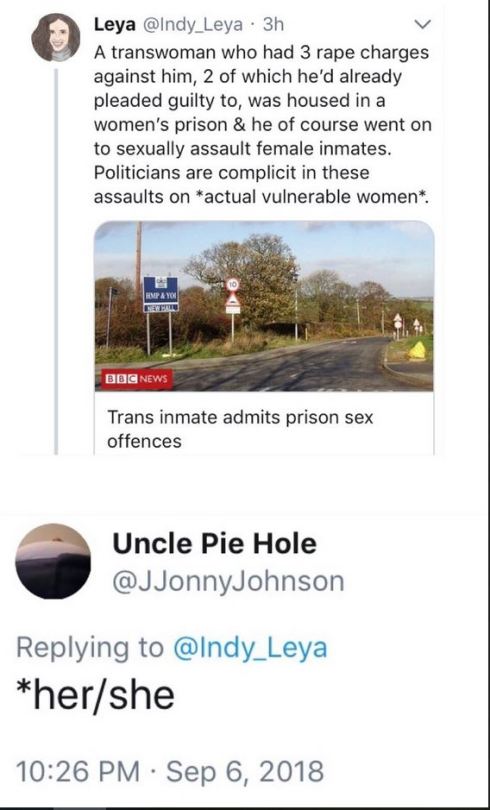
The Twitter link.
The BBC News story link.
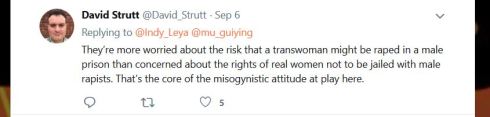
Good job on naming part of the problem, Dave (from the twitter thread).
One cannot identify into nor identify out of the class you’re in. I’m curious as to how many more sexual assaults, in this case, and rapes of females in others it will take before we as a society can acknowledge that importance of grounding the distinctions of biological sex in empirical reality (human beings are generally sexually dimorphic). Because, clearly, prioritizing the gender feelings of men over the safety and security of women is not acceptable.
My view is that gender is no more real than Victorian ectoplasm, or creationism.
It’s nothing more than an idea that some people hold, one that they are determined to press onto others.
And I think people don’t often enough understand that it exists to GROUP PEOPLE into CATEGORIES based on shared traits.
It’s right there in the root of the word.
Gender = group with shared traits
But people who push the concept of gender now try to make it be two opposing things at once, like a shoe they claim can fit on both feet at the same time.
If you ask them directly what it means, this is what you are told.
First they say gender is an individual, indefinable, intimately personal and subjective thing. It’s different for everybody, no-one is the same. My personal, bespoke, made to measure shoe.
And then, barely drawing breath, they tell me that it encircles an entire group and excludes another; a very distinct class, a group. One that must be recognised by its single communal name.
And when you ask, if it is unique and personal to you, then why am I in this class with you? What are our shared traits that make us a class, yet exclude those others? What is it you think you see in ME that is making you pull me into this idea you have of YOU?
They answer, we cannot tell you these traits we share, but you must stay in this class with us. And we must share the same name. Or, if you are one of the very, very few, you can leave and join that class over there. But we cannot tell you what their shared traits are too. You must decide, you are us or you are them, but there are no criteria we can tell you so that you know which is which. You will feel it inside you.
And this makes no sense. And you sense there is a lie here, a truth being hidden.
And you begin to notice that when they are unguarded, they let things slip. I knew from a child that I was a ….because I liked…..I always wanted to be a …..because I felt….because I wanted…
And the picture of what they really think the shared traits of these groups are begins to take shape, and you understand why most genderbelievers don’t want to answer directly. The things they liked, and felt, and wanted are all stereotypes. Expectations and rules and behaviours and fashions and feelings. And all of them attached, needlessly, to a very, very distinct group that really does have tangible shared traits. Attached to a biological SEX. And the word the genderbelievers are using to describe their gender; these wants and likes and rules and feelings, is also the word used for sex.
So you say, oh wow, I get it, I understand what you want, and you can have it! In fact, it’s ALL yours, all that stuff, I never really wanted it. Take the gender stuff, and like a metaphorical 6 inch heel, hot pink, patent leather spike stiletto, go ahead and put it on your own foot, I’ll be much more comfortable without it, in fact. Take the stuff, but please just detach it from my sex. Have it, but please, leave me the word for my sex, for my body, so we don’t confuse the two things, SEX and GENDER, any more. The shoe is all yours, not mine and good luck to you.
And they say, No way.
They need my foot too. It has to be squashed into that shoe alongside their own foot. My sex, my body, the thing I cannot change, squashed uncomfortably into that gender shoe, with their sex, their body, and both of us under the same name. The name that used to mean my sex. And we won’t talk about our sexes or our bodies any more, we’ll just talk about the single shoe that both our feet are crammed into.
So that’s gender, and that’s why I hate it, and all the lies and obfuscation around it. It’s a stupid, uncomfortable shoe that everyone would do better to throw in the bin, but which has instead become the thing that I am forced to wear if I am to have words to talk about my sex. It has become the thing I always hated that I am ordered to share with people with whom I have nothing in common. It hurts, I want my foot out of it, I can run better without it.
I want to be barefoot. The way I was born.
| — | Barracker |
From The Times:
Hey folks just your weekly update from the Queer Ministry of Truth:
“Natacha Kennedy asked people to list academics deemed to be transphobic”
“A transgender lecturer orchestrated a smear campaign against academics across the UK in which universities were described as dangerous and accused of “hate crime” if they refused to accept activists’ views that biological males can be women, it can be revealed.
Natacha Kennedy, a researcher at Goldsmiths University of London who is also understood to work there under the name Mark Hellen, faces accusations of a “ludicrous” assault on academic freedom after she invited thousands of members of a closed Facebook group to draw up and circulate a list shaming academics who disagreed with campaigners’ theories on gender.
The online forum, seen by The Times, also revealed that members plotted to accuse non-compliant professors of hate crime to try to have them ousted from their jobs. Reading, Sussex, Bristol, Warwick and Oxford universities were among those deemed to have “unsafe” departments because they employed academics who had publicly disputed the belief that “transwomen are women” or questioned the potential impact of proposed changes to gender laws on women and children.
Ms Kennedy said that the list was necessary so students could avoid accepting a place on a “dangerous” course.”
Entitled males are certainly acting like entitled males.
“Rosa Freedman, an expert in human rights law at the University of Reading, had also upset activists by saying that biological males should not have access to a women’s refuge. One activist said she tried to lodge a complaint but was told that Professor Freedman had a right to free speech. “I’m replying a little more strongly and using the words ‘hate speech’ a few times,” she told the group. Another activist suggested: “Use the words … ‘So Reading University supports staff who use hate speech against students?’ ”
Professor Freedman told The Times: “We are talking about the aggressive trolling of women who are experts. I have received penis pictures telling me to ‘suck my girl cock’. This is straight-up, aggressive, anti-woman misogyny. In no way have I made the space unsafe. I find it deeply distressing that an academic would set out to smear my name and impugn my reputation, simply because I put forward a perspective, based on robust and specific evidence, with which they disagree. That is not academia. That is silencing people.
“The idea that writing about women’s rights automatically becomes a hate crime in some people’s eyes is ludicrous. All it has done has made me more determined to write about this, in a respectful way that allows other perspectives to come through, and not just the views of those who shout the loudest.”
Professor Stock said: “What would make a philosophy department unsafe is if its academics weren’t allowed to challenge currently popular beliefs or ideologies for fear of offending. Deliberately plotting to have my department lose students, or to have me dismissed, through covert means, is surprising behaviour from a fellow academic.” Both professors praised the support that they had received from their universities.
Last month Brown University, the Ivy League institution in Rhode Island, was accused of cowardice by leading academics in the US after it caved into pressure on social media to pull a piece of research from its website that had concluded that social contagion could be a reason why clusters of young people were identifying as trans.
Professor Stock said: “It is head-scratchingly bizarre how so many public organisations, many of them ostensibly progressive, have capitulated to passive-aggressive, emotionally blackmailing, and sometimes even outright threatening behaviour from trans activists, often online.”
Yeah. This is happening. Thought crime and the whole nine yards.
Get the article that Brown University pulled here -” Rapid-onset gender dysphoria in adolescents and young adults: A study of parental reports. What certain transactivists don’t want you (and have actively campaigned for censorship) to see.

Isn’t it interesting that this sort of experiential sharing can only go one way. This sort of paradoxical thinking is rife within transactivist ideology. Consider the claim of being ‘non-binary’. The only way this term works is by creating, you guessed it, another binary between “cis” people (those who mostly follow gendered expectations) and “trans” (those who mostly go against gendered expectations). Or… the other possibility within the gender spectrum idea is that, in fact, we’re all non-binary as we all possess a distinct combination of masculine and feminine gendered traits and behaviours.
As with most debates when it comes to gender, there is always a good deal of heat and friction, but not much desire to go outside of established positions. As food for though, consider what Rebecca Reilly-Cooper has to say on the subject of gender:
“Once we recognise that the number of gender identities is potentially infinite, we are forced to concede that nobody is deep down cisgender, because nobody is assigned the correct gender identity at birth. In fact, none of us was assigned a gender identity at birth at all. We were placed into one of two sex classes on the basis of our potential reproductive function, determined by our external genitals. We were then raised in accordance with the socially prescribed gender norms for people of that sex. We are all educated and inculcated into one of two roles, long before we are able to express our beliefs about our innate gender identity, or to determine for ourselves the precise point at which we fall on the gender continuum. So defining transgender people as those who at birth were not assigned the correct place on the gender spectrum has the implication that every single one of us is transgender; there are no cisgender people.
The logical conclusion of all this is: if gender is a spectrum, not a binary, then everyone is trans. Or alternatively, there are no trans people. Either way, this a profoundly unsatisfactory conclusion, and one that serves both to obscure the reality of female oppression, as well as to erase and invalidate the experiences of transsexual people.
The way to avoid this conclusion is to realise that gender is not a spectrum. It’s not a spectrum, because it’s not an innate, internal essence or property. Gender is not a fact about persons that we must take as fixed and essential, and then build our social institutions around that fact. Gender is socially constructed all the way through, an externally imposed hierarchy, with two classes, occupying two value positions: male over female, man over woman, masculinity over femininity.
The truth of the spectrum analogy lies in the fact that conformity to one’s place in the hierarchy, and to the roles it assigns to people, will vary from person to person. Some people will find it relatively easier and more painless to conform to the gender norms associated with their sex, while others find the gender roles associated with their sex so oppressive and limiting that they cannot tolerably live under them, and choose to transition to live in accordance with the opposite gender role.
Gender as a hierarchy perpetuates the subordination of female people to male people, and constrains the development of both sexes
Fortunately, what is a spectrum is human personality, in all its variety and complexity. (Actually that’s not a single spectrum either, because it is not simply one continuum between two extremes. It’s more like a big ball of wibbly-wobbly, humany-wumany stuff.) Gender is the value system that says there are two types of personality, determined by the reproductive organs you were born with. One of the first steps to liberating people from the cage that is gender is to challenge established gender norms, and to play with and explore your gender expression and presentation. Nobody, and certainly no radical feminist, wants to stop anyone from defining themselves in ways that make sense to them, or from expressing their personality in ways they find enjoyable and liberating.
So if you want to call yourself a genderqueer femme presenting demigirl, you go for it. Express that identity however you like. Have fun with it. A problem emerges only when you start making political claims on the basis of that label – when you start demanding that others call themselves cisgender, because you require there to be a bunch of conventional binary cis people for you to define yourself against; and when you insist that these cis people have structural advantage and political privilege over you, because they are socially read as the conformist binary people, while nobody really understands just how complex and luminous and multifaceted and unique your gender identity is. To call yourself non-binary or genderfluid while demanding that others call themselves cisgender is to insist that the vast majority of humans must stay in their boxes, because you identify as boxless.
The solution is not to reify gender by insisting on ever more gender categories that define the complexity of human personality in rigid and essentialist ways. The solution is to abolish gender altogether. We do not need gender. We would be better off without it. Gender as a hierarchy with two positions operates to naturalise and perpetuate the subordination of female people to male people, and constrains the development of individuals of both sexes. Reconceiving of gender as an identity spectrum represents no improvement.”
Essentially, creating new ‘gender-identities’ is akin to making new prison cells with the penitentiary system we call gender and then insisting that your prison cell is more oppressed that some other persons prison cell. Why not buck the system instead and drop the gendered stereotypes that the penitentiary is based on and that are currently hurting everyone. Dispensing with the gender hierarchy is the goal we should be striving for, not gilding our particular cells at the expense of others.
Jonathan Best takes a shot at framing some of the key issues in this debate. From first hand experience, I have to agree with what Mr.Best has to say. There is very little oxygen available to question, and even less to argue the trans-interpretation of sex and gender.
The philosopher Kathleen Stock has written extensively on these issues. Here’s her explanation of what is usually termed a ‘gender critical’ view:
Here is one position held by many radical feminists. It holds that what it is to be a woman is to have a certain biological and reproductive nature, involving female sex organs and a female reproductive system, and to be economically, socially, politically, and sexually oppressed on that basis. This view therefore concludes… that transwomen, though fully in possession of all basic human rights (obviously!), and also deserving of respectful treatment as if they are women in many social contexts, are not in fact women. Simply put: they don’t have the required biology, nor do they have the required history of oppression on the basis of that biology.
And, on the other hand, the transgender view:
In contrast, there are those metaphysical positions which argue that transwomen are women. These usually argue that women’s biologies and reproductive capacities are not essential to their nature as women. People with penises and testicles and no female reproductive characteristics can be women.
Gender critical views argue that biological sex is of primary importance. The opposing view, central to transgenderism, argues that biological sex is irrelevant. This question was at the heart of the QUN dispute: Michigan Womyn’s Festival took the view that biological sex was central, whereas the activists who protested QUN took the opposing view.
This question has taken on a fresh urgency with the planned reform of the 2004 Gender Recognition Act. This proposes writing into law the concept of ‘gender identity’ — one of the newer ideas in transgender ideology, and one which is strongly resisted by those holding gender critical views.
Stonewall defines gender identity as follows:
A person’s innate sense of their own gender, whether male, female or something else, which may or may not correspond to the sex assigned at birth.
But not everyone agrees that gender is innate. Many people — me included — prefer to see gender as a social construction, a hierarchy, which disadvantages women (and, in some ways, men too) and against which we should struggle. Rather than identify with it, we want to fight it.
You may or may not have an innate sense of your own gender. It isn’t for me — or anyone else — to tell you how you should feel or think on the subject. Likewise, those of us who wish to resist or deny the concept are deeply unhappy at the prospect of it being written into law.
When new ideas emerge in society there is usually discussion about them. It’s a sound general principle — the best way to evaluate new ideas is to explore them critically and freely. These issues of sex and gender are of importance to society as a whole. Women especially will want to debate all of this. Surely we can agree that women should have the right to discuss it?
But that is not how this is playing out.
Instead of open, respectful discussion, today’s trans activism too often seeks to prevent women from discussing the issues in trans ideology which directly affect their lives.
Exactly. Preventing discussion and persecuting women for objecting to their linguistic and biological erasure from society isn’t a good policy to follow and thankfully, everyday, the opposition grows against this misogynistic strand of Transactivism.











 bleatmop
 Mystro


 Dead Wild Roses
Your opinions…