
You are currently browsing the category archive for the ‘Music’ category.
 Many thanks to Paolo Pietropaolo and the CBC for bringing us the Signature Series.
G minor is a minor scale based on G, consisting of the pitches G, A, B♭, C, D, E♭, and F. For the harmonic minor scale, the F is raised to F♯. Its relative major is B-flat major, and its parallel major is G major.
Changes needed for the melodic and harmonic versions of the scale are written in with accidentals as necessary. G minor is one of two flat key signatures that require a sharp for the leading-tone (the other is D minor).
Mozart’s use of G minor
Main article: Mozart and G minor
G minor has been considered the key through which Wolfgang Amadeus Mozart best expressed sadness and tragedy,[1] and many of his minor key works are in G minor, such as the Piano Quartet No. 1 and the String Quintet in G minor. Though Mozart touched on various minor keys in his symphonies, G minor is the only minor key he used as a main key for his numbered symphonies (No. 25, and the famous No. 40). In the Classical period, symphonies in G minor almost always used four horns, two in G and two in B-flat alto.[2] Another convention of G minor symphonies observed in Mozart’s No. 25 was the choice of E-flat major for the slow movement, with other examples including Haydn’s No. 39 and Johann Baptist Wanhal‘s G minor symphony from before 1771 (Bryan Gm1).[3]
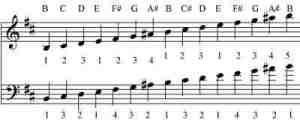 B minor is a minor scale based on B, consisting of the pitches B, C♯, D, E, F♯, G, and A. The harmonic minor raises the A to A♯. Its key signature has two sharps
Its relative major is D major, and its parallel major is B major.
Changes needed for the melodic and harmonic versions of the scale are written in with accidentals as necessary.
In Baroque times, B minor was regarded as the key of utter despair.[citation needed] The theorist Christian Friedrich Daniel Schubart (1739–1791) regarded B minor as a key expressing a quiet acceptance of fate and very gentle complaint, something commentators find to be in line with Bach’s use of the key in the St John Passion.[1] By Beethoven’s time, however, the perception of B minor had changed considerably: Francesco Galeazzi wrote that B minor was not suitable for music in good taste, and Beethoven labelled a B minor melodic idea in one of his sketchbooks as a “black key”.[2]
Thanks to CBC radio 2 and the Signature series for bringing you the lovely key of B minor.
The first movement of Mozart’s Requiem in D minor, performed by the Bezdin Ensemble, under the direction of Adina Spire, with a graphical score.
At the time of Mozart’s death on 5 December 1791, only the opening movement (Requiem aeternam) was completed in all of the orchestral and vocal parts. The following Kyrie and most of the sequence (from Dies Irae to Confutatis) were complete only in the vocal parts and the continuo (the figured organ bass), though occasionally some of the prominent orchestral parts were briefly indicated, such as the violin part of the Confutatis and the musical bridges in the Recordare. The last movement of the sequence, the Lacrimosa, breaks off after only eight bars and was unfinished. The following two movements of the Offertorium were again partially done; the Domine Jesu Christe in the vocal parts and continuo (up until the fugue, which contains some indications of the violin part) and the Hostias in the vocal parts only.
Gotta catch them all, can you distinguish all 20 variations? :)
BWV 582/1: Passacaglia
The passacaglia is in 3/4 time typical of the form. Bach’s ostinato comprises eight bars, which is unusual but not unheard of: an ostinato of the same length is used, for example, in Johann Krieger‘s organ passacaglia. The opening of the piece, which consists of the ostinato stated in the pedal with no accompaniment from the manuals, is slightly more unusual, although this idea also occurs elsewhere, and may even have been used by Buxtehude.[8]
There are 20 variations in BWV 582/1. The first begins with a typical C minor affekt, “a painful longing” according to Spitta, similar to the beginning of Buxtehude’s Chaconne in C minor (BuxWV 159).[9] Numerous attempts have been made to figure out an overarching symmetrical structure of the work, but scholars have yet to agree on a single interpretation.[10] Particularly important attempts were made by Christoph Wolff and Siegfried Vogelsänder.[11] Some scholars have speculated that there is a symbolic component to the structure of the work: for instance, Martin Radulescu argues that BWV 582/1 is “in the form of a cross”.[12]
There is agreement among most scholars that the Passacaglia builds up until its climax in variation twelve.[citation needed] This is followed by three quiet variations, forming a short intermezzo, and then the remaining five variations end the work.
Bach performer and scholar Marie-Claire Alain suggested that the 21 variations are broken down into 7 groups of 3 similar variations, each opening with a quotation from a Lutheran chorale, treated similarly to the Orgel-Buchlein written at a similar time:[13]
- Bars 8-12, the top part spells out the opening notes of “Nun komm’ der Heiden Heiland”
- Bars 24-48, a cantilena spells out “Von Gott will ich nicht lassen”
- Bars 49-72, the scales are a reference to “Vom Himmel kam der Engel Schar”
- Bars 72-96, recalling the “star” motif from “Herr Christ, der Ein’ge Gottes-Sohn”
- Bars 96-120, ornamented figure similar to that in “Christ lag in Todesbanden” accompanies theme in the soprano then moving successively to alto and bass
- Bars 144-168 “Ascending intervals in bass recall the Easter chorale “Erstanden ist der heil’ge Christ”.
Alain also points out that the numbers (21 repetitions of the Passacaglia ground and 12 statements of the fugue subjects) are inversions.
Ludwig van Beethoven‘s Piano Sonata No. 8 in C minor, Op. 13, commonly known as Sonata Pathétique, was written in 1798 when the composer was 27 years old, and was published in 1799. Beethoven dedicated the work to his friend Prince Karl von Lichnowsky.[1] Although commonly thought to be one of the few works to be named by the composer himself, it was actually named Grande sonate pathétique (to Beethoven’s liking) by the publisher, who was impressed by the sonata’s tragic sonorities.[2]
Prominent musicologists debate whether or not the Pathétique may have been inspired by Mozart‘s piano sonata K. 457, since both compositions are in C minor and have three very similar movements. The second movement, “Adagio cantabile”, especially, makes use of a theme remarkably similar to that of the spacious second movement of Mozart’s sonata.[3] However, Beethoven’s sonata uses a unique motif line throughout, a major difference from Haydn or Mozart’s creation.[1]











 bleatmop
 Mystro
 The Arbourist


 Dead Wild Roses
Your opinions…